

I knew squirrel is from Ancient Greek skiouros (σκίουρος), ‘shadow tail’. To me this always seemed quite apt; a squirrel’s bushy tail does resemble a shadow. (Although apparently Ancient Greeks explained it as being because a squirrel carries its own portable sunshade.)
The elements of skiourus are ski-, ‘shadow’, and ourus, which is the same word as ‘arse’.
Yes, really. I was staggered recently when I learn this but there is good evidence that Proto Indo-European (PIE), the ancestor of English, Greek, and many other languages, had a word *ors-, ‘backside’.
By now you may have spotted that this is the second element in cynosure, which today means focus of attention; or something or someone to which all eyes turn. The word is derived from Greek kunosoura (κυνόσουρα), “dog's tail”, first element kuon (κύων), ‘dog’ and the -oura element is a variant form of ouros.
Kunosoura was the Greek name for the constellation we now call Ursa Minor.
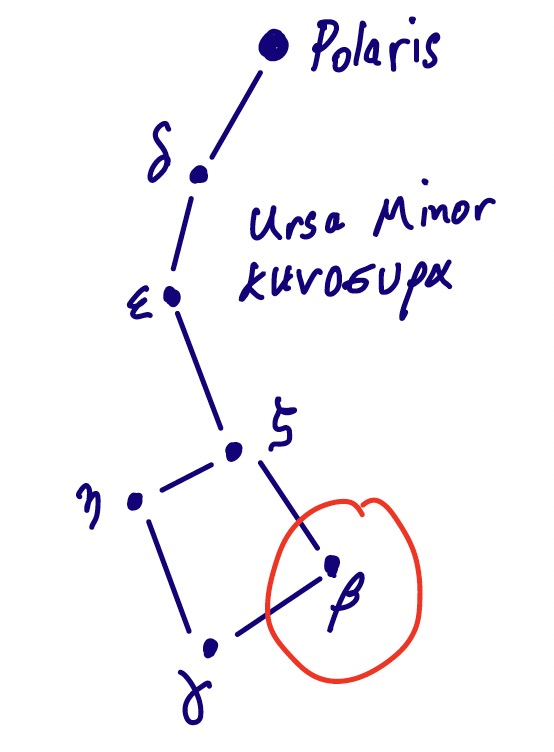
‘All eyes were on it’ because Greek sailors looked to it to find North. My sketch shows things as they are today; but because the Earth’s axis wobbles, the star that was nearest to North in classical Greek times was the one I’ve ringed and that is what Greek navigators used.
And now... the wheatear (Oenanthe Oenanthe). This bird when seen in flight has a very eye-catching white rump.
The general consensus is that it was originally called whiterse, ‘white-arse’, from this striking feature, but the word morphed into wheatear. This might be because the original sense got forgotten and the compound of familiar words wheat + ear was something speakers felt comfortable with. Or there might have been an element of prudery; perhaps arse was just too ‘Anglo-Saxon’ but ear did not offend.
This ‘explaining’ a word’s origin as a compound of more familiar and homely terms is called folk etymology. A nice example is sparrowgrass, a green vegetable better known today as asparagus, but often called sparrowgrass historically and in some dialects to this day.
And now back to our squirrel. Well-respected scholars have been sceptical about the etymology I began this post with. They suggest instead that it was a borrowing from a pre-Greek language and the Greeks rationalised as skiouros by folk etymology. This could well be true, but we shall never know, and the idea of an animal that carries its own beach umbrella around with it is too appealing to give up lightly.