

A well known puzzle asks what English number word describes its own length and it's not hard to see the answer is four. This is a fixed-point number: if you count hpw many letters in the word and write that as a word you get back to four.
Less obviously it is also a black hole number: if you begin with any number whatsoever and apply this process repeatedly you always end up at four. Always.
For example
two thousand and twenty six --> twenty three --> eleven --> six --> three --> five -- > four
I wondered what happens in other languages. Is there always a fixed-point? If so is it always a black hole. Here's what I found (hope it's all correct, it was a bit triccky making sure I didn;t forget numbers.)
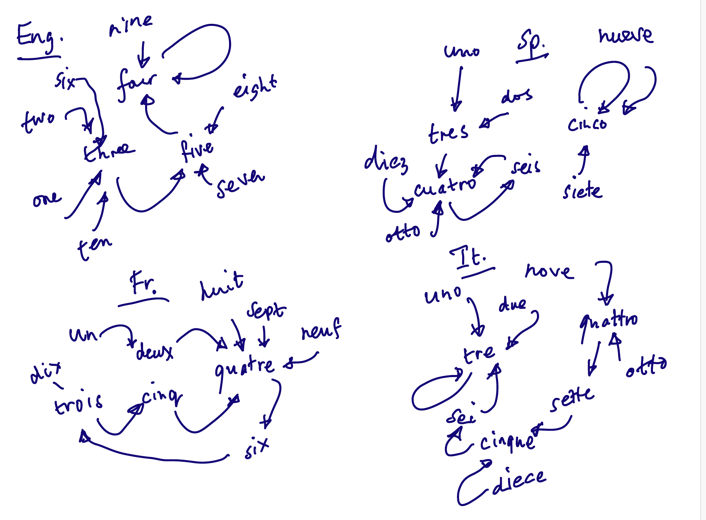 In English four is a fixed point and a black hole.
In Spanish cinco is a fixed point but not a black hole. It drags in nueve and siete, but other numbers get dragged into a 2-cycle, cuatro --> seis and back again.
In French we have a 4-cycle trois --> cinq --> quatre --> six and back again a nd this is an attractor for all other numbers (I think). For example
deux mille seize --> quatorze --> huit --> quatre
Finally, in Italian tre is a fixed point and also a black hole.
We can carry out the same investigation in any language that uses an alphabet (at least 2000 of them) but I think these four give a good feel for the sorts of behaviour that can occur.