OU blog

Personal Blogs

Richard Walker

Not Luggage—Geometry! Why Packing Problems Are Having a Golden Age

Visible to anyone in the world
Edited by Richard Walker, Wednesday 13 May 2026 at 12:59

Packing problems ask questions like 'What is the optimal way to pack n copies of shape A in shape B?' For example we might be trying to pack four equilateral triangles in a square, and the best known arrangement is this. 
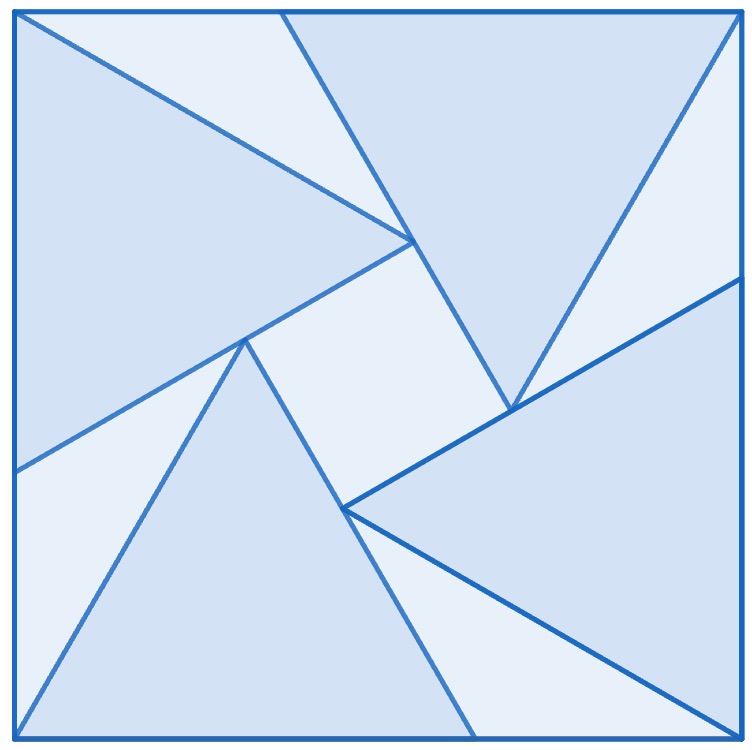
We can think of the problem in two equivalent ways

  • Choose a size for the square and make the triangles as big as possible
  • Choose a size for the triangles and make the square as small as possible

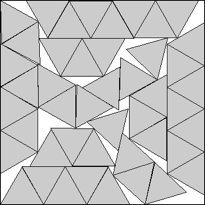
The example above, which I drew in GeoGebra, has been known since 1996 and was discovered by Erich Friedman. It's pleasingly symmetric and you might expect symmetry is the norm. But it absolutely isn't. As n increases every new number has its own idiosyncratic pattern, typically somewhat chaotic but with patches of local orderliness. For instance here is the best known arrangement for n equals 45 .

It was discover this month (May 2026) by Emerson Connelly and I found it on the legendary site Erich's Packing Center, maintained by Erich Friedman for the last 30 years. Erich's site has pages for dozens of different combinations. (Pentagons in Dominoes is one I rather like.)

I've known about this site for ages but when I revisited it yesterday I was astonished to find we have just entered a sort of Golden Age of Packing Problems. Of the 45 arrangements of equilateral triangles in squares found on the site, stretching back to 1996, 27 (60%) have been discovered in the last two months, April and May 2026! That's about one every other day.

And it's not just triangles in squares. Across the many different combinations of shapes hosted on Erich's site 46 have seen updated records in 2026, nearly all in that same two months. 

What accounts for this huge upsurge? I asked Copilot and it trawled the internet and proposed a combination of several factors

  1. Faster and more sophisticated search algorithms
  2. Dramatically greater computing power
  3. Widespread parallel experimentation
  4. Increasing use of AI/heuristics
  5. Rapid online collaboration
  6. A problem structure that rewards brute-force discovery

In some ways the problem resembles the search for bigger and bigger prime numbers. Packing problems have practical importance in manufacturing and transport (and prime numbers have practical importance in cryptography) but the search for new records and the application of such extraordinary human ingenuity and massive computing power is not motivated from practical considerations at all. I guess it comes to the spark of human curiosity and the attraction of a challenge.

And perhaps these records are a little like athletic ones; there is scope for a potentially endless series of small improvements and we always strive to reach them.
Permalink
Share post
Richard Walker

The Unique Triangle that Covers Every Triangle of Perimeter Two

Visible to anyone in the world
Edited by Richard Walker, Wednesday 6 May 2026 at 22:50

In 1999 Zoltán Füredi and John E. Wetzel, two covering problems meisters, found a triangle with a remarkable property.[1]

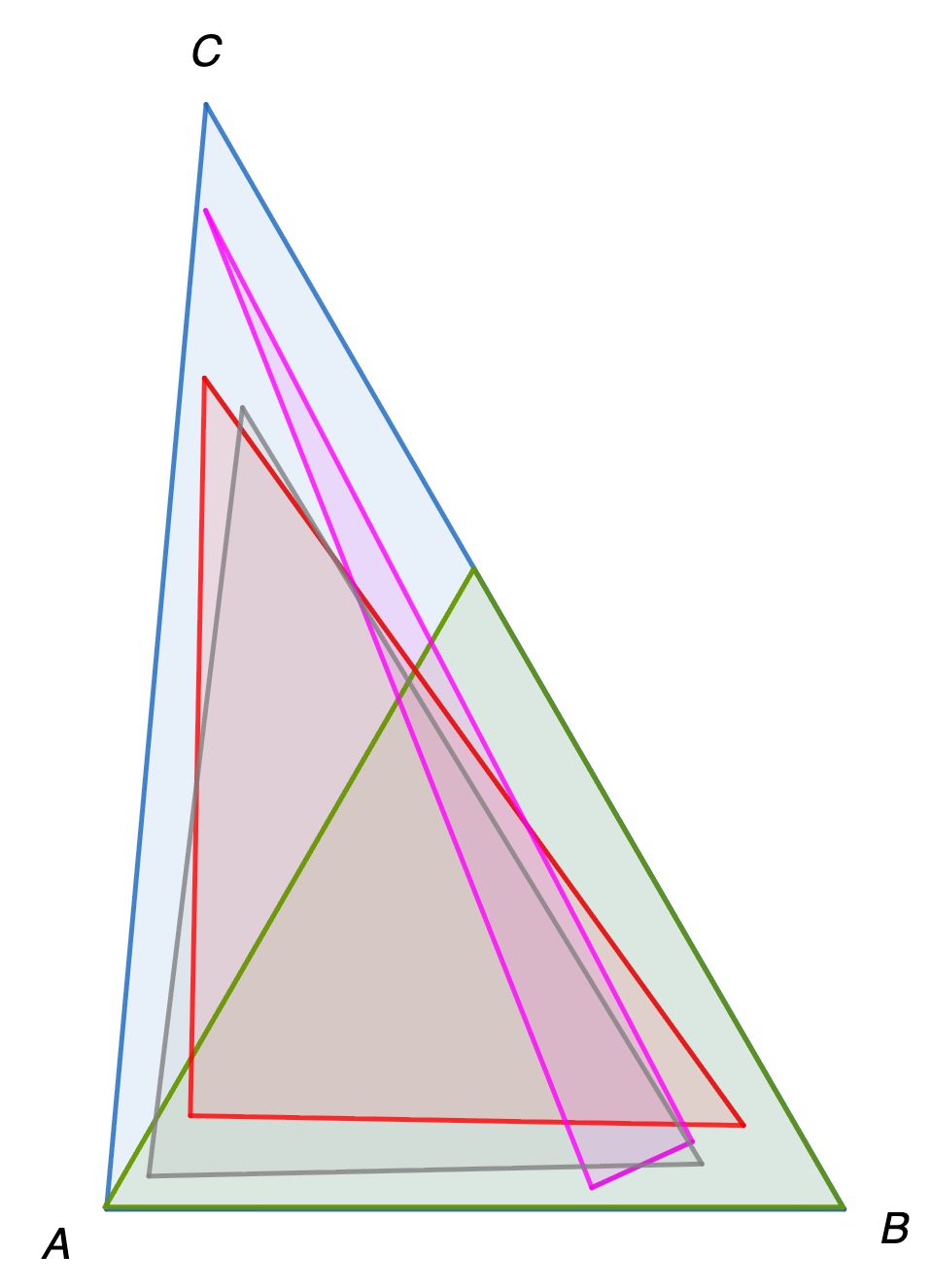
It can cover[2] each and every triangle of perimeter 2. It is the smallest region (not just the smallest triangle) that can do this and it is unique. I made a drawing of it using GeoGebra and fitted some sample triangles with perimeter 2 inside it

The length of cap a times cap b is two solidus three , prefix angle of cap a times cap b times cap c equals 60 postfix degree , the length of cap a times cap b is 1.00285 and the perimeter of cap a times cap b times cap c is about 2.823 .

[1] The smallest convex cover for triangles of perimeter two, Geometriae Dedicata, 2000

[2] To be precise, it can cover a congruent copy of any such triangle.

Permalink
Share post
Richard Walker

Covering One Triangle with Another - An Elegant Proof

Visible to anyone in the world
Edited by Richard Walker, Tuesday 5 May 2026 at 22:55

Covering problems, which ask how a shape can be covered with other shapes, are part of what's called combinatorial mathematics. They often appear in recreational mathematics. have applications to real-world problems such as siting mobile phone mast to get adequate coverage, and are a subject of active current research.

Covering problems are often easy to state but even in simple cases the answers can be difficult to establish, because when you are arranging a bunch of shapes it's hard to be sure all the possibilities have been thought of.

One I thought of the other day and posted in this blog is 

What is the smallest equilateral triangle that can cover every triangle whose longest side has length 1?

This is about as simple as it gets but it's not trivial. The first idea you might have, an equilateral triangle with sides of length 1, turns out not to be the answer; a bigger triangle is needed.

I haven't proved to my satisfaction what the smallest possible answer is but I can prove the following.

Any triangle whose longest side is 1 can be covered by an equilateral triangle of side length two solidus Square root of three almost equals 1.155 .

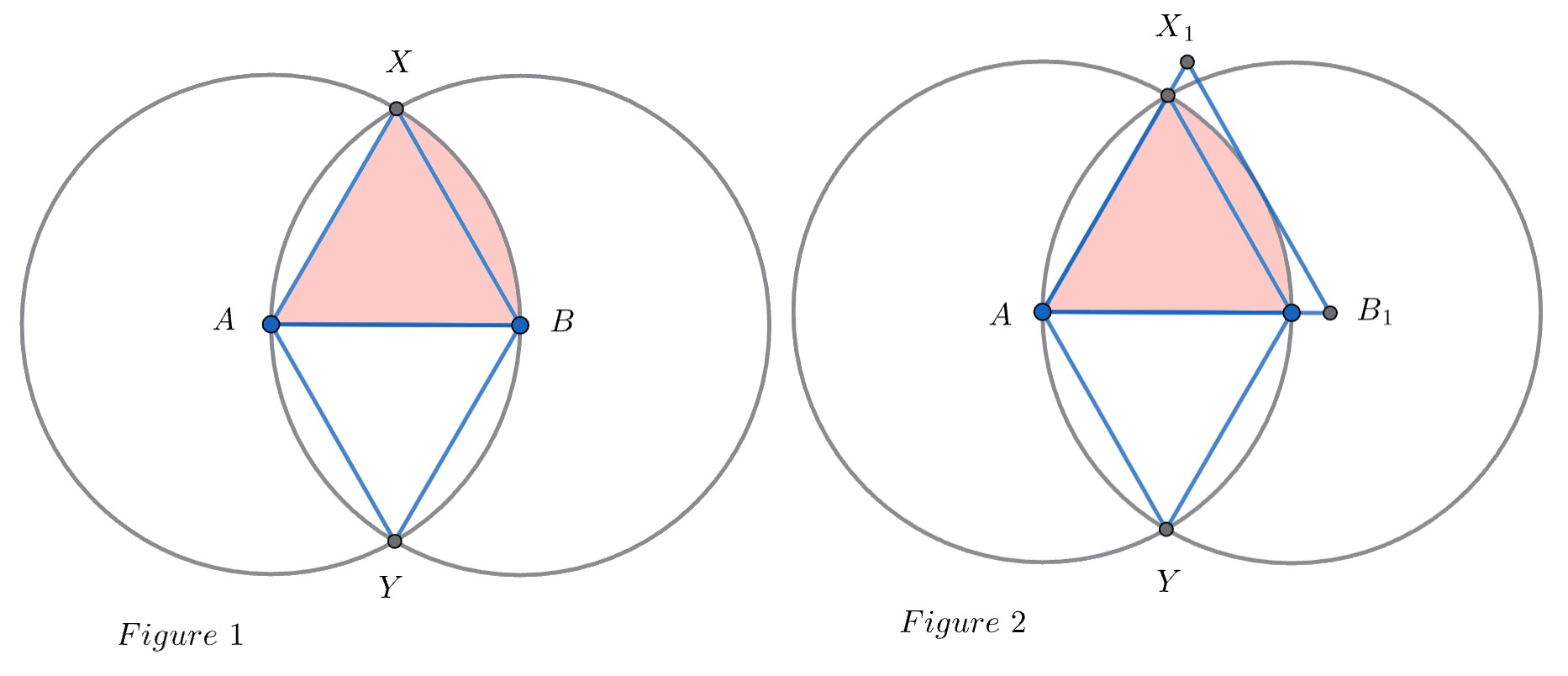
To see this consider Figures 1 and 2 below.

In Figure 1 AB is the longest side of the triangle we wish to cover, so its length is 1. Where can the third vertex of the triangle, call it C, be located?

If we draw circles of radius 1 centered at A and B then C must be in the lens-shaped region AXBY; if not, C would be more than 1 away from at least one of A and B , contradicting AB being the longest side.

From symmetry it is enough to just consider the shaded sector in Figure 1. In Figure 2 we see this sector is covered by equilateral triangle AX1B1, which therefore covers all three vertices of the triangle we want to cover and thus covers the whole of that triangle. 

The side length of AX1B1 is two solidus Square root of three almost equals 1.155 , which completes the proof.

Permalink
Share post

This blog might contain posts that are only visible to logged-in users, or where only logged-in users can comment. If you have an account on the system, please log in for full access.

Total visits to this blog: 6147081