

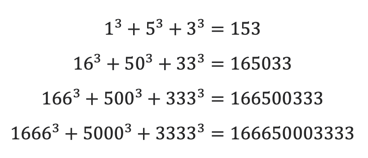
Isn't that neat? It was posted on Quora by Alexander Ferrugia, along with a proof that the pattern goes on forever. His proof was quite long though, and I found one which is a bit shorter.
Something that jumped out at me was the resemblance to recurring decimals. , and and I thought there had to be a connection. So I took the second line (the first doesn't fully show what the pattern is, because 6 doesn't appear) and played with it in the Python Shell, trying to get 16, 50 and 33, the numbers on the left hand side ...
100/6, 100/2, 100/3
(16.666666666666668, 50.0, 33.333333333333336)
Of course that's not right, we only want the whole number part. So let's subtract the fractional parts...
100/6 - 2/3, 100/2, 100/3 - 1/3
(16.0, 50.0, 33.0)
... and now it works. What about the right hand side? If we break it up we see it represents .
To get the equivalent expressions for the -th line we can just replace by everywhere and now we get
, with the left-hand side becoming
We want to prove these two expressions are equal and we can do that very easily. First make them more general by replacing by , giving
and
It is not hard to see that if these were expanded we would obtain cubic polynomials of the form . How can we prove they are the same? We might use paper and pencil to expand them and collect terms in the good old fashioned way. Or we could enter them into reliable computer algebra system and let it do the heavy lifting.
Or much more elegantly we can use this fact
| If two cubic polynomials of the form take identical values for four different values of they are equal. |
Why is this true? Because four values let us set up four equations and solve them to find the four constants .
But we have the requisite four values! This post began with them and so we have proved the two expressions are equal for any value of and for any value of in particular.