OU blog

Personal Blogs

Richard Walker

The Tree-Knowers: How the Word 'Druid' Reached Modern English

Visible to anyone in the world

In his Natural History Pliny the Elder wrote of Druids venerating oak trees and and climbing them on the sixth day of the moon to harvest mistletoe with a golden sickle *.

330px-%22The_druids%3B_or_the_conversion_of_the_Britons_to_Christianit_Wellcome_V0036085.jpg?utm_source=commons.wikimedia.org&utm_campaign=index&utm_content=thumbnail

"The druids; or the conversion of the Britons to Christianity". Engraving by S.F. Ravenet, 1752, after F. Hayman. 

This is a vivid story and part of our stereotype of Druids, but perhaps it is just a myth. However we know the concept of the sacred grove plays a prominent part in the religions of many Indo-European cultures (see the WP article on the topic) and in Greece I once visited a holy well in the woods that felt a bit a distant echo of this tradition.

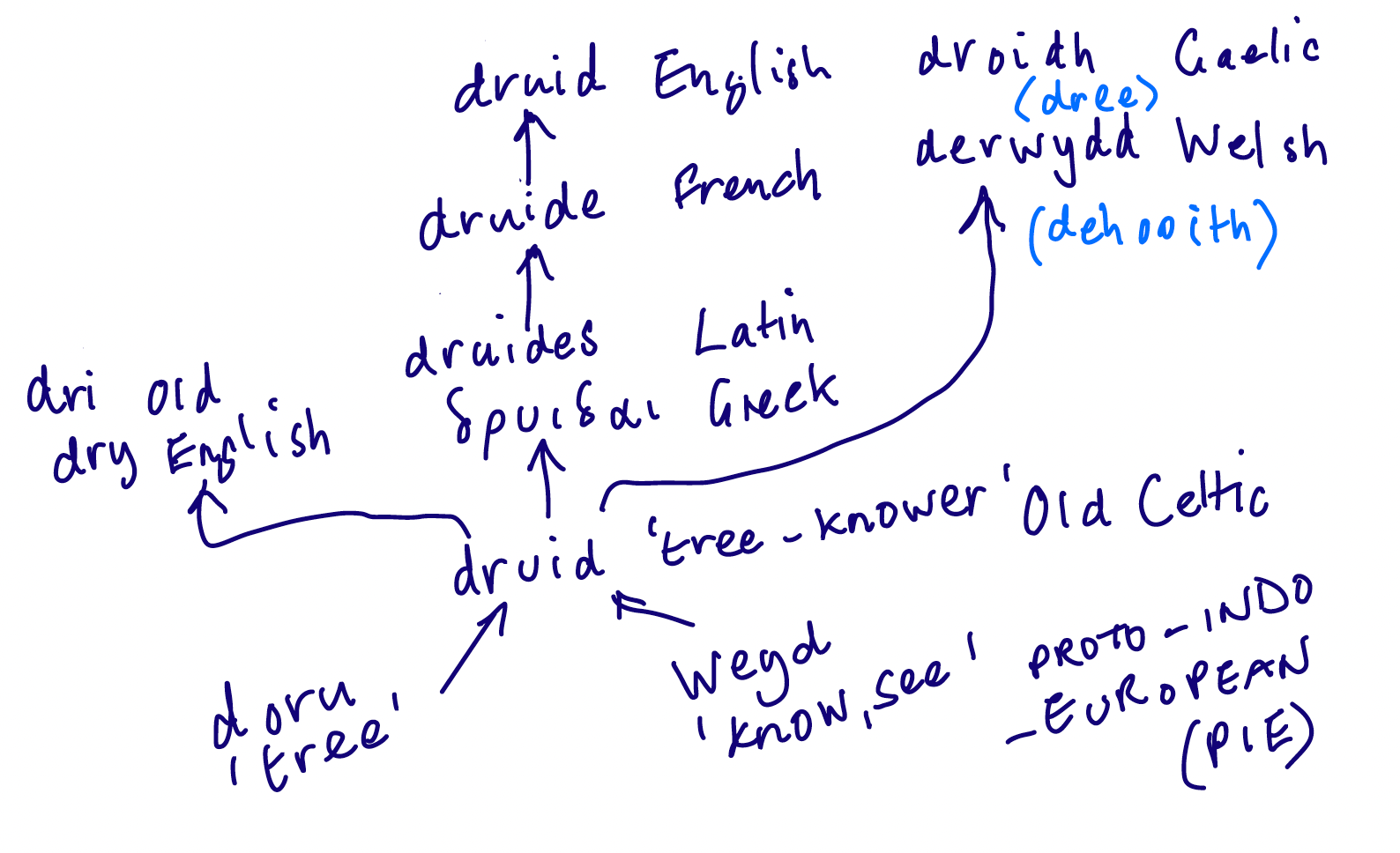
The connects with trees is also supported by the generally accepted etymology (already prefigured by Pliny). Druid seems to come ultimately from ancient PIE roots *doru-, 'tree'§  and *weyd-, 'see, know', so it would mean something like 'tree-knower'.

The word is found in Latin druides and Greek δρυΐδαι (dryidai), borrowed from Old Celtic. Old English had dry, 'magician', a direct borrowing, but Modern English druid came from Latin via French. Modern Gaelic and Welsh have cognates draoidh (dree) and derwydd (dehrooith), presumably directly from Old Celtic. A rough genealogy of these words in shown in this sketch.
sketch.png

*  Fans of Asterix the Gaul will be familiar with these details.

¶  Welcome Foundation ICV No 36622 Licensed under Creative Commons.

§ The first root might instead be a word meaning 'strong' or the two words might be the same (trees are emblematic of strength). 
Permalink 1 comment (latest comment by Russell Larke, Thursday 6 August 2026 at 01:52)
Share post
Richard Walker

The Tree-Knowers: How the Word 'Druid' Reached Modern English

Visible to anyone in the world
Edited by Richard Walker, Wednesday 5 August 2026 at 22:41

In his Natural History Pliny the Elder wrote of Druids venerating oak trees and and climbing them on the sixth day of the moon to harvest mistletoe with a golden sickle *.

330px-%22The_druids%3B_or_the_conversion_of_the_Britons_to_Christianit_Wellcome_V0036085.jpg?utm_source=commons.wikimedia.org&utm_campaign=index&utm_content=thumbnail

"The druids; or the conversion of the Britons to Christianity". Engraving by S.F. Ravenet, 1752, after F. Hayman. 

This is a vivid story and part of our stereotype of Druids, but perhaps it is just a myth. However we know the concept of the sacred grove plays a prominent part in the religions of many Indo-European cultures (see the WP article on the topic) and in Greece I once visited a holy well in the woods that felt a bit a distant echo of this tradition.

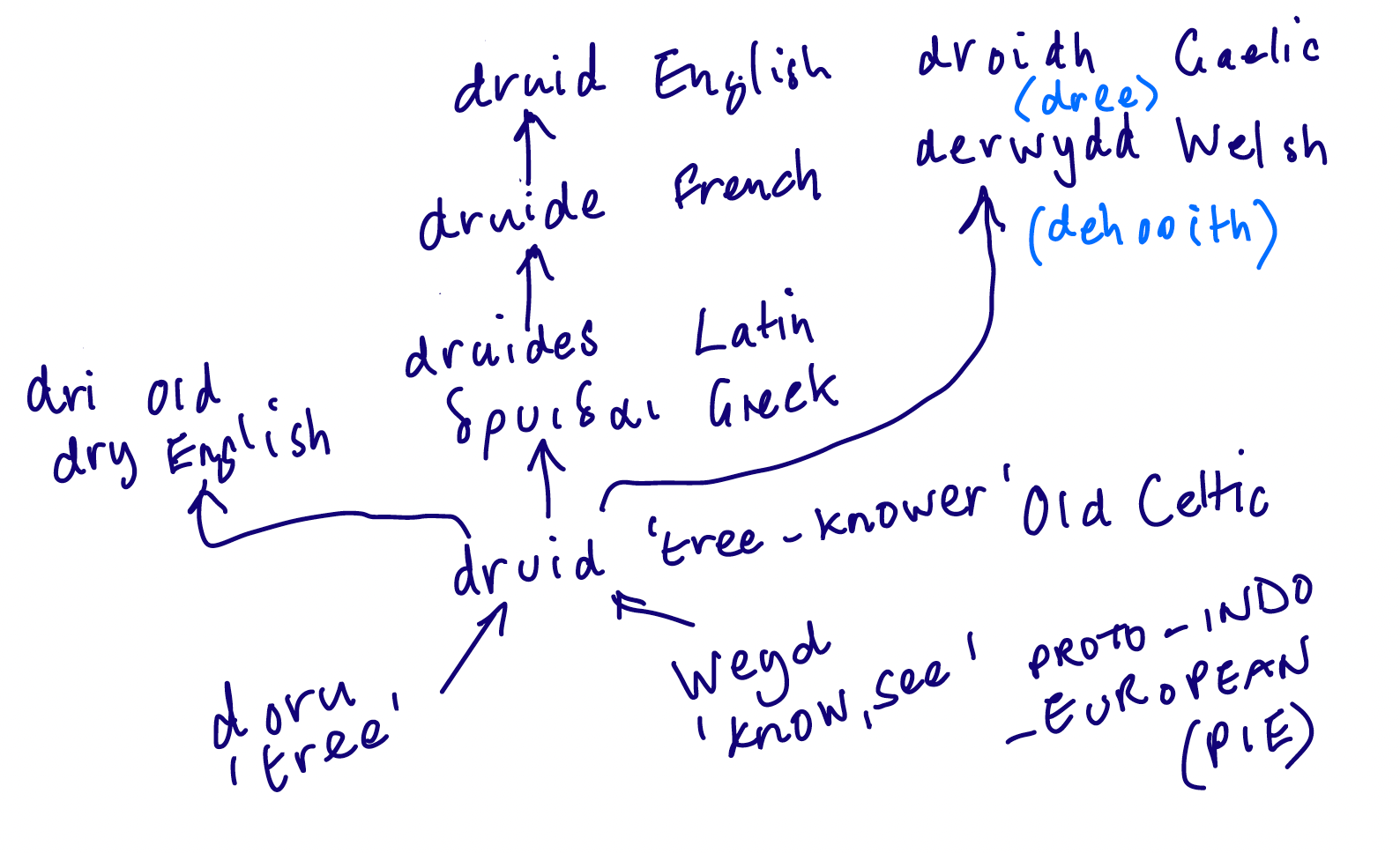
The connects with trees is also supported by the generally accepted etymology (already prefigured by Pliny). Druid seems to come ultimately from ancient PIE roots *doru-, 'tree'§  and *weyd-, 'see, know', so it would mean something like 'tree-knower'.

The word is found in Latin druides and Greek δρυΐδαι (dryidai), borrowed from Old Celtic. Old English had dry, 'magician', a direct borrowing, but Modern English druid came from Latin via French. Modern Gaelic and Welsh have cognates draoidh (dree) and derwydd (dehrooith), presumably directly from Old Celtic. A rough genealogy of these words in shown in this sketch.

sketch.png

*  Fans of Asterix the Gaul will be familiar with these details.

¶  Welcome Foundation ICV No 36622 Licensed under Creative Commons.

§ The first root might instead be a word meaning 'strong' or the two words might be the same (trees are emblematic of strength). 

Permalink
Share post

This blog might contain posts that are only visible to logged-in users, or where only logged-in users can comment. If you have an account on the system, please log in for full access.

Total visits to this blog: 6324265