

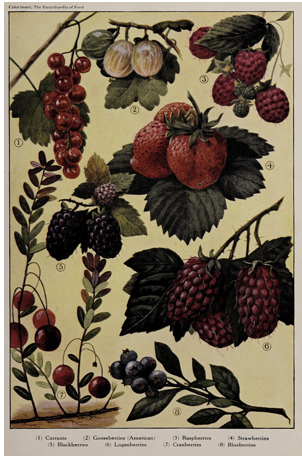
 Many or most do (have unusual names), you see. A handful are perfectly explicable, such blackberry and blueberry from their colour, and Loganberry because in 1881 James Logan accidentally crossed a blackberry with a raspberry.
But many are inexplicable. What has a gooseberry have to do with geese or a strawberry with straw? A word story commonly advanced for gooseberry is that the first bit is a borrowing from French grosele or Dutch croesel. both ultimately from a Germanic root meaning 'crisp' or 'curly'. But the OED is unconvinced, and why would a gooseberry be described as curly?
As for strawberry, it was already in Old English as streawberigei, but where the straw comes into the mix is uncertain.
But at least these two fruits start with a recognisable element having a meaning in its own right., even if it is hard to link with the fruit concerned. Many names of the form 'something-berry' start with a element that is not a word on its own, isn't found anywhere else in the language and on its own has no meaning for native speakers.
The classic example is cranberry. Whatever is a cran? ¶ What does it mean? Well in this case we think we have an etymology: it was originally a crane-berry, as in the bird, but the 'e' got dropped and the meaning forgotten. (But why it was called a craneberry is still a mystery).
This cran is an example of a unique morpheme. A morpheme is like a sort of atom of language, the smallest unit of language and indivisible, and all words are made up from one or more morphemes. A morpheme may or may not be able to stand on its own. For example bookmark has two morphemes that can be independent words. whereas the un- in unhappy cannot exist alone. But crucially, it carries meaning; the cran in cranberry no longer does and contemporary speakers cannot explain what it means.
And most of the X-berry clan are like this; the X- may have a recognised etymology or it may be uncertain, but either way the X is a unique morpheme, found only in this combination, and whatever meaning it may once have had has evaporated.
Of course there are other examples of unique morphemes that have nothing to do with fruit; often quoted example are luke- in lukewarm, -ept in inept and twi- in twilight. The are often called 'cranberry morphemes' in fact, because that was the example used in early writings about this linguistic oddity. But they are particularly common in the vocabulary of berries.
For more example. think of huckle- (what's a huckle) and mul- and bil- and rasp-, all mysterious. Whortleberry looks at first as though it is not a unique morpheme, because whortle is a distinct word. but alas when we look it up we discover it is simply short for whortleberry, so it hardly counts. And then there is lingon-, borrowed from a Swedish word meaning something like 'heather berry' in Swedish, but now a unique morpheme in English.
Why are these unique morphemes there if they don't mean anything? Well we need them, they have a purpose which is to distinguish between different kinds of berry. So they do not need to carry meaning, they only need to be A. different, and B. easy enough for speakers to remember them.
¶ Scrabble players and word geeks may point out that a cran is a measure of herrings, but that is a different word, not our cran.
Picture credit Wikimedia, public domain
