OU blog

Personal Blogs

Richard Walker

One that Euclid missed?

Visible to anyone in the world
Edited by Richard Walker, Tuesday 9 September 2025 at 00:16

More than 2,000 years ago Euclid proved that in any triangle the three lines bisecting the angles of a triangle meet at a point which is the centre of the circle that touches the triangle's sides.
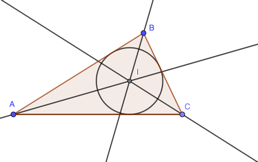
sketch.png

He further proved that the three lines that bisect the triangle's sides at right angles is the centre of a circle passing through the triangles three corners.
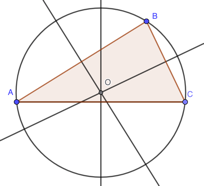
sketch%20%281%29.png

These circles, called the incircle (centre incentre) and circumcircle (centre circumcentre) still studied in schools today, for example here is quite a nice animation showing the construction of the circumcircle, from a GCSE revision site.

And if you are interested in Euclid's original proofs here you can see the relevant pages from the oldest know complete copy of Euclid's Elements, with a transcription into a readable form and an English translation. You want Book IV, Elem. 4.4 and 4.5. This website is an astonishing work of scholarship.

All that was just the preamble. Here is a neat fact I stumbled across about a week ago, when I was just doodling triangles. It's nice because it connects the angle bisectors and the perpendicular bisectors.

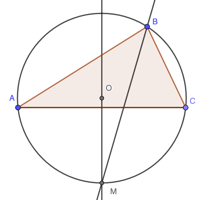
In a triangle the line bisecting an angle meets the perpendicular bisector of the opposite side at a point (M in the diagram below) that lies on the circumcircle

sketch%20%282%29.png

This was new to me but I thought there ought to be quite a simple and accessible proof. But after a bit of head scratching, I couldn't see one, so I thought it must be a standard result, and looked it up. I did find a few proofs, but they were all more complicated than I was hoping (and at least one was wrong). The problem is discussed on Mathematics Stack Exchange but I still didn't find the "obvious" proof I was looking for.

After days of head-scratching I finally had my eureka moment! The proof I was seeking uses the following fact.

In a given circle, any two chords with the same length subtend (i.e.make) equal angles on the circumference. Here's an example:
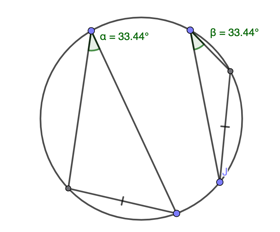
sketch%20%284%29.png

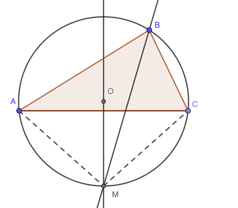
Now it's easy. Add some chords.

sketch%20%285%29.png

I claim that the line BM that joins B and the point M where the perpendicular bisector of AC meets the circumcircle is the line bisecting angle ABC.

Proof: Any point on the perpendicular bisector of AC is equidistant from A and C. So AM and MC are equal chords, and the angles ABM and MBC they subtend are equal, in other words BM bisects angle ABC.
Permalink
Share post
Richard Walker

Conway's Circle Theorem

Visible to anyone in the world
An old story tells of a Maths professor, who at a certain point in his lecture told the class, "The proof of this is obvious", but then began to have doubts. After gazing at the blackboard for some time he said, "Hmmm. Perhaps it's not obvious. I'll have think about it and let you know in next week's lecture."

The following week the class assembled, and after a new minutes the professor arrived. Gazing round the lecture theatre, he said "Since our last lecture I have been thinking about that problem in every waking hour, but I simply could not see it. But you will be glad to know that on my way here today I finally saw the answer."

"It is obvious."

Well, I have been thinking for several days about how to prove the Conway Circle Theorem, a rather nice result usually credited to the brilliant and original mathematician John Horton Conway, who sadly died in the recent Covid Pandemic. I could fairly quickly see a proof but it had a rather messy feel to it, it wasn't anything I would want to explain on this blog. It wasn't what I would call elegant. I felt there must be a nicer proof, one that would make the proof of the theorem, well, obvious.

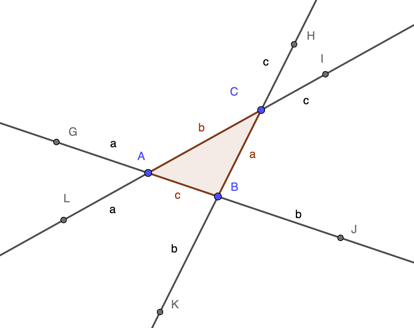
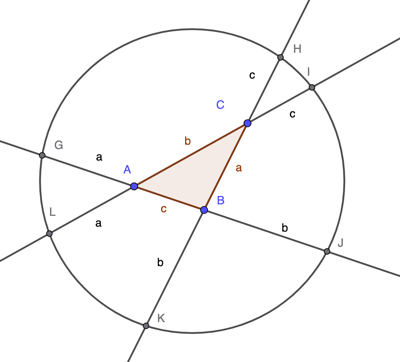
After much chewing the problem over I think I have a proof which does make the theorem fairly obvious. But I'd better tell you what the theorem is before we go any further. Consider the following diagram.


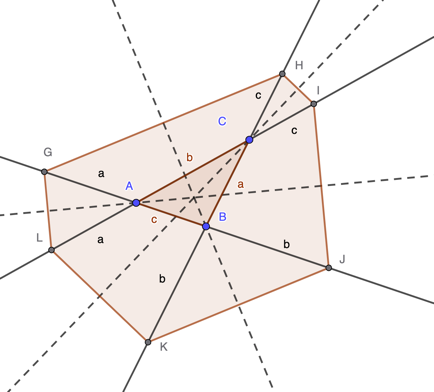
As shown in the diagram, the three sides of triangle ABC have each been extended at both ends, AB by distances a and b, BC by distances b and c, and CA by distance c and a. This gives the six points G, H, I, J, K, L.  Conway's theorem says that (rather surprisingly) these six points lie on a circle, see below:


How to prove this? I'm going to use some well-known properties of isosceles triangles, triangles with two sides equal in length.

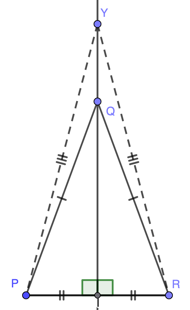
In triangle PQR sides PQ and QR are equal. The line bisecting the base PR at right angles, the perpendicular bisector, must pass through the apex Q, and it bisects the angle PQR. Moreover any point, for example Y, that lies on the perpendicular bisector is equidistant from points P and Q, as shown by the dotted lines.

Going back to our original diagram, let's join up the six points to make a hexagon, and then draw in the perpendicular bisectors of its sides, shown dotted:


We see that each side of the hexagon is the base of a triangle, which by the method use to construct the six  points must be isosceles. Each perpendicular bisector passes through a vertex of triangle ABC and bisects the angle there, and is fact the shared perpendicular bisector of a pair of the hexagon's sides lying opposite one another.

It's well known that the three lines bisecting the angles of a triangle meet in a single point, called the incentre. Because the three dotted lines bisect the angles of ABC this mean they meet at its incentre.

Because the incentre is on the perpendicular bisector of HI it must be equidistant from H and I. Similarly because it is on the perpendicular bisector of IJ it must be equidistant from I and J. By the same argument, it must be equidistant from J and K; from K and L; from L and G; and from G and H. Thus it is equidistant from all six points and is the centre of a circle that passes through them all.

Permalink
Share post

This blog might contain posts that are only visible to logged-in users, or where only logged-in users can comment. If you have an account on the system, please log in for full access.

Total visits to this blog: 3427342