OU blog

Personal Blogs

Design Museum

What Matters When Learning Online: Lessons from 12 Days Sober

Visible to anyone in the world
Edited by Jonathan Vernon, Thursday 23 October 2025 at 07:03

Twelve days ago, I stopped drinking.

What’s been fascinating, as someone who’s spent fifteen years thinking about how we learn, is how much this experience feels like being enrolled on two very different online courses at once.

The first is NHS Drink Free Days, a simple, free public-health app that tracks days without alcohol and gives a little dopamine hit of encouragement.

The second is Reframe, a paid app that treats sobriety not as abstinence but as education: a self-directed, psychologically informed curriculum in how our brains and habits work.

Both aim to change behaviour. But only one truly teaches.

The Lightweight Tracker: NHS Drink Free Days

The NHS app does exactly what it says. You set a target number of “drink free” days, log your progress, and see graphs of units saved. It’s quick, clean, and easy to use.

As a behavioural intervention, it works at the surface level of habit: awareness, accountability, repetition. But it doesn’t teach why change feels difficult, or how to build new patterns of thought. It’s data without reflection.

It’s like being given a scale without a fitness plan. You see the numbers, but not the story.

The Learning Model: Reframe

Reframe is something else entirely.

It’s a masterclass in what good online learning can be: a mixture of psychology, neuroscience, reflection, and gentle humour. It uses short, animated micro-lessons on topics like dopamine, habit loops, and emotional regulation. It asks you to journal, to question automatic thoughts, to build self-awareness.

It’s active learning. Every interaction prompts reflection and, crucially, personalisation.

The tone is warm, human, and intelligent — it feels like having a compassionate coach who also knows their neuroscience.

In short, it teaches you how to learn yourself.

What Makes Learning Work Online

Comparing the two has reminded me of the principles that matter most in any digital learning design — from health to history, coaching to creativity:

1. Purpose and Structure

People engage best when the design matches the goal.

Tracking habits can be linear and simple; changing beliefs or behaviours requires structured reflection and depth.

2. Personalisation and Agency

Reframe adapts to me. It remembers my goals, my streak, my weak points. That sense of agency — I’m in charge of my learning — fuels motivation far more effectively than a one-size-fits-all dashboard.

3. Feedback and Reflection

Numbers are fine, but insight is better.

Reframe’s feedback loops (journals, check-ins, stories) transform data into meaning — echoing Kolb’s learning cycle of experience → reflection → conceptualisation → experimentation.

4. Community and Connection

Even brief contact with others on the same journey builds momentum.

Learning is social: we grow by witnessing each other’s progress and setbacks.

5. Cognitive Insight

Understanding what’s happening in the brain — the craving circuits, the prefrontal cortex’s role in impulse control — gives me both curiosity and compassion. Knowledge, it turns out, is a form of relief.

6. Progressive Mastery

Reframe uses gamification well. Each micro-lesson, streak, and milestone gives a sense of progress — small wins that accumulate. The NHS app’s identical daily task can start to feel static.

7. Tone and Empathy

The tone of voice matters. The NHS app speaks like a public service announcement.

Reframe speaks like a friend. Tone is pedagogy.

Learning How to Learn — About Myself

Both tools have their place. The NHS app gets you started — a nudge toward accountability.

But Reframe keeps you learning — a journey into why we behave as we do and how to shift that behaviour sustainably.

For someone who has spent years immersed in online learning — from the Open University’s MAODE to Coursera and beyond — it’s striking to experience the theory from the inside. This isn’t just behaviour change; it’s applied learning design, lived daily.

Each sober day is, in essence, a micro-lesson: small, repeatable, occasionally challenging, often revealing.

And like any good course, I’m learning that the subject isn’t alcohol — it’s attention, awareness, and agency
Permalink Add your comment
Share post
Design Museum

New blog post

Visible to anyone in the world

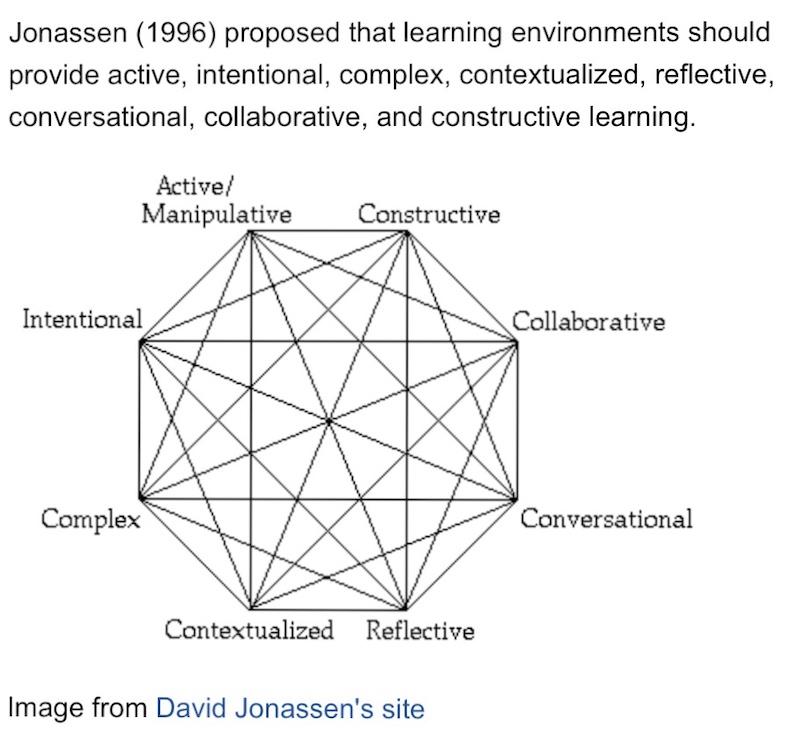
David Jonassens proposed learning environments octogon

Can this be done online? Do I even understand all the terms? Does it all have to happen in the same class?

Constructive : a workshop like activity, or 'group think' in Google Breakout.

Collaborative : they work together in small groups to come to an answer.

Conversational : in the Chat and with each other.

Reflective : with more time at the end, or part way through, they reflect on what they are doing and if they are getting anywhere.

Contextualized : as in the online learning environment and/or the individual context for each person?

Complex : or challenging? Online learning is a fail for some, for reasons of their own making, or not. For technical, persona circumstances and other reasons. Some people don't like bringing the class into the home. It is a cultural shift.

Intentional : (I'm going to have to look this up).

Active/Manipulative : sounds like 'constructive' ?


Permalink Add your comment
Share post
Design Museum

Learning at the speed of desire

Visible to anyone in the world

 All to change in education

Total mayhem all around at this end. 

The PGCE I am doing, onto Module 3, was a must have to balance against the Masters in Education I did 7 years ago. I need the front line practice and experience I do not feel I get as a learning technologist. It makes the academic theory more relevant. I see myself as a Learning Designer in future and will teach both online and in the class.

Due to a Covid-19 scare I have 'volunteered' to run five 90 minute online workshops on Screencastify using Google Meet. I've done one session which was a scary experience. It  can only get easier ... or not. Some will have poor online access, or try to listen in from their phone sitting in their Dad's car - the only place they can work undisturbed. Others for lack of device or internet will have to come into college ... or not. Some want to learn and race ahead. Some have little desire to learn and do little or less. As long as they are not disruptive what can I do?

I have just completed 'Take Your Teaching Online' a free course with the Open University > https://bit.ly/39LI4Vw

If you want to understand the design and delivery of online learning this is the best that there is for now. It could be shorter. Some of the content is a bit dated or no longer relevant. The multiple choice formative quizzes are flawed. The formal assessments are a worthy challenge. 

I see education going the way of retail. 

The 'disruption' brought on by Amazon has been 20 years in the making. Exactly 20 years ago, or perhaps 19, I recall being overly generous with my credit card and buying books from Amazon for every family member I expected to see that Christmas at two annual gatherings split between my family (4 children, mother and stepfather, stepbrother and between 6 and 8 children) and my wife’s smaller family (3 children, mum and dad and 3 children). The disruption on the high street was a slow burn; Covid-19 kicked everything online. 

In 10 years, or sooner, the education landscape will look as different and will have experienced as much disruption. Far more people will learn at a pace suited to their desire to learn and abilities. Or their parents’ desire for their children to learn and the depths of their pockets. All private education costs. And you get what you pay for. Why not home educate as the aristocracy and landed gentry of 120+ years ago did? Being a virtual tutor could be a new job description where teaching online as an educator you tutor enough students privately one to one (rarely face to face) to make a good living. 

The brightest will start university courses at 14 or 15; that is already happening.  

Everyone needs to become a 'lifelong learner' just to stay abreast of the changes.

It’s a phrase I used a decade ago ‘learning at the speed of desire’. Just Google it, then get on with it. What’s the fuss? Tell me what you cannot learn online if you set your mind to the task??  

EdTech 2020 said the other week to expect educational institutions, FE and HE, rather than primary and secondary (I think) moving to a model of 25 to 100 online. Some colleges will close and operate like the Open University. They will deliver it all online … albeit with a twice monthly tutorial day and possibly the acclaimed Open University residential courses. 

Meanwhile if Climate Change causes major 'weather events' every ten years rather than every 50 or 60, I am equally worried, for the same reasons - population pressure, that pandemics like Covid-19 will also come every 20 years or so rather than every 100. We will see.

All doom and gloom? Not for me, I thrive on change.

Permalink Add your comment
Share post

This blog might contain posts that are only visible to logged-in users, or where only logged-in users can comment. If you have an account on the system, please log in for full access.

Total visits to this blog: 17637673