

Napoleon's Theorem says that if we draw an arbitrary triangle and erect equilateral triangles on its sides, the centres of the triangles will form a equilateral triangle. Here is what may the first publication of this fact, in the 1826 edition of The Ladies Diary, which was very strong on mathematics at the time[1]. As you can see the proof is quite verbose and many shorter proof have been found. It's doubtful that Napoleon actually had anything to do with it but presumably somebody attributed it to him and it stuck.
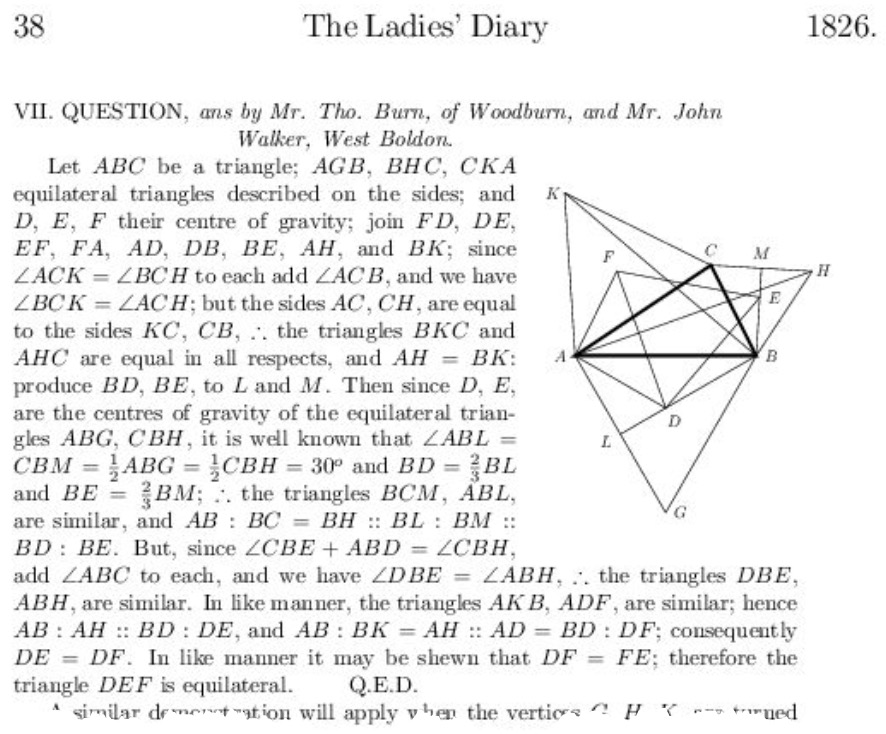
The equilateral triangle formed is DEF in the diagram.
I was musing about Napoleon's Theorem because I really like pretty theorems in plane geometry and it occurred to me that I could reverse the roles of the arbitrary triangle and the equilateral one.
If we draw an
arbitraryequilateral triangle and erectequilateral trianglescopies of an arbitrary triangle on its sides, the centres of the triangles will form a equilateral triangle.
Here it is
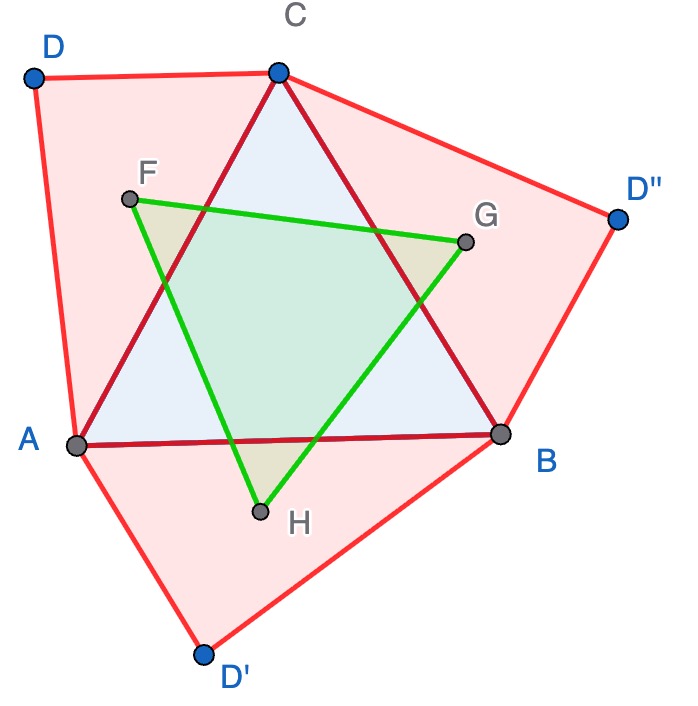
Which is rather neat! It's actually quite easy to see why it must be true, because each copy of the irregular triangle represents a 120° rotation of the previous one about the centre of the original equilateral triangle ABC, the whole figure has 3-fold rotational symmetry, any three corresponding points, for example D' D' and D'', are the vertices of an equliateral triangle.
Now what if we go for a sort of hybrid: start with the figure above and erect equilateral triangles on the two free sides of one copy of the irregular triangle, like this
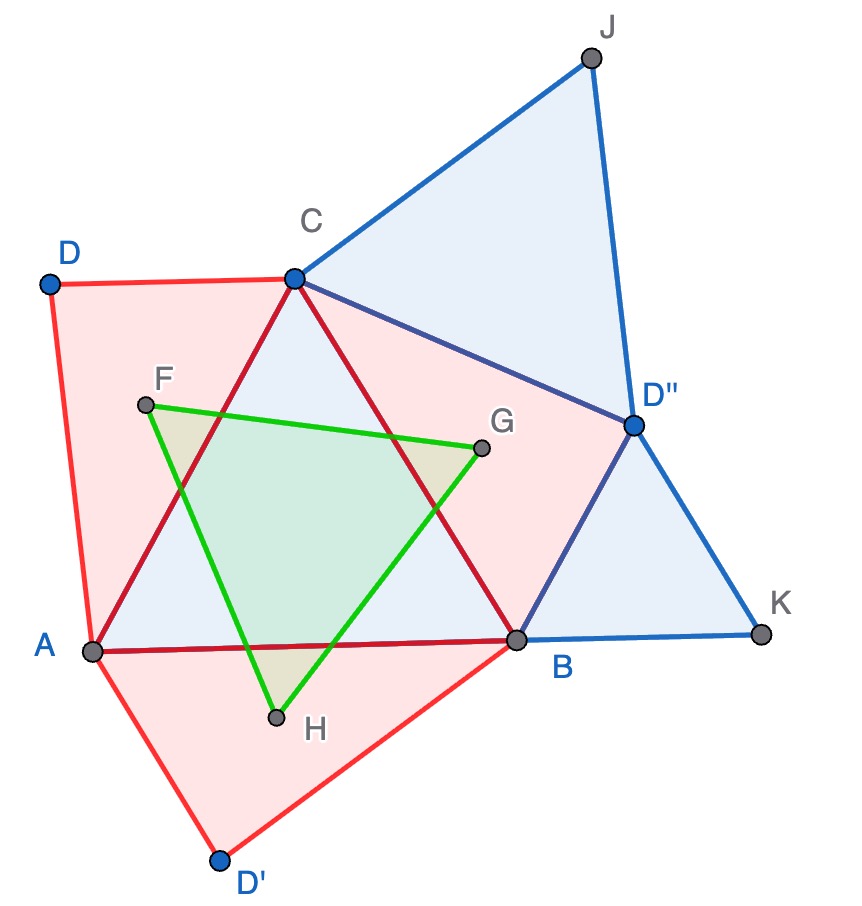
Now let's draw some centres and join them up
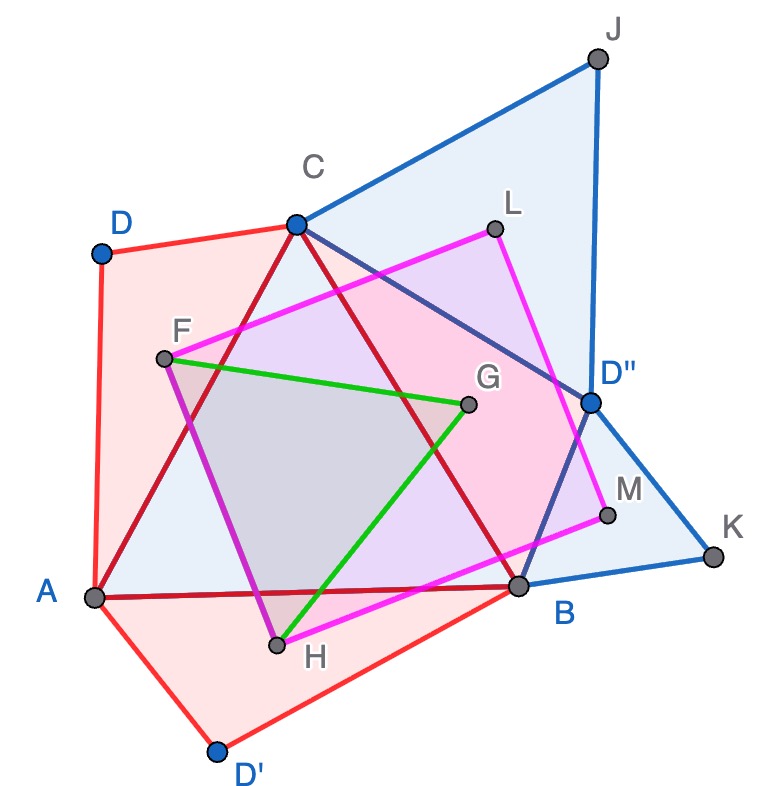
I bet you weren't expecting the rectangle, well, I wasn't anyway! There are no other right angles anywhere in the diagram and it popped out of nowhere.
I haven't proved it mind you. I think I could do it with vectors for example but it would rather messy. I'll see if I can do it just using a Euclid-style proof.