Feyman's 1/7 Area Triangle: A Beautiful New Proof By Dissection
Monday 30 March 2026 at 19:49
Visible to anyone in the world
Edited by Richard Walker, Monday 30 March 2026 at 20:37
Claim: In any triangle ABC, if we draw a line from each vertex to the point along on the side opposite, the inner triangle so formed has area equal to of the area of the orginal triangle.
I posted a proof of this on 28 March but since then I've thought of a simpler and far nicer proof.
Figure 1
In Figure 1 triangle ABC, R, S and T are trisection points of the sides they lie on; and K, L and M the midpoints of the sides. XYZ is the Feynman "one-seventh" triangle formed by lines AT, BS and CR.
In Figure 2 we have rotated triangles XBL, YCM and ZAK through about the midpoints L, M and N respectively.
Figure 2
Figure 2 shows triangle ABC can be dissected into a figure consisting of seven congruent triangles, all of equal area, and that the Feynman triangle XYZ, numbered 7 in the diagram, is one of them. It follows immediately that its area is the area of triangle ABC.
Of course, like the proof I gave previously, this must have already been discovered by many before me, but I worked it out for myself and the 'εὕρηκα' moment was very pleasing.
The Mathematical Gem That Stumped A Nobel Laureate
Saturday 28 March 2026 at 00:02
Visible to anyone in the world
Edited by Richard Walker, Saturday 28 March 2026 at 00:49
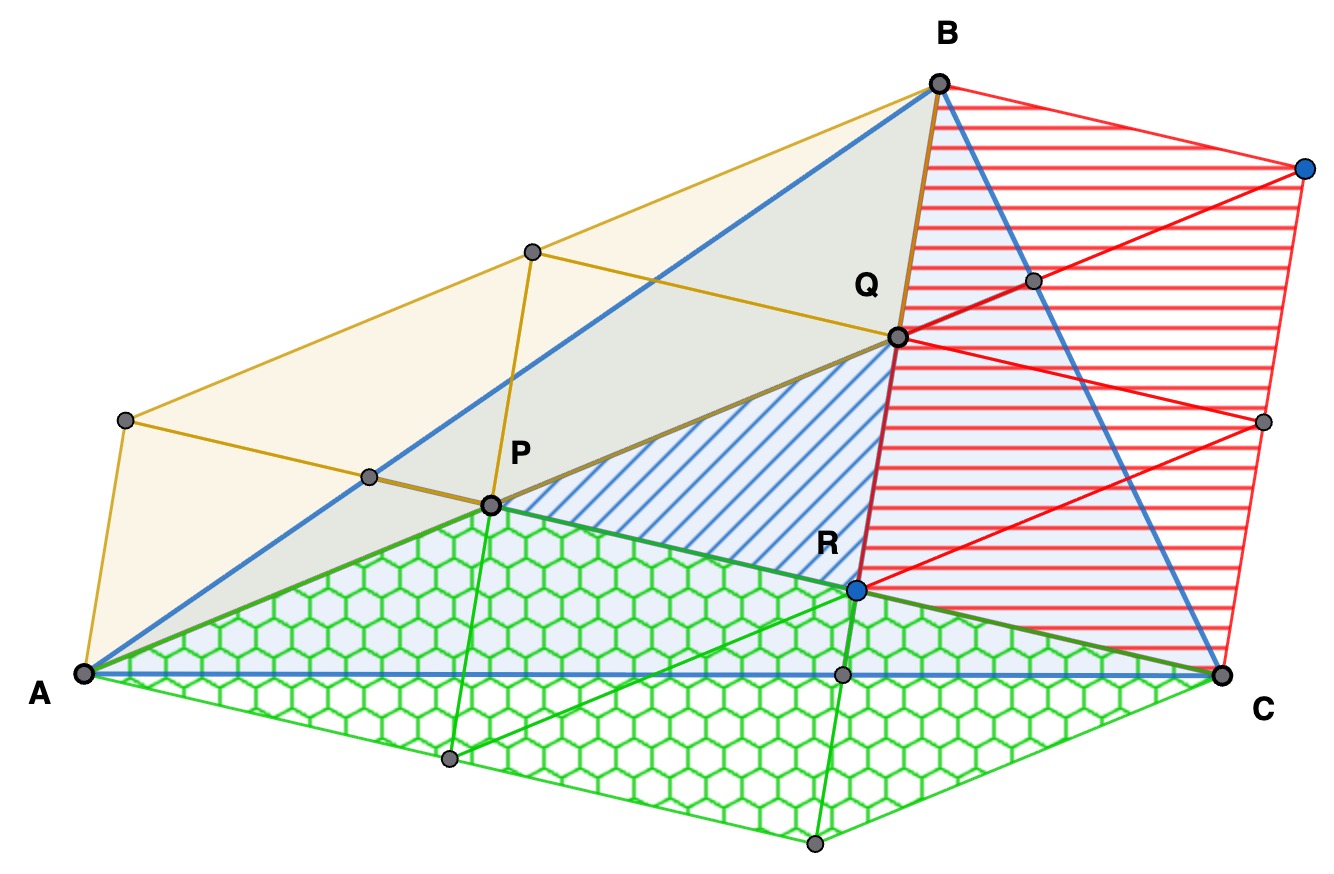
In any triangle, if we join each vertex to the point one-third along the side opposite, the area of the triangle this creates has one-seventh the area of the triangle we started with.
Figure 1
The story goes that the Nobel Prize winning physicist Richard Feynman was introduced to this theorem at a dinner following a talk he gave at Cornell University. Feynman was apparently disbelieving at first, and even sought to disprove it, because the combination of numbers 3 and 7 seemed too unlikely be true. After a time he accepted it and then spent the rest of the evening finding a proof.
I read somewhere that Feynman wrote about the difference between physics and mathematics and maybe this story illustrates a difference between practitioner of the two disciplines. I think the typical mathematician would see the surprising combination of 3 and 7 as being so neat that it's difficult to conceive of the theorem not being true!
Coming across the theorem recently I knew I'd seen it before but couldn't remember the proof or even if I'd ever known one. So I thought I would come up with my own. I wanted a proof that didn't use any coordinate geometry (or vectors or complex numbers) or trigonometry or a long chain geometrical reasoning, or any moving parts.
I knew that sometimes with problems of this kind we can prove what we want by using multiple copies of a figure to build up repeating tiling pattern, a tessellation. so I experiments with various possibilities but without joy.
I left it a while and when I went back bingo! I saw how to draw the 'look and see' proof in Figure 2.
Figure 2
This uses 12 additional triangles congruent to the small inner triangle of Figure 1. They are grouped by fours into three parallelograms, and each side of the original triangle exactly bisects a parallelogram. The original triangle is made up from half of each of the three parallelograms plus the small inner triangle. If we let represent the area of the small triangle we have
So the small inner triangle has one-seventh the area of the original one, as claimed.
Doubtless this proof is not new—many people must have discovered it before me—but it was new to me and I was pleased to have worked it out.
This blog might contain posts that are only
visible to logged-in users, or where only logged-in users can comment. If you
have an account on the system, please log in for full access.


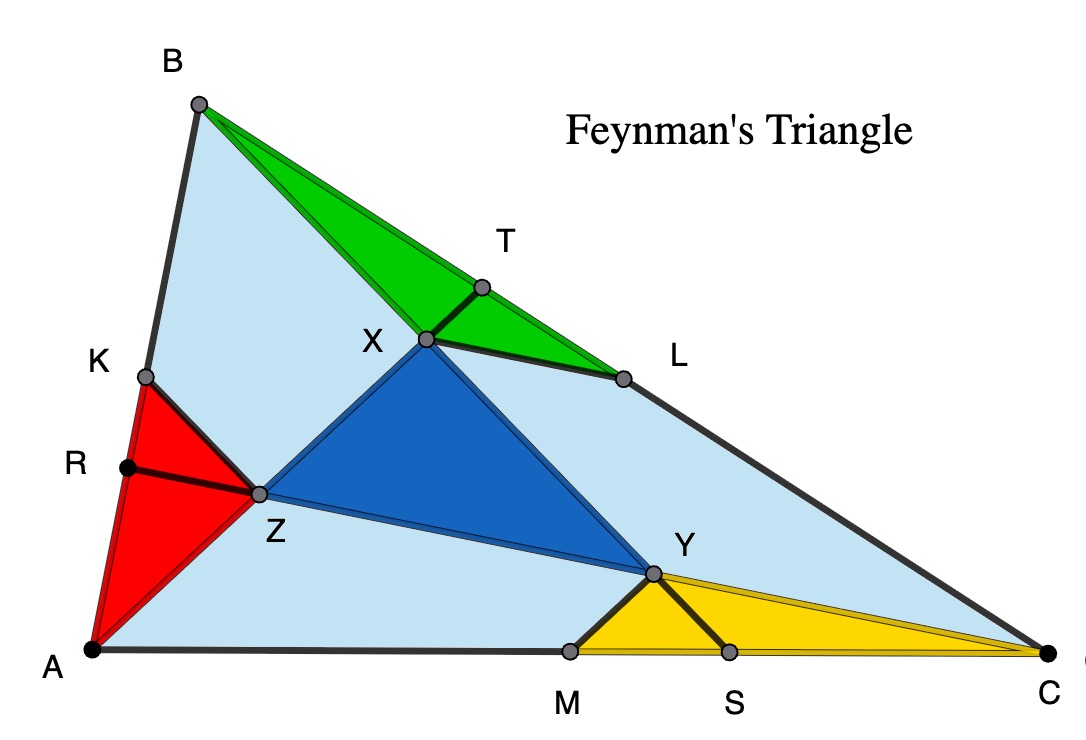 Figure 1
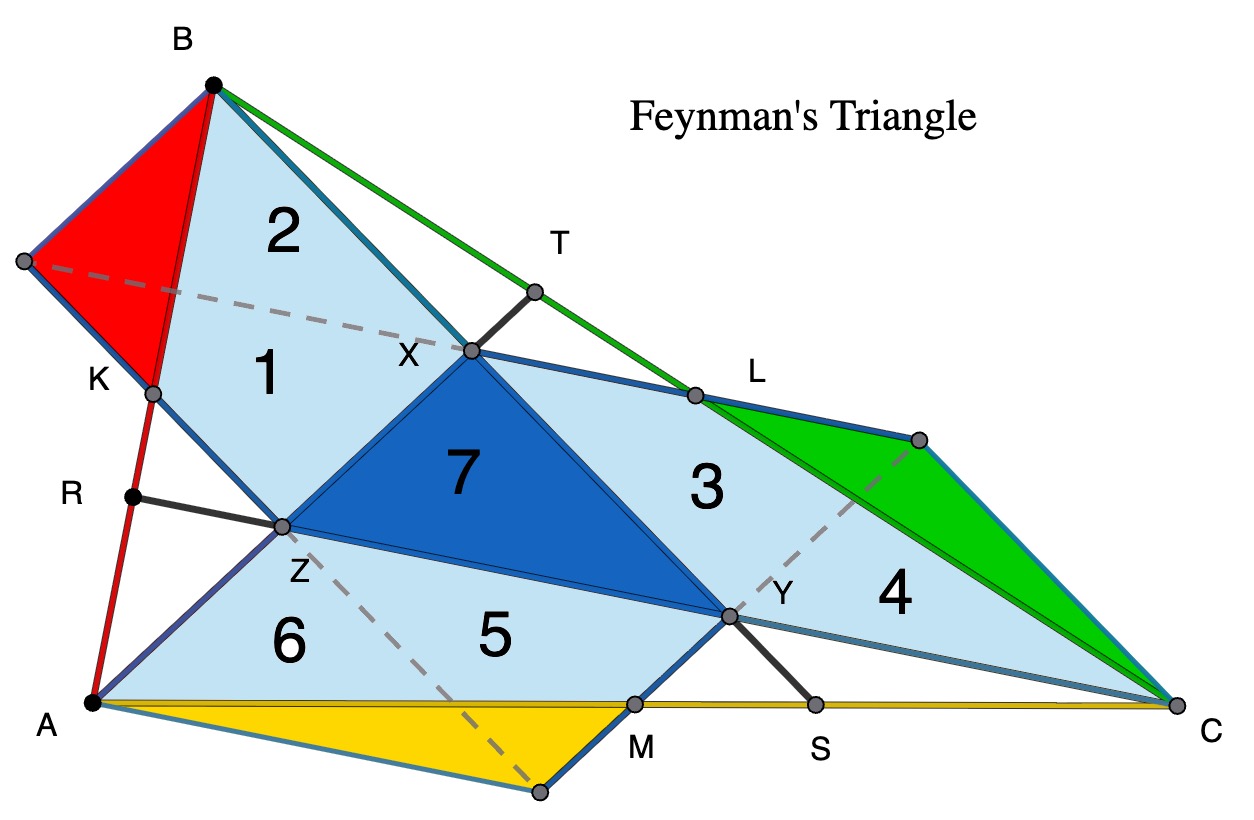 Figure 2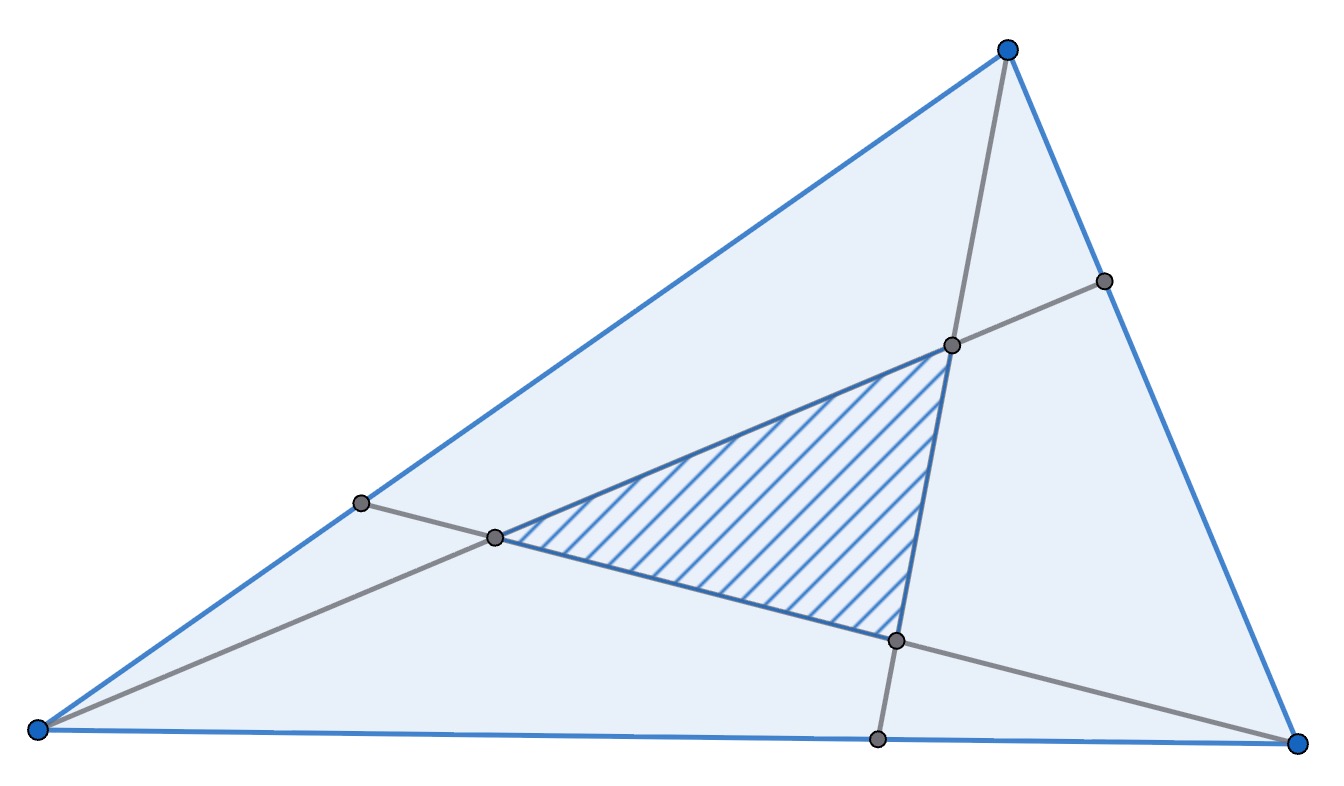
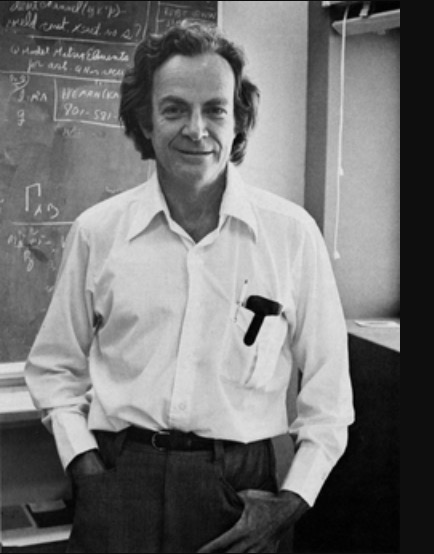 The story goes that the Nobel Prize winning physicist Richard Feynman was introduced to this theorem at a dinner following a talk he gave at Cornell University. Feynman was apparently disbelieving at first, and even sought to disprove it, because the combination of nu