I was playing around with GeoGebra tonight and stumbled across something really surprising.
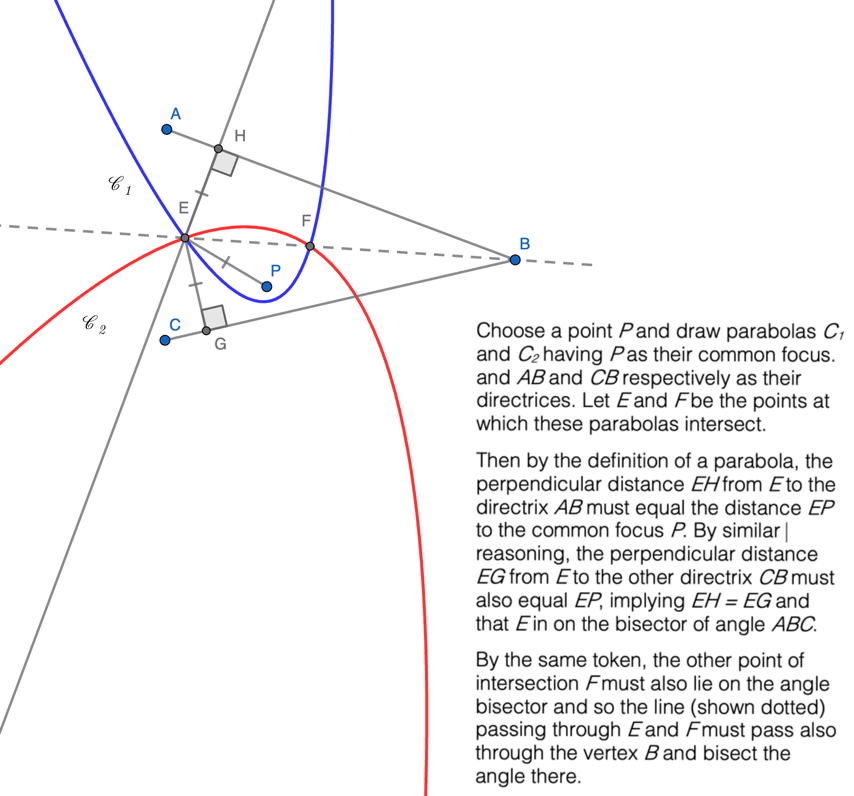
You probably drew some parabolas when you were in school, using coordinate geometry, but a parabola can also be defined in purely geometrical terms, without using coordinates. It is the set of points whose distance for a fixed point, called its focus, is the same as its perpendicular distance from a fixed line called its directrix. A parabola is defined as soon as you specify its focus and its directrix.
It occurred to me to wonder what would happen if we took a point in the interior of a triangle and drew three parabolas, taking this point as the common focus, but using each of the three sides of the triangle in turn as directrix.
So I tried this and I got a very interesting figure.
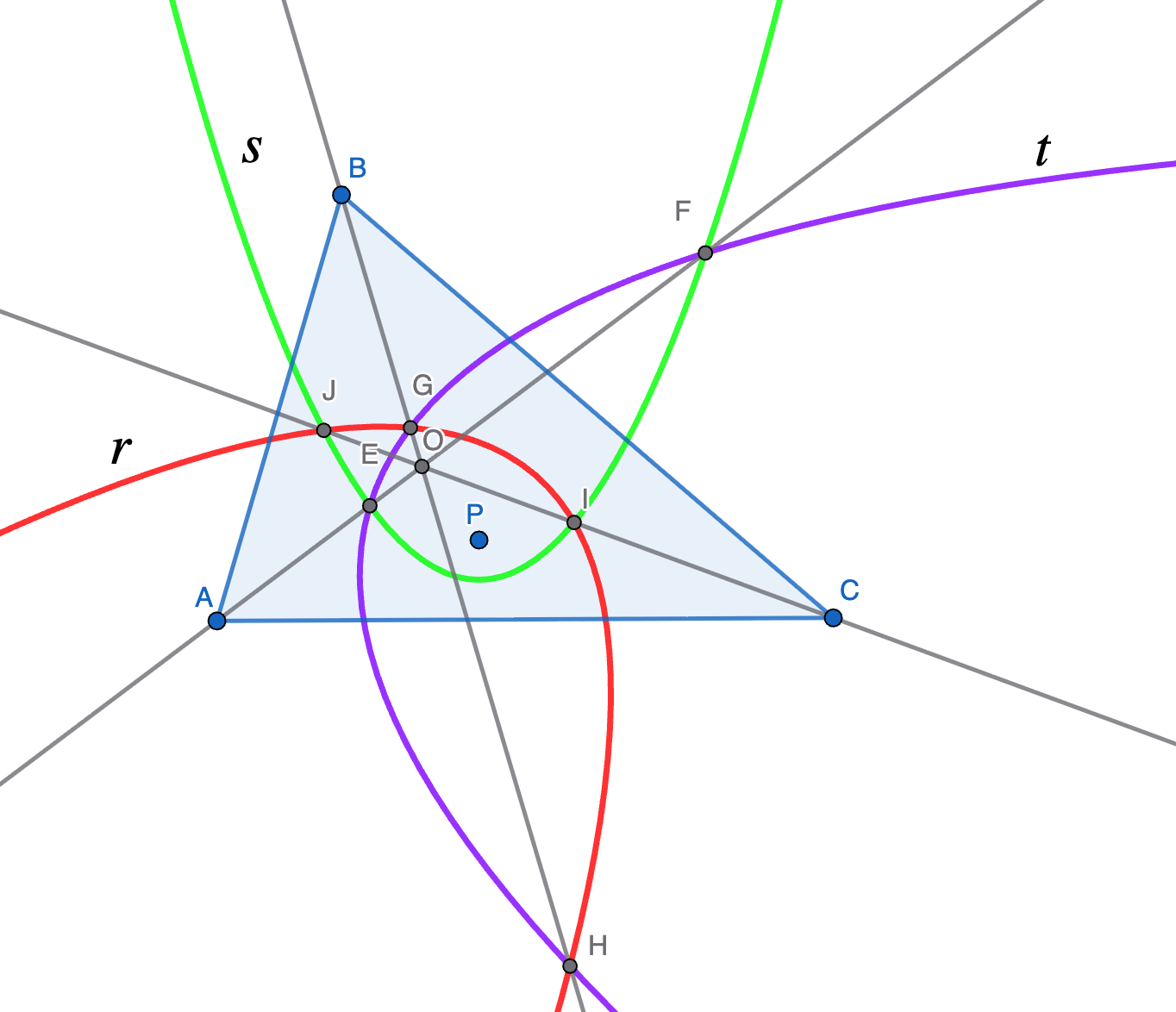
P is the common focus AB, BC, and CA the directrices, and I have labelled the parabolas r, s and t. Each pair of parabolas defines two crossing points: I and J, E and F, and G and F in the diagram.
Now for the surprises. If we draw lines through each of these three pairs, each line passes through a vertex of the triangle, and all three meet at the point I have labelled O.
This is surprising enough, but more surprising still these lines bisect the angles of the triangle/ It is well known that the angle bisectors of a triangle meet at a point called the incentre, because it is the centre of the unique circle, the incircle, inscribed in the triangle and tangent to its sides.
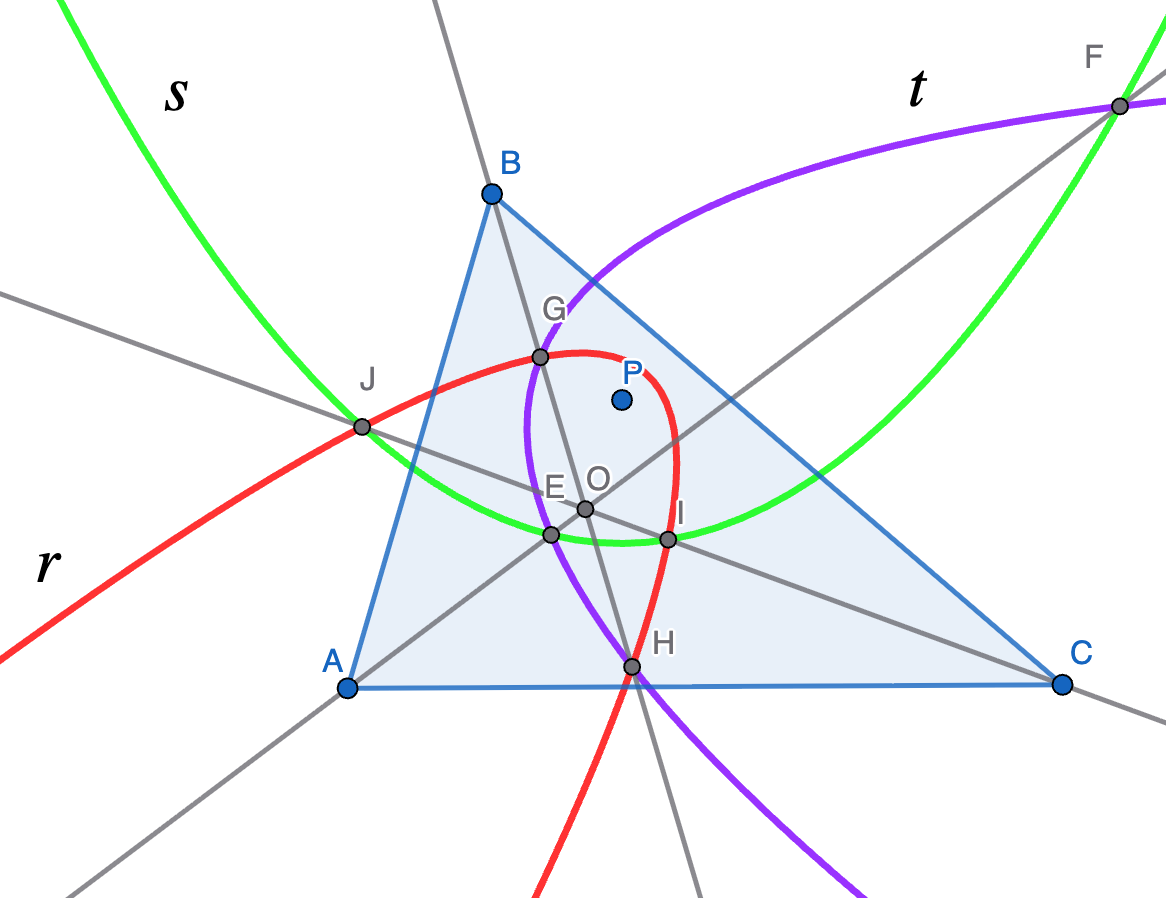
The point O is a fixed point of the triangle. which means the position of P, the common focus, makes no difference to the three lines. Moving P will change the parbolas, and hence the points at which the parabolas intersect, but the intersection points will always lie on the same three lines.
Here are a couple of examples where P is in different places.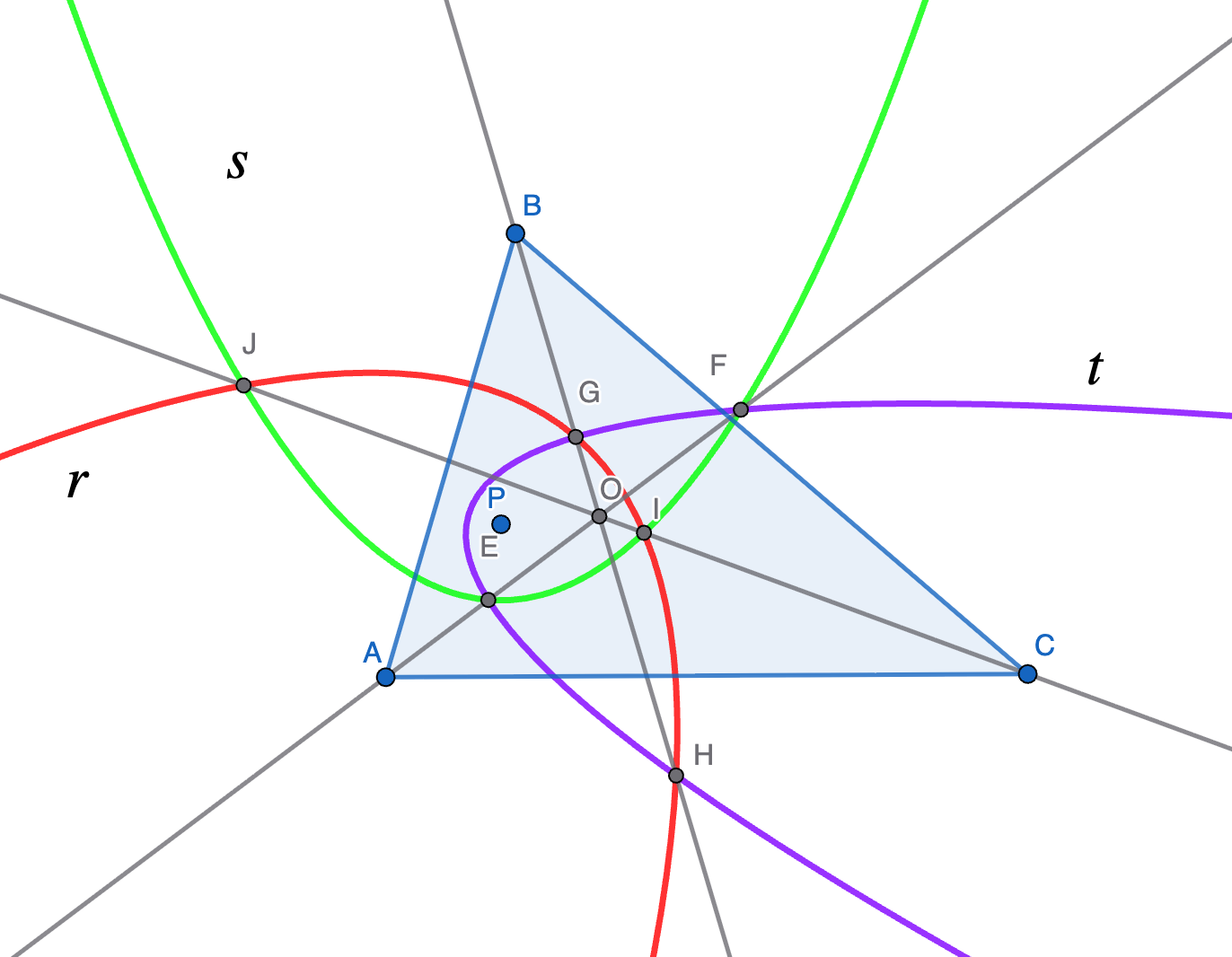
So that's what I discovere, I have no idea (yet) how to prove it, and it's about 99% likely thatit's a well-known result, but if not I shall claim it as Walker's Theorem.