OU blog

Personal Blogs

Stylised image of a figure dancing

Money for nothing

Visible to anyone in the world
Edited by Martin Cadwell, Saturday 16 May 2026 at 07:23

All my posts: https://learn1.open.ac.uk/mod/oublog/view.php?u=zw219551

or search for 'martin cadwell -caldwell' Take note of the position of the minus sign to eliminate caldwell returns or search for 'martin cadwell blog' in your browser.

I am not on YouTube or social media

silhouette of a female face in profile 

Helper or parasite

I thought of you and now I am richer

[ 5 minute read ]

For a couple of days I have been in a somewhat one-sided conversation with one of the local shop-keepers in the neighbouring village. I remarked that my young tomato plants are bigger than the ones he sells for the farmer next door to his shop. He, the shopkeeper, wanted to know what kind of tomato plants I have, 'Bush tomatoes?' I told him about the varieties I am growing. It turns out he wants vine tomatoes; specifically, he wants to have 'tomatoes on the vine', because he thinks they taste better than when they are not on the vine. I told him that tomatoes gain very little once the plant has decided to let them ripen and sealed them off at the node just before the stalk on the tomato and prevented nutrients in rest of the plant from reaching the fruit.

As they do, the shopkeepers suddenly vanish when another customer comes in and the next day he was replaced by his wife (also 'the' shopkeeper). I am used to that, so I just carried on as though they are the same person. 'It is likely that in the 1980s', I said, 'a buyer for M&S went to Italy on a tomato buying expedition and approached a farmer. It is faster, and better for the tomato, to cut the vine with the tomatoes on it than pick them individually, so when the buyer tasted the vine tomato variety, they were impressed with the flavour. Back home, they might have gushed, 'We simply must buy tomatoes on the vine; they taste wonderful.' When they should have said, 'Vine tomato varieties taste better than other tomatoes.' Since then, we, the housekeepers and home cooks and home sous-chefs, pay a premium for tomatoes that are picked in a fashion, not for flavour, but because it is logistically imperative to pick a crop quickly and efficiently without damaging the crop. One snip of a vine collects ten or more tomatoes in one go. Individual tomatoes are more expensive to pick and process than tomatoes left on the vine, I propose; not least because they are washed (note there are no stalks on the tomatoes). However, no stalks could also mean that those tomatoes were picked before they were ripe and the node above the stalk was not the 'break-off' point of the plant it should have been. In other words the tomato left the plant at the weakest point, the tomato/stalk junction. 'It ain't natural, I tell you.'

I needed to collect something from B&Q, the DIY superstore chain, but lack the appropriate transport, so I suggested trading some of my tomato plants with the shopkeeper in exchange for him picking up the item in the city. He was not keen and rinsed the conversation away with silence and reasons for not going to the city during weekends. Essentially, over the last few days he wanted to grow tomatoes on the vine but not if he had to put any effort into the project at any point in the process of attaining free tomatoes on the vine.

The shopkeeper in my own village has previously asked me to fix a bicycle for him. I freely did it and replaced one of the tyres with a slightly worn 'spare' tyre I had (no charge). Incidentally, because I use donor bicycles to keep two of my choice bicycles going I don't really have spare anything. Now, if I need a tyre it will cost me at least £20. I found it a bit curious that the shopkeeper asked me where to get some tyres for another bicycle he has. He has a SmartPhone so google it, I thought. No, that is not what he wanted. He said he would bring it in and I might take a look at it and then be able to help him. It transpires that he wanted me to give him tyres. I suspect that he had said to someone that he knows someone with tyres and he will give them a deal to have the tyres replaced. I, of course, would just be creating more future cost for myself while he reaped a financial reward. As it turns out, I have already given away all my 'spare' tyres to anyone who needed them.

A long time ago, I had a conversation with Sally, my next-door neighbour that revolved around her fetching a couple of baking trays / roasting dishes (Sunday Roast size) for me. I left  her some condiment for making salads on her doorste as a 'Thank you'; she had told me that she eats a lot of salads. I mentioned, in the following conversation, that the cost of Olive Oil prohibited me from including that in the gift package. I have always hated myself for not including it. This morning, I left a bottle of Filippo Berrio Extra Virgin Olive Oil on her door-step at 6:00 am.

Just as I was getting off my bicycle outside my home yesterday, a neighbour pulled up behind me in her car. 'Excuse me, have you got a moment?' I thought, 'Why are you being so formal?' It turns out that she wanted to thank me for letting her daughter ride my bike through a flood to save her feet and shoes from getting wet and muddy, about three months ago. She told me that her daughter was delighted with my chivalry and went about my bike being really big. My bicycle isn't big at all. It is really too small for me. She is about fifteen so she is not particularly small, and I had let the seat right down for her. Since then, this particular neighbour has been trying to thank me as I passed her house, but she said I cycle too fast for her to attract my attention in time.

I much prefer the last two interactions than the previous two. The shopkeepers for all their feigned community spirit are first and foremost money-gatherers.

Permalink Add your comment
Share post
Stylised image of a figure dancing

Looming Spirit

Visible to anyone in the world
Edited by Martin Cadwell, Thursday 7 May 2026 at 21:44

All my posts: https://learn1.open.ac.uk/mod/oublog/view.php?u=zw219551

or search for 'martin cadwell -caldwell' Take note of the position of the minus sign to eliminate caldwell returns or search for 'martin cadwell blog' in your browser.

I am not on YouTube or social media

silhouette of a female face in profile 

[ 6 minute read ]

Sleep without a parasite stealing energy

I haven't had a looming visit from my neighbour's spirit for a while now. He, the person, has been going out a lot more; his live-in carer, whom I think he regards as his girlfriend, has seemed to get him to experience more of the world beyond his own thoughts. He even took fishing tackle out of the boot of his car on May Day.

Whereas I could tell if he had stayed somewhere else overnight by the quality of sleep I had, I can no longer do this. Either he doesn't stare at me in bewilderment while I am asleep or he has grasped that he is not the only person in the world with any kind of meaningful existence and now understands why there is another person sleeping in a neighbouring home. That, of course does not qualify any suggestion that I have a meaningful life or that he does; it is merely to illustrate that I observe a possibility that he may have realised that people revolve around their own sphere of influence or chosen influencers; friends and family.

I once got becalmed with a broken engine on a small sailing boat and caught in a tide that drew me along the Essex coast towards the Thames and Medway estuaries. I had sailed the Essex coast from within the River Medway in Kent (Hoo St. Werburgh, I think). The engine had cut out just as I was leaving the Medway at Sheerness, and entering the Thames estuary to head for Southend seven miles north on the other side of the Thames estuary. The tide also changed just as I was leaving the Medway estuary and my little boat could not make way against both a headwind and the tide, no matter how hard I tried to tack or beat against them. In fact, even with a good wind the hull speed (maximum speed a boat can move at without being towed by a larger boat) was slower than the tide that day. I resigned myself to tying up against a concrete wall that probably served the power station at Gravesend (right where the Medway estuary met the Thames estuary). I had earlier chucked the anchor in alongside a muddy bank and took a viewing of aligned powerlines to later check to see if the boat was dragging its anchor (The anchor failing to hold the boat still). At 22:30hrs I checked one last time before I prepared myself to go to sleep. The powerlines were no longer aligned! The boat was dragging its anchor on a seriously high and rising tide. That is how I ended up tying up to a very large wooden beam next to the concrete dock for Gravesend Power Station. I am so lucky to have slept well during the weeks before I set sail at noon that day. If I was wiped out from lack of sleep I would have made many more mistakes. At that time though the mistakes I made were exclusively from foolishness and lack of experience.

All that night, a motor-boat went back and forth up and down the River Medway. Small boats don't require navigation lights and my old boat had none. I also had no other form of lighting onboard so the motor-boat crew had no idea I was there. They did not enquire why I was there and they did not throttle back when they passed, so their wash rocked my little sailing boat so much that the top of the mast kept hitting the concrete slab that was the dock wall. All night I had one hand on the mast and the other one being scraped and cut by the limpets and old shells stuck to the wall, to prevent damage to the mast; the only means I had to move in the morning. I had only just managed to secure to a huge wooden beam as I drifted past it otherwise I would have just carried on upstream until I hit something.

In the morning, about three or four hours later, dog-tired from no sleep whatsoever, I had to sail off the concrete wall with what is called a 'lee wind' which is an oncoming wind that blows you directly  onto the shore or against a dock or your moorings. This meant that I had to let go from the wooden beam holding me still while the tide was still coming in and was not too strong. I couldn't wait for the tide to change because my way was barred by a series of wooden beams rising from the river bed downstream and the ebbing tide in an hour or two would have sent me into the wooden beam I had tied to all night. Then, once I was again drifting, and only then, could I rig the sails to be able to sail upstream, across the wind, to get enough steerage (speed to make the rudder useful) to complete a 135 degree turn into the wind to immediately start tacking across the wind and slack tide. Fortunately, I managed to do it just before I hit another huge wooden beam sticking up out of the river. The tip of my mast was just about 20 centimetres from hitting hit it as I made the turn. Despite being shattered from lack of sleep I was scared enough to be alert.

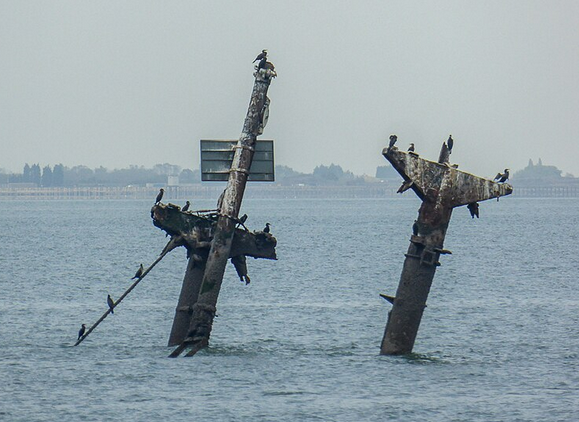
I made Southend a couple of hours later; but not before drawing long stares from other sailing crews who were wondering why I was sailing so close to the World War Two sunken (1944) 'Liberty' ship, the SS Richard Montgomery, still with volatile explosives on it. It is so dangerous that salvage and make-safe divers have never been close to it except for a plan to remove the masts, still visible above the waves, in case the masts fall down and set off the 1,400 tonnes of explosives supposedly still on it. Plans have been to wait for the containers holding the explosives to leak and the explosives to wash away, but no-one knows if the explosives are still there or not. Now (very recently) there is concern that a number of 'metallic' objects have been detected around the sunken hull.
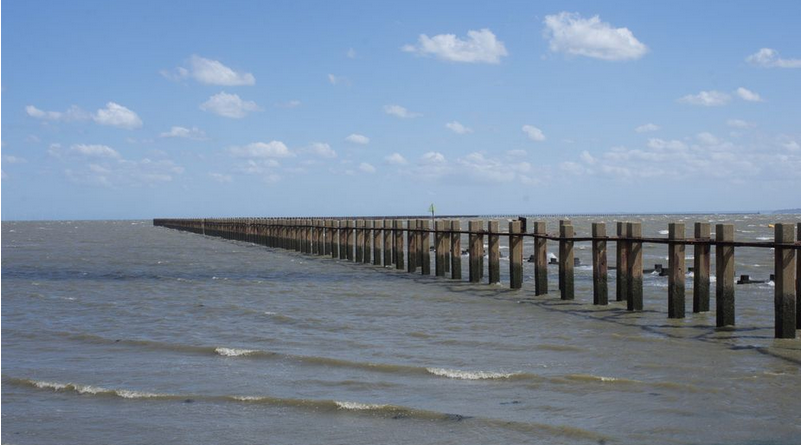
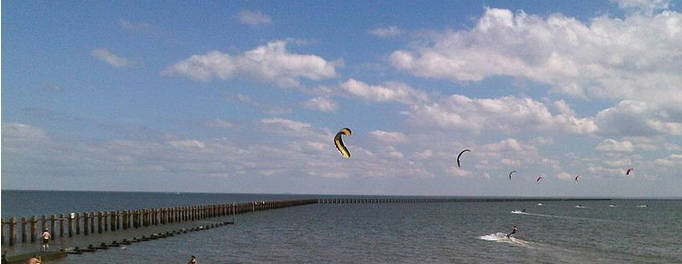
It was a few days later that I was becalmed (no wind to drive my sails) off the Essex coast on a speedy tide, still with a broken engine and heading for the concrete piles that is the World War Two sea defence, the Shoeburyness Boom, also known as the Thames Boom, off the Essex coast (Maplin Sands to be precise). It was built to prevent WWII German shipping and submarines and later 1960s Russian vessels, entering the River Thames and it, still sticking out over 2km and marking the edge of MOD testing ground both on land and the estuary, was about to wreck my tiny boat. The boom in the image above jinks right and if you look carefully you can see it, above half of the closest part, as a dark line on the horizon. You can see the scale of it from the image below. It is only part of the same defences that crossed the entire 7 miles of the Thames estuary.
Mayday, the international distress call for air and sea is actually French; 'm'aidez' or 'help me'. After calmly phoning the coastguard and alerting them that I was becalmed and drifting on a rising tide into the Thames estuary from north of the Shoeburyness Boom, and telling them I needed a tow, I phoned again after discovering that I had switched my phone off. I had watched other sailing boats moving two or three miles further out and none had come to help me. Now, tired from another night of dragging my anchor in the River Crouch estuary further north, I recognised that no matter how brave I was or how clever I might be, I was never going to avoid the disaster of hitting the Shoeburyness Boom at speed. Surviving the impact and piles rising from the sea-bed leant heavily towards improbable. I am not talking a gentle drifting here; I am talking swirling water around raised sandbars as I passed them only tens of feet away. I am talking about two metres a second. Time for some maths: 120 metres a minute or about 7 kph (just under 4 knots) or just over 4mph. When something made of plywood that weighs 900kg, with its heavy keel, hits an immovable body at these speeds (remember the boom was made to stop submarines and warships) there is going to be only one result; shipwreck. What makes it worse is that the Boom has a second one right next to it; covered in sharp shells.

     'Mayday. Mayday. Mayday.' It was inevitable really. The RNLI arrived with a mini-hovercraft and a high-powered Rigid Inflatable Boat (RIB) and the RIB towed me back to Southend. The awful thing is, I could have chucked the anchor in and delayed the inevitable, and waited for a slight breeze to sail around the Boom. I was tired and scared; I panicked.

Now that my neighbour has stopped scaring all the creatures, visible and invisible around and in our homes, and I am not woken by my protective avatar, I sleep so well that I can see hope in my life again. Whether he was parasitically feeding off my energy or just aimlessly looming in limbo, I don't really know. My brother used to steal my energy, as a narcissistic psychopath, so I am inclined to consider theft as the cause for my miserable few years (since he moved in in August 2020). My home is now clean and maintained and I sleep well again.

Image of the sunken SS Richard Montgomery at high tide:

The image has been cropped by the author, Martin Cadwell. The background horizon has been reduced with no foreground or middle-ground objects or persons missing.

Wreck of the SS Richard Montgomery, off Sheerness by Christine Matthews, CC BY-SA 2.0 <https://creativecommons.org/licenses/by-sa/2.0>;, via Wikimedia Commons

https://commons.wikimedia.org/wiki/File:Wreck_of_the_SS_Richard_Montgomery,_off_Sheerness_-_geograph.org.uk_-_4195096.jpg

re-use conditions

https://commons.wikimedia.org/wiki/Commons:Reusing_content_outside_Wikimedia

link to the licence

https://creativecommons.org/licenses/by-sa/2.0/deed.en

Images of the Shoeburyness Boom: Amusing Planet

https://www.amusingplanet.com › 2021 › 01 › shoeburyness-boom-cold-war-era-defense.html

First image of the Shoeburyness Boom:

Julian Osley (photo) in an article by Kaushik Patowary,  Jan 28, 2021. Accessed 07 May 2026

Second image of the Shoeburyness Boom:

'East Beach in Shoeburyness', Essex. Photo: Romazur/Wikimedia Commons in an article by Kaushik Patowary ,  Jan 28, 2021. Accessed 07 May 2026

re-use conditions for Wikimedia Commons

https://commons.wikimedia.org/wiki/Commons:Reusing_content_outside_Wikimedia

link to the licence

https://creativecommons.org/licenses/by-sa/2.0/deed.en


Permalink Add your comment
Share post
Stylised image of a figure dancing

Milk me

Visible to anyone in the world
Edited by Martin Cadwell, Friday 1 May 2026 at 20:04

All my posts: https://learn1.open.ac.uk/mod/oublog/view.php?u=zw219551

or search for 'martin cadwell -caldwell' Take note of the position of the minus sign to eliminate caldwell returns or search for 'martin cadwell blog' in your browser.

I am not on YouTube or social media

silhouette of a female face in profile 


[ 6 minute read ]

Parasite or milking Farmer?

It doesn't seem very long ago that I had a strong standpoint on promoting oneself. (I was about to continue the sentence with 'in public' because the sentence, to me feels incomplete, but it isn't). Social protocol and introductory salutations were always a problem for me; do we say what we do, or are good at or not?

     'Hello. Pleased to meet you. I am a doctor in Physics'

     'Oh, yes. Hello. I am a plumber.'

     'Ah. Interesting. Do you work locally?' (No doubt I shall have use of a local plumber one day)

     'Yes, I live around here.  (I doubt you can help me with anything).

There is an imbalance. The physicist is useful, but not directly to their community. The plumber, on the other hand, is eminently useful. I am in complete agreement with myself in thinking that all tradespeople should promote themselves and be proud of what they do. They are builders, while many other people are merely hangers-on; but not to the coat-tails of the tradespeople or fabricators of society.

I think in West Germany strangers when they met would introduce themselves by name and profession. I may be wrong. It may have been a twee idea I read in a picture book on learning German. You know how some of the phrases are stilted. In truth, when I worked in Germany, I never met anyone who told me what they did. There is a part of me that wouldn't mind if people in the UK did state their job as part of their introduction. Fat lot of chance of that happening; I have had conversations with strangers for over an hour and not even learnt their name. Asking someone's name is like asking for someone else's telephone number if you are attracted to them. It means I hope we meet again. It no longer means, if we meet again I should be pleased to be polite and use your name.

Consider this:

     'You, yes, you, take my bag, would you?'

     'Yes, Guv.'

And this:

     'Hello again, I believe we met some time ago.' (You were so insignificant to me I didn't bother offering my name to you, or accord you any civility in asking you yours.)

The latter greeting is no more polite than the former. But why? In both cases the initiator is in need of something, physical labour in the first, and mental stimulation in the second. An attitude of greater-than-thou, or mightier in some way, is clearly evident because names are not considered to be important and so there is no personal approach. In both cases the meeting has an element of parasitism. We are all parasites in many respects. I can heat my home because someone else has done some work and thinking in the past. But that is a result of people specialising in a job role, and is indicative of a former meritocracy. Someone, long ago, in the dark Winter nights, when no more fieldwork could be done due to the darkness, made an extra pair of boots by candlelight, and their neighbour liked them, and because they were better made then anyone else made in their community, bartered for those boots. Blacksmith, thatcher, cobbler, they all arose through meritocracy.

Do we expect that the tanner in the same village would give away the best pieces of leather to the cobbler, so the whole community could wear good boots? Did the blacksmith shoe horses and forge iron for nothing so the village could thrive; so farmers could get to markets, and tools could always be on hand? 

No, that is communism or, more kindly, altruism, and thriving would only mean self-sufficiency, because if it means thriving in a competitive market there is going to be a metric of some kind, and I strongly suspect it would be in the form of banking; either a harvest, storing fat on the body, or a universal currency; money.

     'It takes a village to raise a child!' Yes, the hunter teaches basic rabbit-skinning skills; the farmer teaches basic food production skills and how to predict weather; and the potter teaches basic clay manipulation skills (removing air pockets before firing).

Modern life in 2026 has the internet and YouTube videos to teach us those basic skills albeit in a classroom and not 'in the field'. When someone introduces themselves as a teacher of young people what should we do? Give them all the knowledge we have despite the possession of that knowledge being the only thing that makes us worthy of a wage? Despite having spent years honing our skills and distilling information down to useful and pithy tips, we should give it away to teachers? Schoolteachers today are paid the same universal currency that we all are. If we could see into the future and see the financial damage we might do to ourselves if we give away material that should have been copyrighted, would we, when we meet a schoolteacher suddenly clam up about what we do? Are schoolteachers parasites that will take knowledge from people they meet and sell it to someone else, albeit with the payment coming indirectly? Those questions, I feel, are a clapper on a cracked bell for many people. They are discordant and terrifying.

     'Hello. My name is Martin. I am writing a book on inventions that have not yet been constructed or implemented. The book has a section on good ideas too.'

     'Hello. I am an inventor. I have some ideas and inventions that no-one has heard about. Would you like me to tell you about them?'

     'Oooo, yes please!'

     'Will you get some kind of reward, money, fame, or something when you publish your book?'

    'Well, yes, I will be considered by my professional community to be eminently useful and I shall make some money.'

     'What will I get?'

     'You will have helped society, of course. It takes a village to raise a child, you know?'

     'Do you consider yourself to be a milker or a parasite?'

     'Good day to you. I feel an important appointment is looming elsewhere.'

     'Well, that is what happens if you moo a lot. You should expect to be milked.'

Like I said, many philosophers state that altruism only exists when it comes to raising our own children. Sacrifice, that is.

If a schoolteacher DOES NOT reveal that they are a schoolteacher, are they being deliberately false, because they intend to parasitically milk information from unsuspecting others and use it for their own advancement?

It is only a thought-experiment that has no resolution in my mind today. It is however, a child of considering cyber-security and fraud.

Permalink Add your comment
Share post

This blog might contain posts that are only visible to logged-in users, or where only logged-in users can comment. If you have an account on the system, please log in for full access.

Total visits to this blog: 504007