OU blog

Personal Blogs

Richard Walker

'The Bonny Rowan Tree' - Why do we call it 'Rowan'?

Visible to anyone in the world

A friend has a rowan tree, also called the mountain ash, in her garden, which set me wondering (a) if I could get hold of some rowanberry jelly, just to try; and (b) where name rowan comes from.
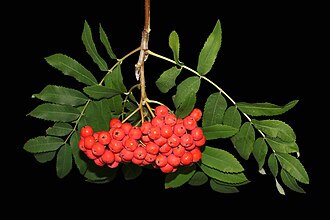
The answer to (a) is no, unless I make myself or pay an exorbitant delivery charge. The answer to (b) is that it's probably named for the bright red colour of its berries. The immediate origin seems to be Scandinavian (the Swedish is rönn) but there is a suggestion that it may go back ro the Proto-Indo-European root *ruidh-, 'red'.

This is the PIE colour word we are most confident of, because words that can be traced back to it, with meanings related to 'redness', are found in so many branches of the Indo-European language family. Some examples are English ruddy, Sanskrit rudhira, Polish rudy, Welsh rhudd, Lithuanian raudona, Latin rufus, Greek erythros.

Other English cognates include red, of course; rust, russet, rouge, roan and ruby. A particularly interesting one is ruddock - Britain's favourite bird, known today as the robin, but called in Old English rudduc, 'little red'. Here's a later example I found in the Middle English Compendium (sote = 'sweet' and the two thrushes are the song and the missel.)

How sote this seson is..The thrustelis & the thrusshis..The ruddok & the Goldfynch. 

Picture credit: George Chernilevsky, Vinnytsia, Ukraine, Rowan Berries, on Wikimedia, Licensed under Creative Commons.

Permalink
Share post
Richard Walker

The colour of magic?

Visible to anyone in the world

Researchers have revived an idea and a question that has been asked before, probably many times.

Can we see new colours?

For example Terry Pratchett's first DiscWorld introduced an eighth rainbow colour octarine, a 'fluorescent greenish-yellow-purple'.

It seems the answer is yes!

The question is not whether our eyes might somehow respond to ultra-violet, like a bee's, or have more types of colour receptor, like some fishes have.

It's concerned with a vivid subjective experience of a 'new' colour, what I think philosophers would call qualia. Qualia are hard to derive just as a consequence of the objective facts (thus knowing the wavelength of light may show that it is red but does not explain its redness, the experience).

The new colours that people can be induced to experience are reddish-green and bluish-yellow.  Scientific American for January 2010 reports these experiments, which improve on ones done many years ago but not fully appreciated at the time.

But all the same these experiences are dependent on the physical properies of the brain, it seems.  So are they true qualia?

Permalink 1 comment (latest comment by William John, Tuesday 19 January 2010 at 20:35)
Share post

This blog might contain posts that are only visible to logged-in users, or where only logged-in users can comment. If you have an account on the system, please log in for full access.

Total visits to this blog: 6228560