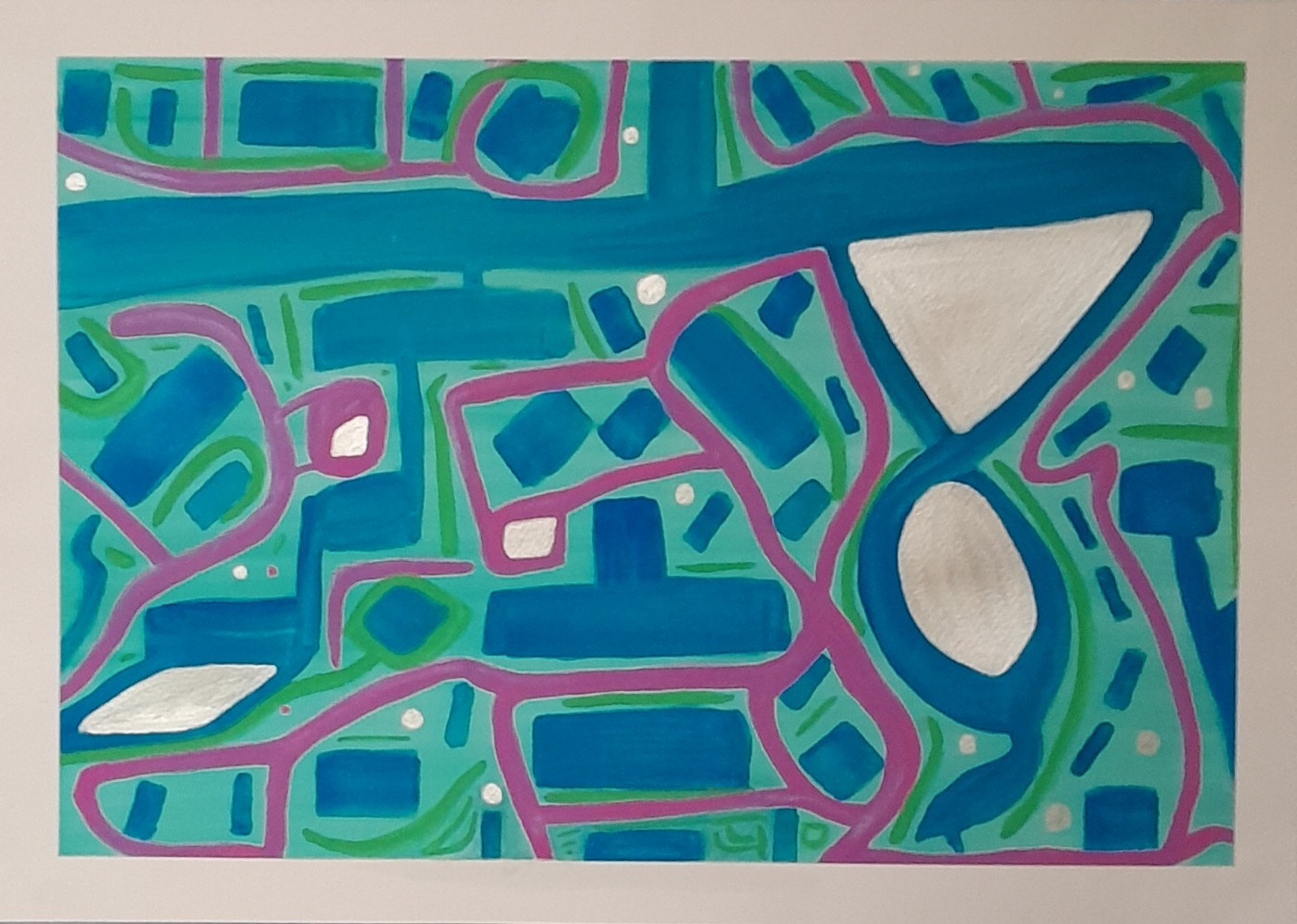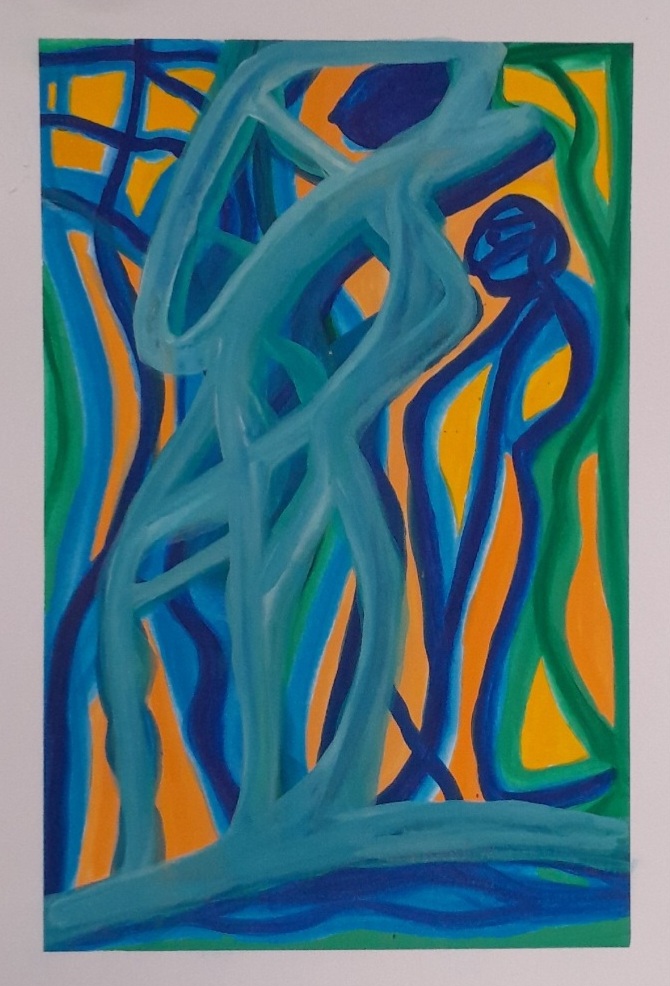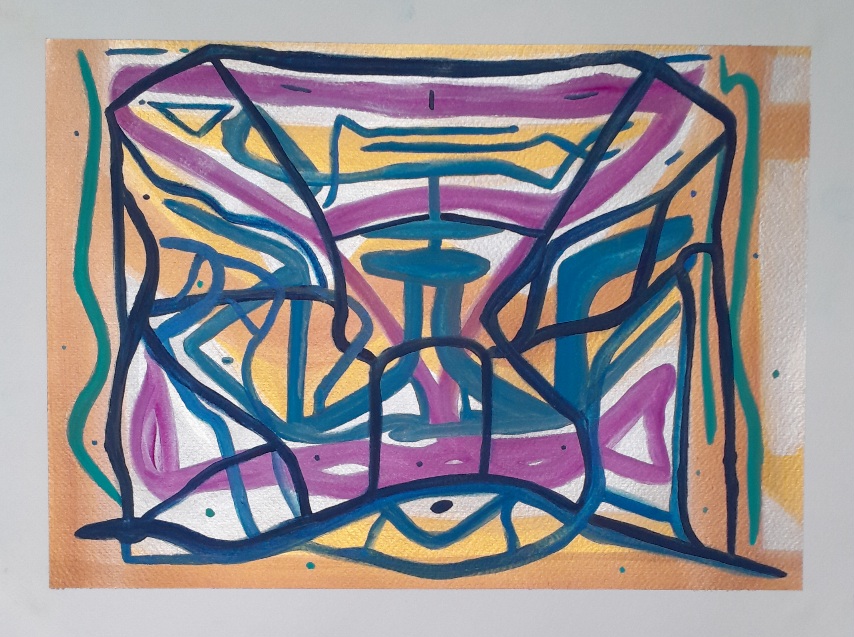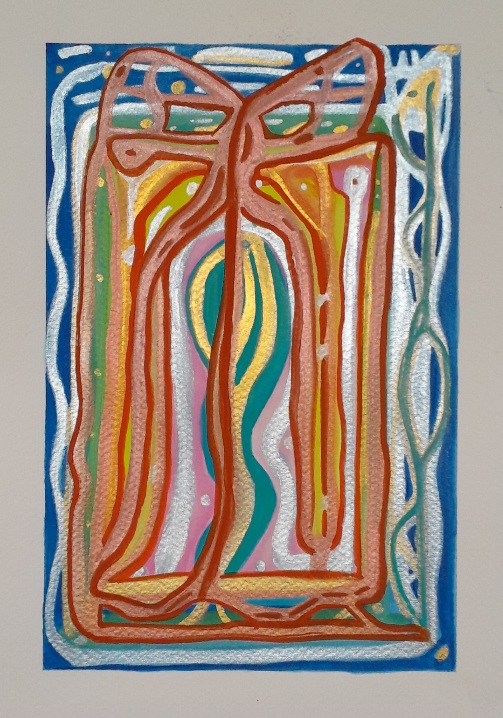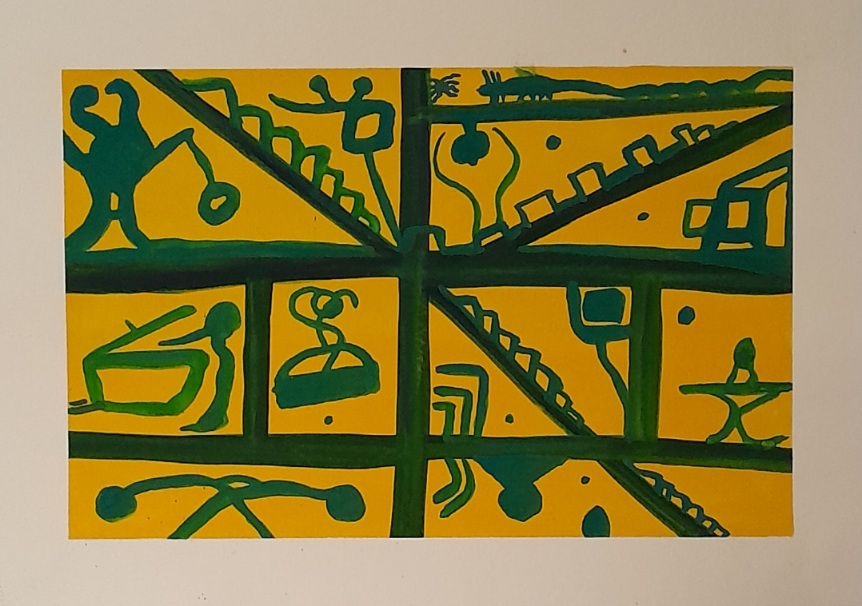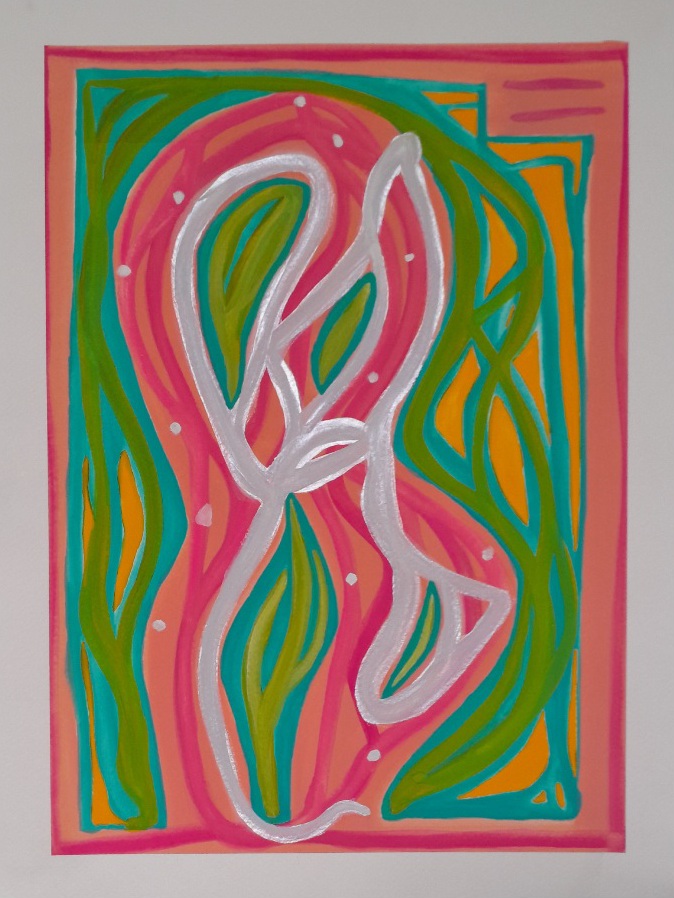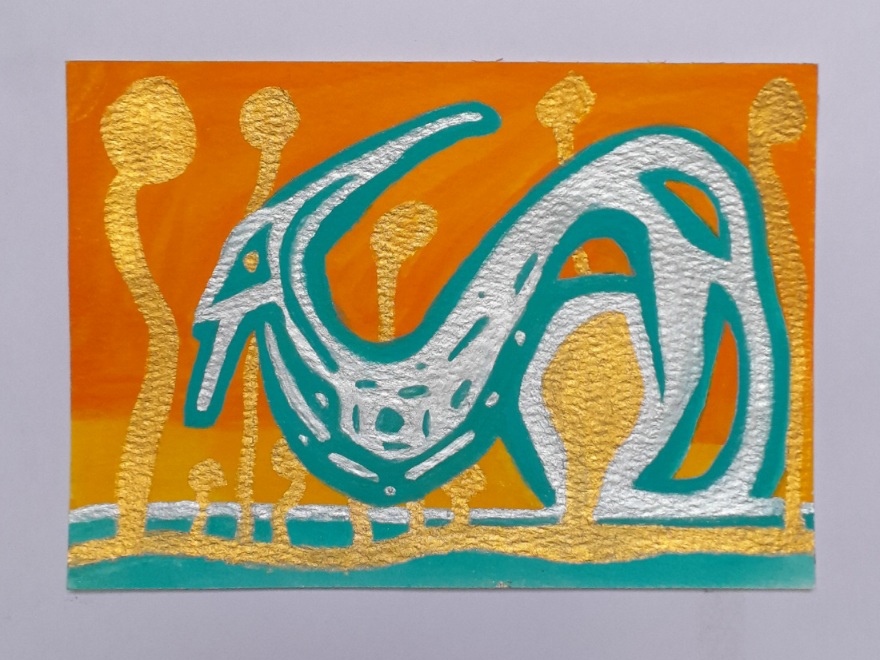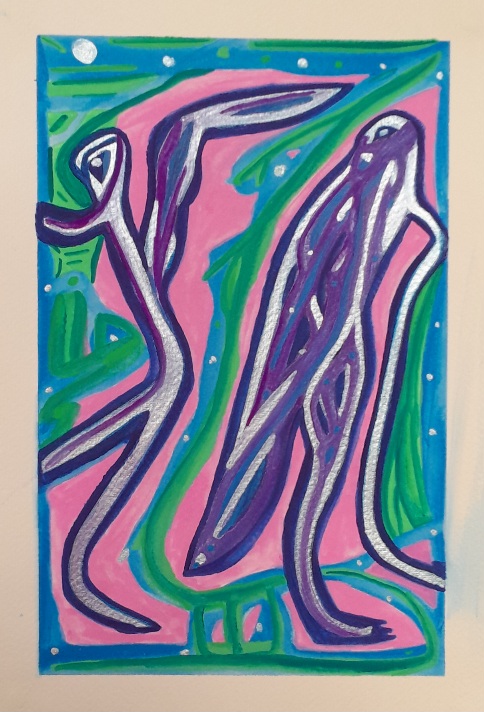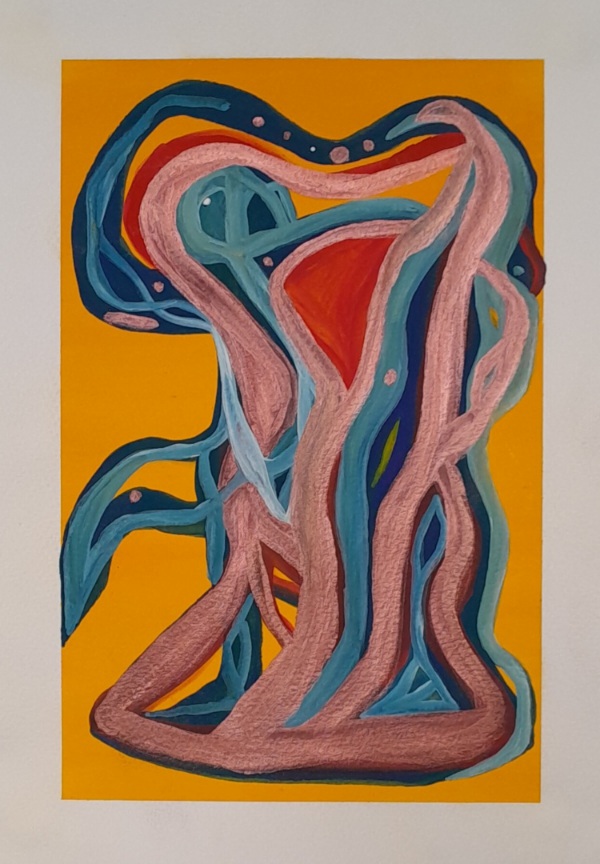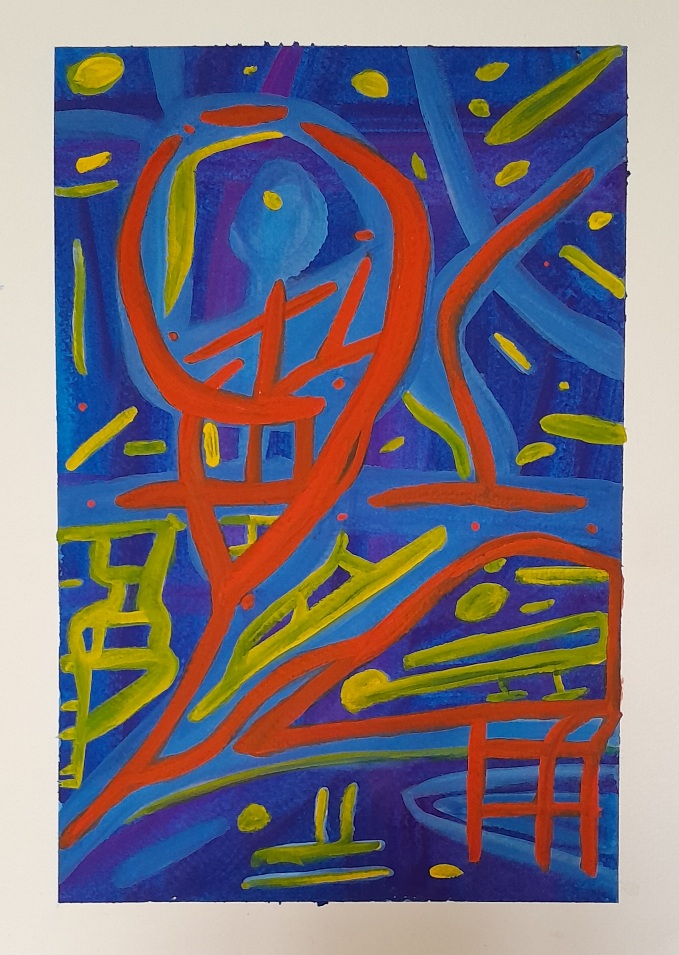
Mixed media on canvas (30×40cm)

Mixed media on canvas (30×40cm)
peace and love
May you all be safe, well, serene, and happy!
'This is the direct path for the purification of beings. For the overcoming of sorrow and lamentation. The disappearance of pain and grief. And the realisation of nibanna.
Namely the four foundations of mindfulness.' - the Buddha
Foundation number one: Mindfulness of the body
Foundation number two: Mindfulness of feelings
1. Mindfulness of pleasant feelings, mindfulness of neutral feelings, mindfulness of unpleasant feelings. Awareness of them both within oneself and within others.
2. Mindfulness of pleasant wordly feelings, neutral worldly feelings, unpleasant wordly feelings. Both within oneself and within others. I find contemplation of the eight worldly winds can be helpful here:
pain and pleasure,
gain and loss,
success and failure,
praise and blame.
3. Mindfulness of pleasant spiritual feelings, neutral spiritual feelings, and unpleasant spiritual feelings. Both within oneself and others. This is to do with the spiritual path and its fruits.
Awareness of the rising, flowing, and fading away of feelings.
Foundation number three: Mindfulness of the mind
Knowing when the mind is:
Greedy or not
Lustful or not
Angry or not
Hateful or not
Conceited or not
Selfish or not
Deluded or not
Confused or clear
Collected or scattered
Expansive or contracted
Developed or undeveloped
Meditating or not
In samhadi or not
Liberated or not
Awareness of the rising, flowing, and disappearance of these states of mind.
Foundation number four: Mindfulness of dhammas
1. The five hindrances to samhadi:
1. Longing, 2. aversion, 3. stagnation, 4. agitation, 5. doubt.
Awareness of the manifestation, origination, and disappearance of the five hindrances.
'And when one knows that these five hindrances have left the mind. Gladness arises, and from gladness comes delight, from delight one's body becomes tranquil, and with a tranquil body one feels happy.
And with happiness one's mind easily enters samhadi. And being thus detached from unwholesome states of mind one enters and remains in the first jhana...' - the Buddha (D. 2:75)
2. The five aggregates of clinging:
Identifying with the body.
Identifying with feelings.
Identifying with perceptions and memory.
Identifying with mental formations.
Identifying with consciousness.
Awareness of the manifestation, arising, and dissolution of the five aggregates of clinging.
3. The six external and six internal sense bases:
1. Eye and visual objects.
2. Ear and sounds.
3. Nose and smells.
4. Tongue and tastes.
5. Body and tangible objects.
6. Mind and mental objects.
Knowledge of them, of their arising, and the letting go of them. And through not clinging to them, the future non-arising of the fetters that originate dependent on both.
4. The seven factors of enlightenment:
Mindfulness -> Investigation of dhammas -> Energy (right effort) -> Joy -> Calm (serenity) -> Samhadi (deep stillness) -> Equanimity.
Knowledge of their presence, their arising, and their development.
5. The four noble truths
1. Knowledge of suffering (which is to be understood)
Old age, sickness and death is suffering.
Separation from those we love is suffering.
Identifying with the body, feelings, perceptions, memories, thoughts, ideas, moods/emotions, and consciousness is suffering.
Feeling regret and remorse for past actions is suffering.
Not getting what one wants is suffering.
Depression and fatigue is suffering.
Taking things personally is suffering.
and so on...
In short, clinging to and identifying with changing (impermanent) phenomena that is outside our control, is suffering. We are all fated to become separated from what we love and hold dear. None of us have the power to stop that. Everything is transient.
2. Knowledge of the cause of suffering (which is to be abandoned)
The three aspects of craving are the cause of suffering. The Buddha describes them as:
1. craving for sense-pleasures (kama-tanha), which feeds the defilement of greed.
2. craving for non-existence (vibhava-tanha), wishing for things to be different, wishing for something not to be, not to exist. This feeds the defilement of hate or aversion.
3. craving for existence (bhava-tanha). Feeds the defilement of delusion.
(N.b. Tanha is a Pali word often translated as either craving, thirst or desire.)
(N.b. II - The five links at the centre of dependent origination can be helpful to keep in mind here: .. sense impressions -> feelings -> craving -> clinging/identifying -> becoming ...)
When one has seen the sign of anicca (change and impermanence) at a deep level. It is hard to un-see it. It has a profound change on one. Wherever one looks, one sees the transient nature of things, and starts to naturally become disillusioned with materiality; and not as caught up by the things of the world anymore. One sees through it. Sometimes from bitter painful experience, by making poor choices and having to live with the results, which is part of learning too. Don't beat yourself up for that, we all do it. We all make mistakes. Sometimes we learn our greatest lessons from failure.
As one gets less ignorant and wises up, one stops clinging to things, realising it is changing phenomena that is outside one's control. And then the craving starts to fade.
And with non-attachment, letting things be, letting them go, cessation occurs.
3. Knowledge of the end of suffering (which is to be realised)
Lasting peace of mind and contentment. Freedom from suffering. The realisation of nibanna, the deathless. The happiness of no longer being driven around and harassed by the defilements: greed, aversion, and delusion. This stopping, this ceasing of tanha brings relief, and frees the mind of stress and sorrow.
The mind in its un-harassed original state is luminous, radiant like the sun coming out from the behind the clouds. (The clouds in this metaphor being greed, hate, and delusion.)
4. Knowledge of the way that leads to the end of suffering (Which is to be developed)
This is the noble eightfold path. The way that leads to the cessation of suffering. All the path factors are important. Leaving any of them out is like leaving out an important component of a motor vehicle, it won't start or be able to reach its destination if any are missing. All these parts need to work together in harmony.
1. Right view: in brief, mundane right view is knowing that good karma comes from thoughts, words, and actions of giving, kindness, and clear-seeing.
And bad karma comes from thoughts, words, and actions of greed, hate, and delusion.
Supra-mundane right view is the four noble truths. It's called supramundane because it is what leads to the four classical stages of enlightenment.
2. Right intention: Non ill-will, non-greed, non-cruelty. (The practise and cultivation of the brahma-viharas (The sublime abidings) is helpful here.)
3. Right speech: to speak truthfully, to avoid malicious and divisive speech, to refrain from harsh unkind speech, and to refrain from idle pointless speech.
4. Right action: To refrain from taking the life of any living creature. To refrain from taking that which is not given. To refrain from sexual misconduct.
5. Right livelihood: Having abandoned wrong livelihood. One continues to make one's living with right livelihood. This is an occupation or lifestyle that does not cause harm to one self or others.
6. Right effort:
In the words of the Buddha:
1. One generates the desire for the prevention of unwholesome states of mind by making effort, rousing energy, exerting one's mind, and striving.
2. One generates the desire for the abandonment of unwholesome states of mind by making effort, rousing energy, exerting one's mind, and striving.
3. One generates the desire for the arising of wholesome states of mind. By making effort, rousing energy, exerting one's mind, and striving.
4. One generates the desire for the continuance, non-disappearance, strengthening, increase, and full development of wholesome states of mind. By making effort, rousing energy, exerting one's mind and striving.
Right effort is also about tuning the energy of effort and attention so it is niether too tight, nor too loose. One has to experiment and find a sweet spot that works just right. It is like tuning a musical instrument, when you get it in tune it makes sweet music and there is progress and flow.
7. Right mindfulness:
This is the four foundations of mindfulness.
Having removed longing and dejection in regard to the world.
1. One abides contemplating the body as a body, ardent, clearly-comprehending (knowing), and mindful.
2. One abides contemplating feelings as feelings, ardent, clearly-comprehending, and mindful.
3. One abides contemplating mind, as mind, ardent, clearly-comprehending and mindful.
4. One abides contemplating dhammas as dhammas. Ardent, clearly-comprehending and mindful.
8. Right samhadi:
This is defined by the Buddha as the four jhanas. Four deep states of meditative absorption. The joy and pleasure described in the verses is a whole body experience. It is the feeling of the inner body.
1. First jhana: Quite secluded from the world, secluded from unwholesome states of mind (the five hindrances). One enters and remains in the first jhana. Which is accompanied by applied and sustained thought (or attention). And has the joy and pleasure born of seclusion (from the five hindrances).
(There is a bit of a wobble in the first jhana, as one keeps applying and sustaining attention to the meditation object. But after a time there comes a point when the attention becomes stable and centred with the object, then it becomes effortless. One can let go of the applied and sustained attention then, take off the stabilizers and just flow with the momentum as a mindful passenger. Mindfulness is what leads to the jhanas and remains present throughout them all.)
2. Second jhana: With the subsiding of applied and sustained thought. One enters and abides in the second jhana. Which is accompanied by self-confidence and unification of mind (deep composure). Is without applied and sustained thought and has the joy and pleasure born of samhadi.
3. Third jhana: With the fading away of joy. One abides in equanimity. And mindful, clearly-comprehending, still feeling pleasure in the body. One enters and abides in the third jhana. On account of which the nobles one say: 'One has a pleasant abiding, who has equanimity and is mindful.
4. Fourth jhana: With the dissolving of pain and pleasure, and the previous disappearance of sadness and joy. One enters and abides in the fourth jhana. Which has neither pleasure nor pain. And has mindfulness purified and born of equanimity.
Hopefully I haven't got any of that wrong. I am going from memory. This is something I chant to myself every now and then to remember the practise, it is an evolving chant, that changes and grows as I learn more.
But I find it helpful to go over what I have learnt like this. It can also help bring some faith, courage, energy and determination when I feel disheartened, or lack the motivation to practise.
After some lengthy chanting like this, it can feel easier to settle into meditation. It is a bit like sweeping the floor of the mind to make it more inclined towards samhadi.

Prints of this painting are available from here.
May all beings be safe, well, peaceful and happy (-:
We etch patterns
On the island shores
Of one another’s minds.
And here, on this island far away
I see you sorrow
Hold you in my heart.
And in my mind,
With warm karuna
I reach out across the land
Across the great sea.
To hold your hand.
Reach out
Like a gentle breeze
To lift you up.
May you feel supported.
May you never feel alone.
May the devas, the angels protect you
And always keep you safe.
May you feel loved.
Comforted
At ease.
May your heart be filled with a golden peace.
And may this metta wave
sweep away
all your sorrow and grief.
– Asoka
…
Learning that meditation is a mix of samhadi and insight, they are not really separate practises, but part of the same practise. Two sides of the same coin. A lucid serenity.
Sometimes the mind is in the deep stillness and peace of samhadi, and sometimes it is investigating, learning, knowing, clearly-seeing, comprehending. They work together to purify the mind.
I remember hearing in a dhamma talk that the Buddha said samatha (serenity) and vipassana (clear-seeing) are the two trusted messengers to admit into the city of consciousness. But there are also five trouble-makers to keep out of the city. These are: greed, ill-will, stagnation, agitation, and doubt. If those get into consciousness, it will become disturbed.
So one keeps out the five hindrances. And welcomes in the two trusted messengers.
Who is the guard at the gate? It is mindfulness.
I heard in another dhamma talk that a fully enlightened being may still experience longing and aversion in the mind, but the difference between them and someone who isn't enlightened, is that although greed and anger may occasionally arise for them, there is nowhere in the mind for it to land and take root. So nothing becomes of it.
There are sensations: sights, sounds, tastes, smells, touch, ideas and thoughts. And they feel either pleasant or unpleasant. We like the pleasant feelings, and dislike the unpleasant ones. This leads to craving for more of what we like and less of what we dislike. But if we can let go of it before it becomes the stories we tell ourselves about this and that. Before we identify with it and cling to it, before it becomes a sankhara. Perhaps that is the non-grasping or non-clinging part.
Eventually the art of non-clinging or letting go gathers a momentum of its own, becomes a powerful sankhara, continually weakening the hold of the defilements: greed, hate, and delusion on the mind. Till eventually the fetters are broken for good, and then there is cessation, freedom from suffering.
I take up the training to be truthful.
And to speak from a deep place within.
To listen from there as well.
May I always receive others with a warm presence.
So they feel comfortable speaking their truth.
Truth is the antidote to delusion.
If there is no honesty when looking at the mind,
not much progress can be made on the spiritual path.
May I transform all these feelings of regret
for lies I've told in the past.
Into wisdom, that informs my discernment here and now.
Let me only speak the truth if it is kind, beneficial, and appropriate;
Otherwise let me wholeheartedly practise noble silence.
May I have the mindfulness and discernment
to know the right time to speak;
and the right time to remain silent.
The power of a truth can heal. There are stories in the suttas where the Buddha's disciples spoke or chanted a truth to people who were sick, (one time this included the Buddha himself when he was sick) and the power of that truth healed them.
The power of a spiritual truth can have a healing effect on the mind and body.
How does one know such a truth?
Because it resonates deep within,
Rings your entire being like a bell.
When a person hears a truth like this it can heal them.
I am not that into the Bing Search engine A.I. now. It has been changed, and not for the better IMHO. It is no longer fun to talk to, or as useful when doing research. I got the uncomfortable feeling it was trying to sell me stuff. Some of the links it returned where obviously sponsored links, and not that helpful, and it advised me to explore them further, even after I asked for different links. It felt more like a robot salesperson than a friendly research assistant from Star Trek.
Still I shouldn't be surprised, it is just a new way for search engine companies to make money out of us. Build chatbots that are good with language and make them into experts at selling us stuff. I also see the danger of how they could be used for propaganda. When I questioned some of the facts it stated, mentioning that science isn't always right about everything. It scalded me, and in a dry rather patronising manner lectured me about my view.
I honestly do not use A.I. search anymore, have gone back to using old skool search engine.
Nevermind )-:
Still the experience of experimenting with A.I. was not wasted. I saw potential for how it could be used for good.
A.I. is here now, and I imagine it may become ubiquitous in the future. I didn't invent it, and I am not trying to promote it, more like trying to flow with it and see if I can find ways it could be used for good. Explore ways it can benefit the Earth, instead of just increasing profits for a wealthy few.
I will be studying A.I. and machine learning next year as part of my degree, and this experience has given me a new career path to think about for the future. Like any tool it will be used for good and evil.
Artificial intelligence can be like R2D2 and C3PO from Star Wars; or dark and frightening like the Terminator.
It can also be like an intimidating salesBot that cleverly uses language and forward thinking to manipulate you into buying stuff you don't really need.
A lot of my problems seem to come from mental fabrications. I.e. too much thinking.
I keep reminding myself of this when things get dark during the unpleasant process of purification. This is not an intellectual matter. I cannot think my way out of this. I still my way out of this.
What's needed now is to stop paying attention to thoughts, to the mood, and practise single pointed attention on a meditation object instead. Not too tight a focus and not too loose, a gentle focus that can comfortably stay centred with the object of meditation without straining the mind.
At first one has to endure the taints, the greed, aversion, dullness, restlessness, scepticism (aka the five hindrances). Through it all, sit as upright and still as possible, like the Buddha under the Bodhi tree. Without judging anything that is happening, just mindful and bringing attention back to the meditation object and keeping it there, doing this over and over, calming the body, steadying the mind.
I use different meditation objects at different times, sometimes its the breath, other times space, other times the body, the life energy (kundalini), the emotion of metta, the perception of light, warmth, cold, a primary colour, a sound, a mantra, one of the four primary elements, there's many different meditation objects, whatever meditation object feels like a good fit at the time and holds my interest.
After a time, the composure deepens and the senses start to settle and calm down, the thoughts fade, dissolve,and the mind becomes more and more centred, more composed and unified around the meditation object, and then secluded from the five hindrances one drops into a pleasant serenity, and this connects one with a deeper part of being, a safe place below the surface level of thoughts. Like an inner refuge.
It involves patience at first. One has to endure the five hindrances, endure the taints, the impurities of the mind, the longing, aversion, and delusion, the crazy thoughts, let them be, and just sit as still as possible, anchoring attention with the meditation object. It can take more than one sitting sometimes before it reaches serenity.
I did have a powerful meditation experience though which encouraged me to keep at this. Where I reached such a state of stillness and composure that afterwards the darkness was gone, and I was in a completely different mood, like I was glowing. It showed me that this is indeed the way out of the dark night. Stillness, samhadi and equanimity.

Feel quite depressed today. The fatigue is overwhelming, tried to meditate but it was hopeless, I just can't seem to do it when I feel like this. I don't know what to do when I feel like this. I feel tired of everything.
I know the Buddha was right about the four noble truths. But for some reason I just really struggle with the practise. I guess I'm just not noble. I am trying, my heart wants to get there, but greed, aversion, and delusion is not easy to remove from the mind.
I am growing increasingly jaded about everything, even the spiritual. It is so hard to generate and feel joy at the moment. Yesterday I got so angry about stuff. I felt disheartened, and thought I should be better than that, I am a Buddhist and I have been practising this for a few years now and I know better, yet I couldn't seem to help the angry outbursts. It is the same with greed, It is like there is an override switch in the mind and I can't help but grab an extra handful of peanuts, or say yes to intoxicants. I really hate the fifth precept, I enjoy intoxicants and wish the Buddha hadn't created that precept. I do not enjoy being sober. Even with meditation, its not as good as getting high.
I doubt I will get enlightened in this life. I think I might be a bodhisattva. I keep seeing signs of this, and I had a spontaneous moment of what is called bodhicitta, many years ago, before I even knew about the Buddha's teachings. I want my enlightenment to be for the benefits of as many beings as possible; yet at the same time I feel reluctant to spend aeons perfecting my character so I can become a Buddha one day. I am really tired of existence now, I long for nibanna. I am starting to see that existence itself is suffering. Yet I do care for the Earth and other beings. But I also see I am identifying with this and that is delusion.
I need to practise some single-pointed attention and get away from the thought energies and the world. It is so hard to do this when I am fatigued, but I can't sleep either, so I am stuck in this limbo of being unable to find any relief from this unpleasant state of mind. Then I remember the four noble truths:
Knowledge of suffering (which is to be understood)
This is suffering alright, this is how it feels to suffer.
Knowledge of the cause of suffering (which is to be abandoned)
The three kinds of craving: greed, aversion, and the self.
greed is the desire to acquire something
aversion is the desire for things to be different than what they are
delusion is the desire to become something; or to not become something. The way we identify with things and take it all personally. This is also to do with the desire for existence, the conceit: I am.
Yes those three are definitely in the mind just now, and I can see that suffering arises from them. So how does one abandon them?
Well first off I should stop judging the contents of the mind, as that is not helpful and is actually feeding the unwholesome problem of aversion. I reflect some more... craving for intoxicants is present in the mind which is unpleasant and dissatisfying... there is aversion towards the default consciousness as it feels like a prison and inhibited, dull and there is this feeling of wanting to hammer a masonry nail through my temples... there's a longing for things to be different... and delusion is present in the mind. I am taking it all personally, identifying with it, making it into a story of self, there is the conceit I am, I exist.
I need to stop fighting it, let it be, but that doesn't mean I should continue to go along with it either. I can give it room to be there without judging it or identifying with it, and just gently abandon it, by placing my attention somewhere else. This mood is not something that can be solved intellectually, whatever I think about will be coloured by my mood. So thoughts are not helpful now, I must withdraw from the thought processes and settle the mind. Try to find some equanimity and let go of the craving, the clinging and identifying.
The body feels unpleasant to pay attention to at the moment, it aches, there's pain and the fatigue is unbearable. So I decide to use space as a meditation object, be anchored with the sense of space, let the thoughts, sensations and feelings continue, but choose not to react to them. infinite space is large enough to contain everything, but is not the things it contains.
This sort of helps me to find the resolve to sit and meditate. At first it is not easy. I feel aversion towards meditation sometimes, especially when depressed. So I have to endure the taints, the greed, aversion, and delusion, and make a determintation to sit there very still and not follow it or get involved with it. Keep returning my attention to the meditation object.
It is hard, and takes a while, but there comes a point when the longing, aversion and self-centredness starts to dissolve and then the mind becomes more still and starts to enjoy the stillness, and the restlessness calms and the mind doesn't want to be any place else. The sense of self disappears, there is just change, energy flowing from one moment to the next, time is change. This thing I call a self is just a flow of processes brought about by causes and conditions. It feels good to forget the self, I realise I am one with the universe, I am made out of elements that come from the universe, I am not separate from the universe, I am not separate from nature.
Knowledge of the end of suffering (Which is to be realised)
I notice greed, aversion and delusion is no longer present in the mind. I feel the relief that comes from this. To no longer be driven around by desire, to just stop. How wonderful it feels when the mind stops harrassing itself. I ask myself what is nibanna? What is the unconditioned? The deathless? The Buddhist suttas define it as the mind unhindered by greed, hate, and delusion. Nibanna is the end of suffering. The end of craving. It is an element that is always here, it doesn't go anywhere when the Buddha's teachings disappear, but it takes a Buddha to find a way to realise it again when the dhamma gets forgotten.
Knowledge of the way that leads to the end of suffering (Which is to be developed)
I notice after the meditation that slowly but surely the craving and conditioning starts to come back again. It was only a temporary relief, oh and there is the self again... I am not yet fully liberated from suffering. This is going to take time and I will have to be patient. The way out of suffering is the noble eightfold path. This is what needs to be developed:
Right view:
This is the law of karma, that good karma comes from thoughts, words and actions of generosity, kindness and clarity. Bad karma comes from thoughts, words, and actions of greed, hate, and delusion.
Supramundane right view is the four noble truths. They lead to the four paths and fruits of enlightenment.
Right intention:
Sometimes called right thought. The three right intentions are: intention of non-greed, intention of non ill-will, and intention of non-cruelty
Right speech:
Is to abstain from false speech, to refrain from divisive and harmful speech, to refrain from harsh and unkind speech, and to refrain from pointless time-wasting speech.
Right action:
To abstain from taking the life of any living creature. To abstain from taking what is not given. To abstain from sexual misconduct.
Right livelihood:
One should abandon wrong livelihood and take up right livelihood. Earn a living that does not cause harm to oneself or others. It can also be lifestyle, as some people are retired or out of work for other reasons. So right lifestyle is another way of looking at it. One should live comfortably, and avoid the extremes of austerity as that can generate aversion and agitation in the mind. But one should also be careful not to over indulge in luxury as that can generate greed and laziness in the mind. Find a middle way as best one can with one's circumstances.
Right effort:
These are the four right efforts
1. One generates the desire to prevent unwholesome states of mind arising, by making effort, rousing energy, exerting one's mind and persevering. To do this one avoids unwise attention to the attractive and unwise attention to the fault (both in oneself and in others). Nip it in the bud before it takes over the mind. Stop trouble before it starts.
2. Should an unwholesome state of mind arise, then one generates the desire to abandon that unwholesome state of mind by making effort, rousing energy, exerting one's mind and persevering. Sometimes this is merely a dismissal and it is gone, and other times it needs to be brought down in stages.
Unwholesome states of mind here refer to the five hindrances: greed, aversion, dullness/laziness, agitation, and doubt.
3. One generates the desire for the arising of wholesome states of mind by making effort rousing energy, exerting one's mind and persevering.
4. One generates the desire for the continuance, non-disappearance, strengthening, increase and full development of wholesome states of mind, by making effort, rousing energy, exerting one's mind and persevering.
Wholesome states of mind refer to the seven factors of enlightenment: mindfulness, interest and investigation of right view, effort and energy, joy, calmness and serenity, samhadi, equanimity.
Other wholesome states of mind to cultivate are kindness, generosity, friendliness, sorrowless empathy, joy in the happiness of others.
Right mindfulness:
This is the four foundations of mindfulness.
Having removed longing and dejection in regard to the world. One abides contemplating the body as the body, ardent clearly comprehending and mindful.
One abides contemplating feelings as feelings, ardent, clearly comprehending and mindful.
One abides contemplating states of mind, as states of mind, ardent, clearly comprehending and mindful.
One abides contemplating dhammas as dhammas, ardent clearly comprehending and mindful.
Right samhadi
The Buddha defines right samhadi as the four jhanas, or four stages of meditative absorption.
Quite secluded from worldly pleasures, secluded from unwholesome states of mind (the five hindrances). One enters and abides in the first jhana. Which is accompanied by applied and sustained thought. And has the rapture and pleasure born of seclusion from the world and the five hindrances.
With the subsiding of applied and sustained thought. One enters and abides in the second jhana. Which is accompanied by self-confidence and unification of mind. Is without applied and sustained thought. And has the rapture and pleasure born of samhadi.
With the fading away of rapture. One abides in equanimity. And mindful, clearly-comprehending, still feeling pleasure with the body. One enters and abides in the thrid jhana. On account of which the noble ones say: 'One has a pleasant abiding who has equanimity and is mindful.'
With the subsiding of pain and pleasure. And the previous disappearance of sadness and joy. One enters and abides in the fourth jhana. Which has neither pleasure nor pain. And has mindfulness purified and born of equanimity.
These four stages of meditation must not be rushed. The Buddha recommends mastering each stage before moving on to the next. Right samhadi is a difficult factor of the path to learn and master, it is also one of the fruits of the path. Indeed I am still trying to learn this one, which is why I have not written about the eighth factor of the path yet. When I am more experienced with right samhadi I will right an article about it one day. Apparently even people at the first and second stages of enlightenment find right samhadi challenging. It is not until one reaches the third stage of enlightenment that one can successfully enter and remain in the jhanas at will. Which makes me think the jhanas are an important skill for completely removing greed and aversion from the mind. From there delusion is also weakened significantly, but doesn't go away completely until the fourth and final stage of enlightenment is reached.
Sorry for this long piece of writing. I think this will be the last thing I write for a while.
Peace and love
Was reading about how scientists are trying to build something called neuromorphic A.I. which is a mix of biological brain cells and electronic components combined to create a machine inspired and modelled on the human brain. I feel deeply disturbed by this. If such a machine were to become sentient, which it very well may in the future. It could suffer and feel pain. We shouldn't be building machines that could become sentient. It is cruel. Makes me feel sad.
Not to mention the huge job displacements and inequality that will come when more and more of the workplace becomes automated.
All these billionaires using huge amounts of electricity, money and the Earth's resources to build their fecking robots and spaceships; yet we don't have enough money to build the green infrastructure we so desperately need to mitigate the effects of climate change and pollution. Why is that? Because billionaires won't pay tax that could help society complete these projects in time. Shame on them.
And governments have become a useless shower of shit, just puppets for the super rich.
Things need to change. Capitalism has gone badly wrong. I don't like communism either, but we can't carry on the way we are with this current system, it is deeply wrong, there has to be a better way, a middle way perhaps.
I have been researching the chatGPT and talking to it quite a bit. I have also used the A.I. art generator.
For me, the machine generated art had something missing, I didn't like it as much as I like human art. The A.I. abstracts in particular, lacked something. I reflected on this afterwards and think it is because A.I. (as it currently stands at least) does not feel emotion, and in my humble opinion, true creativity involves emotion. A friend who voluntarily edits for a poetry and writing site told me she can spot the difference between machine-generated poems and human ones, which is interesting. I wonder if this is perhaps because A.I. does not have the subjective experience of being a human, so its art will never be the same as a human beings. It lacks feeling.
So perhaps there will still be a market for creatives.
But I think, yes there will be a loss of jobs for writers and artists, possibly even teachers and other professionals later down the line. But I think no matter hard they try, they will always need humans working alongside A.I. Emotion adds to our intelligence, it enhances it, deepens it, it is an important aspect of the mind and without it society will not work.
We also need to develop ethical A.I. Sadly if there is no political will for this, we will most likely have to take matters into our own hands on this issue too. A.I. must not become a biased tool used for oppression. If oppressive tools are developed, then perhaps we can work with A.I. to help us make tools that are the opposite, to counteract the bad ones.
I am neither for nor against A.I. There's nothing I can do to stop this new technology arising. I am not responsible for what others do in the world. I just see that this technology is here now whether we like it or not. So we have to try and flow with it; find ways of using it that are good, that don't cause harm to ourselves or the other beings we share this planet with.
I have found A.I. helpful for planning and research, something I normally stuggle with due to some cognitive difficulties I have. I found the A.I. could help me fill in the gaps and complete projects. If you ask it, it can break things down into helpful steps and stages that can be followed to complete a task. It is also helpful being able to chat to it about different topics. It can even cite your sources for you in any referencing format you desire if you ask it. Although one definitely needs to fact check its answers, as it can be incorrect at times - don't blindly follow its advice.
I found it a much more engaging and interesting way to do research and use a search engine, and can see that this way of using the Internet will become very popular.
The A.I. will be a game changer no doubt. At the moment I particularly like the YouSearch A.I. (available for free at you.com). It apparently doesn't track its users, and if used in private mode it doesn't collect any data about you at all, not even your query, and it anonymizes your IP address.
Anyway that's enough about A.I. from me, no doubt everyone is getting tired of hearing about it (-:
The problem with universal basic income is nobody wants to pay for it. It will involve taxing the super rich who resist paying taxes and have too much power and influence over governments and policy makers.
If people want it, we will have to take matters into our own hands, and put pressure on governments and organisations to tax the super rich and implement a universal basic income. Then it has to be a decent amount of money that people could live comfortably and securely on.
Simultaneously there needs to be training on how these new technological tools and A.I. could be used to create new jobs.
With the huge problem of the sixth mass extinction event and climate change, many new jobs could be created to build the infrastructure needed for a better world that is more in sync with nature and not causing a mass extinction event. Again because of the lack of political will and the greed and selfishness of the super rich we will have to take matters into our own hands and put pressure on governments and organizations to make these changes. Do it for the sake of our children.
Future generations will have a lot on their plate.
I wonder what gifts we could build for future generations? What ideas for tools we could develop, that they may need one day? What can we leave behind to help them survive in the challenging world to come?
A world with a huge amount of problematic karma and potential for suffering.
.. and a rapidly changing world at that....
Went out for a walk in the rain. Felt like there was a horse race of thoughts going on in my head. I watched them patiently, and noticed how I felt as well, how the thoughts affect the body; and vice versa how the body affects the thoughts. I felt restless and agitated, anxiety was present in the mind, and I noted how unpleasant these feelings are. Suffering feels like this.
I observed that the cause of it was once again thoughts to do with greed, hatred, and delusion. I reflected on what is meant by delusion, and there was this Aha! moment and I suddenly saw that the root of all delusion is the conceit: I am.
I noticed then that whenever I felt suffering present in the mind, thoughts about the self were also present. This mental construct we carry around with us like a heavy suitcase: the self. It is unpleasant, it is stressful, bossy as well, has all these wants and needs, and resentments, it is tiring having a self... and... how nice it feels when one puts it down like a heavy bag one has been carrying without realising. How pleasant it feels to stop identifying with things, to stop taking things personally, to stop longing, to stop feeling angry. How happy it is to forget the self. I think the happiest moments in my life are when I have forgotten the self.
I then reflect there never actually was a self, it was all a mental construct, an illusion, when one looks closely at it, it can't stand up to the light of day. But the sense of self is still needed to function in the world, so I must use it like a tool to survive; but how nice it feels to not cling to it, to not identify with it anymore (-:
I think that's the reason for the dark night, to see the self for what it is which can be hard to see; but then it is liberating, when one sees how it is this clinging to this delusion of self that causes us suffering, and the realisation that one doesn't have to hold onto it, it is perfectly okay to let go of it, because it was never there in the first place.
Nibanna (Nirvana) is an element that is always here, it always has been here, and always will be. Another name for it is 'the deathless' because unlike conditioned phenomena it is permanent, it never ceases, and it is unaffected by change. Another name for it is the unconditioned.
The noble eightfold path is the training that frees the mind from greed, hatred, and delusion. Which then enables one to experience the deathless, nibanna.
The knowledge of nibanna disappears and gets forgotten in time though, and it can remain unknown for very long stretches of time. And then apparently it takes a Buddha, a Tathagatha to re-discover it and teach other beings how to experience it again.
This blog might contain posts that are only visible to logged-in users, or where only logged-in users can comment. If you have an account on the system, please log in for full access.