OU blog

Personal Blogs

Design Museum

Learning how to learn

Visible to anyone in the world

We need to get off our devices. A decade or more ago I swore in favour of all things digital. I wouldn't read a book; it had to be on an iPad. Now I want the physical artefact. I didn't want to travel to a lecture; I wanted a Zoom call or Webinar. Now I want to make the journey, meet the prof, eyeball my fellow students and talk over the topic before and after the talk. I do not want 'slides' after the PowerPoint. Ideally, there is no slide show anyway - we are expected to take notes and do so - pen on paper, not furiously typing into a laptop or recording it on a phone. That is not engaged. It is delayed interest. 

We have to learn how to learn, learn how to read, learn how to take notes. 

I think 'Learning how to learn' should be a class taught throughout the first term of every new school year, from primary school to university. Postgraduates need it too.

We spend years teaching people what to learn without spending nearly enough time teaching them how learning works, or why we do all these strange things called lessons, homework, projects, fieldwork, tests and exams.

So teach that first.

Explain why classes matter. You are not simply there to receive information from a teacher. You are listening, questioning, comparing what you think with what other people think, discovering what you have misunderstood and learning to articulate an idea.

Teach people how to take notes — and, more importantly, what notes are for. They aren’t a transcription of what the teacher said. The act of deciding what matters, putting it into your own words and connecting it with something you already know is part of learning.

Explain homework. It isn’t punishment for having spent the day at school. It asks you to retrieve, practise, extend and apply something without the teacher standing beside you.

Explain tests. A test isn’t merely there to produce a mark. It tells you what you can retrieve when the book is shut. Getting something wrong can be extraordinarily useful if you discover why you got it wrong.

Explain why projects matter. They make you plan, investigate, select, discard, organise, create and finish. Explain why fieldwork matters. The map, textbook or screen is not the territory. Go outside. Look at the river, building, rock, tree, factory, street, coastline or community. Measure something. Interview somebody. Discover how untidy reality becomes when it refuses to behave like the diagram in the textbook.

Explain exams too. There is value in sitting alone with a blank sheet of paper and discovering what you can summon, organise, argue and communicate without assistance. Then reflect on the result. What did I know? What couldn’t I retrieve? Where was my argument weak? What will I do differently next time?

Teach people to learn from one another. A classmate may explain something in a way that suddenly makes sense because they have only just understood it themselves. A teacher brings another perspective. Another teacher brings another one. Books, lectures, conversations, documentaries, museums, podcasts, videos and the internet approach the same subject differently. Learning from multiple sources teaches us something enormously important: knowledge does not arrive through a single authorised pipe.

And now we have AI.

It should be part of learning how to learn in 2026 because pretending it doesn’t exist would be absurd. Teach students how to question it, challenge it, check it, use it to explain something differently, interrogate an argument, generate questions, practise retrieval, explore counterarguments and find gaps in their understanding. Teach them that getting AI to produce the answer is not necessarily learning. The important question is: what can I now understand or do that I couldn’t understand or do before?

Teach languages across subjects too. I once heard that in Germany you could study Geography in English. I would have loved to study History in French or German. Imagine studying the wars and religions of Europe partly through the languages of the people involved. Language would cease to be a sealed-off school subject and become another way into history, geography, politics and culture. The additional difficulty might be precisely what makes some of it unforgettable.

And teach the biology and psychology of learning.

Sleep matters. Nutrition matters. Exercise matters. Attention matters. Curiosity matters. Friendship matters. Family life matters.

Laughter matters enormously.

Fear may produce obedience, but it is a rotten foundation for curiosity. Threats and punishment can make a child desperate not to be wrong when education should be giving them the confidence to discover why they are wrong. Teachers therefore have to coach as much as teach: observe, question, encourage, challenge, give feedback, adjust the task and gradually make themselves less necessary.

Perhaps most important of all, teach children how to ask questions and how to live for a while without an answer.

What do I know?

How do I know it?

Where did that information come from?

What evidence would change my mind?

What don’t I understand?

Who sees this differently?

What happens if I try it?

Can I explain it to somebody else?

Can I use it somewhere completely different?

And what have I learned about the way I learn?

That last question should follow almost everything: the lesson, homework, field trip, project, conversation, failure, success and examination. Learning followed by application followed by reflection becomes another round of learning.

We used to say it takes a village to raise a child. Perhaps it takes the world to educate one now.

The classroom, teacher, friends, family, library, playing field, laboratory, landscape, museum, workplace, another language, another country, books, films, conversations, the internet and AI are all available to us.

Use them.

The purpose of education shouldn’t be to produce someone who has finished learning.

It should be to produce someone who knows how to continue.

Permalink 1 comment (latest comment by Russell Larke, Tuesday 11 August 2026 at 17:33)
Share post
Design Museum

Taking Notes 2020

Visible to anyone in the world


I have to take notes or I remember little. Or I simple miss what was said. I learnt to deal with this two decades ago by using a dictaphone to record meetings. It made me listen back to what had been discussed to flesh out notes taken at the time and get a fuller insight into what was said, even having a chance to reflect on what was or what was not agreed and the emphasis people were putting on something. That was 1992.

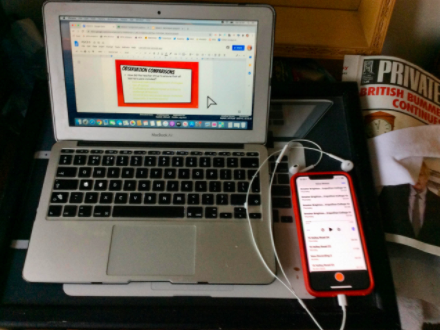
Now I use a phone, to record voice notes, to snatch images of presentations, and what I missed in our Week 5 Class, one student joining remotely who was physically placed at a desk via a laptop so that they could listen in and observe. There would occasionally be a plaintive cry to turn him around or to answer a question. He could hear us and we could hear him perfectly well. Someone offered a story of a partner at a firm of solicitors being wheeled around on a trolley. There are movies where they do this well - science fiction becoming science fact.

If If take notes, old school, like in school or a lecture, then I will miss too much. I won't pick up on conversations, I wont be able to look up and see how the teacher/lecturer is answering a question, or pay proper to what and how a fellow student is replying. My problem, I am ADHD, is that everything is a stimulus to remember something, or think about something else: that font reminds me of a cereal packet, but which one? My fellow student takes photography - has she replaced my colleague who took photography who I only realised had left a week or so yet she has been gone since months ago. Or where have I seen that person before? Why do I recognise her? Is she a parent of a swimmer, someone from Lewes? I will be just as distractable as I go through my typed up, hand written and recorded notes days later but the cumulative time spent ought to mean that I fill in most of the gaps left by the previous pass. 


Permalink Add your comment
Share post

This blog might contain posts that are only visible to logged-in users, or where only logged-in users can comment. If you have an account on the system, please log in for full access.

Total visits to this blog: 21405762