How do "Identify" Quotient Groups with Another Standard Group (Algebra Self Study)
Monday 23 March 2026 at 09:28
Visible to anyone in the world
Edited by Zafar Bakhromov, Wednesday 1 April 2026 at 13:44
A Quotient Group is the set of cosets of in , with a law of composition that makes it into a group. The whole idea is that, if we write the law of composition on as "", then we want to view two elements and that "differ by a multiple of " as the same element in .
While self-studying the book "Algebra 2.e." by Michael Artin, I found it somewhat difficult to grasp how to analyze the structure of a quotient group. Here I will summarize what I've learned through several exercises.
Exercise:
Let be the group of upper triangular real matrices , with and different from zero. For each of the following subsets, determine whether or not is a subgroup and whether or not is a normal subgroup. If is a normal subgroup, identify the quotient group .
(i) is the subset defined by .
(ii) is the subset defined by .
(iii) is the subset defined by .
Source: "Algebra" 2.e., Michael Artin, p.75
My Solution:
(i) is the set of diagonal matrices, with nonzero entries and on the diagonal. This forms a normal subgroup of , but we omit the proof to keep our focus on quotient groups.
Since , an element of looks like:
and we need to choose a representative element for each to analyze . With the entries and of free to choose for any , we may pick and to make multiplication easier. Hence, denoting a representative element of as , we get:
where we have defined . Thus, we have reduced into workable form.
Now, to analyze , we have to multiply two of its elements. Taking , we have that:
Hence, all multiplication does in is that it adds the entries in the top right corners of and , so it really looks like the addition of real numbers.
We are now ready to identify the quotient group with a standard group. Let , where denotes the additive group of real numbers. Then, is an isomorphism. The bijectivity of is given by the fact that can be any real number (including 0), and is a homomorphism because:
Hence, is isomorphic to .
(ii) We similarly have that is a normal subgroup of . For some particular , an element of looks like:
With the entries of free to choose, we may take and , in which case we get that:
so
Thus, by similar logic as before, , where is the multiplicative group of nonzero real numbers.
(iii) I'm getting a little tired of typesetting this so we're just going to note that by similar reasoning as in (ii).
Conclusion:
It took me about a week of working through examples like these to really grasp what a quotient group is doing. The key insight, for me, was not just the definition, but learning how to choose useful representatives of cosets. By simplifying each coset to a canonical form, the group operation in becomes explicit and often reveals a familiar structure. In this way, quotient groups stop feeling like abstract sets of cosets and instead become concrete objects that capture exactly what remains of a group after “modding out” a chosen symmetry.
Resolving a Confusion About Implicit Function Theorem and Manifolds
Friday 27 February 2026 at 16:03
Visible to anyone in the world
"How do I show that a unit sphere is a smooth submanifold of ?"
That is the question I was pondering about when trying to solve exercise 3.1.1 of the book "Vector Calculus, Linear Algebra and Differential Forms - A Unified Approach" by John and Barbara Burke Hubbard. The problem asks for a proof of the above question, but trying to prove that the unit sphere is a submanifold of from the definition of a manifold is very cumbersome. For reference, this is how a manifold embedded in is defined as in the said book:
A subset is a smooth -dimensional manifold if locally it is the graph of a mapping expressing variables as functions of the other variables.
Here, "locally" means that every point has a neighborhood such that (the part of in ) is the graph of a mapping expressing of the coordinates of each point in in terms of the other .
So, in order to prove that the unit sphere is a manifold in , I would have to specify
a "chunk" of the (some variable, some variable) plane, such as
a "part" of the (remaining variable)-axis, such as
a function giving the graph of in the open neighborhood "(chunk) direct product (part of axis)". In this case, is the open neighborhood we're looking for, and is the graph of the function .
Quite tedious, but this is not over. Since this method only specifies an open neighborhood of when (in this case) , we have to also do the same thing using all of and ., and the functions:
Wow.
The implicit function theorem, on the other hand, gives a neat way to check whether
is a smooth manifold. We just have to check that the derivative of is surjective at every point on . In this case,
where , so since
by the implicit function theorem we get that is a smooth manifold in .
Looking back, the thing I was first misunderstanding was that, I mistakengly believed "I have to find a local representation of at every point first, then I can use the implicit function theorem". But doing so would defeat the whole purpose of the implicit function theorem, because by that point I would have already proved that is a manifold!
Also, I was having some difficulties grasping why we have to check the case for discussed earlier, why just being globally describable as two graphs is not enough to show that is a manifold. First, the case does not define an open neighborhood; it's just going to be a two dimensional plane. But at a deeper level, it taught me that manifold structure is a local condition at every point. This is exactly why the implicit function theorem is so powerful; we just have to check one condition and it automatically guarantees that a local representation as a graph exists at every point!
In the end, what felt like a technical shortcut turned out to be something deeper: the implicit function theorem is not a computational trick, but a precise machine that guarantees local manifold structure from a single global condition.
Confusion while studying Vector Calculus from Hubbard & Hubbard
Monday 22 September 2025 at 16:00
Visible to anyone in the world
Edited by Zafar Bakhromov, Monday 22 September 2025 at 16:02
On page 93 of John & Barbara Hubbard's Vector Calculus, Linear Algebra and Differential Forms, I noticed something unusual. The authors state that functional limits behave well under composition (Theorem 1.5.22).
More formally, let be subsets, and and be mappings, so that is defined . If is a point in and
and
both exist, then exists, and
At first, this seemed false, because in order for it to be true the function needs to be continuous. But no such assumption is made here. I was scratching my head the whole afternoon trying to figure this out, and after a long time of googling, I found the following result in wikipedia:
It seems like whether whenever is near is important. So I looked back on the definition of function limits in the book, and I found the key fact that was confusing me: the authors did not require whenever is near ! Appearently this definition of functional limits is common in France, while the usual definition is common in the United States.
As an example, consider the functions
and
Then, we get the following table of facts:
French Definition
US Definition
exists?
Yes
Yes
exists?
No
Yes
exists?
No
No
Is Theorem 1.5.22 True?
Yes (vacuously: the hypotheses aren't met)
No
It is straightforward to show that does not exist under the French definition, because for any we can always find an s.t. (Here, is either equal to 0 or 1). Hence, the theorem is true.
This little detour reminded me that even definitions we take for granted can vary by culture, and those small differences can have big consequences. For me, it was a reminder that part of learning mathematics is also learning to pay very close attention to the precise conventions being used.
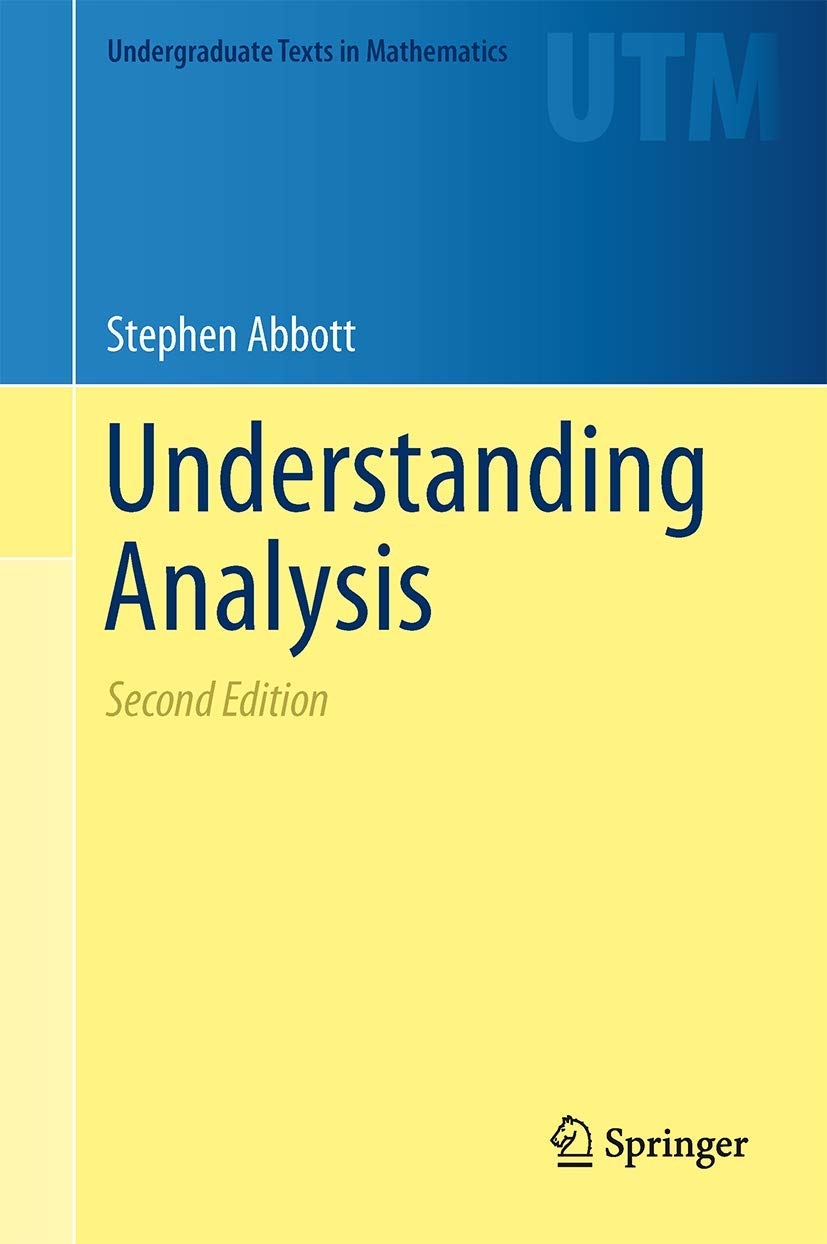
Book Title: Understanding Analysis Author: Stephen Abbott Edition/Year: 2nd edition, 2015 Read: Chapters 1 ~ 7 (8 chapters in total) Exercises Solved: All (Chapters 1 ~ 7)
When I picked up Abbott's "Understanding Analysis", I wasn't sure if real analysis would be an interesting subject. Having only basic set theory under my belt, I thought it would be just "calculus done rigorously" - formalism for the sake of formalism. But little did I know, this would be the beginning of my first true mathematical love )).
"Understanding Analysis", despite being a rigorously written textbook, almost reads like a conversation between you and the author. Every chapter begins with a "Discussion" section that motivates new ideas. For example,when introducing epsilon–N proofs, Abbott doesn’t just drop definitions - he shows why they matter through examples of pathological sequences and series, like rearrangements that change the sum or limits that don’t commute.
I studied the book almost every day for six months, working carefully through Chapters 1–7 (I’ve left Chapter 8 for the future). Since this was my first real higher math text, I often struggled with the execution of proofs: summations, inequalities, or inventing a clever function at the right moment. The exercises on power series almost broke me - I remember spending 3 days trying to show that where 1/L is the radius of convergence. When the reasoning finally fell in place, I had a newfound respect for power series.
However, more than the theorems, what I took away was a sort of mathematical patience. I learned that being stuck in mathematics is a natural process of learning, and the important thing is not to "never get stuck", but to know how to "unstuck" yourself. That lesson, is worth just as much as any epsilon-delta proof. It also taught me how to think like an analyst: to search for hidden leverage in the problem’s assumptions and exploit them.
Moving forward, I'm now studying from John and Barbara Hubbard’s Vector Calculus, Linear Algebra, and Differential Forms. But I carry with me the conviction that I can learn real mathematics independently, as long as I'm willing to wrestle with the ideas. If you're hesitating on whether to pick up Abbott's Understanding Analysis, my advice would be to brush up on proof techniques, and dive in. It will be difficult, but finishing it might just make you fall in love with analysis.
This blog might contain posts that are only
visible to logged-in users, or where only logged-in users can comment. If you
have an account on the system, please log in for full access.