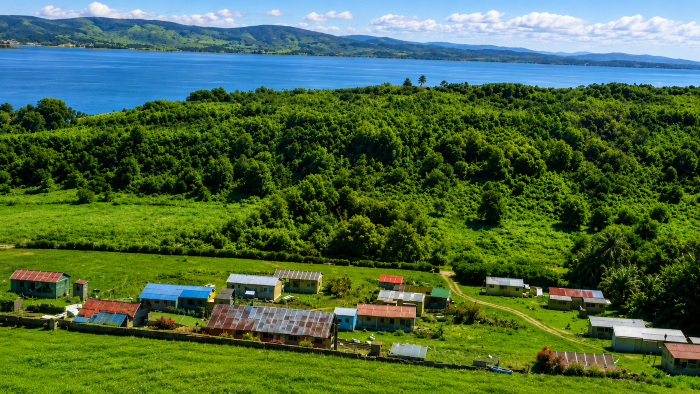
The "Huts", Bogany Farm, circa 1960s AI enhanced
Home, Stars, Milkmaids and Bedouin Shepherd Boys
Some songs seem to accompany us through life without ever asking to be noticed. We hear them when we are young, carry them somewhere beyond conscious memory, and then, years later, they return. When they do, they bring more than melody. They carry people, places, rooms, weather, and versions of ourselves we had almost forgotten.
Clifford T. Ward’s Home Thoughts from Abroad has always been such a song for me. There is something wonderfully restrained about it. It never reaches for grandeur, yet somehow finds it. Ward, an English schoolteacher before music brought him wider recognition, had a quality that made his songs feel less like performances and more like confidences. When I first heard him, I was young, and although I could not have articulated it then, I sensed that he was not singing at me. He was sharing something, and somewhere between his experience and mine we met.
The title reaches further back, of course, to Robert Browning and his poem Home-Thoughts, from Abroad. Browning writes of England from elsewhere, noticing the things absence has made precious: blossom, birdsong and the coming of spring. It is an old human experience. Distance alters our vision. We begin to see the ordinary things we once overlooked, and a place that scarcely announced itself while we inhabited it can acquire an extraordinary power once we have left.
Maybe that is because home is not merely geography. It is emotional ground. It is the place, or sometimes only the memory of a place, where something within us once settled and said, without words, I belong here.
I found myself thinking about this one Saturday evening while sharing a meal with friends. Among us was a friend from Mongolia, and as she spoke about home, I sensed that she meant something larger than the country marked on a map. It led me afterwards to the Mongolian expression нутгаа санах (nutgaa sanakh), commonly translated as homesickness or longing for one’s homeland. Yet “homesickness” seems too slight a word for what I heard in her conversation. This was closer to a tether: an attachment to homeland that survives distance because the landscape itself has somehow become part of the person.
I found myself envying that certainty. Not Mongolia itself, but the knowledge of where one belongs.
I have never really possessed it. There are places I love deeply. My heart is drawn to the Hebrides and to Norway, and to another place I shall come to, but I did not grow up in any of them. The landscape of my childhood was the heartland of the Clydeside shipbuilding industry, a world shaped more by labour than romance. It was soot, tenements, industry and function. Beauty existed, but you had to know where to look for it.
For me, one of the places where it revealed itself was across the water.
We had a cabin on the Isle of Bute, between Rothesay Golf Course and Bogany Farm, and when the summer holidays arrived, I would spend the full six weeks there. The distance from Clydeside was not enormous, yet to a child it might as well have been another country. Loch Ascog lay on one side, quiet and watchful, while the Firth of Clyde opened towards a horizon that seemed impossibly wide.
Then there were the stars.
City darkness is never truly dark, but on Bute the night seemed to reveal what the city had been hiding. The stars did not merely appear; they cascaded.
My days were spent fishing and wandering with the extravagant aimlessness available to children before we discover schedules. Friendships formed quickly because summer demanded it. We knew, without dwelling on it, that most of us would disappear from one another when the season ended, so we belonged intensely for the little time we had.
The cabin had neither running water nor electricity. One of my daily jobs was to take containers to the communal well. Cows would wander towards me with that peculiar combination of suspicion and curiosity that cows seem to have perfected. The smaller ones sometimes ventured closer, studying me as though I were the unusual animal in the field.
When evening came, we lit paraffin lamps. I can still remember their soft, sibilant sound and the warm, imperfect light they cast across the cabin. My father would read aloud to us: Heidi, Tales from 1001 Nights, Chinese folk stories. We ate pancakes with jam and were given small glasses of stout, which seemed to me less like a drink than participation in some ancient ceremony of adulthood.
As the kerosene burned down, the light softened and the cabin became quieter. Sleep did not arrive abruptly. It gathered around us.
I would lie in bed and look through the window at the stars. The stories my father had read were still alive in my imagination, and I wondered whether somewhere far away a Chinese farmer boy, a Bedouin shepherd or a milkmaid among the Swiss mountains might be looking upwards at the same sky.
I did not have theological language for such thoughts. I was simply a boy staring into the immensity of things. Yet I remember a sense of presence, a feeling that the world was greater, deeper and more mysterious than the visible things immediately around me. Looking back, I think those were among my earliest intimations of God. Nothing was spoken. Nothing needed to be. The stillness itself seemed full.
Then came the part every summer had been quietly moving towards: leaving.
There were bags to pack, the ferry to catch and school waiting on Monday. The wide skies disappeared and the tenements of Clydeside closed around us again. I remember a heaviness that I could not explain. It was not ordinary disappointment at the end of a holiday. It felt more like grief, as though I had left something of myself on the island.
Only by leaving did I begin to understand that the cabins near Bogany Farm had become home.
Not home in the conventional sense. We did not own the landscape and our lives there were temporary. Yet something about those summers felt complete. We needed very little. A paraffin lamp, a fishing rod, a campfire, pancakes, stories, friends and six weeks that seemed capable of lasting forever.
Many years later I encountered a word coined by John Koenig in The Dictionary of Obscure Sorrows: kenopsia, the eerie atmosphere of a place that was once bustling with life but is now abandoned and quiet.
I knew the feeling immediately.
When I return to Bute and walk the stretch between Bogany Farm and Canada Hill, the world I remember has largely disappeared. Once there were fifty or sixty cabins scattered across the land. Now there is overgrowth. Nettles have reclaimed paths once made by human feet, and the outlines of our little summer civilisation are difficult to find beneath everything that has grown in its place.
The cows still look at me, though now they seem to have a stronger claim on the land than I do. In fairness, they are probably right. I am the visitor now. The landscape continued living while I was away.
Yet I can still populate that empty field.
I can smell barbecue smoke and burnt toast carried on the sea air. I can hear songs around campfires and children calling to one another through the dusk. I can see adults sitting outside their cabins, leaning into the last of the evening sunlight as though unconsciously storing it against the darker months ahead.
Memory cannot be trusted as a perfect historian. It edits, rearranges and softens. It illuminates one corner while leaving another in shadow. The people I remember may not have been quite as carefree as memory makes them, nor every summer day as golden. Childhood was no more immune to disappointment then than it is now.
But memory's failure to reproduce the past exactly does not make it false. Memory tells another kind of truth. It tells us what mattered.
Something about those summers made people seem more open to one another. Time moved differently. Nobody appeared to be measuring every hour for its productivity. There was space to wander, to talk, to sit beside a fire, to watch the sea or to do nothing of consequence at all. For a few weeks each year, ordinary people seemed permitted to inhabit their lives rather than constantly hurry through them.
The cabins are gone now, and most of the voices I associate with them have long since fallen silent. Still, when I walk through that landscape, absence does not feel entirely empty. Places absorb our stories. A path remembers us in its own way, even when grass eventually covers it. A field once filled with laughter cannot literally retain the sound, yet we retain it on the field's behalf.
This is one of the strange gifts of landscape. We imagine ourselves passing through places, but places also pass through us. They become part of our interior geography, and years later a smell, a quality of evening light, a bird call or an old song can suddenly open the door.
Time is cruel in that it takes away the world we knew, but it is generous in another sense. Only after something has gone do we sometimes understand what we were given.
That has changed the way I think about home.
I once imagined home should be the place from which you came, a homeland capable of producing the deep certainty I heard in my Mongolian friend's voice. I do not think that way now. Some people inherit a profound sense of homeland, while others discover home in fragments. It may be scattered across landscapes and years, held in people, rituals, sounds and moments of inexplicable peace.
For me, part of it will always lie on Bute: in the walk to the well, in the suspicious cows, in my father's voice reading by paraffin light, in pancakes and jam, in campfire smoke and in a little boy staring through a cabin window wondering whether children on the other side of the world were looking at the same stars.
I could return to the exact coordinates, but I could never return to that place. Not really. The place I long for exists at the meeting point of landscape and memory, and time has closed the road back to it.
Yet I no longer think that makes it less real.
Home may not always be somewhere we can remain. Sometimes we recognise it only after leaving. Sometimes it survives as a collection of moments in which, for reasons we barely understood at the time, life felt whole.
And sometimes it returns as an old song, heard in youth, carrying us across the years to somewhere we thought we had lost.
One final, rather lovely footnote: five years ago, I met a woman who had been taught English by Clifford T. Ward. Somehow that small connection pleased me enormously. A man whose song had accompanied my memories of home had once stood in an ordinary classroom, teaching English to someone I would eventually meet.