OU blog

Personal Blogs

Richard Walker

Odom's Problem: Out of 74 Solutions the Winner is...

Visible to anyone in the world
Edited by Richard Walker, Monday 29 June 2026 at 20:44

At the start of this month I wrote about the following problem.
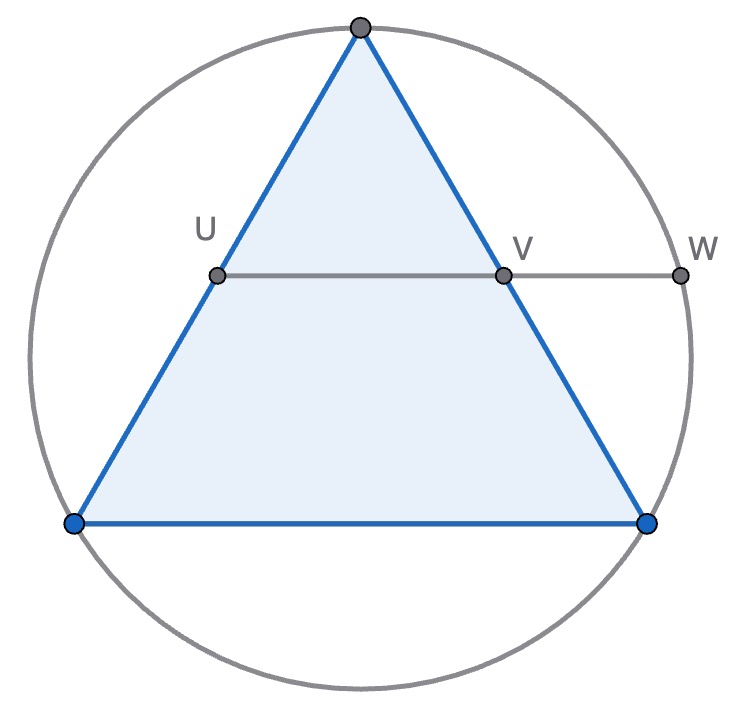
Inscribe an equilateral triangle in a circle. Draw a line through the midpoints cap u and cap v of two of its sides, to meet the circle at cap w .

Show that cap u times cap v divided by cap v times cap w is equal to phi , the number of the Golden Section.


This elegant result was proposed by George Odom as problem E3007 in the American Mathematical Monthly in 1983 and the best solution out of the 74 receive was published in 1986. Here is the miraculous solution given by Jan van de Craats. I have drawn my own diagram and provided slightly more explanation but not changed the underlying proof at all. Here is the diagram above but with some additional lines and labels.
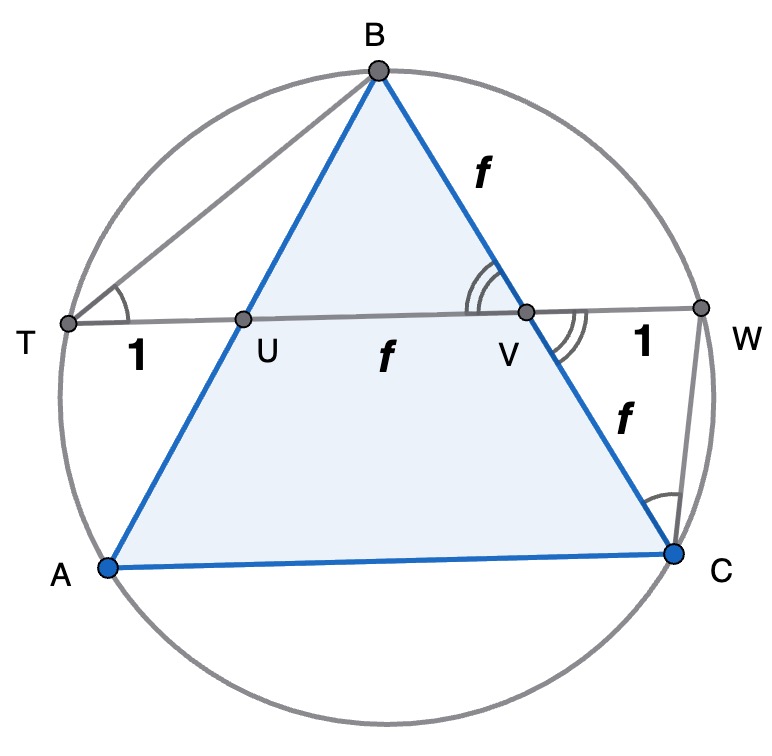
Take the length of cap v times cap w as one and suppose cap u times cap v equals f . By symmetry cap t times cap u equals one . Because the small triangle cap u times cap b times cap v is equilateral and cap v is the midpoint of cap b times cap c we have equation sequence part 1 cap v times cap c equals part 2 cap v times cap b equals part 3 f .

Because cap t and cap c are subtended on the circumference of the circle by the same arc cap b times cap w the angles there are equal. Angles cap t times cap v times cap b and cap c times cap v times cap w are equal, because they are vertically opposite. Hence triangles cap t times cap v times cap b and cap c times cap v times cap w are similar.

The ratios of corresponding pairs of sides in these two triangle must therefore be equal, so we have 

one divided by f equals f divided by one plus f

and rearranging gives one plus f equals f squared or f squared minus f minus one equals zero , the equation whose positive root is phi , the number of the Golden Section.

(Jan van de Craats' write-up was terser; he just gave the diagram above and underneath wrote

f squared equals f plus one

relying on the Intersecting Chords Theorem, but I thought it would be better to use similar triang;es and not assume knowledge of that theorem.)

Footnote: I quite liked my own proof but the one above is far, far nicer, which I suppose is the reason it got published. Mine was a worthy effort but really just an 'also ran', along with the 74 other ARs.
Permalink
Share post
Richard Walker

A Nice Problem with Two Equilateral Triangles - Can You Find a Proof?

Visible to anyone in the world

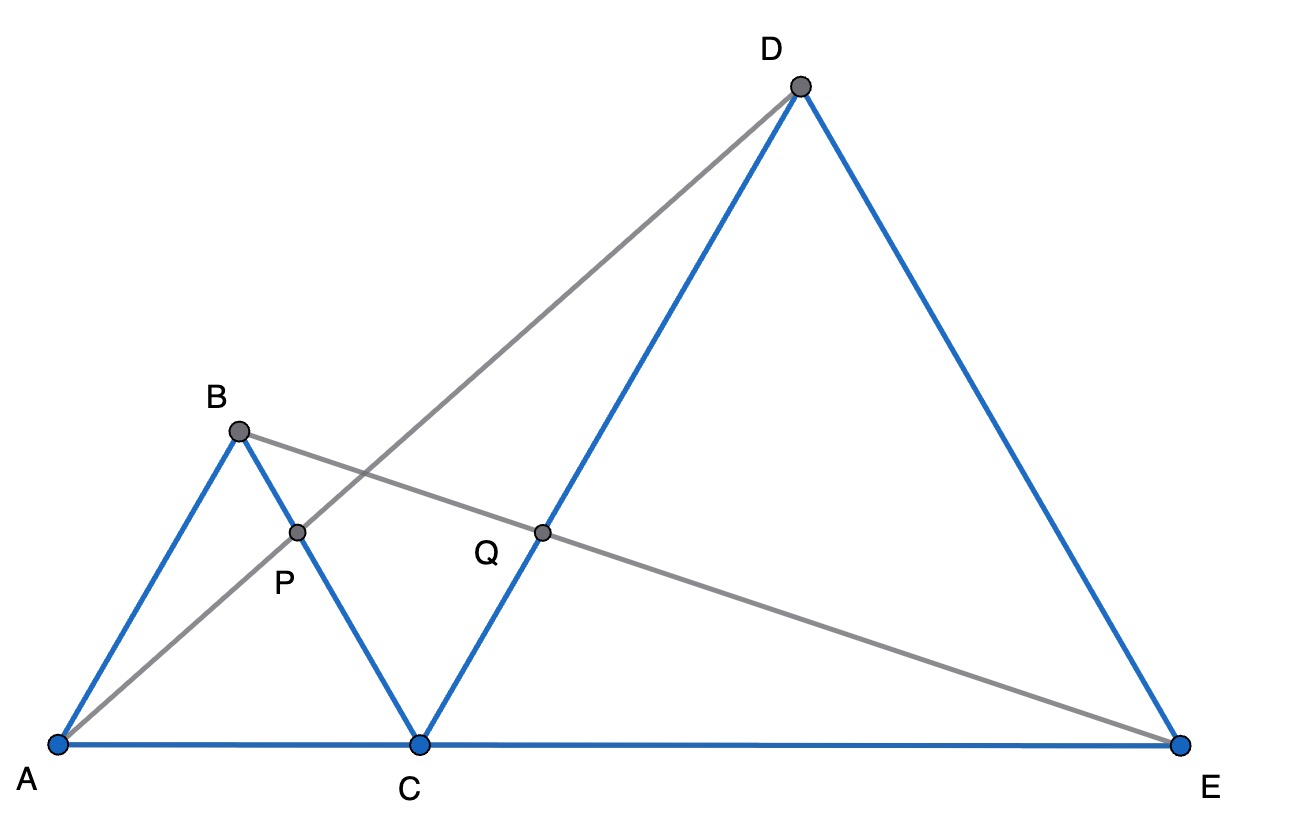
Here's a nice problem I found on math stack exchange (question 1182471).

ACE is a straight line and triangles ABC and CDE are equilateral. Prove that CP = CQ.

If you have a solution do put in the comments. I imagine there are a number of different solutions. I'll post mine this Monday coming.

Permalink 1 comment (latest comment by Darren Menachem Drapkin, Monday 18 May 2026 at 21:21)
Share post
Richard Walker

A Pretty Geometrical Theorem

Visible to anyone in the world
Edited by Richard Walker, Sunday 14 July 2024 at 00:40

Although the Ancient Greek mathematicians discovered an enormous amount about geometry, in modern times a number of rather nice facts have been found that the Greeks didn't know about. One of these is Bottema's Theorem, named for Oene Bottema, a Dutch mathematician of the 20th century. It goes like this 


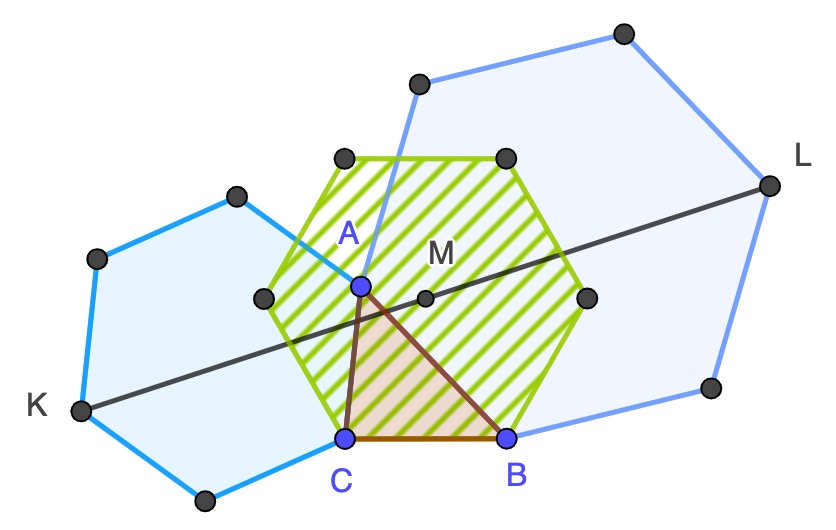
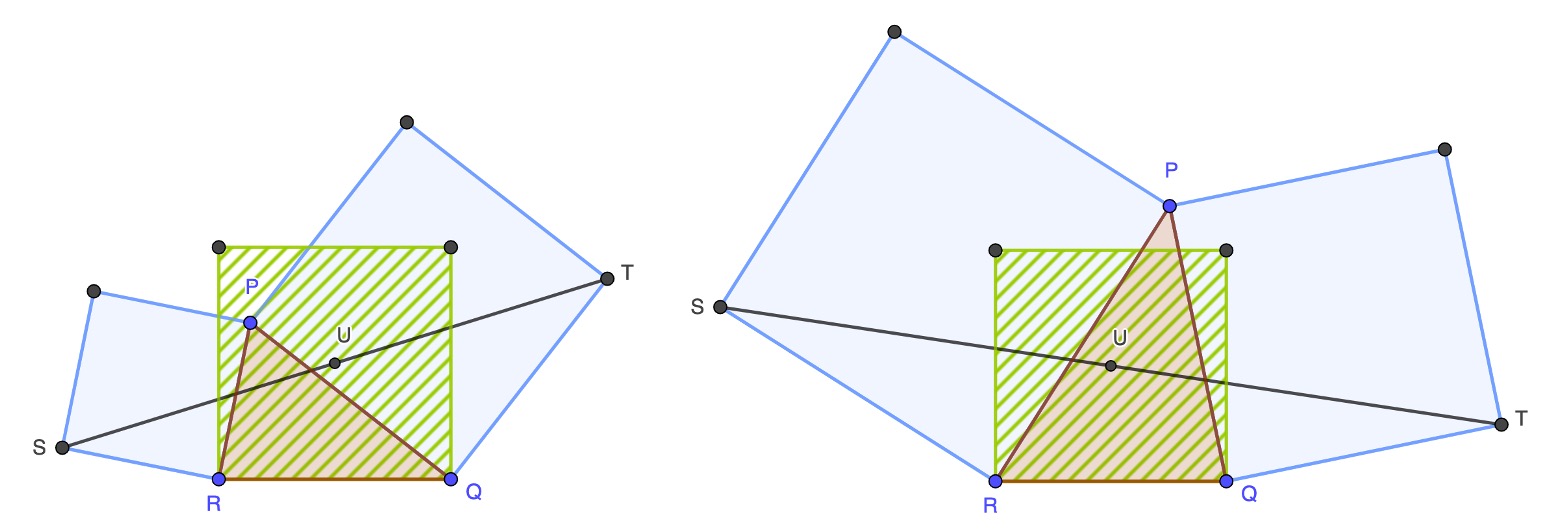
Suppose we have a triangle, PQR in the diagrams, and draw squares on two of its sides as shown. Draw a line joining the two vertices of the square that lie opposite to the vertex P and mark the midpoint U of the line that joins them.

Then the midpoint lies at the centre of a square resting on the base of the triangle and rather unexpectedly this is true wherever we move move the vertex P. The diagrams above show two positions of P and you can see that the position of U is indeed the same in both cases. 

There are quite a few websites that discuss the theorem and give proofs, and there are also some nice animations and YouTube videos that demonstrate the fact that the midpoint is independent of P's position. 

There are also some published variations on Bottema's theorem, but here is a neat one one I discovered by chance and  which I haven't seen anywhere and which is new, to me at least.

Bottema's theorem works not just for squares but for any regular polygon with an even number of sides. For example, here is an example where the polygons have six sides.


Notice that the midpoint M is now the centre of a third hexagon, rather than a square, resting on the bases of the square, and as with the square case the position of the midpoint does not depend on the position of vertex A.

If we instead erect octagons on the sides of the triangle then the midpoint will again be independent of the location of A, and will be the centre of an octagon resting on the base of the triangle. We can construct analogous configurations for any even number of sides, and the midpoint will always be fixed in the same way. I think that's rather neat and I was pleased when I discovered it.

Permalink
Share post
Richard Walker

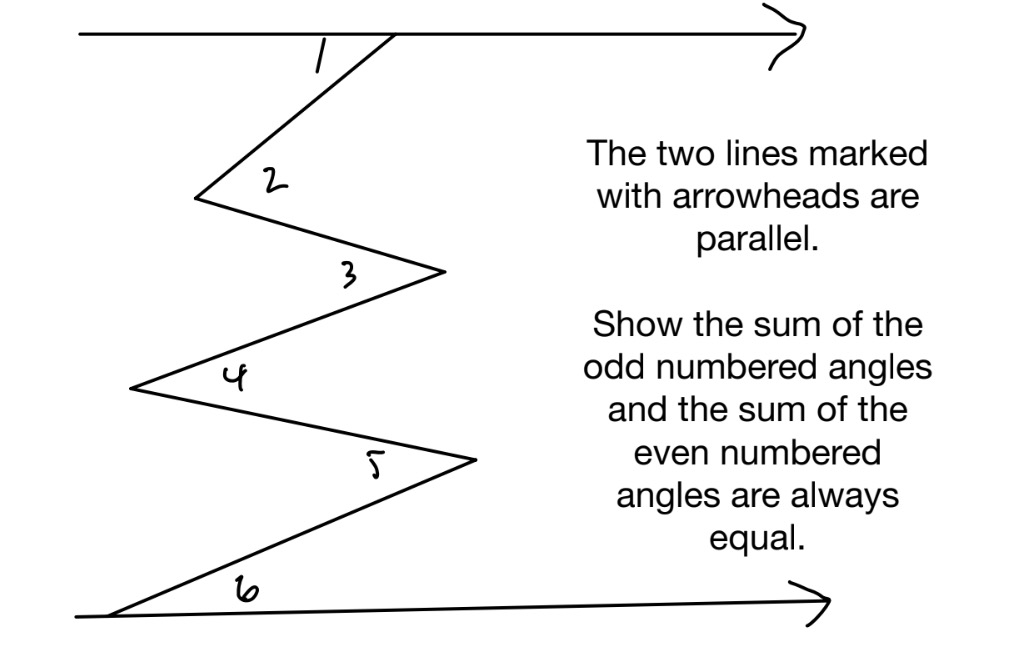
Zig-Zag Angles

Visible to anyone in the world
Edited by Richard Walker, Saturday 16 September 2023 at 23:03


Permalink 2 comments (latest comment by Richard Walker, Tuesday 19 September 2023 at 13:35)
Share post

This blog might contain posts that are only visible to logged-in users, or where only logged-in users can comment. If you have an account on the system, please log in for full access.

Total visits to this blog: 6206385