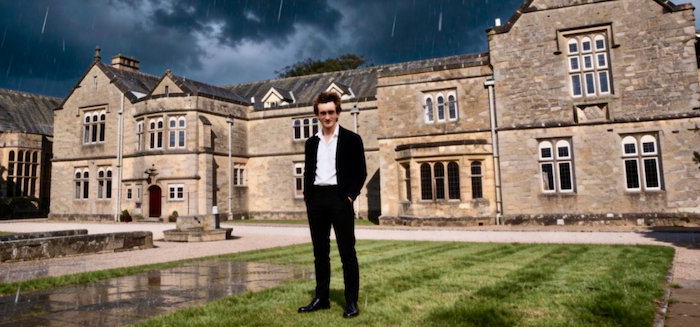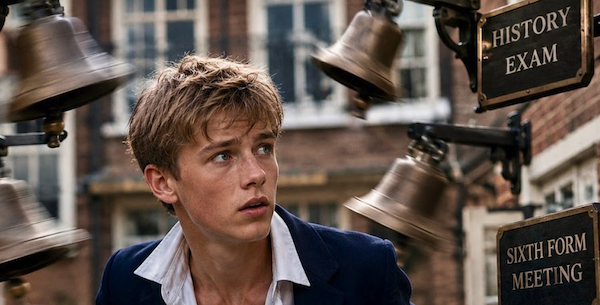
An AI-generated image of the author in his late teens was created from photographs of him as a teenager, and here he is, tortured by the ever-present school bell.
Revisiting my diaries from fifty years ago (A Collins Five-Year Diary) has led me to an unexpected conclusion: much of what I value most about history, I learned despite how I was taught at school, not because of it.
At my school in the 1970s, history was largely presented as something settled and inherited. Dates, causes, consequences, kings, treaties, essays. Knowledge flowed in one direction: teacher to pupil, textbook to exercise book. The institution valued certainty, continuity and authority. We were expected to absorb and reproduce.
What strikes me now is how little this resembles the way historians themselves actually think.
Only later, as a history scholar in the Sixth Form at the RGS Newcastle, did I encounter a different conception of history altogether. Historians such as R. G. Collingwood, E. H. Carr and A. J. P. Taylor shifted the ground beneath my feet.
History, they implied, was not the memorisation of conclusions. It was an active process of reconstruction.
Collingwood argued that history involves "re-enacting" past thought in the historian's mind. Taylor made history feel alive, contingent, human. Carr questioned the very idea of objective historical facts detached from interpretation. Suddenly, the subject ceased to be a sequence of examinable topics and became an encounter with consciousness across time.
That distinction matters enormously.
Poor history teaching presents the past as fixed. Better history teaching allows students to enter into uncertainty. Instead of simply learning "the causes of the English Civil War", students should be encouraged to ask:
-
Why did intelligent people support the King?
-
What did liberty mean to them?
-
Why did religion matter so much?
-
What assumptions about the world seemed obvious at the time?
History becomes less about answers and more about recovering mental worlds.
The irony is that I may have learned this most effectively outside the classroom.
The letters I received from girls. The novels I read. Music, television, films, magazines, conversations, walks across the fells, hours spent drawing or daydreaming. These formed a parallel education. They taught me that people are contradictory, emotional, self-deceiving, hopeful, frightened and endlessly interpretative.
That is history too.
Now, fifty years on, as I revisit my Diary entries alongside the letters, books and artefacts of the time, I realise I am approaching my own adolescence as a historian might approach any archive. The Diary entries are not "the past"; they are traces of it. A line saying "Read He & She: the mental side of it very good, how girls react etc." contains within it a whole set of tensions:
-
institutional morality versus lived experience
-
prescribed knowledge versus curiosity
-
official narratives versus private interpretation
The process has made me think hard about education itself.
At my private school, we were often being prepared for a world already disappearing: hierarchy, deference, inherited authority, moral certainty. Yet outside the classroom, the future was already arriving—through feminism, changing attitudes to sex, television culture, popular music, psychology and increasingly self-directed learning.
The institution often confused discipline with education, tradition with wisdom, coverage with understanding.
The best history teaching, I now think, does six things:
-
It tells compelling stories (I've taken a shine to the historical sagas of Ken Follett).
-
It uses primary sources
-
It exposes students to competing interpretations
-
It develops historical imagination
-
It connects the past to lived human experience
-
and it allows intellectual freedom and curiosity
Most importantly, it teaches students not simply to know about the past, but to think historically.
That means recognising that every document, every Diary entry, every letter and every memory is part of an ongoing act of interpretation. (I kept a daily Diary from 1976 to 1990).
Perhaps that is why my 'Fifty Years On' project (50YON) feels so alive to me now. I am not merely remembering my past. I am investigating it.
And perhaps the best history teaching ultimately does the same thing: not telling students what to think about the past, but giving them enough evidence, structure and freedom that the past begins to speak for itself.