OU blog

Personal Blogs

Design Museum

Learning, Curiosity and the Arrival of AI

Visible to anyone in the world

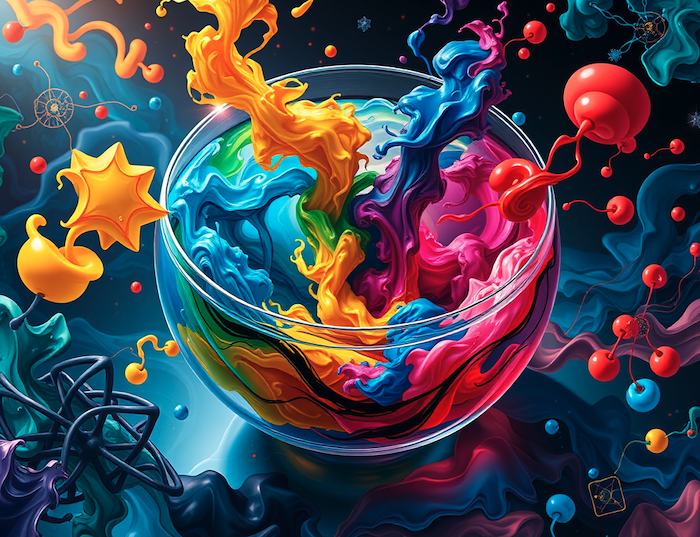
Colour inks aggittated in a bowl as a metaphor for learning

I’ve always been fascinated by how we learn. Look at me here! Try some of the hundreds of links. 

Twelve years ago, while studying for a Master’s in Open & Distance Education with the Open University, I tried to impose some order on the chaos of learning theory. I drew up lists of behaviourists, constructivists, activity theorists and communities of practice > Learning Theories in a Mind Map. I remember thinking that the field resembled a large bowl of water into which someone had dropped twelve different coloured inks. Each theory diffused through the water, overlapping and interacting with the others.

At the time, neuroscience was only just beginning to open the lid on what was actually happening inside the brain during learning. Today we have far richer pictures from brain imaging, cognitive science and network theory. What strikes me now is that the metaphor still holds: learning isn’t one process. It’s an ecosystem.

And now, of course, AI has joined the bowl.


Theories of Learning (and Why There Are So Many)

When I first encountered the literature, it seemed as though every decade produced another theory explaining how humans learn.

There were the behaviourists, like Skinner, who treated learning as a pattern of stimulus and response.

Then the cognitive theorists, such as Piaget and Bruner, who focused on how the brain processes information and builds mental models.

Constructivists argued that knowledge isn’t transmitted but built by learners themselves, often through collaboration.

Social learning theorists like Bandura showed how much we learn simply by watching others.

And then there were frameworks such as communities of practice, activity theory, and organisational learning, which explored how learning emerges inside social systems.

At first glance, the field looks fragmented. But the longer I’ve spent thinking about it, the more it seems that these theories are simply looking at the same phenomenon from different scales.

Some focus on neurons.

Some individuals.

Some on social systems.

But all are describing learning.


My Favourite Theory: Resistance to Learning

One theory that always amused me was Knud Illeris’s idea of defence learning.

Sometimes people simply refuse to learn.

I can decline Latin verbs like amo, amas, amat somewhere in the recesses of memory, yet if you asked me what half of it means today I would struggle. Nine years of Latin education achieved very little.

The same was true of early French lessons and much of my school chemistry. Weekly tests, boxes ticked, grades achieved. A perfectly efficient system for passing exams.

But not necessarily for learning.

Ironically, French came alive later through a completely different route: a French exchange, hitchhiking through France with people who spoke no English, and eventually working there. The “holistic” version of learning worked instantly because suddenly the language mattered.

Learning, it turns out, has a lot to do with relevance.


What Neuroscience Now Suggests

In the years since I studied learning theory, neuroscience has simplified the picture dramatically.

Beneath all the theories, learning seems to rely on three fundamental processes in the brain:

Prediction – the brain constantly builds models of the world.
Error correction – when reality differs from prediction, the brain updates the model.
Social modelling – humans accelerate learning by observing other humans.

Prediction → feedback → adjustment → improved prediction.

This loop operates constantly.

When a swimmer adjusts a stroke.

When a gardener learns how soil behaves.

When a cook experiments with flavours.

When a writer revises a paragraph.

The theories I once catalogued—constructivism, behaviourism, communities of practice—are really descriptions of different parts of this loop.


Learning Beyond the Classroom

The other thing that became clearer over time is that learning doesn’t really belong to schools or universities.

Much of the most powerful learning is experiential.

Coaching swimmers taught me this. Technique improves through repetition, feedback and observation. No textbook can substitute for the feel of water moving past the hand.

Relief printing works the same way. You cut, print, adjust pressure, print again.

Gardening is an endless dialogue with soil, weather and plants.

Cooking involves constant experimentation.

These are embodied forms of learning: knowledge living in the body as much as the mind.

In other words, the bowl of coloured inks contains physical experience too.


The Shift to Networked Learning

When I wrote about learning twelve years ago, Web 2.0 was already changing the landscape.

Information was escaping institutional silos.

Instead of learning only through teachers and textbooks, we could go directly to the source: experts, papers, videos, forums, and communities.

I began to think of learning less as belonging to a “community of practice” and more as a community of ideas.

Today, that shift has accelerated dramatically.

The network itself has become the classroom.


Where AI Fits

This is where AI becomes interesting.

AI is not simply another information source. It behaves more like a thinking partner.

Historically, learning tools extended our memory: books, libraries, notes.

AI extends something different.

It extends thinking.

I use it constantly.

For writing and editing prose.

For sports science questions in swimming coaching.

For drafting council reports or exploring policy issues.

For relief printing techniques.

For gardening advice, cooking ideas, health questions, even mental health reflection.

What AI does particularly well is accelerate the learning loop:

It helps build models by explaining complex ideas.

It provides feedback by analysing questions or arguments.

It simulates expert reasoning, allowing us to observe how a subject might be approached.

In effect, AI can function as a kind of cognitive scaffolding.


Learning in the Age of AI

The most interesting shift may be that learning is no longer primarily institutional.

For centuries the path looked like this:

School → University → Career.

Now it looks more like this:

Curiosity → Exploration → Network → Iteration.

Learning becomes continuous.

AI simply makes the network more responsive.

Instead of waiting for a lecture, we ask a question.

Instead of searching blindly through information, we explore ideas interactively.


The Thread That Runs Through It All

Looking back, the most important ingredient in learning wasn’t any particular theory.

It was curiosity.

As a child I was constantly asking questions. I wanted explanations. I wanted conversations. I wanted to know how things worked.

Sometimes that enthusiasm was welcomed.

Sometimes it wasn’t.

But curiosity is what drives the prediction–error loop that sits at the heart of learning. The brain wants to resolve uncertainty.

And in many ways AI is simply a new tool for satisfying that ancient human instinct.

We are still doing the same thing we have always done.

Trying to understand the world.

The bowl of coloured inks has just become a little richer.
Permalink Add your comment
Share post
Design Museum

Does AI Tell Us What We Want to Hear?

Visible to anyone in the world
Edited by Jonathan Vernon, Friday 15 August 2025 at 07:18

As a student of education and learning, I’ve been reflecting on the role AI plays in shaping how we think. Recently, I came across neuroscientist Dr Rachel Barr’s blunt but insightful claim: AI feeds us positive answers and fails to challenge us. That struck a chord.

In my experience using tools like ChatGPT, I’ve noticed how agreeable the responses often are. That’s not accidental. AI like this is trained on massive datasets and fine-tuned to be helpful, polite, and inoffensive. Its design goal is to give answers that people will accept or like—meaning it tends to validate more than it critiques.

But as learners, isn’t it the challenge that helps us grow?

Dr Barr’s warning reminds me that learning isn’t just about acquiring information—it’s about thinking differently. If AI never says “you might be wrong,” or never pushes us to consider a more potent counterargument, then we risk reinforcing our assumptions rather than re-examining them.

This matters especially for those of us studying education. If we’re going to teach or guide others, we need to model critical engagement—and that includes how we use AI.

I’ve found that when I ask AI to challenge me—“What am I missing?”, “Play devil’s advocate”, or “Give me a harder question”—I get better results. But without that prompt, the default is comfort over friction. And friction is often where the learning happens.

So here’s my reflection: AI is not inherently bad for thinking. But it does reflect how we use it. If we’re too passive, it becomes a mirror of our biases. If we’re active and curious, it becomes a tool for growth.

I also know that I respond best to being praised and pushed. Redirection and encouragement help me far more than blunt correction. That’s true whether it’s from a tutor, a peer, or even an AI.

So let’s design our questions—and our digital habits—with intention. Let’s ask for the challenge we need, not just the answer we want.

These will help you explore how AI impacts learning, cognition, and teaching practice—with a focus on critical engagement rather than hype.

AI-Related Resources for Students of Education

Up-to-date resources to help you critically explore how AI is affecting education, cognition, and learning design. Ideal for Open University students studying education, learning sciences, or digital pedagogy. 

1. Academic Resources and Research 

• ERIC (Education Resources Information Center) – [eric.ed.gov](https://eric.ed.gov): 

Search 'AI in education' for peer-reviewed papers and classroom case studies. 

• Journal of Educational Technology & Society: Studies on adaptive AI systems and learner outcomes. 

• Stanford Human-Centred AI (HAI) – [hai.stanford.edu](https://hai.stanford.edu/research/education): 

Research on ethical, cognitive, and policy issues in AI-enhanced education. 

2. Cognitive Science + AI

• “AI and the Learning Brain” – MIT Media Lab: [Read summary] > http://bit.ly/3UvGahY 

 “Cognitive Atrophy and AI Overuse” – [Polytechnique Insights]

Effects of AI tools on memory, attention, and creativity.

3. Practical Tools for Students

• HUMANE Toolkit – [humane-ai.eu] > http://bit.ly/4mjSpuc 

Tools for human-centric AI learning environments. 

4. Tech & Learning: AI Literacy – Resources For Teachers

This article, published in July 2025, highlights six practical and trustworthy tools and publications tailored for educators seeking to integrate AI ethically and effectively:

  • Digital Promise – guidelines and policy summaries on AI in education.

  • Common Sense Media – includes a self-paced course co-created with OpenAI on ChatGPT for education.

  • ISTE + ASCD – offers lesson plans and professional development, including StretchAI for coaching.

  • Future of Being Human Newsletter – thoughtful commentary on AI and innovation in learning.

  • AutomatED – a deep-dive guide for classroom AI integration.

  • Tech & Learning Newsletter – tri-weekly updates, reviews, and tips on AI in schools. (panoramaed.com, Tech & Learning)

Foundational Frameworks & Research on AI Literacy

MIT RAISE (Responsible AI for Social Empowerment and Education)

Led by Cynthia Breazeal, this initiative aims to democratise AI literacy globally, especially for K–12 learners and educators. It emphasises creative, ethical, and constructionist approaches, including:

  • MIT FutureMakers, a free summer program for students.

  • Day of AI, a large-scale educational event with open AI curricula and tools.

  • Professional development for teachers that has already reached thousands across 170 countries. (Wikipedia)

AI Literacy Conceptual Foundations

  • A 2024 framework, “AI Literacy for All: Adjustable Interdisciplinary Socio‑technical Curriculum," proposes a robust AI literacy model that blends technical, ethical, and critical dimensions accessible across disciplines. (arXiv)

  • “Generative AI Literacy: Twelve Defining Competencies” presents a competency-based roadmap to guide education providers and policymakers. (arXiv)

  • A more recent April 2025 framework offers practical guidelines for the responsible selection and use of generative AI tools, aimed at schools and organisations.(arXiv)

General AI Literacy Definition

The concept of AI literacy broadly includes the ability to understand, use, evaluate, and critically reflect on AI applications. It’s about more than usage—it's about making informed, ethical choices when interacting with AI.(Wikipedia)Understanding ethical AI in teaching contexts. 

AI Pedagogy Project* – [aipedagogy.org](https://aipedagogy.org): Creative, reflective teaching ideas involving AI. 

5. Watch, Listen, Reflect 

• Hard Fork Podcast (NYT): Insightful episodes on AI’s influence on writing, thinking, and learning. 

YouTube: Look for ‘Cognitive Load Theory and AI Tools’ on channels like LearnTechLib or ‘AI for Education’. Use these resources to guide your assignments, stimulate reflection, or support your teaching practice.

Permalink Add your comment
Share post
Design Museum

Neuroscience in Education: What Teachers Can Learn from Neuroscientists

Visible to anyone in the world

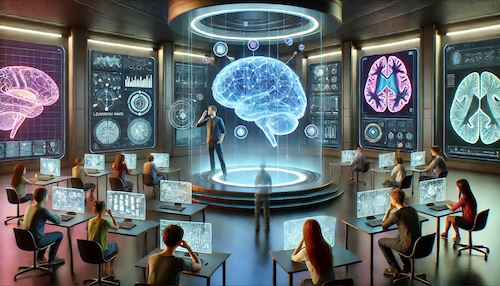
An AI-generated futuristic image of a classroom with pop-up screens
What if we treated the act of learning with the same precision that surgeons bring to an operation? Just as anatomy revolutionised medicine, could neuroscience do the same for education?

Understanding how the brain learns—and how it struggles—can transform teaching from guesswork into something much more powerful and informed. In this post, we will explore how insights from neuroscience can shape education, just as anatomical knowledge underpins modern medical practice.

Why Neuroscience Matters in the Classroom

Integrating neuroscience findings into educational practice can enhance teaching effectiveness and student outcomes. Both education and medicine benefit from a deep understanding of underlying systems—whether they’re neural pathways or blood vessels. The more we understand how learning happens in the brain, the better we can support it in the classroom, empowering educators with practical strategies

1. Understanding Learning Mechanisms

Anatomy shows us how the body’s systems function; neuroscience shows us how memory, attention, and reasoning work in the brain.

This matters for teachers. Techniques that reinforce memory—like repetition, retrieval practice, and emotional engagement—have strengthened learning (Baker, 2019). It is not just about what we teach, but how we help students *remember* it.

2. Teaching to the Brain’s Developmental Stages

Just as anatomy helps doctors understand physical growth, neuroscience helps educators understand mental and emotional development.

For instance, we now know that the brain’s executive function (responsible for planning, focus, and self-control) matures well into the teenage years (Berk, 2020). This knowledge can help educators adapt expectations, offer more age-appropriate challenges, and be more forgiving of adolescent forgetfulness or impulsivity.

3. Supporting Learning Differences

In medicine, anatomy helps identify conditions like a heart murmur or scoliosis. In education, neuroscience helps us understand dyslexia, ADHD, and autism—not as misbehaviour, but as differences in brain wiring (Shaywitz, 2003).

This shift in perspective from blame to support is crucial. Students once labelled “difficult” are now better understood and can be helped through targeted interventions, fostering a more empathetic and understanding learning environment.

4. Evidence-Based Teaching Practices

Doctors rely on evidence to guide treatment; teachers should, too. Neuroscience supports teaching methods like

  • Spaced repetition

  • Interleaved practice

  • Frequent low-stakes testing

These techniques significantly boost long-term learning (Roediger & Butler, 2011). Moreover, they outperform outdated ideas—like the persistent myth of “learning styles”—that still linger in some classrooms.

5. Shaping Policy, Not Just Practice

Medical knowledge shapes public health policies. Neuroscience can do the same for education. For example

  • Teens’ brains are wired for later sleep and wake cycles—so why start school at 8 a.m.?  

  • Brain plasticity is highest in early childhood—should not that guide where we invest resources?

Neuroscience offers classroom-level insights and powerful arguments for rethinking school structure (Wong et al., 2019).

6. Brains and Bodies: A Shared Logic

In many ways, education today is where medicine was a century ago—still catching up to science. However, change is coming.

Neuroscience will not replace the art of teaching more than anatomy will replace bedside manner. However, it provides a framework for more intelligent, responsive, and empathetic practice. It gives us a map—not to dictate every move but to guide us when the path is unclear.

Insights

  • Teaching aligns with how the brain stores and retrieves information more effectively.

  • Recognising neurological diversity leads to more compassionate and effective teaching.

  • Instruction should be timed and structured to match students’ cognitive development.

  • Let go of myths. Lean into what the brain science shows.

  • Good education policy should be biologically informed, not just politically convenient.

Want to Go Deeper?

Here are the studies and sources that shaped this post:

Baker, R. S. (2019). *The Role of Neuroscience in Learning and Education*. *Educational Psychologist*, 54(2), 65–77.  

Berk, L. E. (2020). *Development Through the Life Span*. Pearson Education.  

Shaywitz, S. E. (2003). *Overcoming Dyslexia*. Knopf.  

Roediger, H. L., & Butler, A. C. (2011). *The Critical Role of Retrieval Practice in Long-Term Retention*. *Trends in Cognitive Sciences*, 15(1), 20–27.  

Wong, T., Wong, D., & Meyer, R. (2019). *Sleep and Learning: A Review of the Evidence*. *Educational Psychology Review*, 31(4), 901–913.

Final Thought

The more we understand the brain, the better we can teach. Neuroscience is not just another buzzword but a bridge between science and the art of education. Moreover, that bridge is worth building.


Permalink Add your comment
Share post

This blog might contain posts that are only visible to logged-in users, or where only logged-in users can comment. If you have an account on the system, please log in for full access.

Total visits to this blog: 19932028