The Barefoot Pilgrim: The Search For Truth
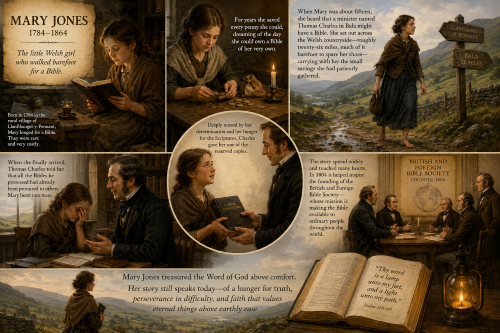
Mary Jones was born in the rural village of Llanfihangel‑y‑Pennant in 1784. Her family was poor, and in those days, Welsh Bibles were rare and costly possessions. From childhood she longed to own one for herself. She is still remembered as “the little Welsh girl who walked barefoot for a Bible.”
For years Mary saved every penny she could. When she was about fifteen years old, she heard that a minister named Thomas Charles in Bala might have a Bible available. Determined to obtain one, she set out across the Welsh countryside and walking roughly twenty‑six miles, much of it barefoot to spare her shoes and carrying with her the small savings she had patiently gathered over the years.
When she finally arrived, Thomas Charles told her that all the Bibles he possessed had already been promised to others. Mary reportedly burst into tears. Deeply moved by her determination and by her hunger for the Scriptures, Charles gave her one of the reserved copies.
The story spread widely and touched the hearts of many Christians. In time, it helped inspire the founding of the British and Foreign Bible Society in 1804, whose mission became making the Bible available to ordinary people throughout the world.
Whether every detail has survived exactly as it happened matters less than the truth at the centre of the story: a young girl treasured the Word of God enough to endure hardship simply for the privilege of owning it. Her story still speaks today because it reveals something rare, a hunger for truth, perseverance in difficulty, and faith that valued eternal things above comfort.
Today the contrast is striking. Bibles are no longer scarce. Many people own several copies, and digital versions can be downloaded freely within seconds. Yet despite such abundance, few take the time to read them deeply. One cannot help but wonder why.
Science has expanded human knowledge, yet it has not replaced the questions the Bible addresses. The Scriptures stand apart as more than a historical document or a collection of moral sayings; they speak to the meaning of life, to conscience, suffering, forgiveness, hope, and salvation. In an age increasingly uncertain of what virtue even means, the Bible remains profoundly relevant.
Modern society often appears to be losing its moral and spiritual centre. As people abandon shared truths, each increasingly follows his own way, and the result is confusion, loneliness, and division. The Bible teaches that humanity is made in the image of God. In other words, we bear, however imperfectly, reflections of qualities that originate in God Himself, those of love, justice, mercy, reason, creativity, and moral awareness. Scripture not only reveals these qualities but also defines what is truly good, grounding human dignity in something higher than personal opinion or social fashion.
Many people sense that something in the modern world is disintegrating, even if they struggle to explain exactly what it is. The philosopher Friedrich Nietzsche famously wrote, “God is dead. God remains dead. And we have killed him.” Yet Nietzsche understood the terrible question that followed: if humanity removes God from its centre, by what standard will we guide ourselves, and how shall we console ourselves in the emptiness left behind?
Perhaps that is why the story of Mary Jones still matters. Her journey through the Welsh hills was not merely a search for a book. It was a search for truth, meaning, and the voice of God in a troubled world. In many ways, the modern world possesses infinitely more knowledge than Mary ever could have imagined, yet far less certainty about what it means to live well. The tragedy today is not that Bibles are unavailable, but that so many remain unopened.