

I've been reading a wonderful book 'The Tea Party and the remaking of Republican Conservatism' by Theda Skocpol and Vanessa Williamson.
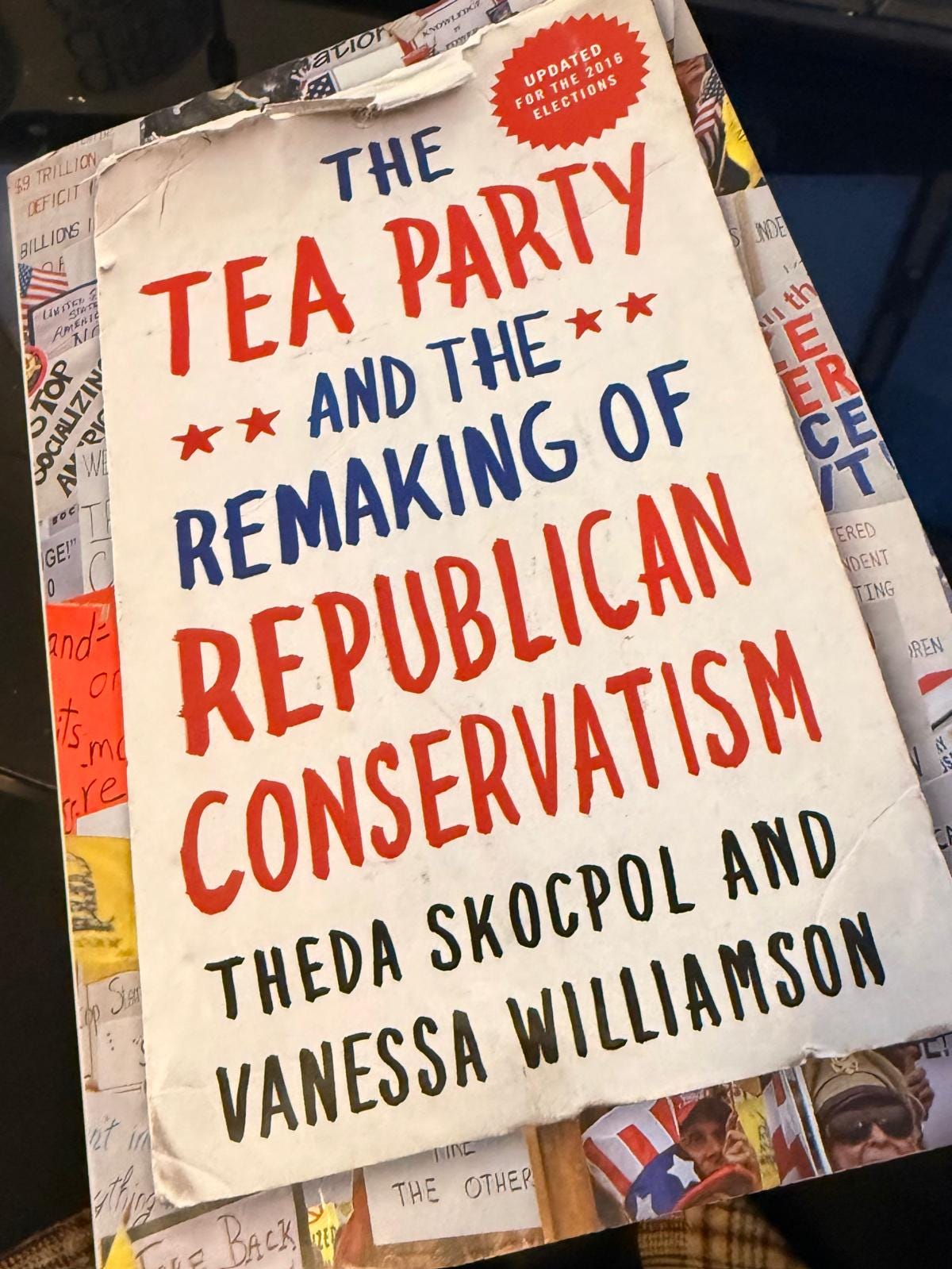
Skocpol in particular is one of the leading political scientists in the world today and as a Harvard academic is very much part of the 'liberal elite' that today's populist right rail against.
The book is fascinating for many reasons, not least the parallels between the rise of the Tea Party movement from 2009 onwards and the rise of Reform UK in 2024, but I have been struck by one particular paragraph in the introductory chapter:
"We found each person we spoke with admirable and likeable in his or her own way. Though their politics puts them toward the far right of the U.S. political spectrum, the Tea Partiers we have me are art once as typical and as eccentric as any other group of Americans you might run into... We hope that as we try to put the Tea Party into historical and ntional context, we also convey a human story - and we are very grateful to all who spoke with us for taking the time to participate in our research."
Isn't that wonderful and extremely rare in politics?
Academics who share almost nothing in terms of ideological outlook with the group that they are studying but setting out that its members are fundamentally decent people, who just happen to share different views.
I don't think politics has changed too much, but perhaps what has is our ability to like those who are different to us?
Of course, if you are of a liberal, progressive persuasion you're not likely to agree with the ideas of those on the populist right, but it wouldn't go amiss to try and understand why they think as they do and even accept those with right wing views are not too different from those on the left.