

Packing problems ask questions like 'What is the optimal way to pack copies of shape A in shape B?' For example we might be trying to pack equilateral triangles in a square, and the best known arrangement is this.

We can think of the problem in two equivalent ways
- Choose a size for the square and make the triangles as big as possible
- Choose a size for the triangles and make the square as small as possible
The example above, which I drew in GeoGebra, has been known since 1996 and was discovered by Erich Friedman. It's pleasingly symmetric and you might expect symmetry is the norm. But it absolutely isn't. As increases every new number has its own idiosyncratic pattern, typically somewhat chaotic but with patches of local orderliness. For instance here is the best known arrangement for .
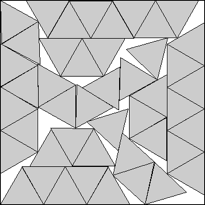
It was discover this month (May 2026) by Emerson Connelly and I found it on the legendary site Erich's Packing Center, maintained by Erich Friedman for the last 30 years. Erich's site has pages for dozens of different combinations. (Pentagons in Dominoes is one I rather like.)
I've known about this site for ages but when I revisited it yesterday I was astonished to find we have just entered a sort of Golden Age of Packing Problems. Of the 45 arrangements of equilateral triangles in squares found on the site, stretching back to 1996, 27 (60%) have been discovered in the last two months, April and May 2026! That's about one every other day.
And it's not just triangles in squares. Across the many different combinations of shapes hosted on Erich's site 46 have seen updated records in 2026, nearly all in that same two months.
What accounts for this huge upsurge? I asked Copilot and it trawled the internet and proposed a combination of several factors
- Faster and more sophisticated search algorithms
- Dramatically greater computing power
- Widespread parallel experimentation
- Increasing use of AI/heuristics
- Rapid online collaboration
- A problem structure that rewards brute-force discovery
In some ways the problem resembles the search for bigger and bigger prime numbers. Packing problems have practical importance in manufacturing and transport (and prime numbers have practical importance in cryptography) but the search for new records and the application of such extraordinary human ingenuity and massive computing power is not motivated from practical considerations at all. I guess it comes to the spark of human curiosity and the attraction of a challenge.
And perhaps these records are a little like athletic ones; there is scope for a potentially endless series of small improvements and we always strive to reach them.