

Obeli (singular: obelos) were marks Greek editors and scribes made in the margins of manuscripts: annotations with a variety of meanings, such as drawing attention to passages that might be spurious, making emendations, marking paragraphs and new sections, and so on. They are the distant ancestors of the proofreader's marks still in use by editors today.
They have beautiful and exotic shapes and even more beautiful names. The ones in the title of this post are the Coronis, the Dotted Diple, the Dotted Obelos, the Downwards Ancora and a different Dotted Obelos which has become the modern day division sign. These have Unicode encodings, so I could put them in the title, but not all obeli have encodings. Here are some drawings I made of other, based on my reading of the Wikipedia articles Obelisms and Aristarchian symbols.
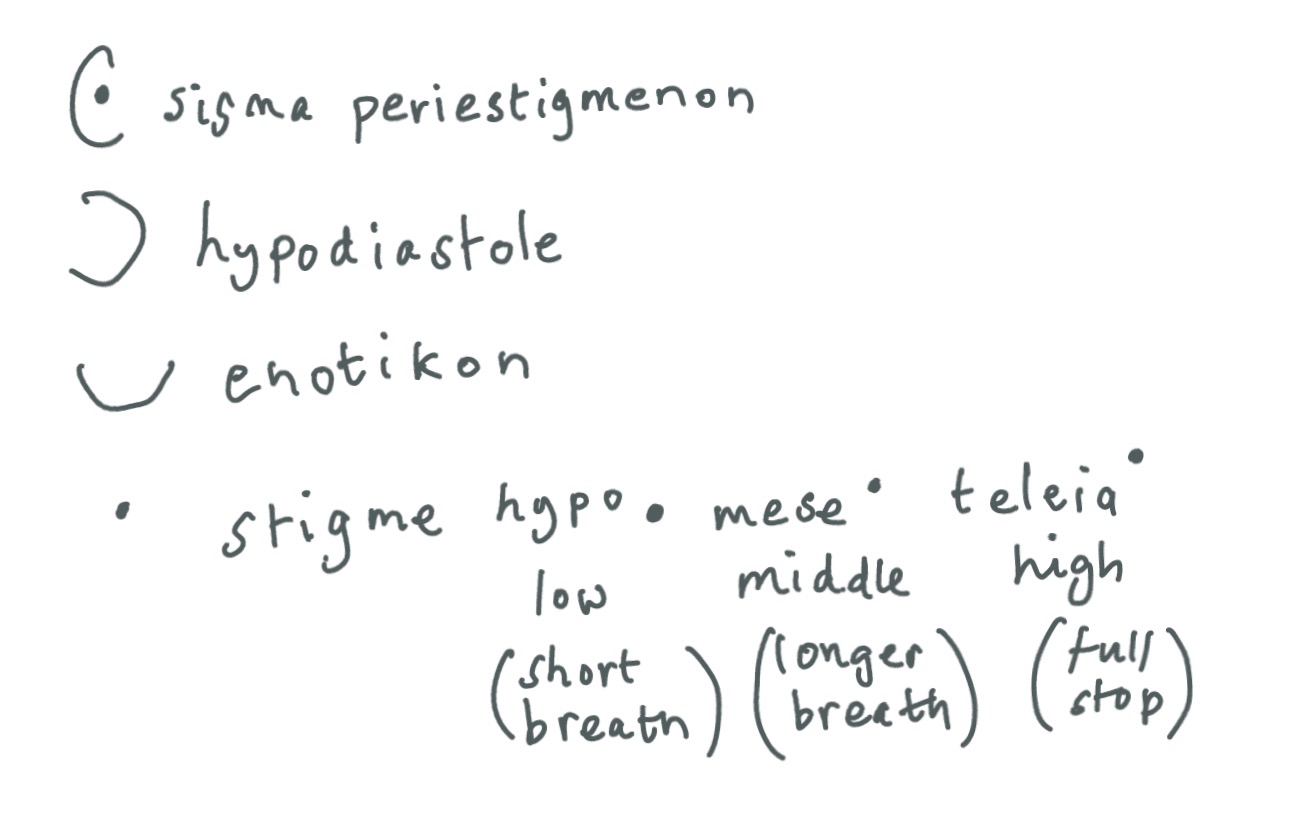
In the three types of stigme, "mark", you can already see the beginning of modern punctuation, although telling the difference between low and middle, or middle and high must have ben a bit hit-and miss sometimes. So now we keep them all on the same level, give low a tail, and make middle a hybrid of low and high. Genius or what.
, ; .
Obelos has an interesting etymology. It came into OE from Latin obelus, a borrowing from Greek ὀβελός, which meant a pointy thing such as a spit or a lance or a needle, and I guess it came to be applied the kind of obelos this post is about because some of these marks look a bit pointy or like needles.
The same root gives us obelisk, "little obelos", the name the Greeks used for the tall slender four-sided monuments of Ancient Egypt. You can see one of these on the Embankment in London, carried far from its original home, and usually known as Cleopatra's Needle. Quite a few of these obelisks were removed from their original locations, many in Roman times, and today I believe more olelisks survive outside Egypt than in the country itself.
We also have the Obol, an Ancient Greek coin worth of a Drachma, which itself meant a "handful" (of obols) and I have read that at an early period in Greek history iron nails might have been used a currency and, if so, that would account for the later name of the coin.
The Latin abbreviation of obolus, ob. was borrowed into Middle English to mean a happeny ½ d and an obale was the ale you could get for ½ d.
That's my 2p worth,