OU blog

Personal Blogs

Learner as individual or as a community

Visible to anyone in the world

Sannino (2011) poses the following question:

Is the learner to be understood primarily as an individual or as a community?

This question is key to my research.

It is based on the concept of community of practice developed by Wenger (1998) and Lave and Wenger (1991).

However, this might be seen as a one-dimensional approach. The theory of expansive learning (Engeström 1987) calls for a more multidimensional approach: communities as learners, transformation and creation of culture, horizontal movement, hybridization, formation of theoretical concepts.

The theory of expansive learning uses the metaphor of expansion.

It has been useful in studies of non-traditional, hybrid and multi-organizational settings.


References

Sannino, A. (2011) Lecture handout from the Building competencies in and for work course. Helsinki: University of Helsinki.

Permalink 1 comment (latest comment by Carlos Montoro, Monday 28 March 2011 at 10:35)
Share post

Slow

Visible to anyone in the world

My progress reading Engeström's 1987 book on expansive learning is slow.

Chapter 2 is proving much harder to read than expected. I only managed to get through 40 pages yesterday.

Today's aim: finish Chapter 2 and do some work on PR06. Can't spend all day working on one thing only.

Also today: must go shopping and exploring the routes to CRADLE and the Institute of Behavioural Sciences ahead of Monday's first day of class and 'work'.

Permalink Add your comment
Share post

Expansive learning

Visible to anyone in the world
Edited by Carlos Montoro, Friday 14 January 2011 at 09:32

I'm reading Engeström's 1987 book on expansive learning*. I had been putting off reading this book because at first glance it appeared too complex. But this is the time now because Engeström has invited me to attend his course on expansive learning starting next Monday. What a fantastic opportunity!

And actually, having read the first few pages, the book is not at all as complex as I thought. I think I was under time pressure the first time I looked at it.

What I find hard to follow are some of Engeström's interpretations of the work of others. He often includes a quotation only to destroy its underlying argument in a couple of short sentences. I look back at the quotation and I can't see what he's interpreting. Of course he's operating on a whole different level, but I might also be limited by not knowing enough about the wider picture (conceptual, ideological, historical) and not having read the books he refers to.

One thing strikes me though. So far he's only saying that learning should be expansive, creative, not defensive or repetitive. This makes sense. He's also saying that the individual doesn't exist in isolation, and neither does his/her learning. This seems to me to be a simple fact. But I know it's not. I can accept this because of all the reading I've done up to now, especially the works of Vygotsky and Leontiev.

Anyway, back to work.

PS Fascinated at how a single Helsinki City Council employee managed to single-handedly create a little ice rink since before dawn for the delight of a two-year-old boy on ice skates and her mum.
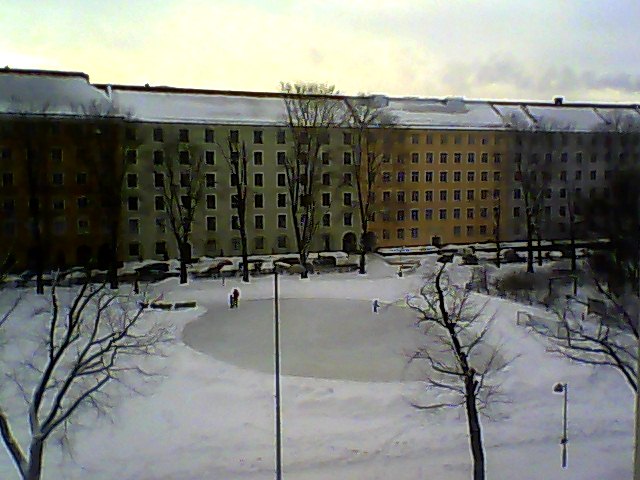
Little boy on ice rink.

Picture: Boy on ice rink.

* Engeström, Y. (1987) Learning by expanding: An activity-theoretical approach to developmental research. Helsinki: Orienta-Konsultit.

Permalink Add your comment
Share post

COMPLEX STRUCTURE OF ACTIVITY

Visible to anyone in the world
Edited by Carlos Montoro, Wednesday 24 November 2010 at 17:40

I need to write this down here before it evaporates into thin air. Engeström's complex structure of activity has proved to be extremely helpful in my research, but the more I work with it the more I find that its one-dimensional and linear nature doesn't quite capture what goes on in real life. I'm working on a three-dimensional version of it, adding one more element which I think is fundamentally missing, and would like to replace the arrows with channels where energy flows freely, just like blood in the heart.

Just an idea. I know it might be crazy, but I need to explore it just to have some peace of mind that I didn't let it go unnoticed.

Permalink Add your comment
Share post

This blog might contain posts that are only visible to logged-in users, or where only logged-in users can comment. If you have an account on the system, please log in for full access.

Total visits to this blog: 164176