Edited by Richard Walker, Tuesday 28 July 2026 at 00:12
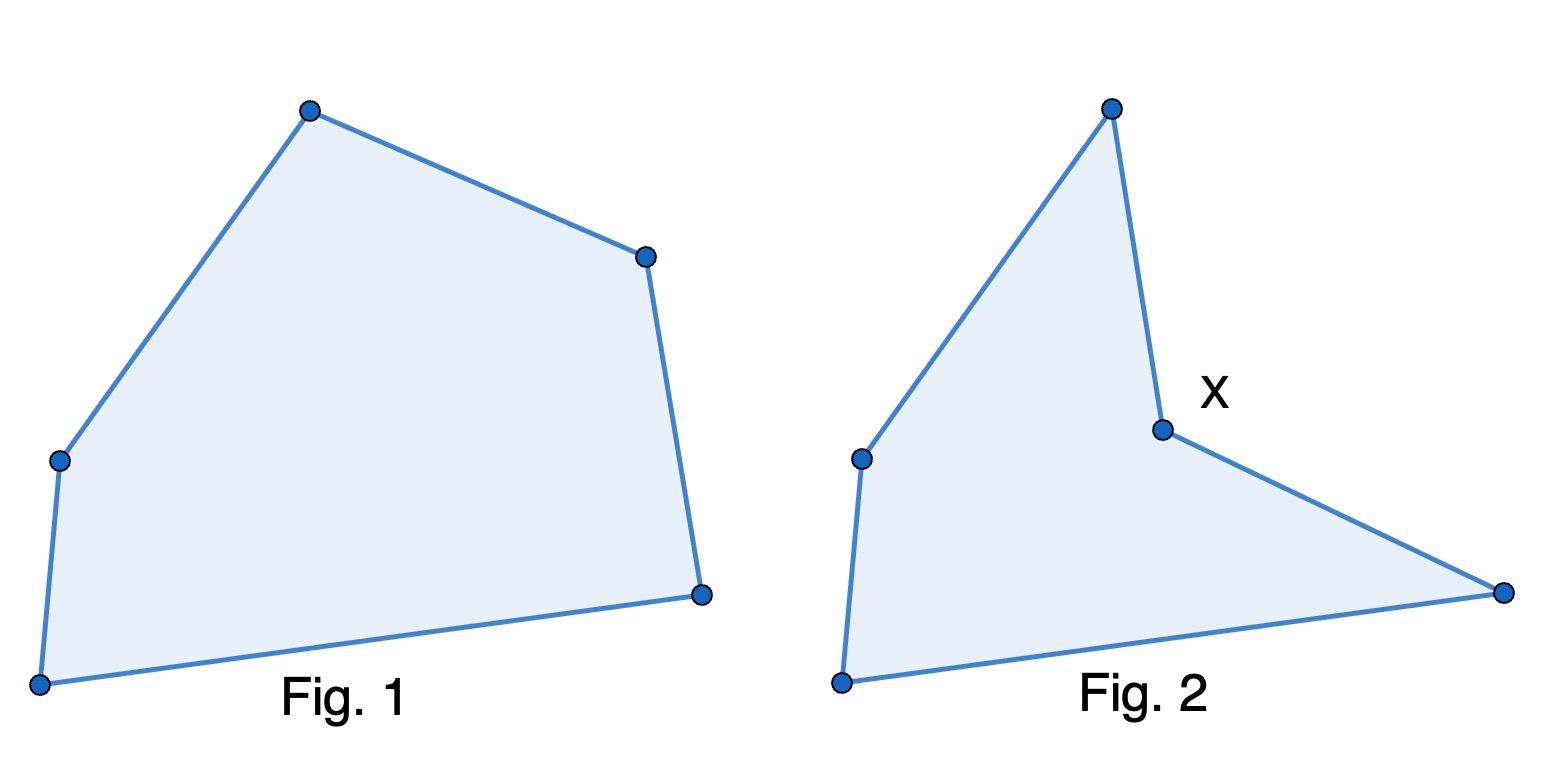
A convex polygon is one that has no reentrant corners, or to put it differently, has no interior angles greater than . Figure 1 below is convex; Figure 2 is not.
An acute angle is one that is less than a tight angle, that is, less than .
Prove that a convex polygon with sides can never have more than acute angles and that for any it is possible to construct a polygon with exactly acute angles.
Odom's Problem: Out of 74 Solutions the Winner is...
Monday 29 June 2026 at 12:16
Visible to anyone in the world
Edited by Richard Walker, Monday 29 June 2026 at 20:44
At the start of this month I wrote about the following problem.
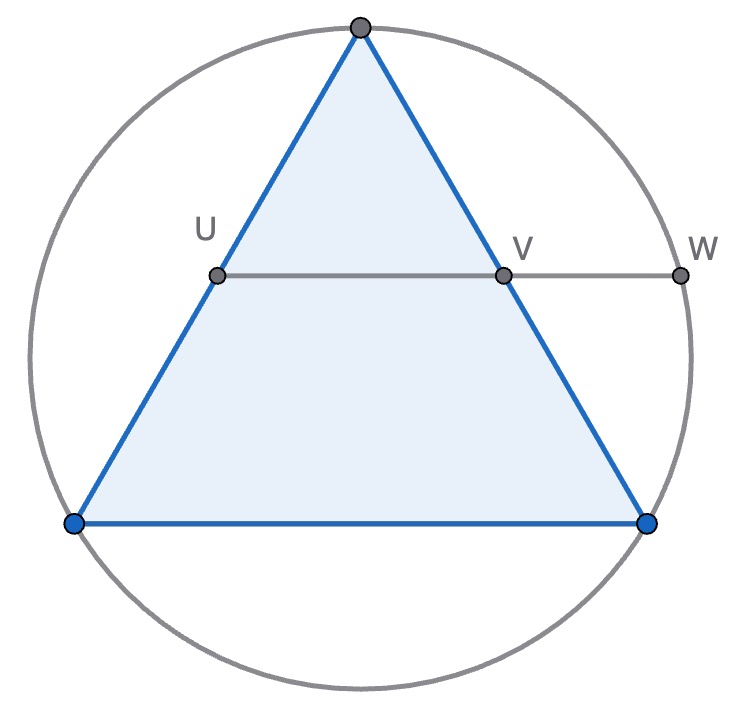
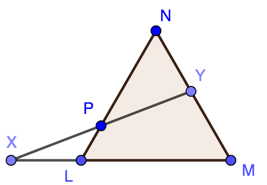
Inscribe an equilateral triangle in a circle. Draw a line through the midpoints and of two of its sides, to meet the circle at .
Show that is equal to , the number of the Golden Section.
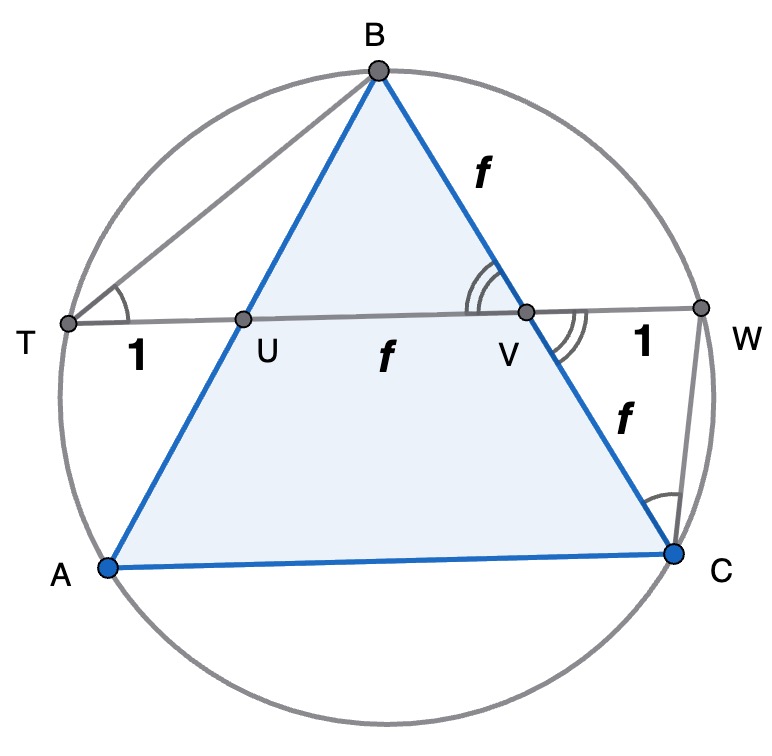
This elegant result was proposed by George Odom as problem E3007 in the American Mathematical Monthly in 1983 and the best solution out of the 74 receive was published in 1986. Here is the miraculous solution given by Jan van de Craats. I have drawn my own diagram and provided slightly more explanation but not changed the underlying proof at all. Here is the diagram above but with some additional lines and labels.
Take the length of as and suppose . By symmetry . Because the small triangle is equilateral and is the midpoint of we have .
Because and are subtended on the circumference of the circle by the same arc the angles there are equal. Angles and are equal, because they are vertically opposite. Hence triangles and are similar.
The ratios of corresponding pairs of sides in these two triangle must therefore be equal, so we have
and rearranging gives or , the equation whose positive root is , the number of the Golden Section.
(Jan van de Craats' write-up was terser; he just gave the diagram above and underneath wrote
relying on the Intersecting Chords Theorem, but I thought it would be better to use similar triang;es and not assume knowledge of that theorem.)
Footnote: I quite liked my own proof but the one above is far, far nicer, which I suppose is the reason it got published. Mine was a worthy effort but really just an 'also ran', along with the 74 other ARs.
Solution to Earlier Problem with Two Equilateral Triangles
Monday 18 May 2026 at 22:15
Visible to anyone in the world
Edited by Richard Walker, Monday 18 May 2026 at 23:25
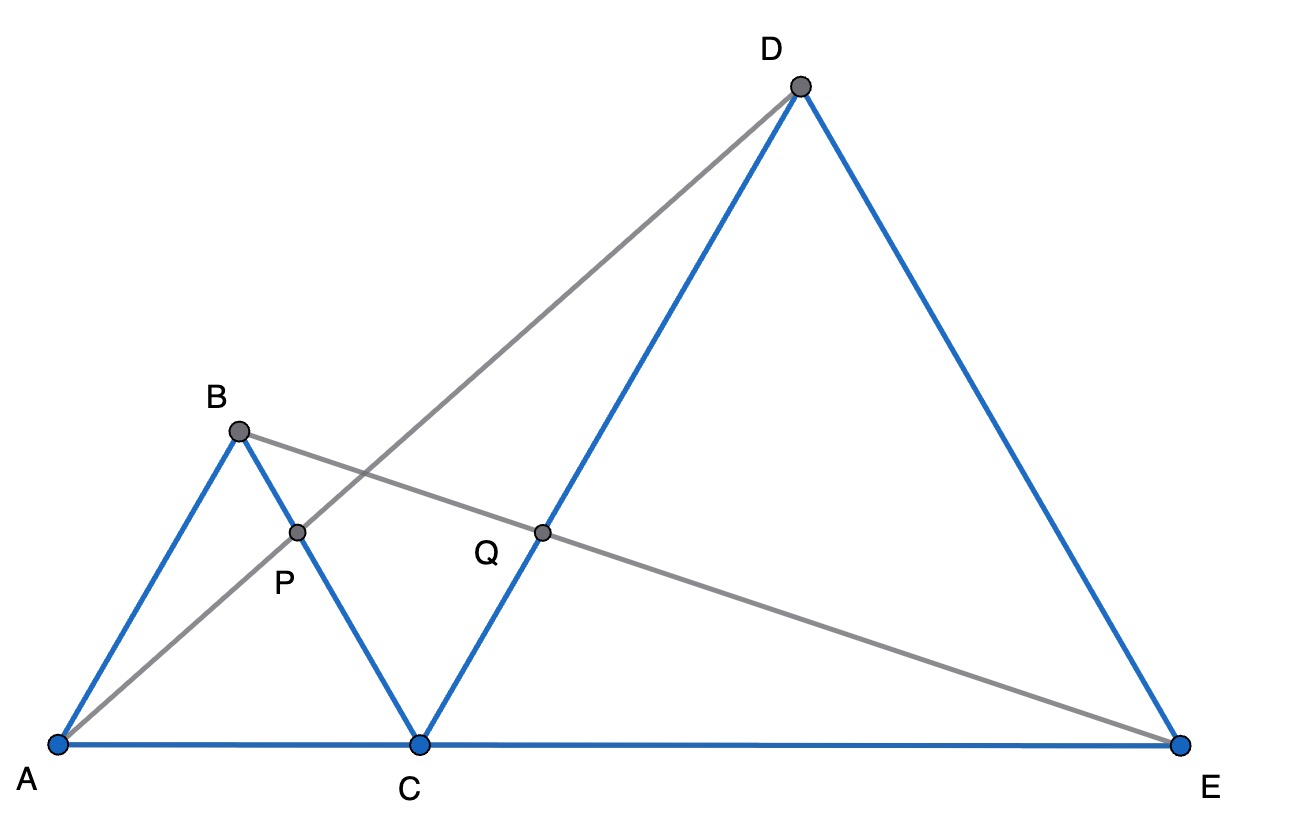
This is a solution to the problem I posted 16 May 2026.
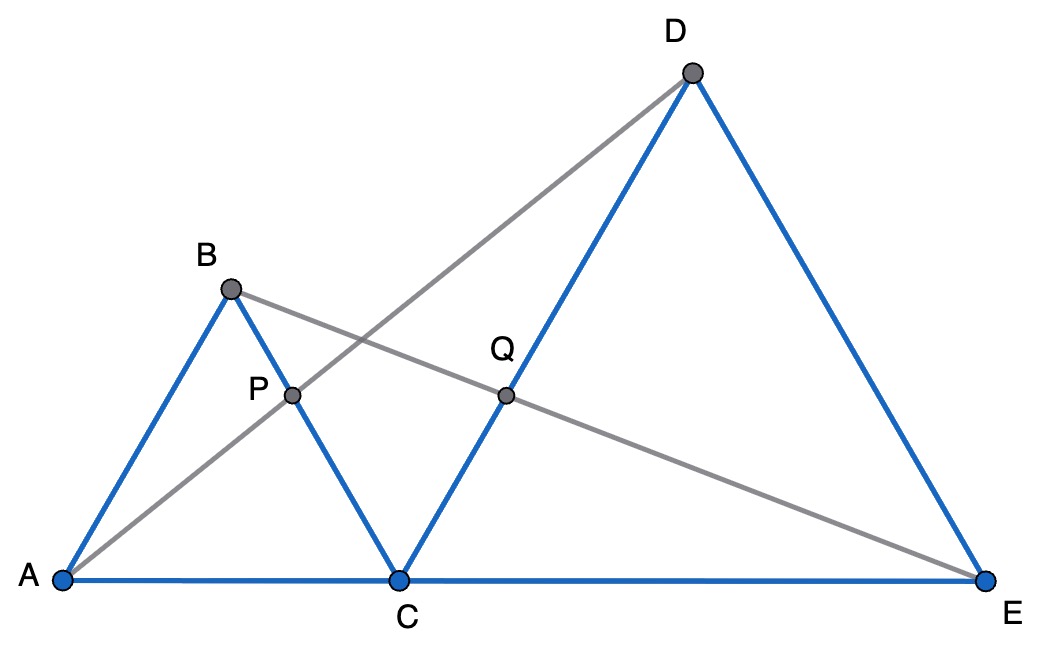
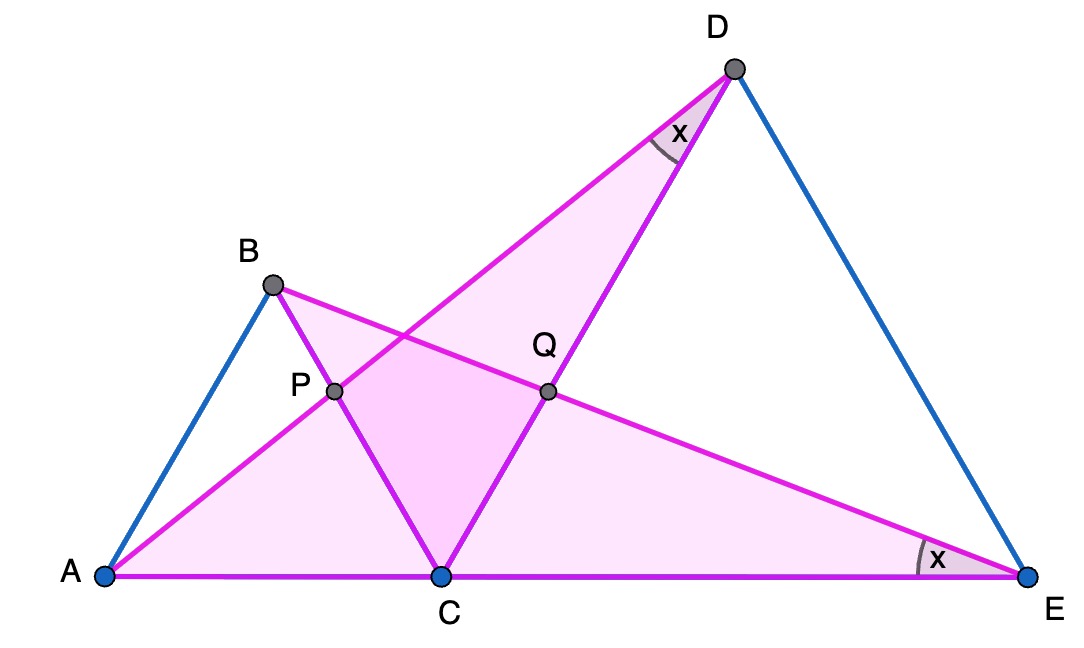
In the diagram triangles ABC and CDE are equilateral, with points A, C and E lying on a straight line. The problem is to prove CP and CQ have the same length.
There are probably many proofs - for example using coordinate geometry or complex number - but here is a short one using Euclidean geometry.
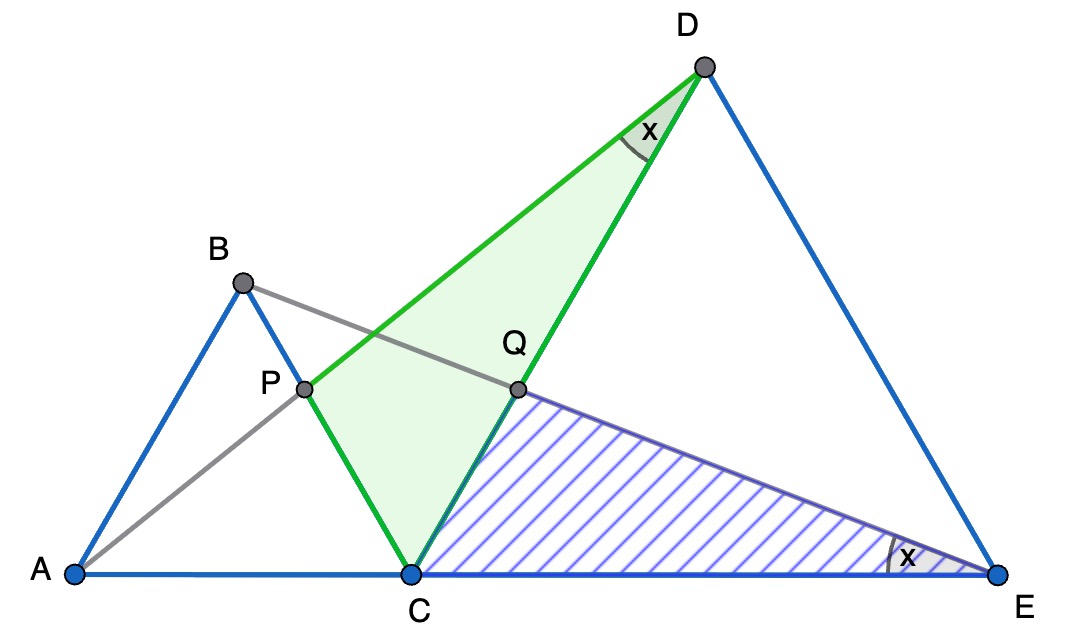
In the second diagram the coloured triangles ACD and BCE are congruent ('two sides and the included angle'), because AC = BC, CD = CE, and angle ACD = 120° = angle BCE . The two angles marked are therefore equal.
In the third diagram the coloured triangle CPD and the shaded triangle CQE are congruent ('two angles and the included side'), because angle PCD = 60° = angle QCE, angle PDC = = angle QEC and side CD = side CE.
Edited by Richard Walker, Wednesday 15 April 2026 at 22:10
I saw this problem on Mind Your Decisions.
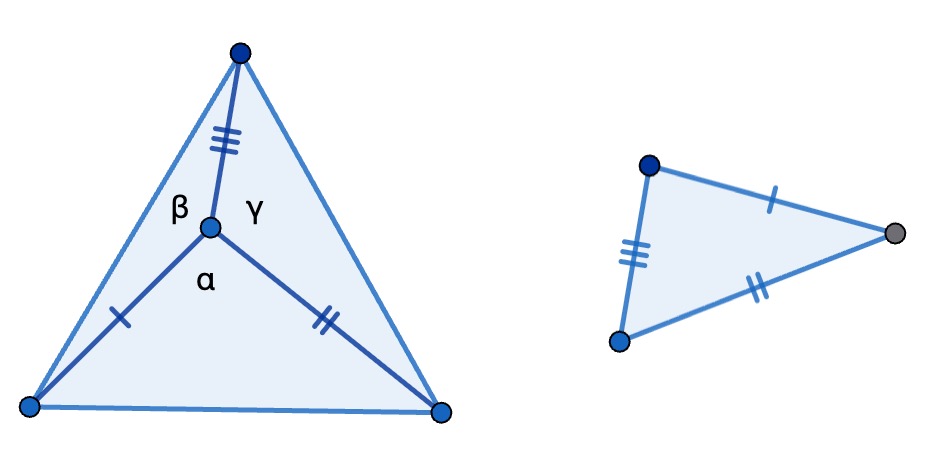
At left is an equilateral triangle. From an arbitrary point in its interior we draw line segments to its vertices, making angles , and as shown. If now we construct a second triangle (right) whose sides are equal in length to these three line segments, as indicated by the tick marks—What will the angles of the new triangle be?
I have never seen this before and have not viewed the solution. But I have worked out what the answer must be, just not proved it yet. And it's a truly beautiful result.
I wonder if it can be generalised to non-equalateral triangle? Or to a square?
Edited by Richard Walker, Friday 30 January 2026 at 13:17
Sangaku were geometrical puzzles from the 18th, 19th and early 20th centuries, painted on wooded tablets and hung in Japanese temples. Here is a problem I came across which is either a Sangaku or inspired by that tradition. It is very simple to state.
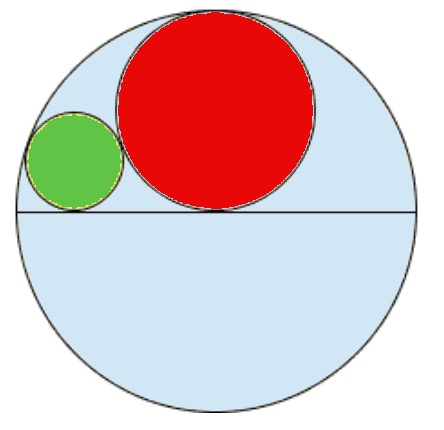
Inside a circle another smaller circle is drawn which is tangent to the bigger circle and to a diameter of the bigger circle.
An even smaller circle is then drawn which is tangent to the diameter and to both the other circles, as shown in Figure 1.
Figure 1. The green circle is tangent to the red circle, the diameter and the enclosing blue circle.
What is the radius of the smallest circle, as a fraction of the radius of the biggest circle?
Can you see how to construct the smallest circle using straightedge (i.e. a ruler with no makings on it) and compasses? If you can it should help you answer the first question.
I had a lot of fun solving this problem which turns out to have a really nice answer. I'll post my solution, which I am pretty comfident is correct, at the end of the week.
Edited by Richard Walker, Thursday 6 April 2023 at 18:04
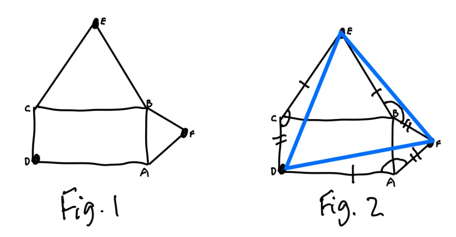
Suppose we take a rectangle and erect equilateral triangles on two of its side, as shown in Fig. 1. Show that pointsC, E and B are the vertices of an equilateral triangle.
Here is my proof: If we draw in the sides of the triangle (Fig. 2) we can see triangles DCE, BEF and DFA all have
a side of length | and one of length || an angle of 150 degrees included between those sides.
Consequently the three triangles are all congruent (the same as on another) and DE = EF = FD, so DEF is equilateral as required.
This blog might contain posts that are only
visible to logged-in users, or where only logged-in users can comment. If you
have an account on the system, please log in for full access.