OU blog

Personal Blogs

Richard Walker

Cracking the Japanese Temple Riddle

Visible to anyone in the world
Edited by Richard Walker, Friday 30 January 2026 at 22:18

Here is my solution to the Japanese Temple Problem (Sangaku) I posted here a couple of days ago.

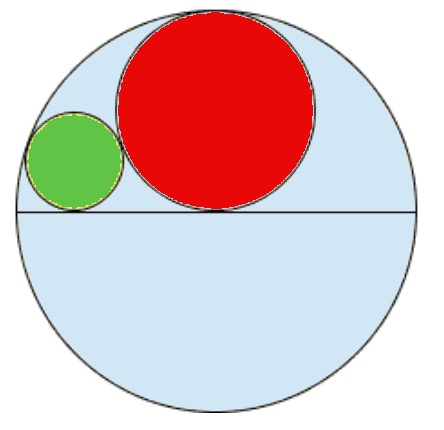
The problem ask for the radius of the small green circle in Figure 1 below, assuming the radius of the largest circle is 1 unit.
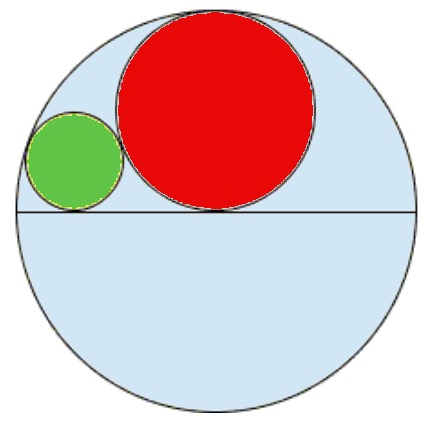
Figure 1. Sangaku problem

Figure 2 shows the construction, which is followed by the explanation.
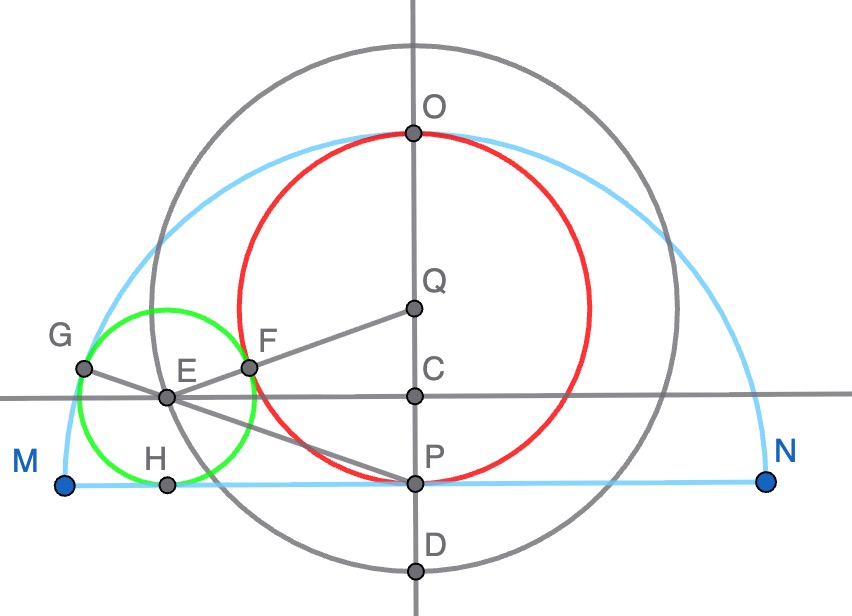
Figure 2. The construction

Explanation

O and P are respectively the points at which the red circle is tangent to the blue semicircle and its diameter MN. Q is the centre of the red circle.

Draw a line bisecting PQ at right angles. The distance CP is one divided by four and the perpendicular distance between any point on the bisector and the diameter MN must therefore also be one divided by four .

Next draw a circle with centre Q and radius three divided by four to intersect the bisector of PQ at E. Now draw the green circle with centre E and radius one divided by four .

To show this is the required circle we need to show it is tangent to the diameter, the red circle and the semicircle.

Because the radius of the green circle is \(\frac{1}{4\}) and that is also the distance between the bisector and the diameter, the green circle and the diameter must be tangent at H.

Because the distances QE and FE are three divided by four and one divided by four by the construction and QF one divided by two by assumption, QE = QF + FE and so the red and green circles are tangent at F.

Because CE is the perpendicular bisector of PQ, PE= QE = three divided by four , PG must pass through E, and PG = OE + EG = three divided by four + one divided by four = one . G therefore lies on the circumferences of the blue and green circles and must be the point at which the are tangent.

The answer to the problem is therefore one divided by four , a very neat result.

Permalink
Share post
Richard Walker

A Japanese Temple Problem — Can You Solve It?

Visible to anyone in the world
Edited by Richard Walker, Friday 30 January 2026 at 13:17

Sangaku were geometrical puzzles from the 18th, 19th and early 20th centuries, painted on wooded tablets and hung in Japanese temples. Here is a problem I came across which is either a Sangaku or inspired by that tradition. It is very simple to state.

Inside a circle another smaller circle is drawn which is tangent to the bigger circle and to a diameter of the bigger circle. 

An even smaller circle is then drawn which is tangent to the diameter and to both the other circles, as shown in Figure 1.

Figure 1. The green circle is tangent to the red circle, the diameter and the enclosing blue circle.

  1. What is the radius of the smallest circle, as a fraction of the radius of the biggest circle?
  2. Can you see how to construct the smallest circle using straightedge (i.e. a ruler with no makings on it) and compasses? If you can it should help you answer the first question.

I had a lot of fun solving this problem which turns out to have a really nice answer. I'll post my solution, which I am pretty comfident is correct, at the end of the week.

Permalink
Share post
Richard Walker

Transit Across a Purple Sun

Visible to anyone in the world
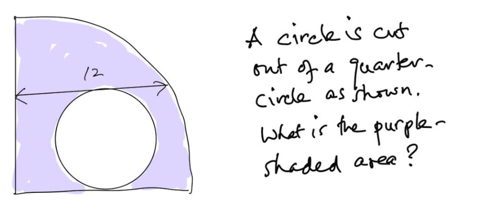
This very attractive geometrical puzzle is from Catriona Agg. It looks like there isn't enough information, although there is. See the Comments for my solution.


But even after solving it it still feels as though there is an information deficit somewhere!


Permalink 2 comments (latest comment by Jan Pinfield, Thursday 4 March 2021 at 15:07)
Share post
Richard Walker

A Geometric Puzzle

Visible to anyone in the world
Edited by Richard Walker, Sunday 11 October 2020 at 00:36

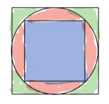
Here's an easy to understand geometric question, with a purely look-and-see solution. It comes from YouTuber Michael Penn but I have modified it slightly.

To be in the spirit of the traditional wooden Japanese temple offerings, called Sangahu, I have added decorative colours.

Question

If the larger square is 1 x 1 and so has area 1, what is the area of the smaller square?


Permalink 4 comments (latest comment by Hazel Shaw, Wednesday 14 October 2020 at 23:47)
Share post
Richard Walker

Samurai Puzzle - A Square in a Triangle

Visible to anyone in the world
Edited by Richard Walker, Friday 2 October 2020 at 09:23

This is a Sangaku-like puzzle (see https://learn1.open.ac.uk/mod/oublog/viewpost.php?post=230691)

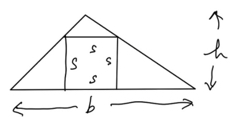
We have a square inscribed in a triangle of known base b and height h, as shown. What is the length s of the square's side?


I called this a Samurai puzzle because many of the original sangaku were the work of Samurai.

(Solution in Comments.)

Permalink 2 comments (latest comment by Richard Walker, Thursday 1 October 2020 at 23:34)
Share post

This blog might contain posts that are only visible to logged-in users, or where only logged-in users can comment. If you have an account on the system, please log in for full access.

Total visits to this blog: 3925279