Edited by Richard Walker, Tuesday 20 October 2026 at 14:24
Not knitwear but an umbrella term for expressions we use when we can't remember the word for something or can't be bothered to think what is; words such as
Thingamabob
Oojamaflip
Whatchamacallit
Thingamajig
Modern English has a very rich collection of words like this, with new ones being coined as recently as the second half the 20th century. I think the official name for this category of words is undifferentiated placeholders, rather a mouthful, and although it's not made it into the Oxford English Dictionary yet, the word kadigan seems to be an alternative popular amongst people interested in this kind of thing.
The origins of kadigan are debated. One suggestion is that it was coined by the American word lover Willard R. Espy around 1960 but the Useless Etymology websote suggest some other possibilities.
Can We Extend "A" Paper Sizes To 3D? If So, What Are The Dimensions Of An A0 Block?
Sunday 18 October 2026 at 16:04
Visible to anyone in the world
Edited by Richard Walker, Monday 19 October 2026 at 00:24
If you cut a sheet of A4 paper in half you get two sheets of A5, which have half the area but maintain the same proportions of length to width.
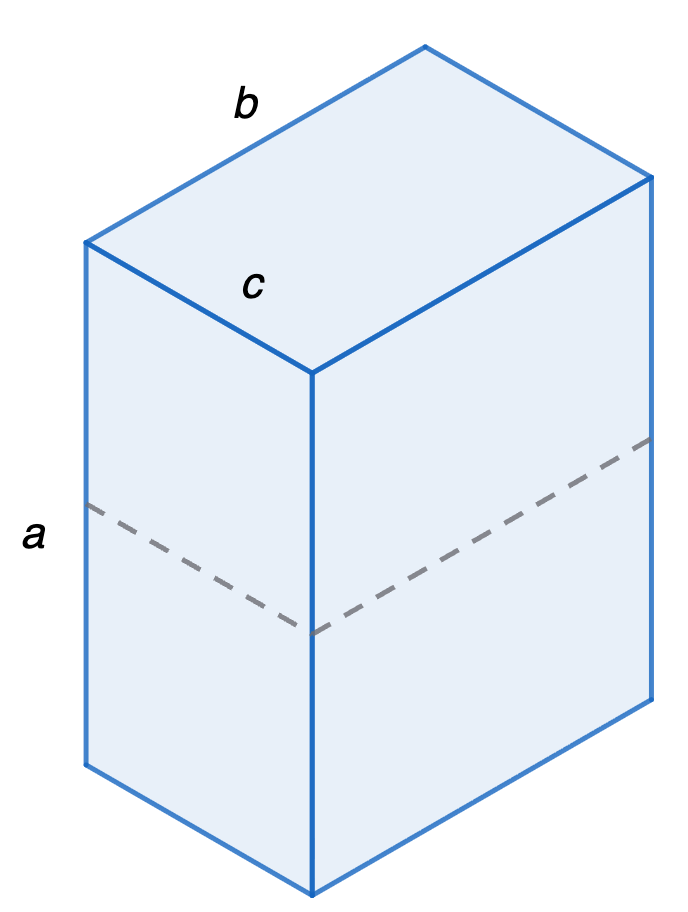
Can we do the same in 3D? Yes we can!! Imagine a block with dimensions , and , with being the longest side.
If we "cut along the dotted line" and let be the longest side of the new blocks so formed, we need the proportions to remain the same,so we can write
or . Solving gives
and . For a proper "A" system we need A0 to have a volume of 1 m3, in the same way as an A0 sheet of paper has an area of 1 m2. So
m3 and making the dimensions of the A0 block 1260 mm x 1000 mm x 794 mm.
This extends naturally to higher dimensions, even though we can't physically construct the higher-dimensional blocks we can describe them mathematically. In four dimensions, the A0 hyperbox would have dimensions in the ratio and higher dimensions follow the same pattern.
"The score!" he burst out. "Three goes o' rum! Why, shiver my timbers, if I hadn't forgotten my score!"
Robert Louis Stevenson, Treasure Island, Ch. 8.
Wiktionary suggests this expression refers to a wooden ship being pounded by rough seas, so its 'timbers shake' and its sailors experience 'fear' and 'awe', so the sense is of shivering or trembling with fear, both ship and man.
But I don't think this explanation is correct. I think in this context shiver literally means split apart, the image is of the ship breaking up. One definition of shiver in the OED is 'To break or split into small fragments or splinters', recorded from the 12th century.
It's sometimes suggested that it's a purely literary or comic phrase but Etymonline gives several examples of very similar phrases in which 'my timbers' get started, smited or split, and suggests the tantalising idea that sailors might have used timbers as slang for arms and legs, so it could have been a profanity, similar to blimey, 'blind me'.
And what is the etymology of shiver? It's thought to come ultimately a Proto-Indo-European root *skei-, 'split', so it shares it origin with a fascinating medley of words, including
shin = a bit cut off
science = originally to separate things out, to know
nice = originally careless or ignorant, from Latin nescius, 'not knowing'
schism = a rift between factions
shit = waste got rid of
shingle = wooden rooftile
shed = cast off
ski = a piece of wood split off
To finish off here's a joke
'I' before 'E', except after 'C'. Disproved by Science.
Edited by Richard Walker, Friday 16 October 2026 at 11:31
Another one from Perelman's book.
In each row A - C identify the expression with the largest and smallest values
A. , ,
B. , ,
C. , ,
Scroll down for answers
Answers A. is only so it is smallest. is clearly bigger than so it is largest. B. is less than so it is smallest. is clearly bigger than so it is the largest. C. is much less than the gigantic , but this time the 'power tower' is the winner because , clearly greater than .
St Hubert, Patron Saint of Mathematics, and a Devilish Puzzle
Wednesday 14 October 2026 at 22:49
Visible to anyone in the world
Edited by Richard Walker, Wednesday 14 October 2026 at 22:51
Something prompted to wonder : Does mathematics have a patron saint?
So I looked it up and was quite surprised to find it does. St Hubert of Liège is the traditional patron saint of mathematics.
He was a real person, a 7th century Frankish nobleman, who was passionately fond of hunting (and hunting is also part of his patronage). One day while out hunting, so the legend goes, he encountered a stag with a crucifix between its antlers and was converted to Christianity on the spot, going on to become an important church leader and widely venerated in the Middle Ages.
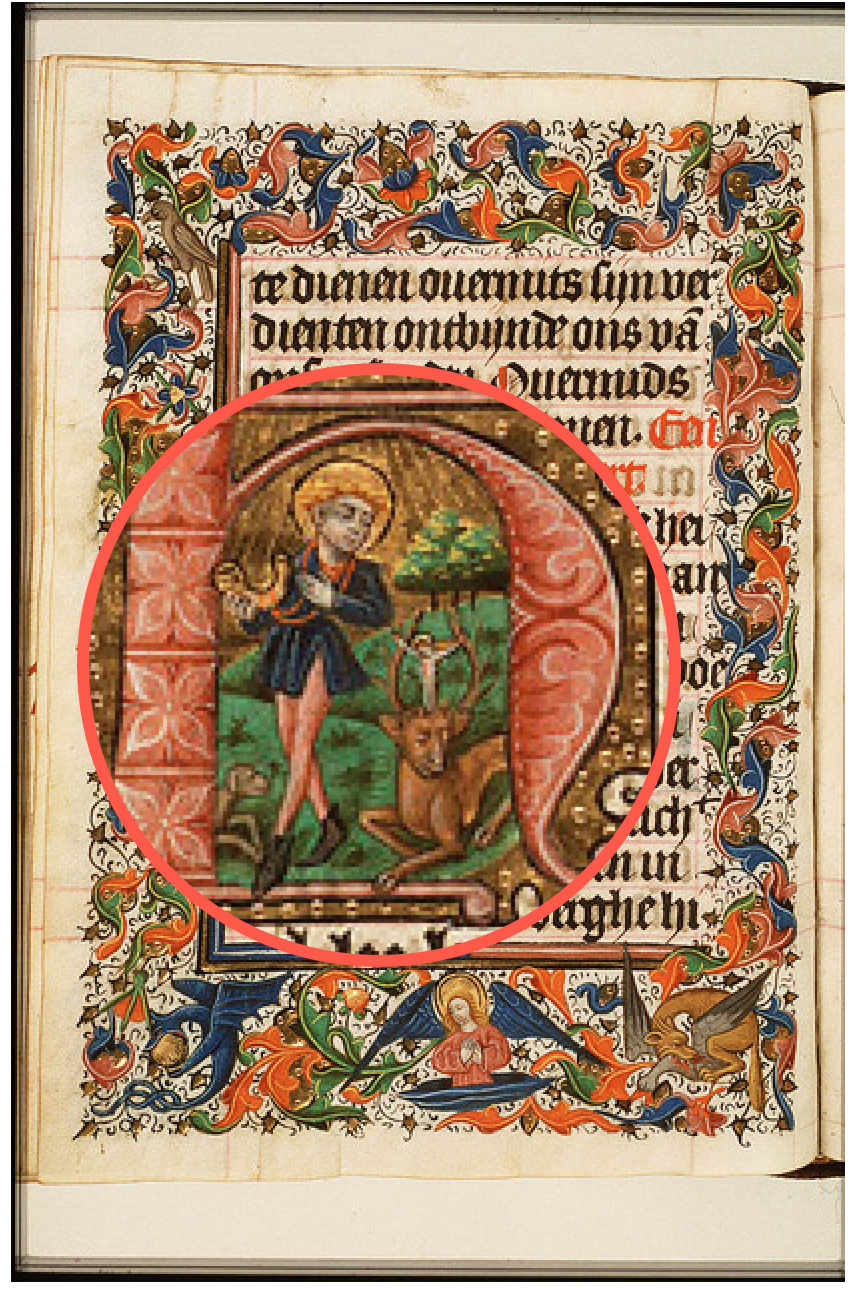
Here is a much later (ca. 1470) picture of the conversion scene. I have enlarged the illustration. I can't really make the text out but I could see 'S. Hubert' there.
St. Hubert of Liège with a hunting horn, the stag with the crucifix at his feet. National Library of the Netherland, Public Domain.
Why the connection with mathematics? Well to be honest there is no contemporary link in the literature and the most likely explanation is that a group of mathematicians adopted his as their patron, perhaps because he was so well-respected. But a rather nice legend has grown up, one that I rather like.
St Hubert's great piety was taken by the Devil as a challenge. So the latter posed Hubert a fiendishly difficult mathematical problem, in the hope he would be distracted from his prayers. But Hubert managed to calculate the answer to the problem without allowing himself to be diverted from his religious observances, and so the Devil's plan was thwarted.
Only a story... but if only we could know what the devilish puzzle was!
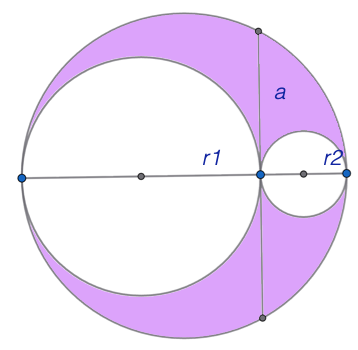
Can You Prove that if n is an Integer > 1 then n^4 + 4 is never a prime? And what about Sophie Germain?
Tuesday 13 October 2026 at 21:01
Visible to anyone in the world
Edited by Richard Walker, Tuesday 13 October 2026 at 22:19
I found this in another book by Yakov Perelman, Algebra Can Be Fun (1979).
Here's a near solution
Write as . Now notice the first three terms are equal to , so we have .
But we know that for any and we have , the so-called 'Difference of two squares', and applying this to the expression above we get after rearranging slightly, . Providing these are both and thus we have found factors of and it cannot be prime.
Rather neat.
This identity is usually attributed to Sophie Germain, a mathematician and scientist, who amongst other things did important work on Fermat's Last Theorem in the early 19c.
When the Eiffel Tower was built the names of 72 (exclusively male) scientists were engraved on it. Now as a result of student campaigning and support from the Sorbonne, that wrong (as it seem to me to be) is being righted and the names of 72 female scientists including Sophie Germain have been approved and will be added to the monument in January 2027.
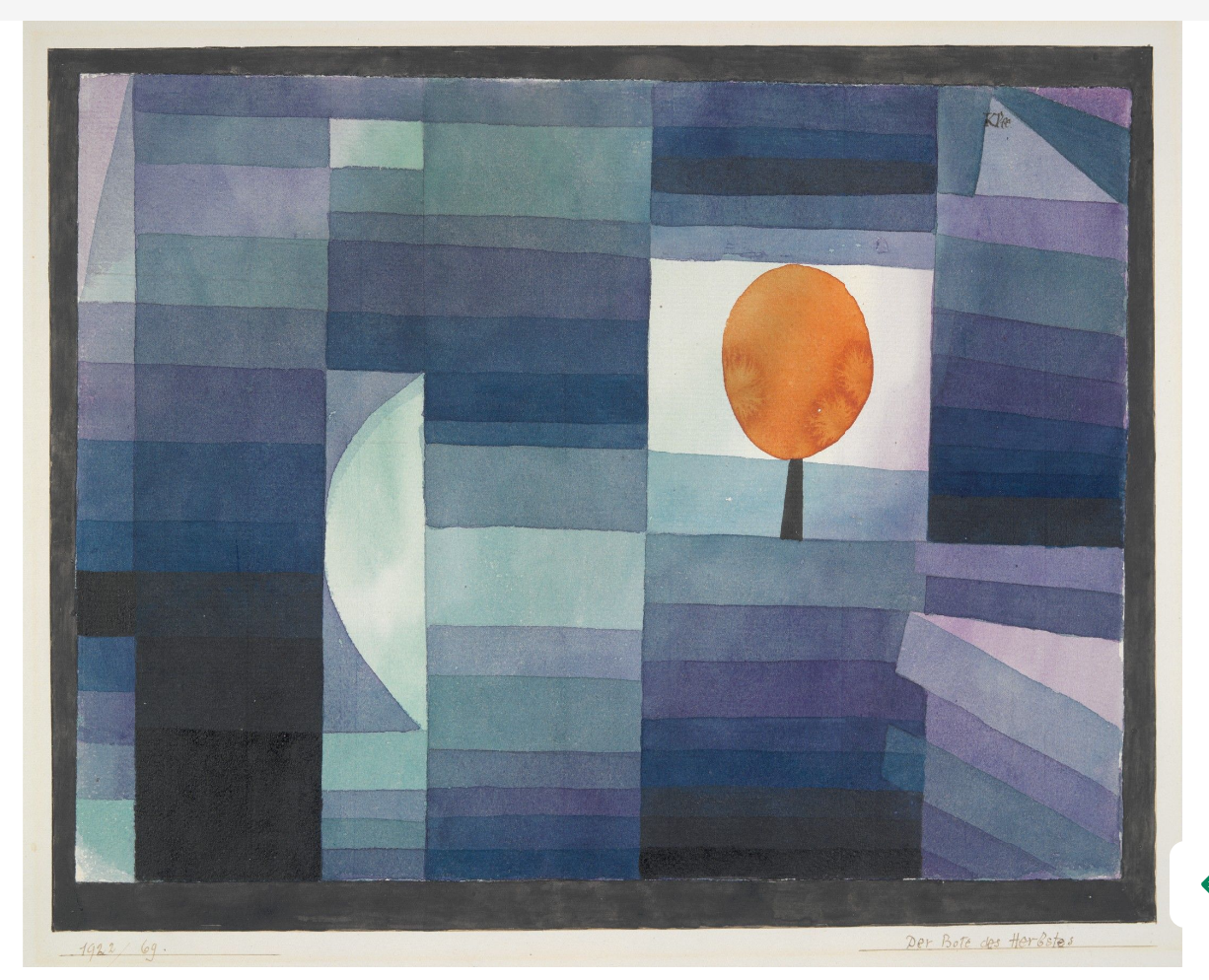
Today a harbinger means a messenger or foreteller, but it comes via French from a Frankish word *heriberga, 'lodging', and originally had the sense of an army camp. The sense of a messenger developed from the name given to an official sent on ahead with the news that the army needed putting up at yours ('Oh goody!').
In German the painting is called Der Bote des Herbstes, Bote meaning 'messenger', presumably cognate with English bode, 'warn of', and Herbst being the German for autumn; essentially the same word as harvest. The Old English for autumn was hærfest and most extant Germanic languages use a similar word, but we borrowed the French word automne.
Here's a snatch of Old English poetry; the four seasons —
It's interesting that we can make this out in parts, "Winter be-eth coldest, Lent (so Spring) rimiest (frost is still described as rime), Summer sunlightiest, Autumn is ??". The last word is harder to guess but when I looked it up it means 'gloriousest' (this word really exists!)
Edited by Richard Walker, Monday 12 October 2026 at 00:53
I found this puzzle in the 1950 book Figure for Fun, by Yakov Perelman, where it is problem 29.
It concerns two workers who live in the same apartment block and work in the same establishment. Both walk to work each day and the first worker takes 30 minutes for the journey, whereas their faster colleague takes only 20 minutes.
Suppose the slower worker sets off 10 minutes before the faster and they move at their usual speeds. When will the faster worker catch the slower one up?
Scroll down for my solution.
Solution
(This is one way to solve the problem but I expect other approaches are possible.)
Suppose the distance is km. Then the speed of the slower worker must be km/h and that of the faster km/h. After minutes the slower worker will have travelled km.
Now we calculate how far each will have travelled at time hours (after the faster worker sets off.
Slower worker:
Faster worker:
The faster worker will have caught up when these are equal, so , which reduces to or hours = minutes.
The Hearth, The Temple and The Kitchen : A Word Story
Sunday 11 October 2026 at 01:33
Visible to anyone in the world
I was thinking about Latin borrowings in early Anglo-Saxon.
I knew there quite a number of Latin words had already been adopted into Germanic languages on the Continent, before the Angles, Saxons and Jutes (the traditional names), had migrated to Britain, so I Googled for examples off these. An interesting one I came across was kitchen, reconstructed to be from an early Germanic word *kokina, a borrowing from Latin coquina.
If the borrowing was early enough, I reasoned, all modern Germanic languages would use similar words for kitchen, so I checked German and Dutch and the Scandinavian languages and they nearly all did. The only outlier was Icelandic.
An Icelandic kitchen is an eldhús, el-Tuss. and digging a bit deeper revealed this was the Old Norse word too, and it means 'fire-house', so it probably harks to back what kitchens were called before the borrowing of what may have been a prestige loanword *kokina (think of cuisine usedinstead of cooking).
What about the Temple and the Hearth alluded to in the title of this post? The hus part of the Icelandic word is recognizably the same as English, perhaps as used in words like smokehouse or icehouse. The other element eld means 'fire', in the sense of hearth, which survives as a rare Scots or North of England dialect word elding, 'kindling or fuel for a fire', and surprisingly eld is cognare with the first element Latin aedificium, 'building with hearth' = temple, because at some distant time temples were thought of as places containing a hearth, presumably because the hearth is the focal point of a home, and a temple is the home of a deity
The same Proto-Indo-European root is seen in words associated with heat or burning in several different languages, such English oasthouse, 'drying shed', Greek aether, 'upper air, and Welsh aidd, 'burning zeal'.
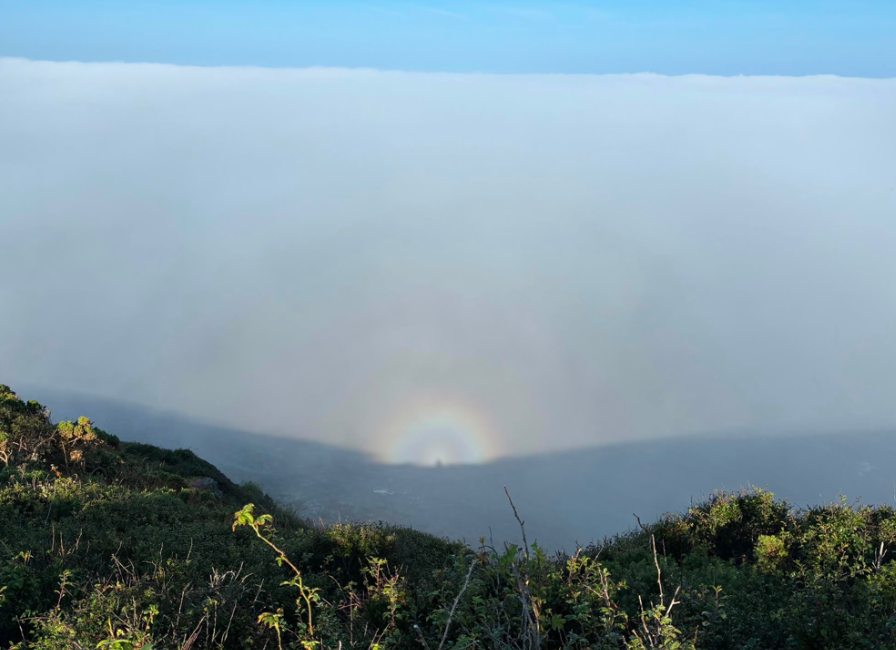
A friend of my daughter's snapped this Brocken Spectre near Abergavenny, in the Bannau Brycheiniog (Brecon Beacons).
When the sun shines from behind an observer onto a bank of mist, the observer's shadow may be cast on the mist and depending on the elevation of the sun the shadow may look like a giant figure, giving rise to the legend of the 'Brocken Spectre', named after the Brocken, a peak in the Harz mountains of northern Germany, where the condition are often favourable for seeing the phenomenon.
In this example the shadow appears tiny but we can clearly see the other feature of a Brocken Spectre: the observer's head is surrounded by a 'glory' – a ring of light like a halo. The ring has colours, in the same order as a rainbow, although distributed somewhat differently, but a glory is much smaller that a rainbow and caused by different mechanisms.
The water droplets in the mist are much smaller than the raindrops responsible for a rainbow, by a factor of about 100. The incoming light is back scattered and the colours are caused by the light waves interfering. But how does this back scattering happen?
Theory 1
The water droplets refract the light back. Unfortunately the water does not bend the light enough for this to be the explanation.
Theory 2
The physics of electromagnetic waves predicts the light can become a wave that travels round the surface of the raindrop and then emerges as a back scattered wave. This seems to happen but does not account for the amount of light actually back scattered.
Theory 3
More recent calculations have shown that energy can tunnel into a water droplet from light waves close by and after travelling round inside the droplet emerge as back scattered light, and that this effect can explain the observed brightness of glories. This is all explained in more detail in the excellent 2012 Scientific American article The Science of the Glory by H. Moysés Nussenzveig.
Can *You* Figure Out The Price of Grandad's Turkeys?
Friday 9 October 2026 at 01:09
Visible to anyone in the world
Going through a desk that belonged to my Grandad, I found an old bill but unfortunately the first and last digits of the total had faded and were no longer legible. All that can still be read is
72 turkeys £_67.9_
where the underscores represent the unreadable digits.
What was the price of each turkey?
I found this nice puzzle on Cut-The-Knot, that treasure store of problems. It was original a question in a Stanford examination. You can find my solution further down the page.
Solution
We can ignore the decimal point for the moment and just try to deduce the missing digits, let's call them X and Y, from the fact that X679Y must be divisible by 72, the number of turkeys. 72 is even, so Y must be an even digit; 0, 2, 4, 6, or 8.
Moreover 72 is a multiple of 9, and a number is only divisible by 9 if the sum of its digits is divisible by 9. The digit sum of the known digits is 24 and for each possible value of Y we can then work out what the corresponding value of X must be for the digit sum to meet this condition.
The possible combinations are
Y
X
Resulting number
0
5
56790
2
3
36792
4
1
16794
6
8
86796
8
6
66798
We also know that 72 is divisible by 8 and so the number we want must be divisible by 8 also. So now we test the candidate numbers in turn and only 36792 passes the test.
Finally 36792/72 = 511, so the price per turkey back then must have been £5.11
A Little Nautical Etymology : Starboard, Larboard and Port
Wednesday 7 October 2026 at 22:59
Visible to anyone in the world
Edited by Richard Walker, Thursday 8 October 2026 at 16:09
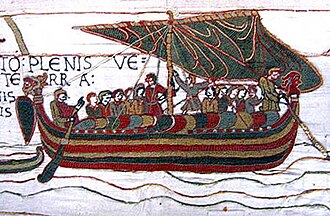
In this section of the Bayeux Tapestry, which shows Harold landing in Ponthieu, we can see the ship is steered by an oar, as was common at the time. Steering oars did not get replaced by rudders until a couple of centuries later. The steering oar was on the right-side of the ship facing forward, so that side of the ship was called in Old English steorbord, 'steer side', bord being the term used for the ship's side. I guess if you were a left-handed steerer you just had to live with it.
This has direct cognates in Germanic languages e.g. German Steuerbord, Old Norse stýriborð, and because of the influence these peoples had as seafarers the word was borrowed into Romabce languages, so we have e.g. French tribord.
Tracing the Proto-Germanic *steuro further back seems inconclusive, with more than one explanation appearing in the literature.
Turning now to larboard, the side opposite starboard was at first 'backboard', bæcbord in Old English, but by Middle English we have ladde-borde, which seems to mean the side the ship was loaded or unloaded; think of the modern word laden. Naturally this would be the opposite side from the steering oar.
However having starboard and larboard, although a pleasing rhyming pair, is a recipe for confusion give the similar sounds, and so larboard was been displaced by port, with similar connotations of being the side that comes alongside the quay, so now larboard is rare and archaic, and 'port and starboard' is the normal expression.
Picture credit: Wikimedia, Section of the Bayeux Embroidery showing Harold arriving in Ponthieu, Public Domain.
Why is Ice Slippery? What We Were Taught in School is Wrong
Monday 5 October 2026 at 23:42
Visible to anyone in the world
Edited by Richard Walker, Tuesday 6 October 2026 at 00:58
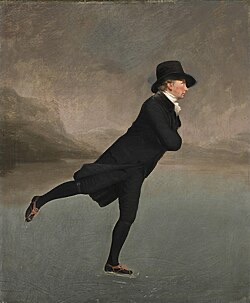
This iconic picture shows a minister gliding serenely across the ice, but how is thos possib;e. Why is ice slippery enouhgh?
At school we were taught the reason is the pressure of the skates melts the ice and the resulting water act as a lubricant. This is a wonderful explanation, put forward by James Thomson in 1849 based on the fact that pressure lowers the melting point of ice, and it seemed so satisfying that everybody took it for granted that it was correct and it was long taken as received wisdom.
But it can't be quite right; even if the pressure is sufficient to melt the ice when we are talking about ice skating, it is nothing like enough to explain how skis glide along (or why I fall over on icy pavements for that matter!)
So rival theories have been advanced. One is that friction could melt the ice. It's possible this could have an effect but we'd expect melt water from friction to trail behind the sliding object and so not provide much lubrication going forward.
A third idea, based on an observation by Michael Faraday, is premelting. According to this theory the water molecules in the interior of the ice are tightly locked into a crystal lattice that restrict their movement but ones on or close to the surface are bonded to fewer close neighbours, allowing them more mobility, so they can act rather like water. Computer simulations support this as a plausible reason why the surface of ice should act as though it is wet.
It's conceivable all three of the mechanisms outlined above play a part. But very recently a fourth idea has emerged: the skate or ski (or the sole of my shoe) disrupts the crystal lattice of the ice and creates a layer of disorder molecule that are not fixed in a lattice and yet not quite liquid water, but which can act a lubricant. So far this has only been investigated in computer simulations and at present other researchers are not sure how it should be interpreted.
So we have not finally answered the question 'Why is ice slippery?' but this new research does represent an important advance, and we have edged closer to understanding exactly what is happening.
A Bwbach, 'BOO-bahk', is a Welsh House-Goblin. Bwbachod are basically benevolent and will do useful chores, such as sweeping the floor, during the night, in return for a bowl of cream. However they have a mischievous side too and like to play tricks on teetotallers and priests.
As of September 2026 bwbach has been added to the Oxford English Dictionary!
'Bleen' : Comedian George Carlin's Number Joke Sparks a Tricky Puzzle
Saturday 3 October 2026 at 15:32
Visible to anyone in the world
Edited by Richard Walker, Monday 5 October 2026 at 18:01
The American comedian George Carlin once did a routine in which he said a new integer, called bleen, had been found between five and six.
The Nobel Prize in mathematics has been awarded to a California professor who has discovered a new number. The number is “bleen,” which he claims belongs between six and seven. [1]
This idea was taken up in a New York Times puzzle column. There they wrote
Suppose that a “new integer” is “discovered” between 5 and 6 called bleen, written B.
This is a little misleading and doesn't quite make sense; at bottom, we are not being asked to imagine any new integers have been discovered, but that we are going to represent the same old integers in a different number base, specifically eleven, so that for example whereas 42 normally stands for 4 tens and two units, if taken to be in the new system it would stand for 4 elevens and two units.
Most people nowadays will have met different bases in school and hexadecimal — base sixteen — is widely used in computing. In that base we write digits — we need sixteen of them now, so we co-opt some letters — .
And the Dozenal Society of Great Britain has long campaigned for us to use a system of counting in dozens, on the grounds that a dozen has more divisors than ten. Dozenal uses the digits .
Notice that in both these real-life examples, we add symbols representing the extra digits needed at the end of the list, and that would be the normal convention.
The genius of Bleen is that we break this convention and insert the extra digit, B for Bleen, between 5 and 6. So now we have . This quixotic decision makes the new system quite challenging.
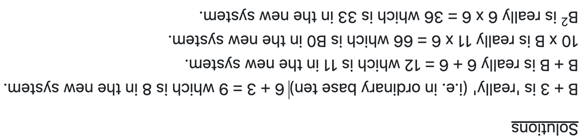
Frank Potter, who submitted the puzzle, then invited us to work these out in the new system
Petrichor is the distinctive smell of rain falling on dry ground, when a long hot drought is finally broken by a summer downpour.
I didn't know the word until today. What brought it to my attention was an article in Scientific American describing how climate change is affecting petrichor.
This is one of those words for which the etymology is not in any doubt. It was coined in 1964 by Bear and Thomas, writing in Nature[1].
I think it works as a word, in the sense that it is memorable, but we can see its Greek roots and you would hardly be able to work out its meaning from them. The first element is petr-, a shortening of petros, 'rock, stone'. The second element -ichor was the liquid that flowed on the veins of the Gods, according to Greek myth. Neither Greek word has been traced any further back and the conjecture is they are borrowing from an unknown pre-Greek language.
[1] Bear, I and Thomas, E., (1964) "Nature of Argillaceous Odour”, Nature201, 993–995.
Edited by Richard Walker, Wednesday 30 September 2026 at 23:14
The OED has this to say about the etymology of awkward
<awkadj. + ‑wardsuffix, i.e. ‘in an awk direction’; compare forward, backward.
Northward, southward, upward, downward, etc., are all familiar directions, but awk seems to take us somewhere different from any of those. perhaps into another dimension.
It seems to be a borrowing from Old Norse afug, 'turned the wrong way, back foremost', similar to the colloquial expression 'arse about face', and in Icelandic for example the related word öfugur means 'inside out'.
So awkward at first meant 'in a contrary direction' but has shifted semantically and now usually means clumsy or social inept, embarrassed ('An awkward silence fell'), uncooperative etc.; the original meaning is obsolete.
So where did afug come from? Etymonline suggests it is from a PIE root *apo-, 'from, away', surviving in Modern Greek with the sense 'from', e.g. Apo pou isse?, 'Where are you from?' (a useful conversational opener). It might also be the origin of Latin ab-, seen in words like abscond, absence, abstain, etc.
Awk once had derived words; awky, awkly and awkness, al sadly obsolete now, but easy enough to understand.
On Swans and Songs: Are they really the same word?
Tuesday 29 September 2026 at 00:36
Visible to anyone in the world
There's a decent amount of linguistic evidence that swan and song both come from an ancient root *swen-, '(make a) sound'. In Old English the bird was called swan, from a Germanic root *swanaz, 'singing bird', related to Old English geswin, 'song' and swinsain, 'to make a musical sound'.
This root *swen- is probably also the origin of sound, Latin sonus, Sanskrit svan, Irish seinn, 'play music'.
But, I hear you cry, the kind of swan we are most familiar with is the Mute Swan, which as its name implies doesn't make a very conspicuous or musical sound. How can calling it the singing bird make sense?
One theory runs like this. When the swan was dubbed 'singing bird' the people that named it were more familiar with a different kind of swan, such a Whooper Swan, which does produce a very noticeable sound.
Then as people and the Indo-European languages migrated south they met swans that didn't sing. But people were still vaguely aware that swan was something to do with singing, which produced a cognitive dissonance, which was resolved by inventing a myth.
The swan is silent all its life but then at the approach of death sings for the first and last time, its Swansong.
A word you might say to someone setting out on a journey and I've always imagined it expressed hope for a swift journey. But TIL it has a deeper meaning, because speed is from English sped or speod, which meant 'success, good luck'. So it was wishing that God would grant them a successful journey, rather than a rapid one.
I think we also see this meaning of speed reflected in the traditional phrase Speed the plough or Go. speed the plough, an agrarian blessing, as Wikipedia puts it.
Ultimately speed derives from a Proto-Indo-European root *spe- and this is also the origin of Latin sperare, 'to hope', so speed is related to despair, desperado, desperate, Esperanto, sperate, a rare and archaic legal term referring to a debt which has a reason hope of being repaid — and possibly also prosper, although this is debated.
Pick A Sequence Of Digits. Is There Always A Perfect Square Beginning With That Sequence?
Friday 25 September 2026 at 16:21
Visible to anyone in the world
Edited by Richard Walker, Friday 25 September 2026 at 18:34
This question occurred to me and I thought it ought to be true; it holds if we replace 'perfect square' with 'prime number', for example. Of course it is not new and many others have asked it, see [1] for a example proof.
Looking for an informal approach, I enlisted the help of Gemini. Here's, not a proof, but a process, that I think always finds such a square.
As an example here is the number of the Golden Section, , to digits. We can ignore the decimal point because it doesn't make a material difference.
Take the square root
Take the first figures and ignore the decimal point, so we have the integer and also take the integer that is one larger, . Square both these and we should find one of the squares begins with the required digits.
This procedure should let you find a number whose square commences with your birth year, all you need is the calculator on your phone.
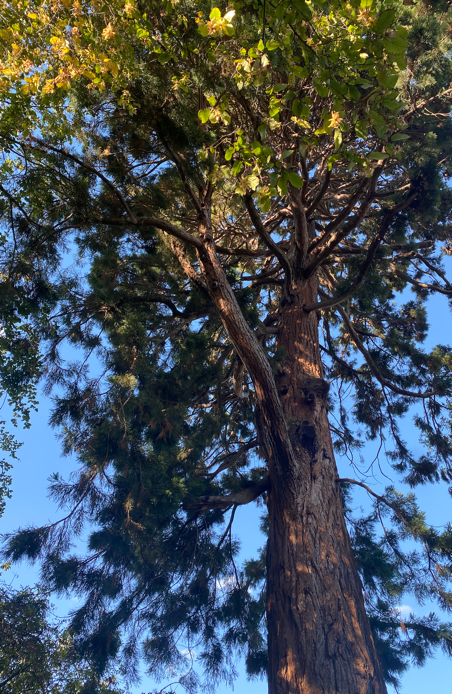
Here is a Giant Redwood (AKA as a Giant Sequoia) in a village near where. I often pass it and always stop to admire it. I couldn't get a good angle to take the photo so a bit of another tree is visible at upper left but I hope you can see the Redwood is very impressive.
In their native range, the Sierra Nevada in California, the species is threatened: a combination of historical logging, suboptimal fire policies that led to build-up of combustible material causing the fires that finally occurred to be far more damaging; drought which made trees susceptible to bark beetles; and climate change has reduced the number of trees to around 80k.
However in Victorian times seeds were brought to Europe and in the UK particularly owners of large gardens grew them enthusiastically. And the trees liked it here and have thrived, so now there are about 5k notable specimens and about 500k younger redwood trees. A small minority are Coast Redwoods and Dawn Redwood but the bulk are Giant Redwoods.
Of course most of these are young trees, as Redwoods go. The oldest is a mere 150 years old, compared with the 3,000 years some wild trees have reached. They grow fast here though; the tallest documented is 55 m, compared with around 95 m for wild trees, although the oldest wild specimens have a relatively greater volume.
But paradoxically Giant Redwoods may be commoner in the UK than they are in California (it's not an open and shut case though, because the 80k in California are large trees and we don't have a count of how many smaller trees have survived recent devastating fires and beetle attack). It's good that these magnificent trees have been able to grow so successful on another continent from the one where they evolved and let's hope some of the ones growing here today — perhaps the one picured — will live for 3,000 years.
A swainmote seems in Medieval Britain to have been a sort of tri-annual assembly of the free men living within the bounds of a Royal Forest. I'm not sure how much solid information we have about these assemblies, but the etymology is interesting.
The first element, swain-, is now a rare word meaning a young lover, e.g.
'Who is Silvia? What is she, That all our swains commend her?'
Shakespeare, The Two Gentlemen of Verona
but an earlier meaning was 'country worker', 'young lad', 'servant', 'assistant'. The assistant meaning is seen in e.g. boatswain. Its ultimate origin is an ancient root PIE meaning 'oneself', which developed into the sense of something like 'my assistant'. It has many cognates and is seen in the given name Sven, a fairly common Scandinavian name, and seen it's believed in Swansea, 'Sven's Island' in old Norse, suggesting the settlement was founded by a Viking.
The second element -mote is seen in moothall, a place for community discussions, and a moot point, something debatable. It has cognates in pretty well all Germanic languages.
Swainmote is very rare in modern written English, at 0.01 occurrences per million words. So just by writing this blog post I've used it the number of times we'd expect in three hundred million words.
This blog might contain posts that are only
visible to logged-in users, or where only logged-in users can comment. If you
have an account on the system, please log in for full access.