Here's a classic aeroplane parked up at London City Airport earlier this week. It's a 1946Â de Havilland Dragon Rapide, one of only around nine airworthy examples left. This one is normally based at Duxforn in Cambridgeshire.

Here's a classic aeroplane parked up at London City Airport earlier this week. It's a 1946Â de Havilland Dragon Rapide, one of only around nine airworthy examples left. This one is normally based at Duxforn in Cambridgeshire.
Gaspard Monge was a French mathematician of the 18th and 19th century, a man of many parts who was a friend of Napoleon and took part in the latter's expedition to Egypt. He gave his name to a theorem in geometry which is easy to see in this illustration from Wikipedia (image by Jason Quinn).

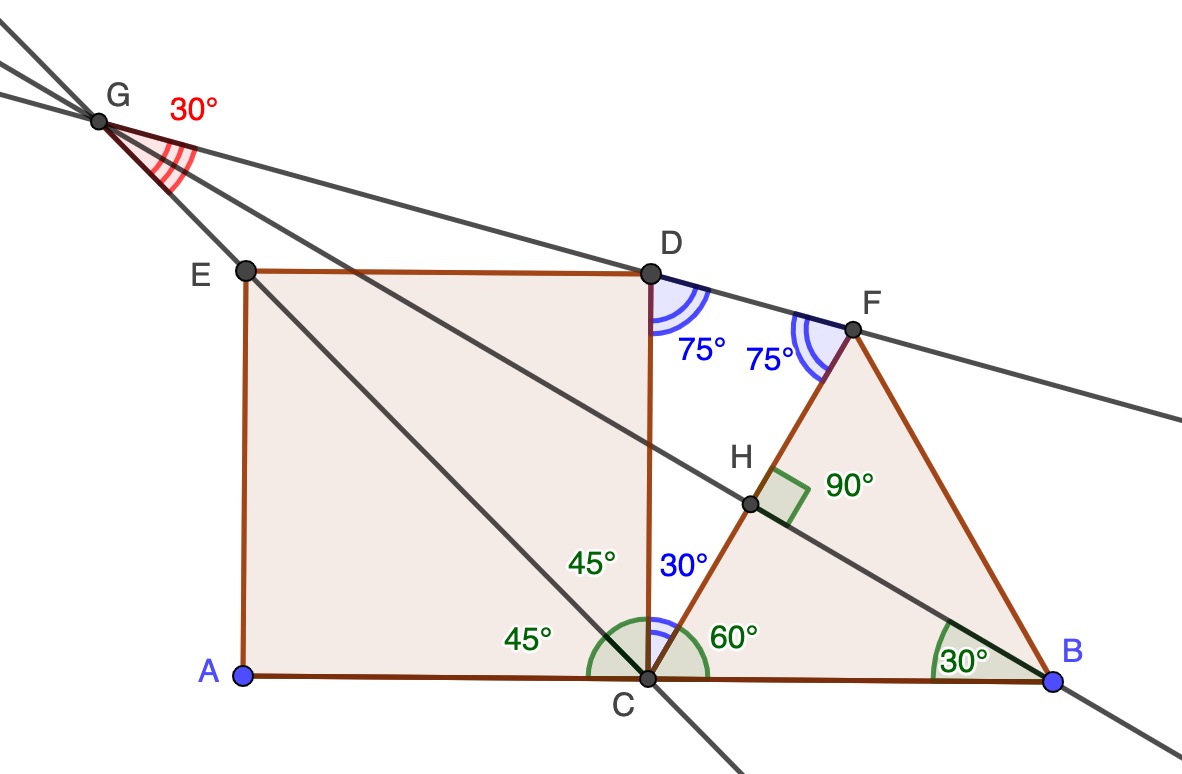
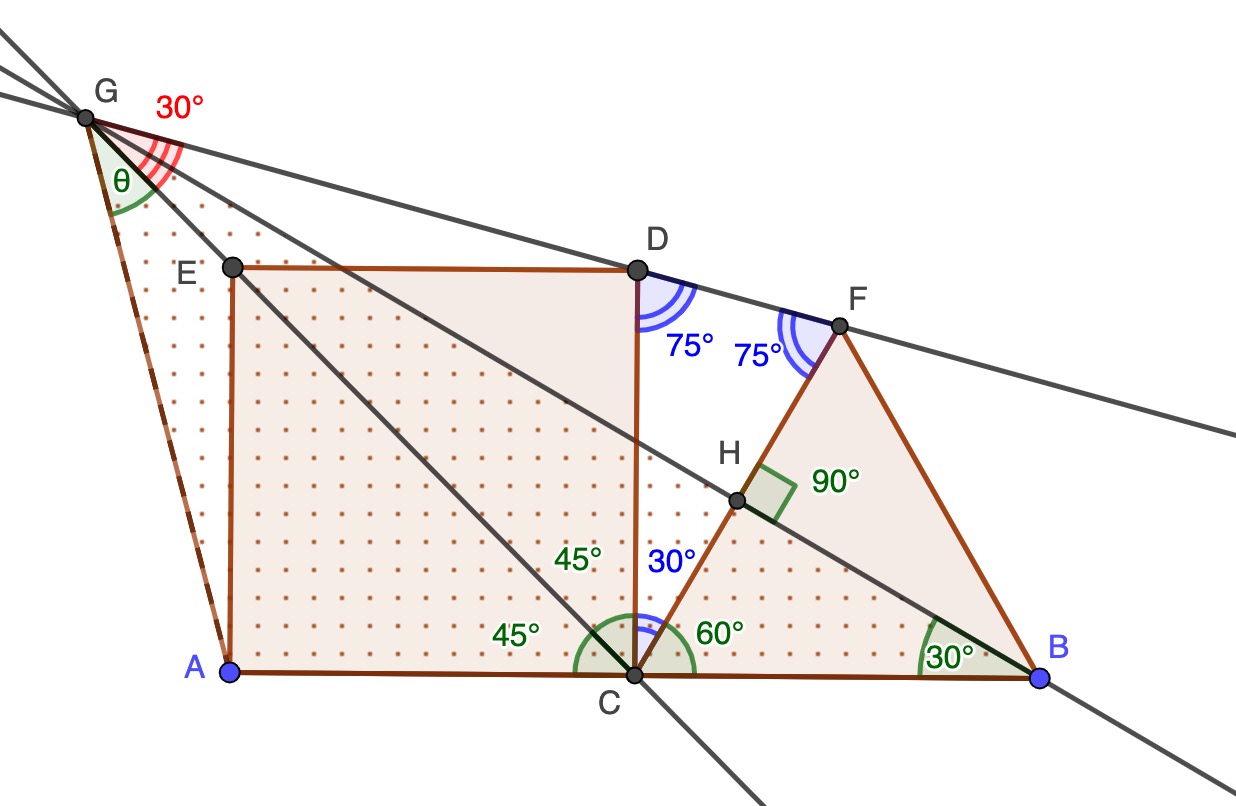
Although it is usually presented as as theorem about circles and tangents it seems more general than that. Here is my drawing of an analogue for equilateral triangles, produced using GeoGebra.

For any pair of triangles, the lines drawn through pairs of corresponding points meet at a point, and for any set of three triangles taking the triangles in pairs produces three such points that all lie on the same line.
I don't think equilateral triangles are special, as far as I can see we could choose any shape.
Monge's theorem can also be generalised to three dimensions (four spheres and six cones, one for each pair of spheres, all of whose vertices lie on a common plane), and indeed to higher dimensions, although it obviously gets harder to visualise.

Scroll down for solution
based on joke posted on r/dad jokes by tjetersÂ
Anise: Sibling's daughter.
Borage: Jail term.
Chervil: Type of rodent, often kept as a pet.
Chicory: Deception.
Cloves: Fings you wear.
Cumin: Opposite of going.
Fennel: Tapering tube for guiding liquids.
Mace: Small rodents.
Marjoram: Impaired your molasses-based alcoholic spirit.
Rosemary: Got up in a cheerful mood.
Sage: Reason why I'm not as sprightly as I once was.
Thyme: See Borage.Â
What happens if you donât pay your spice bill? They send the bay leaves round.
Our old friend Tom has been at it again.
"Are all your pies this small?" asked Tom tartly.
After I'd thought of that one I wondered if Chat GPT knew about Tom Swifties. It does and came up with quite a decent effort when prompted with "pie" and "Tom Swifty".
"This pie is half-baked," Tom said crustily.


I don't know why but I was thinking about the word "mog" and wondered where it came from, and whether it is a "real" word, i.e. one I could find in the dictionary (turns out yes). With the help of the Oxford English Dictionary and Wikipedia I managed to piece together a possible etymology.
mog < shortened from moggy
moggy < regional dialect, a young woman, variant of Maggie
Maggie < pet form of Margaret
Margaret < late Latin Margareta
Margareta < classical Latin margarita, a pearl
margarita < ancient Greek ΌαÏγαÏÎŻÏÎ·Ï (margarites), pearl
ΌαÏγαÏÎŻÏÎ·Ï < Persian murwÄrÄ«d, pearl
murwÄrÄ«d < an old Iranian word meaning something coming from a shell
Some more geometry!Â
We can inscribe a square in an equilateral triangle so that all itas corners lie on the sides of the triangle. How? Well, consider this sketch.

We draw a chord of the triangle parallel to the base and draw a square with the chord as one of its sides. Then we move the chord vertically downwards, keeping it parallel to the base and with its ends on the sides of the triangle and progressively enlarging the square, until the base of the square lands on the base of the triangle, and we are done.

We can extend the idea to three dimensions and inscribe a cube in a regular tetrahedron.

We take a section parallel to the base and in this equilateral triangle inscribe a square using the method described above, and construct a cube with this square as one of its faces. Then we move the section vertically downwards, keeping its vertices on the sides of the tetrahedron, progressively enlarging the cube, until the base of the cube lands on the base of the tetrahedron, and we are done.
It's conjectured, but I don't think proved, that this gives the largest cube that can be inscribed in a regular tetrahedron, see here.
Rather neat, and It seems to me that an analogous construction would be possible in dimension and beyond, a hypercube in a 4-simplex and so on, but I canât prove it and drawing a picture of even the four dimensional case feels quite a challenge.
No round holes involved, the Square Peg Problem is a deceptively simple mathematical problem, first posed over a hundred years ago. It asks whether every closed curve has an inscribed square, that is, a square with all four of its vertices on the curve, as in the example below.

I've been fascinated by this problem for nearly 50 years. It's easy to state but hard to solve and although solutions have been found for many particular categories of curve, a completely solution is still lacking and it remains an active research topic. There is a good summary of the history and current state of the problem here:
https://diposit.ub.edu/dspace/bitstream/2445/151918/2/151918.pdf

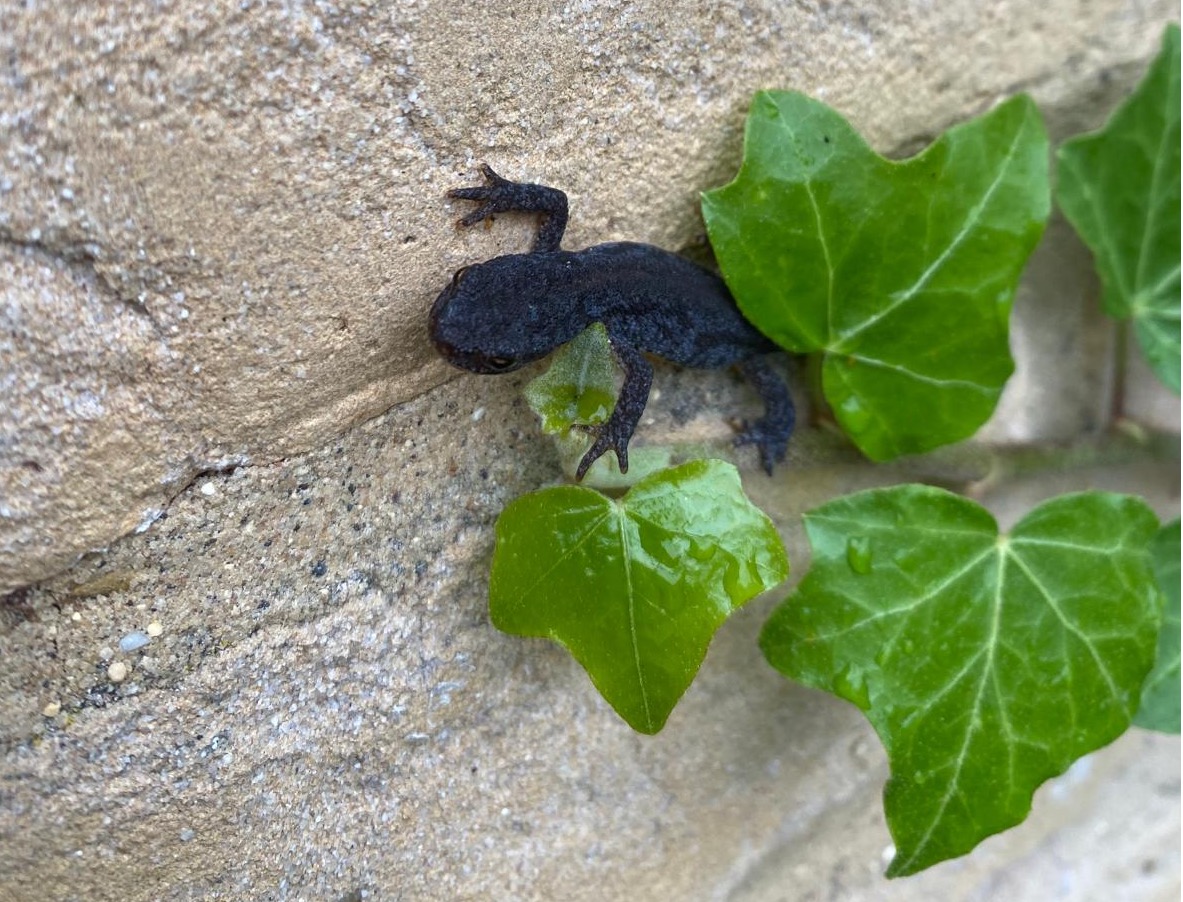
This attractive little plant likes my front garden wall, where it grows profusely. In the photo itâs intertwined with some actual ivy, at left, and you can see that the leaves of the toadflax really do look like miniature ivy leaves.

This year there is more of the toadflax than I can remember ever seeing before. Perhaps itâs because we have such a lot of rain in the last few months.

If you try to steal my grapes, then you better watch Shiraz.

âGolden Bouquetâ

Here's a rather neat bit of geometry. If we take a quadrilateral ABCD and join the midpoints of its sides, we get a parallelogram.

This theorem is named after Pierre Varignon (pictured, courtesy Wikipedia), a mathematician of the 17th and 18th century.Â
Varignon was well-connected; it seems he knew Newton and Leibnitz, for example.
Now why should the theorem be true? Well suppose we concentrate just on EH and FG and draw in the diagonal BD, see below

Now there is a theorem that says if we join the midpoints of two side of a triangle the segment so obtained is parallel to the third side and half its length. Looking at triangles ABD and DBC tells us are half the length of the diagonal and parallel to it. Hence HEFG must be a parallelogram.
We can also see that a half is not special, for example if F, G, H and E had been one-third the way along the sides they lie on, instead of one half, we would still have obtained a parallelogram.
Last week I visited Solva, a place in South-West Wales. It's a fishing village and harbour. Up on the cliff overlooking the sea there is an (Iron Age?) fort, it was once an significant commrercila port and centre for lime burning, and it probably has some Viking associations. The name might be derioved from Old Norse Sol = sun and Vo/Voe whichh means inlet in English and so may have had a similar meaning in Old Norse. But the orgin of the name does not seem to be attested - there is no early written evidence - so it's hard to know for sure.
Here is a picture of the estuary by Bill Boaden.
![]()
Here is a photo taken by one of our party, showing what it looks like from the shore with the tide out.

From Solva there is a cliff path that takes you to St David's and the cathedral of the monastery founded by the saint. It was a fine day and I would have liked to have walked it, but I am simply not mobile enough.
In my hedge grown these âpinkbellsâ, from bulbs I planted many years ago.

I just stumbled across this paradox which was only discovered (or invented?) quite recently. It's called the Brandenburger-Keisler Paradox and I'm still trying to get my head round it.
Ann believes that Bob assumes that Ann believes that Bobâs assumption is wrong.
Does Ann believe that Bobâs assumption is wrong?
There beautiful flowers are snakes-head fritillaries, in flower a couple of weeks early than usual.

They are widely cultivated, but also grow wild in southern and central Britain, although it is not clear whether it is native or a garden escape. See Wkipedia for more on this.Â
Next year will be a square year. 2025 = 45 x 45, and this is the only square year in this century, because 44 x 44 = 1936 and 46 x 46 = 2116.
By the way, here is a neat trick for squaring numbers that end in a 5. Suppose the number is X5, where X is some series of digits that form a number in their own right. Work out X times X+1, then pop 25 on the end.
Take 135 as an example. 13x14 = 182, so we get 18225, which is indeed 135 squared.

This blog might contain posts that are only visible to logged-in users, or where only logged-in users can comment. If you have an account on the system, please log in for full access.