

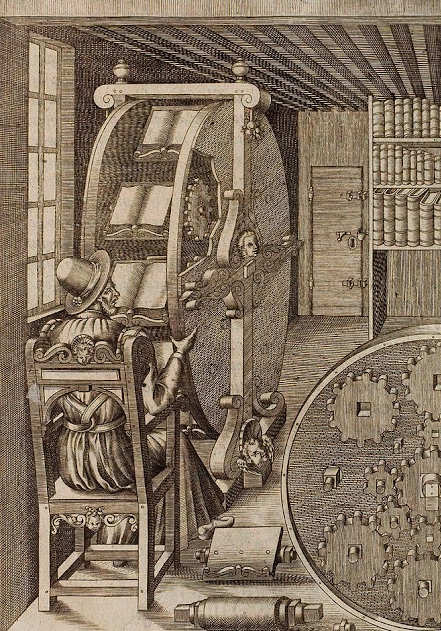
How many posts have I here? I can go back a decade or more and find the most random of posts. This one intrigued me because of the image from the 16th century of a 'bookwheel' - so 'scrolling' is not something modern at all!
There is something deeply reassuring in discovering that what feels like a distinctly modern anxiety—this sense of being pulled from one text to another, never quite finishing, always half-reading—was already imagined over four centuries ago.
Agostino Ramelli's 1588 engraving of a book wheel stops me in my tracks. A scholar sits within a rotating mechanism of texts, each volume poised, open, ready to be brought into view. The wheel turns; the reader moves seamlessly from one book to the next, never losing their place. It is, in effect, a mechanical solution to an intellectual problem: how to hold multiple threads of thought at once.
And yet, looking at it now, I can't help but see something else. Not just ingenuity—but anticipation. A prefiguration of what we now call scrolling.
What I was trying to grasp in my earlier writing—and can now see more clearly—is that the transition from print to digital is not simply technological. It is epistemological. It reshapes not just how we access knowledge, but what knowledge is.
In the world of print—the libroverse—knowledge is ordered, bounded, and stabilised. Books sit on shelves, catalogued, indexed, and complete. Each one represents a finished act of thinking. Authority is conferred through publication, through editorial gatekeeping, through the physical permanence of print. A book, once printed, does not change. It can be cited, returned to, and trusted as a fixed point.
But even here, Ramelli's wheel hints at a tension. The reader is not meant to move linearly from one book to another, but to orbit them—to compare, cross-reference, and synthesise. The seeds of non-linear reading are already present, albeit constrained within a physical system.
The digital docuverse takes this latent possibility and removes the constraints.
Now, knowledge is no longer a set of discrete, finished artefacts, but an open, evolving network. Texts are unstable—edited, updated, versioned. Authorship is distributed across links, tags, and contributions. Authority becomes diffuse, emerging not just from expertise but from visibility, engagement, and network effects.
Where the book closes, the webpage remains perpetually open.
This shift has profound consequences. It blurs the boundary between thinking and publishing. In print, what we read is the result of digestion—ideas refined, structured, and finalised. In digital space, we increasingly encounter thought in its raw form: provisional, iterative, unfinished. Blogs, wikis, threads—these are not conclusions but processes.
And so the reader's task changes.
We are no longer simply consulting knowledge; we are navigating it.
The metaphor I reached for before—the "digital ocean"—now feels exactly right. Unlike the library, which offers shelves and systems, the ocean offers flow, depth, and drift. There are currents (trends), shoals (echo chambers), and vast, uncharted expanses. One does not retrieve knowledge so much as move through it.
And this is where Ramelli's wheel returns with new force.
What he designed was not just a convenience, but a cognitive apparatus—a way of managing multiplicity. His reader remains anchored, physically and intellectually, even as the texts revolve around him. There is control, continuity, and a sense of mastery over the material.
Our contemporary equivalent—doom scrolling—feels like its inversion.
The wheel has come loose from its axis.
Instead of bringing the right book into view, we are pulled endlessly onward, often without intention. The promise of seamless access has become a condition of perpetual distraction. We do not rotate the texts; they rotate us.
And yet, I am not inclined to see this purely as a decline.
What we are witnessing is not the collapse of knowledge, but its transformation. The system has given way to the network. Stability has yielded to dynamism. Authority has fractured into participation.
The question, then, is not how to return to the libroverse, but how to become more adept navigators of the docuverse.
Ramelli's wheel reminds us that this challenge is not new. The desire to hold multiple ideas in play, to move fluidly between them without losing coherence, has always been part of intellectual life.
What is new is the scale—and the speed.
We are all now seated at the wheel. The mechanism is no longer mechanical but digital, no longer finite but effectively infinite.
The task is the same: to read, to connect, to make meaning.
Only now must we also learn when to stop the wheel from turning.
This is my original post > https://bit.ly/digitization-of-everything