OU blog

Personal Blogs

Jim McCrory

The Ache of Longing: A Fjord, Grandma's Garden, Paradise

Visible to anyone in the world
Edited by Jim McCrory, Monday 21 April 2025 at 07:51


And each man will sit under his own vine and under his own fig tree, 

with no one to frighten him. For the mouth of the LORD of Hosts has spoken.

 - Micah 4:4
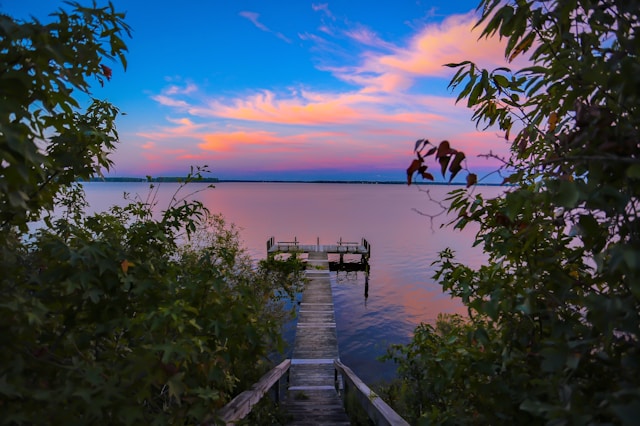

Image courtesy of https://unsplash.com/@todddesantis


I asked my wife recently what her happiest childhood memory was. Without hesitation, she said, "Playing in my grandparents’ garden back in our little village in the Philippines." I saw that memory come alive again just this weekend. As she bent down among the flowerbeds, bedding new plants with quiet joy, her face glowed with the same peace I imagined she felt as a child. There was something sacred about it.

It brought me back to a thought I explored in a previous blog—the idea of redesigning life on earth. Despite the fractures of this world, despite its often hopeless state, there are still oases of healing. Why is it that we experience deep psychological and physical restoration when exposed to nature? Science points to hormones, neural pathways, circadian rhythms. But I think it’s simpler than that: we were made for a garden.

This was God’s original plan—for us to cultivate the earth, to walk with Him in a place of harmony. But something broke. The emergence of selfishness and evil shattered that sacred space. And yet, deep within, the longing remains.

It’s no coincidence that we are drawn to beauty, to peace, to the natural world. Who hasn’t at some point prayed the Lord’s Prayer and glossed over the words, “Thy Kingdom come, Thy will be done on earth as it is in heaven”? Or heard Jesus' words to the criminal on the cross: “You will be with me in Paradise.” These are not vague hopes. They’re promises—a return to the garden.

And maybe that’s what our longing really is: an ache for Paradise.

I’ve felt this longing since I was a boy. I remember the moment it took hold. My music teacher had introduced us to the haunting, soul-deep compositions of Edvard Grieg. As the first notes of Morning played, I was no longer in the classroom. I was somewhere else—somewhere vast and wild, where mist clung to mountains and fjords cut deep into the earth like ancient wounds of beauty. I was ten years old, but I felt something I couldn't name: a kind of homesickness for a country I had never seen.

Later I would learn the German word Fernweh—a deep longing for a faraway place, especially one you’ve never been. That word has stayed with me because it captures something I’ve never quite shaken. Even now, when I hear Grieg’s Peer Gynt Suite, something stirs. I feel the tug of mountains I’ve never climbed, forests I’ve never wandered, and air I’ve never breathed but somehow know in my bones. It’s as though that music opened a door in me, revealing a home I’ve yet to find.

Strangely, this ache is not unique. It’s deeply personal, yes—but universally human. We are creatures of longing.

I often wonder—if I moved to Scandinavia, would I still feel the same ache? Or would I miss the rugged coastline of Scotland, the wild Atlantic winds, the place I’ve called home for decades?

Perhaps the truth is that we belong to that redesigned society we pondered on in the previous blog. Maybe Fernweh is a reminder that we have roots scattered across the earth, planted by stories, by melodies, by memories passed down or inherited in ways we can’t explain. My own surname is Celtic, with threads tied to the old Norse. Who’s to say that somewhere deep in the psyche, those ancestral echoes aren’t still at work?

And maybe that’s where the spiritual meets the personal. Could it be that this longing—whether for gardens or fjords, tropics or tundra—isn’t about geography at all? Maybe it’s a longing for the world as it was meant to be. Maybe it’s the soul’s way of remembering Eden.

My friends and I often discuss God’s future plans. Will the faithful go to heaven or remain on earth? Could Paradise be somewhere not yet revealed? I don’t claim to know. But one thing I do believe: in that place, wherever it is, we won’t feel homesick.

Because home, in its truest sense, isn’t just a place. It’s the fulfilment of every yearning we’ve ever had. It’s the sound of Grieg’s mountains, the scent of a grandmother’s garden, the quiet joy of planting something beautiful in the soil. It’s the world made whole again.


Permalink Add your comment
Share post
Jim McCrory

Where would you like to go after this life? Go ponder

Visible to anyone in the world
Edited by Jim McCrory, Thursday 19 December 2024 at 18:36


"We cannot change the world, but we can change our own hearts and create ripples of peace and joy."

– Unknown


Image generated by Microsoft Copilot


It happened like this, I was packing stuff into my car and a carpenter came out and said, “Look! She never charged me for this.” He showed me a couple of cheap things amidst a trolley of stuff.

          I said, “You will never be happy going through life like that.”

He looked puzzled.

Now, why do I mention this? I will come right out and say it: I deeply loathe some of the culture I’m living in. Perhaps that sounds harsh, but my disdain isn’t for Scotland or its people in itself—far from it. I love this land: its rugged mountains, its misty lochs, the scent of bracken in the highlands, and the call of the curlew, the tap of the woodpecker and sound of the morning cuckoo. Scotland’s natural beauty and rich culture, with its song and poetry, its humour and resilience, remind me daily of what is good and worth loving including the people who are open and friendly for the most part.

But some people—ah, some of the people—that’s where my frustration lies. And it's not just Scotland, it's worldwide. 

I’ve been a victim, repeatedly, of dishonesty. Builders who charged for work they never did. Car mechanics who fiddled with repairs only to leave me worse off than before. Internet companies that quietly siphoned money from my account despite repeated cancellations. Each experience chipped away at my trust and fuelled my weariness of the world we inhabit. but it’s not everyone, of course. There are good people—many good people—who brighten this life with kindness and generosity. And yet, there’s no escaping the dark shadow cast by dishonesty, violence, selfishness, and exploitation. Those who dominate their fellow humans for personal gain. Those who wound and take without thought for the injury they leave behind. These are the ones who make me feel displaced, as though I don’t belong here, in this time, in this culture.

Our German friends have a wonderful word for this feeling: Fernweh. It can mean a homesickness for a place you’ve never seen. Can it be a longing for somewhere otherworldly? C.S. Lewis, with his usual eloquence, offered a similar sentiment: “If we find ourselves with a desire that nothing in this world can satisfy, the most probable explanation is that we were made for another world.” His words resonate deeply with me.

Perhaps that’s the crux of it. My frustration with this world stems not from its design—because the earth, with its endless beauty, is breath-taking—but from its corruption. We are creatures who long for truth, justice, and love, but we so often fail to uphold them. And in that gap between the world as it is and the world as it could be lies my discontent.

But that discontent isn’t hopeless. Rather, it stirs something within me—a sense of yearning, not just for escape, but for a restoration of what is broken. Maybe this dissatisfaction is itself evidence that we were made for something more, for a place where dishonesty doesn’t exist, where violence is a distant memory, and where selfishness has been replaced by generosity.

Until then, I’ll continue to love what is good in this world while lamenting what is not. I’ll walk the hills of Scotland, soaking in the grandeur of creation, and hold fast to the hope that one day we might find ourselves in that better world Lewis spoke of—the one we were always meant for.

As for the carpenter I spoke of, I don’t think he will forget what I said when I replied, “You will never be happy living like that.”

Hmm! Go ponder.


Blessed are the meek,

for they will inherit the earth.

Blessed are those who hunger and thirst for righteousness,

for they will be filled.

Matthew 5:5,6 BSB.


Permalink Add your comment
Share post
Jim McCrory

Good Morning Germany! I Like Your Word Fernweh

Visible to anyone in the world
Edited by Jim McCrory, Thursday 24 October 2024 at 09:33


You open your hand,

    and satisfy the desire of every living thing


Image generated with the assistance of copilot

I was only a boy when my music teacher introduced me to the hauntingly beautiful music of Edvard Grieg. It was the kind of music that reaches deep into your soul and stirs something ancient and unnameable. Grieg’s Peer Gynt Suite, especially Morning and In the Hall of the Mountain King, carried me far away, beyond the confines of the classroom, into a place where mountains stretched endlessly toward the heavens and fjords cut through the earth like jagged wounds of breath-taking beauty. That day, I was struck by a peculiar feeling—a homesickness for Scandinavia, as if I had lived there in some other time. I felt, with an intensity that has stayed with me all my life, that I was born in the wrong country.

The Germans have a word for this: Fernweh. It translates as a kind of homesickness but can have a twist. Instead of pining for a place you've been, it describes a longing for somewhere you've never visited. It's the pull of an unfamiliar land that somehow feels more like home than the ground beneath your feet.

As a boy, I couldn’t have understood Fernweh in such terms, but I felt it keenly. It was as if Grieg’s music unlocked a door within me, leading to a distant, mist-shrouded land I had yet to see but already loved. The ache that came with it was as real as homesickness, a longing so profound that it almost felt like loss. To this day, when I hear Grieg’s compositions, that sensation returns—a yearning for mountains I’ve never climbed, forests I’ve never wandered, and the crisp, cold air of Scandinavia that I’ve never breathed but know in my bones.

This feeling isn’t unique, though it is deeply personal. Whilst reading at the dentist yesterday, I read about the story of Pablo the Penguin from Disney’s The Three Caballeros fascinated me. Pablo, living in the icy expanse of Antarctica, dreams of warmth. He builds a little boat and sails toward the tropics, yearning for sunshine and palm trees. But once he reaches the warm seas of his dreams, something unexpected happens. He feels homesick. He misses the icy winds of Antarctica, the very place he had been so desperate to leave behind.

Pablo’s story resonates with me because it captures the paradox of longing. We yearn for something different, something distant and elusive, and yet, when we reach that place, there’s a chance we might long for the familiarity of where we began. I’ve often wondered if I would feel the same if I lived in Scandinavia. Would my heart still yearn for those fjords and snowy landscapes, or would I find myself pining for the rugged coasts and rolling hills of Scotland?

Like Pablo, I’ve come to understand that homesickness, whether for a place we know or one we imagine, is part of the human experience. It speaks to a deeper truth about us: we are creatures of longing. We seek out beauty, peace, and belonging, sometimes in distant lands or in the melodies of foreign composers. But this longing is often as much about the journey as it is about the destination.

For me, Scandinavia is a place where my soul feels it belongs, even though my body has only been there a few times. The mountains and fjords I dreamed of as a child feel as real to me as my own home. I wonder if this is because there is a part of us, perhaps, that has roots in many places. Some of those roots are nurtured by the landscapes we live in, while others are stirred by the music we hear, the stories we tell, or the dreams we dream. Additionally, my surname is Celtic where a rich history of Scandinavian connection once waved over these landscapes. Who knows if this rich connection is still impeded in our psyche.

And maybe, just maybe, that’s what Fernweh truly is: the recognition that we belong not just to one place, but to many. It is the ache of knowing there are pieces of ourselves scattered across the world, waiting for us to find them, in countries we’ve never visited, in melodies we’ve never heard, and in the hearts of people we’ve yet to meet.

Pablo may have longed for the warmth of the tropics, only to miss the cold of Antarctica, but perhaps that’s the nature of longing itself. It moves us forward, reminding us of the places that call to our souls, while always leaving room for the pull of home—wherever that might be.

My friends and I got to talking about God's future plans. Will faithful humans go to heaven or earth? Could the future Paradise that Jesus spoke of be somewhere that has not been revealed to us yet.? I am not sure. But one thing is sure: we will not be homesick.

You open your hand,

    and satisfy the desire of every living thing.

Psalm 145:16 WEB


Permalink Add your comment
Share post

This blog might contain posts that are only visible to logged-in users, or where only logged-in users can comment. If you have an account on the system, please log in for full access.

Total visits to this blog: 1888765