OU blog

Personal Blogs

Design Museum

How History Should Be Taught

Visible to anyone in the world

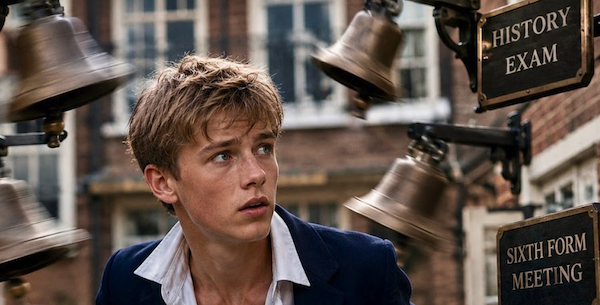
A young man at school is torn between conflicting bells

An AI-generated image of the author in his late teens was created from photographs of him as a teenager, and here he is, tortured by the ever-present school bell. 

Revisiting my diaries from fifty years ago (A Collins Five-Year Diary) has led me to an unexpected conclusion: much of what I value most about history, I learned despite how I was taught at school, not because of it.

At my school in the 1970s, history was largely presented as something settled and inherited. Dates, causes, consequences, kings, treaties, essays. Knowledge flowed in one direction: teacher to pupil, textbook to exercise book. The institution valued certainty, continuity and authority. We were expected to absorb and reproduce.

What strikes me now is how little this resembles the way historians themselves actually think.

Only later, as a history scholar in the Sixth Form at the RGS Newcastle, did I encounter a different conception of history altogether. Historians such as R. G. Collingwood, E. H. Carr and A. J. P. Taylor shifted the ground beneath my feet.

History, they implied, was not the memorisation of conclusions. It was an active process of reconstruction.

Collingwood argued that history involves "re-enacting" past thought in the historian's mind. Taylor made history feel alive, contingent, human. Carr questioned the very idea of objective historical facts detached from interpretation. Suddenly, the subject ceased to be a sequence of examinable topics and became an encounter with consciousness across time.

That distinction matters enormously.

Poor history teaching presents the past as fixed. Better history teaching allows students to enter into uncertainty. Instead of simply learning "the causes of the English Civil War", students should be encouraged to ask:

  • Why did intelligent people support the King?

  • What did liberty mean to them?

  • Why did religion matter so much?

  • What assumptions about the world seemed obvious at the time?

History becomes less about answers and more about recovering mental worlds.

The irony is that I may have learned this most effectively outside the classroom.

The letters I received from girls. The novels I read. Music, television, films, magazines, conversations, walks across the fells, hours spent drawing or daydreaming. These formed a parallel education. They taught me that people are contradictory, emotional, self-deceiving, hopeful, frightened and endlessly interpretative.

That is history too.

Now, fifty years on, as I revisit my Diary entries alongside the letters, books and artefacts of the time, I realise I am approaching my own adolescence as a historian might approach any archive. The Diary entries are not "the past"; they are traces of it. A line saying "Read He & She: the mental side of it very good, how girls react etc." contains within it a whole set of tensions:

  • institutional morality versus lived experience

  • prescribed knowledge versus curiosity

  • official narratives versus private interpretation

The process has made me think hard about education itself.

At my private school, we were often being prepared for a world already disappearing: hierarchy, deference, inherited authority, moral certainty. Yet outside the classroom, the future was already arriving—through feminism, changing attitudes to sex, television culture, popular music, psychology and increasingly self-directed learning.

The institution often confused discipline with education, tradition with wisdom, coverage with understanding.

The best history teaching, I now think, does six things:

  • It tells compelling stories (I've taken a shine to the historical sagas of Ken Follett).

  • It uses primary sources

  • It exposes students to competing interpretations

  • It develops historical imagination

  • It connects the past to lived human experience

  • and it allows intellectual freedom and curiosity

Most importantly, it teaches students not simply to know about the past, but to think historically. 

That means recognising that every document, every Diary entry, every letter and every memory is part of an ongoing act of interpretation. (I kept a daily Diary from 1976 to 1990). 

Perhaps that is why my 'Fifty Years On' project (50YON) feels so alive to me now. I am not merely remembering my past. I am investigating it.

And perhaps the best history teaching ultimately does the same thing: not telling students what to think about the past, but giving them enough evidence, structure and freedom that the past begins to speak for itself.

Permalink 2 comments (latest comment by Jonathan Vernon, Thursday 7 May 2026 at 16:15)
Share post
Design Museum

BE CAREFUL WHEN REFLECTING ON WHO GETS A MENTION

Visible to anyone in the world

There was a time when publishing meant safety.

To post something online was to know it wouldn’t be lost to a dying hard drive or a drawer full of obsolete discs. Since 1999, I’ve treated the web as a kind of external memory — a filing cabinet that couldn’t burn down.

But memory has a habit of remembering too much.

Four times now I’ve had to delete or hide what was never meant to be public: a diary fragment, a reflection on coaching, a family outburst, a half-remembered love affair. Each began as something private and harmless, written in the spirit of honesty. Each, when read by someone else, became something else entirely.

A coach took offence at an insight I’d meant only for myself.

A relative disliked the light I’d cast on an old story.

A woman from my youth misread a scene, believing it was hers.

And my late father, even in death, seemed to reach from the grave through the indignant voices of others, asking me to stop digging.

So I did. One by one I made twelve years of posts private. Then, just to be sure, I locked the whole site.

For a while I thought I’d silenced myself. But what I’d really done was discover the difference between writing and publishing. The diary has always been a rehearsal room, not a stage. Anaïs Nin knew it; so did Pepys. They wrote to survive the day, not to perform it. Their true audience was time itself.

I’ve come to think of my writing life now as having three rooms:

The locked study — raw notebooks, session reflections, the things I write before I know why. The reading room — pieces I’ve polished or anonymised, safe for trusted eyes. The gallery — curated fragments, shaped for strangers but still carrying the scent of the original paper.

Everything begins in the first room. Some pieces migrate outward; others stay behind. The movement between them is the real work — the slow act of deciding what belongs to me and what I’m ready to give away.

Being “private by default” isn’t retreat. It’s discipline. It means I can keep faith with the thirteen-year-old boy who first began these diaries, while protecting the people who wandered into his pages uninvited.

The web may still be my archive, but the key now stays in my pocket.

Permalink Add your comment
Share post
Design Museum

Post every day?

Visible to anyone in the world
Edited by Jonathan Vernon, Thursday 3 November 2022 at 06:46

Post at all! There was a time, here included, where I posted something every day. I still had this hangup going back decades that a diary, like bedside prayers, is something you do every evening without fail. I must have done if for 20 years on paper and for a decade online until I realise it wasn't getting me anywhere; it didn't achieve anything.

Is reflection supposed to 'get you anywhere'?

The mistake in a way was to ever imagine anyone would read this except for me.

Anyway, from time to time towards the end of a month, or in the first few days of a new month - and especially at New Year, I think (like tens of thousands of others), 'should I keep a daily diary?'

Frankly I am too busy doing, too exhausted to care to. I'd have to give up the end of day ritual of an hour of TV/Streamed drama. I'd have to give up my Scrabble App. And writing down the day wakes you up rather than sends you to sleep - it will impose itself on you and expand like foam of a can.

On verra.

I did a lot yesterday. Up at 5.00am something to create and post social media for someone, a bit more sleep then out early to walk the dog and track down the source of a local stream (for a blog/social media), then to volunteer the morning and early afternoon to a class of primary school children visiting the River Ouse. After which I had two swim coaching sessions to write, then deliver ... which took me to 9:30pm when I got home. I'm enjoying 'The Empress' right now about the Hapsburg Royal Family in Austro-Hungary in the 19th century.

And while here I looked at Free Online Courses on the Environment, and looked at post graduate study too. My time spent with Friends of this, or that or the other, on planning and environment committees with the Town Council (I'm an elected Green Councillor here in Lewes) has me thinking if I can revisit my undergraduate degree (Geography) and build on that. 

Permalink Add your comment
Share post

This blog might contain posts that are only visible to logged-in users, or where only logged-in users can comment. If you have an account on the system, please log in for full access.

Total visits to this blog: 20319836