

I've set myself the challenge of accompanying my A225 studies of the 'The British Isles and the modern world, 1789–1914' with a year of 19th century reading. I'm going to try and keep roughly to the chronology of the module and also make sure that I'm exploring the geographical spread of the course (so some Irish, Scots, ?Welsh reading). I'd started just thinking about novels, but have been persuaded that the period also featured a lot of narrative poetry, so this will also get a look in.
So here goes - probably aiming to stop somewhere around HG Wells, but that feels a long way away right now...
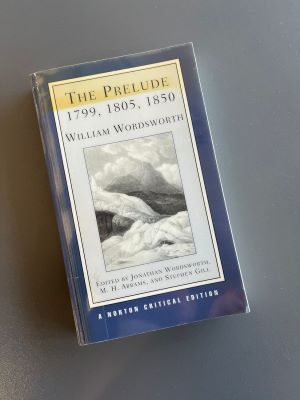 |
William Wordsworth - The Prelude Published: 1850 (after Wordsworth's death), but the version I read wasn't published until 1926. This was the manuscript of his 1805 revision of the 1799 original. Period covered: 1770s to 1805 A225 links: The text includes the 'Bliss was it in that dawn to be alive' section, exploring Wordsworth's experience of the French Revolution. By 1805 he had revised his original optimism, but I spared myself too much conservative retrenchment by avoiding the 1850 text. There are sections describing Wordsworth being under surveillance as a 'radical' in the Revolutionary period that link to OU examination of links between the Romantic movement and more radical politics. Another A225 connection is in the idealisation of childhood - something that underpinned some responses to child labour in the industrial revolution. Stars: ⭐⭐ (quite heavy going) |
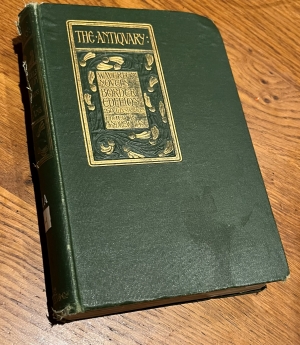 |
Walter Scott - The Antiquary Published: 1816 Period covered: Summer 1794 A225 links: In one sense the whole idea of a historical novel and Scott's role in the Romantic movement is a solid A225 connection. There are definitely links to the ideas of identity formation (and the false narratives of 'invented' tradition in the Antiquary's theories. There is a section on the patriotic formation of the militia in response to an empty threat of invasion (with an English officer coming to lead them). Stars: ⭐⭐⭐ (wordy, but lighter and more humorous than I'd anticipated) |
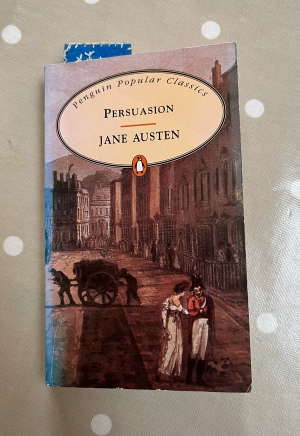 |
Jane Austen - Persuasion Published: 1817 (after Austen's death) Period covered: 1814 A225 links: The meaning of aristocracy and the role of gentry (and military) in early 19th century society explored in this, as in every, Austen novel. Nature of naval lives - particularly outside of conflict - features. The naval activity often makes reference to the Caribbean - so some interesting links to the A225 content on the Atlantic world and the importance of naval dominance in enabling trade and domestic wealth. Stars: ⭐⭐⭐(a re-read, not my favourite - but good bitchy humour) |
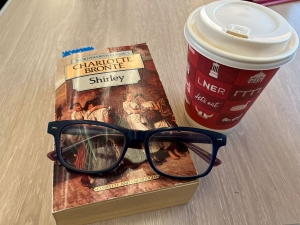 |
Charlotte Brontë - Shirley Published: 1849 Period covered: 1811-12 A225 links: Radical politics, 'Luddites', patriotic conservatism, 'working class' identities are all present. There are also some interesting aspects of illness behaviour and health included (Shirley's fear of rabies was a surprise) Stars: ⭐⭐⭐(not as off the scale as Jane Eyre, but still fabulously heightened - quite a queer book, hard not to read some Anne Lister into Shirley....until she is 'mastered' 😃) |
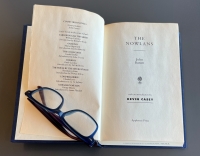 |
John Banim ('Barnes O'Hara') - The Nowlans Published: 1826 Period covered: c1820s A225 links: Sectarian divide in Ireland, some referral back to 1798 uprising, several references to the 'Peelers' - the 'paramilitary' force set up ahead of police force in Britain, long discussion regarding need for education and public schools in Ireland. Stars: ⭐almost unreadable in parts, melodramatic and ridiculous plot twists. Some interestingly 'modern' aspects with mental anguish over forsaken vows of celibacy |
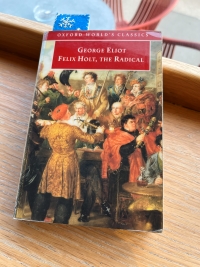 |
George Eliot - Felix Holt, the Radical Published: 1866 Period covered: 1832 A225 links: Excellent description of changing society over time in the opening section, embedded in an imaginary coach ride. There is little political theorising - Eliot seems to hope for a conservative 'amelioration' of problems, there's certainly little appetite expressed for 'radicalism'. Sections on the chaotic scenes surrounding the election were interesting - and highlight how different the process of voting was in a public forum. Important to note the book was published around time of the second Reform act, looking back on the first. There's a sense of persisting middle-class (novel writer/reader class) anxiety about further extension of the franchise. (There's an interesting sounding bit of writing by Eliot 'Address to Working Men, by Felix Holt' that's aimed directly at these new voters - worth hunting down perhaps) Stars: ⭐⭐ Felix is such a 'serious' character that he does seem to suck the life out of much of the book - I wasn't expecting quite so much 'mystery' and felt this was laid on a bit thick in parts. Not Middlemarch 😀 |
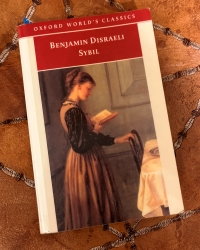 |
Benjamin Disraeli - Sybil or The Two Nations Published: 1845 Period covered: late 1830's and 1840s A225 links: Disraeli obviously enjoys satirising the salons and shenanigans behind the Whig/Tory politics and there is a strong sense of how personal and aristocratic parliamentary government was. Chartism is central to the 'plot' and the 'poor' are shown sympathy, even if they feel pulled directly form press reports and 'Blue Books'. Disraeli's (bizarre) solution to the divided 'Two Nations'; ??young, reformed aristocratic leadership and reinvigorated feudalism?? is the real heart of the novel - definitely (unfounded) confidence and crisis rolled into one! Stars: ⭐ Hard work with barely a single credible character, except the narrator! 😀 |
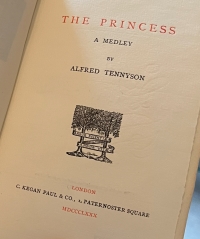 |
Alfred Tennyson - The Princess: a Medley Published: 1847 A225 links: Education, and specifically further education for women, isn't touched on much in the module - so any links are tenuous. The narrative section has plenty of 'chivalry' and 'medievalism' alongside the provocative ideas of female power and independence, evidence of some of the 'anti-modern' cultural responses of the time which are highlighted. Stars: ⭐⭐ Odd and interesting, rather than deeply engaging - but with occasional moments - couldn’t resist quoting this speech from one of the female scholar leaders on her view of the future (still some work to do!) At last |
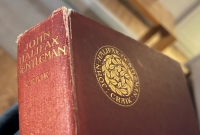 |
Dinah Maria Mulock ('Mrs Craik') - John Halifax, Gentleman Published: 1856 Period covered: 1790s-1834 A225 links: There were so many, perhaps the strongest was the central theme of a man rising into the middle class - becoming 'Gentleman'. There are: corrupt elections, Catholic emancipation, vaccination (successful), steam power, food riots, fear of the French, emancipation, the Atlantic World (love-torn son flourishes in the New World)... The other inescapable theme is a domestic Christianity that seems to deliberately avoid an overly 'Anglican' perspective, with Quakers and Catholics featuring quite favourably. Stars: ⭐⭐⭐⭐ an unanticipated pleasure, once I'd got over the omnipresent asexual crippled narrator!! Felt like it existed wholly in a Victorian sensibility - couldn't have been written/read before or after. (First time I've really felt this reading idea might be a good one 😂) |
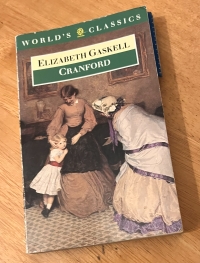 |
Elizabeth Gaskell - Cranford Published: 1853 Period covered: early 1840s A225 links: First and foremost, female middle class life! The chapters also touched on the expansion of the railways (and their danger), banking collapses and their social consequences and ideas of empire and the orient. Stars: ⭐⭐⭐⭐⭐ a complete pleasure. I loved the gentle humour and the brilliantly captured characters. Just the right length and hardly put a step wrong in tone. Definitely my favourite read in quite a while. |
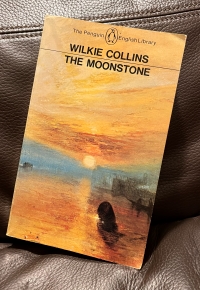 |
Wilkie Collins - The Moonstone Published: 1868 Period covered: (1799) 1848-1850 A225 links: The 'Indian' links are of course central - with trouble coming from the East. It is interesting to see Collins make the primary 'evil' a British affair, with pillage and murder committed to obtain the Moonstone. Oriental stereotypes abound, wily and ready to stop at nothing in the name of their religion - opium plays a central part in the mystery. There's a lot of communication and transportation infrastructure at work in the plot as well, railways, steamers, telegraph and horse cabs are key parts of moving the story and characters around. Miss Clack embodies the 'awful' end of the Evangelical spectrum, weaponising religious tracts - and the 'ladies committees' that Godfrey Ablewhite monopolises suggest some of the ways middle-class women tried to find avenues for agency! Stars: ⭐⭐⭐⭐ I'd forgotten that it was a real page-turner, with some great surprise twists and fantastic characters. Let down perhaps only by the occasional unfeasible plot device. |
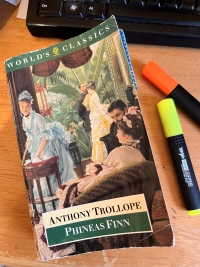 |
Anthony Trollope - Phineas Finn Published: 1869 Period covered: 1867-8 A225 links: Trollope was quite happy to bend history to fit his narrative - in this version it is the Liberals who get to pass the 2nd Reform Act! 😄 However, overall this was an excellent accompaniment to the A225 material on high politics. Best novel so far on aspects of the relationship between Ireland and Britain, with Phineas eventually politically compromised by his support for Irish tenants-rights. Also touched on imperialism, Phineas if for a time an under-secretary at the colonial office - working on the railways and development of Canada. Stars: ⭐⭐⭐⭐ Some fantastic female characters, so depressing on the limits faced - including marriage as 'property'. Not as much fun as the Barchester Chronicles - but still a good read. |
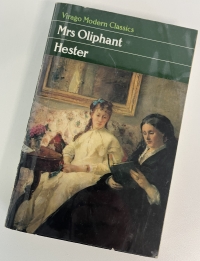 |
Mrs Oliphant - Hester Published: 1883 Period covered: 1860s-1870s A225 links: 'Domestic ideology' is at the heart of the book, with the matriarch, Catherine Vernon, demonstrating the power and limits of female agency as she saves the local bank (twice!). An interesting set of reflections on financial 'speculation' a route to ruin, but perhaps also a morally acceptable career (for some) Stars: ⭐⭐⭐⭐ The inner lives of Hester and the other characters, female and male, were cleverly and convincingly explored - and a great range of female characters in particular. |
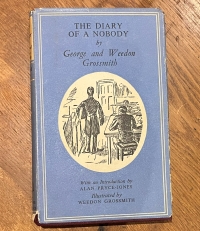 |
George and Weedon Grossmith - The Diary of a Nobody Published: 1894 Period covered: late 1880s A225 links: A great source for suburban and domestic middle-class life, much discussion of 'swells' and the markers of class in dress and behaviour. The transport system is used regularly to cross the metropolis and the seaside holiday features. Stars: ⭐⭐⭐⭐⭐ It would be hard to like someone who does not fall for Mr Pooter - I'm so pleased that A225 simply adds another layer to enjoying this book. |
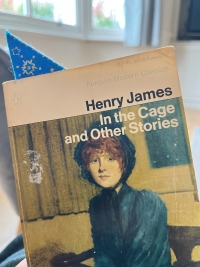 |
Henry James - In the Cage Published: 1898 Period covered: late 1890s A225 links: Social class interactions and the potential (and hardships) for female employment. Information technology sits at the centre of the book - speed of communication, privacy, storage and recall are very contemporary 'modern' features. Stars: ⭐⭐⭐ Enough to make me think I'll approach Henry James with caution - simply a stylistic challenge, and I wondered if the payoff was really worth it. |
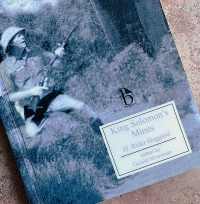 |
H Rider Haggard - King Solomon's Mines Published: 1885 Period covered: 1870-80s A225 links: Given its contemporary success. there's no doubt it is interesting evidence of how 'tales of Empire' and encounters with the African 'other' were presented - and what that might say about cultural impacts of Empire. The book is informed by racism, there are essential differences based on race represented throughout the story - although these are not a simple case of 'white supremacy', some African characters are accorded considerable power and status. Resource exploitation is central - ivory, diamonds, gold all extracted. Stars: ⭐⭐⭐ An 'adventure story' that keeps you turning the pages and whilst populated almost entirely by conventional stereotypes is surprisingly 'balanced' in the way 'races' are presented. |
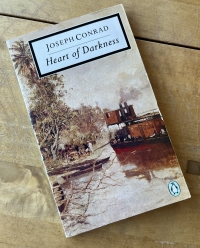 |
Joseph Conrad - Heart of Darkness Published: 1902 Period covered: 1880s A225 links: Empire and the 'Scramble for Africa', 'on one end a large shining map, marked with all the colours of a rainbow. There was a vast amount of red - good to see at any time, because one knows that some real work is done in there, a deuce of a lot of blue, a little green, smears of orange, and, on the East Coast, a purple patch, to show where the jolly pioneers of progress drink the jolly lager-beer'. Stars: ⭐⭐⭐⭐ Perhaps the most over-interpreted book on the list, simply because Conrad leaves so much unstated or opaque 😃 Astounding creation of oppressive atmosphere. |
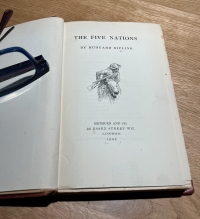 |
Rudyard Kipling - The Five Nations Published: 1903 Period covered: 1899-1902 A225 links: Some of the strongest and most direct links to A225 content so far. The 'five nations' are the 'settler-colonies' of the British Empire: Canada, Australia, New Zealand, South Africa plus Great Britain and the poems generally all touch on 'decline' and/or 'renewal'. There is a section of 'barrack room ballads' specific to the South African War and others which touch on the economics of Empire (even including one specifically about preferential tariffs in Canada!). Stars: ⭐⭐⭐ Whilst the read has been great in combination with A225, the ideas expressed are often deeply uncomfortable. However, the poetry is powerful - undoubtedly. |
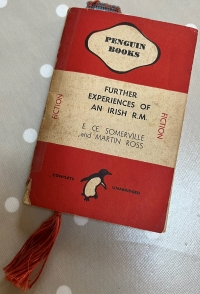 |
E Œ Somerville and Martin Ross - Further Experiences of an Irish R.M. Published: 1908 Period covered: early 1900s A225 links: Whilst 'fish-out-of-water' is the central premise of Anglo-Irishman Major Yeates's misadventures, there is a strong sense of a functioning community. In a way the A225 link is in presenting a counter-argument - a different image of Irish society to the tensions that populate the module. It also gives a good idea of an elite who could pass comfortably between Ireland and England. Stars: ⭐⭐⭐⭐ Despite fox and bird slaughter and whipped dogs and horses, I still really enjoyed. Shades of Wodehouse, Blandings and Lord Emsworth 🙂 |
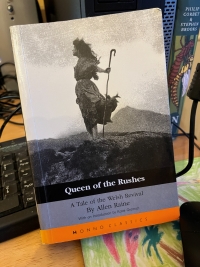 |
Allen Raine - Queen of the Rushes. A Tale of the Welsh Revival Published: 1906 Period covered: 1904-5 A225 links: Despite its 20th century setting the strongest links are with the coverage of the 1859 Ulster revival. The descriptions of charismatic behaviour are relatively limited, but there is plenty of hymn singing! Stars: ⭐⭐ My one 'Welsh' outing. Quite a lot of romantic 'gush' as one critic described it ('Cold Comfort Farm' came to mind quite often 😂). |
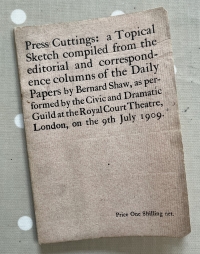 |
George Bernard Shaw - Press Cuttings: A topical Sketch compiled from the editorial and correspondence columns of the Daily Papers Published: 1909 Period covered: April Fool's Day 1912 A225 links: Couldn't be a more direct link with the campaigns of the suffragettes - as this short play satirises 'resistance' to women's suffrage. There are also asides to most of the other topics that come up in the chapter on political turmoil. Stars: ⭐⭐⭐⭐ A little gem - helped that I got a cheap copy of the 1909 original, added to the reading experience.
|
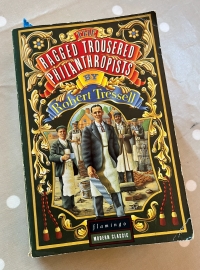 |
Robert Tressell (Noonan) - The Ragged Trousered Philanthropists Written 1906-10 Published: 1914 Period covered: 1906-10 A225 links: The experience of poverty and working-class lives are the main links. There are satirical accounts of charitable societies and their screening out of the 'undeserving', and (negative) perspectives on both Conservative and Liberal political policies. Accounts of utopian socialism and a sense of political turmoil on the streets. Stars: ⭐⭐ Just a long re-read, particularly as the didactic sections are repeated so frequently. I also found the critique of working class male lives and culture harder to take this time round. Remains an important book on my shelves - but not one to read for pleasure! |
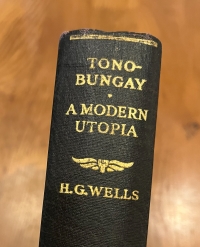 |
H.G. Wells - Tono-Bungay and A Modern Utopia Published: 1905 A Modern Utopia, 1909 Tono-Bungay Period covered: c1870-early1900s for Tono-Bungay, ? for A Modern Utopia 😀 A225 links: A Modern Utopia - strong links with A225 content on eugenics and 'race science' (Wells all in favour of the first - highly critical of the second). World government was in the hands of an acetic band of self-identified samurai, open to women but there seemed fewer of these - and the recurrent focus for discussion of women was as mothers. Tono-Bungay - again links frequently with A225, social structure, rise of the middle-classes, technological change and financial speculation, imperial exploitation and crime and the conflict between tradition and 'modernity'. Stars: A Modern Utopia Stars: ⭐⭐ interesting ideas, but a dry read, Tono-Bungay ⭐⭐⭐⭐⭐ I think even better on a re-read, a very underrated novel (IMHO 😀) An excellent end to my long 19th century reading journey! |