OU blog

Personal Blogs

Richard Walker

Solution to Earlier Problem with Two Equilateral Triangles

Visible to anyone in the world
Edited by Richard Walker, Monday 18 May 2026 at 23:25

This is a solution to the problem I posted 16 May 2026.

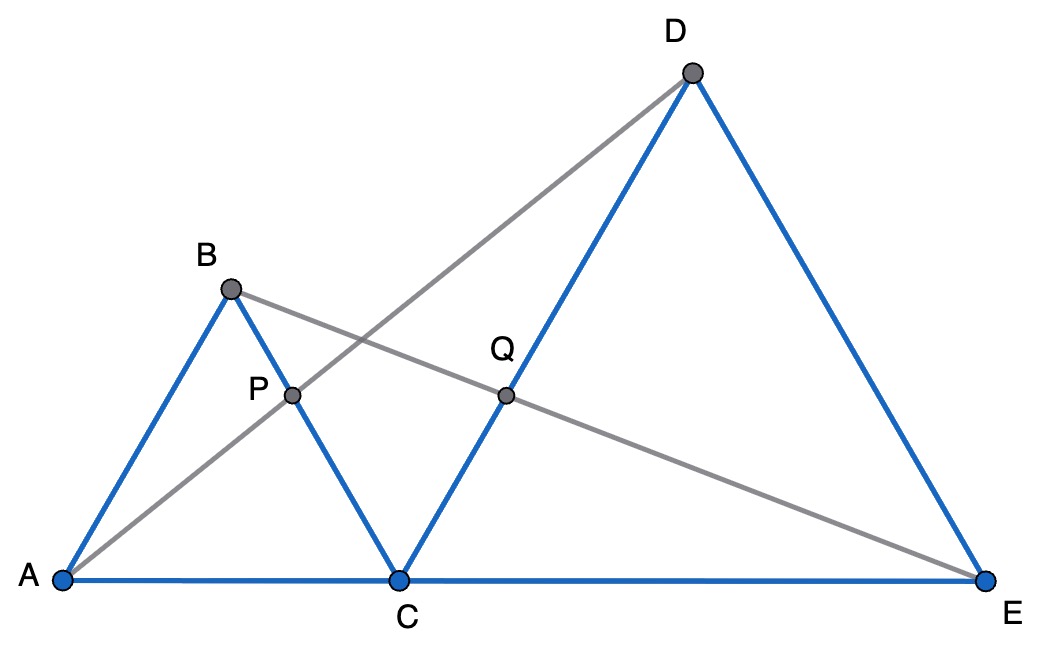
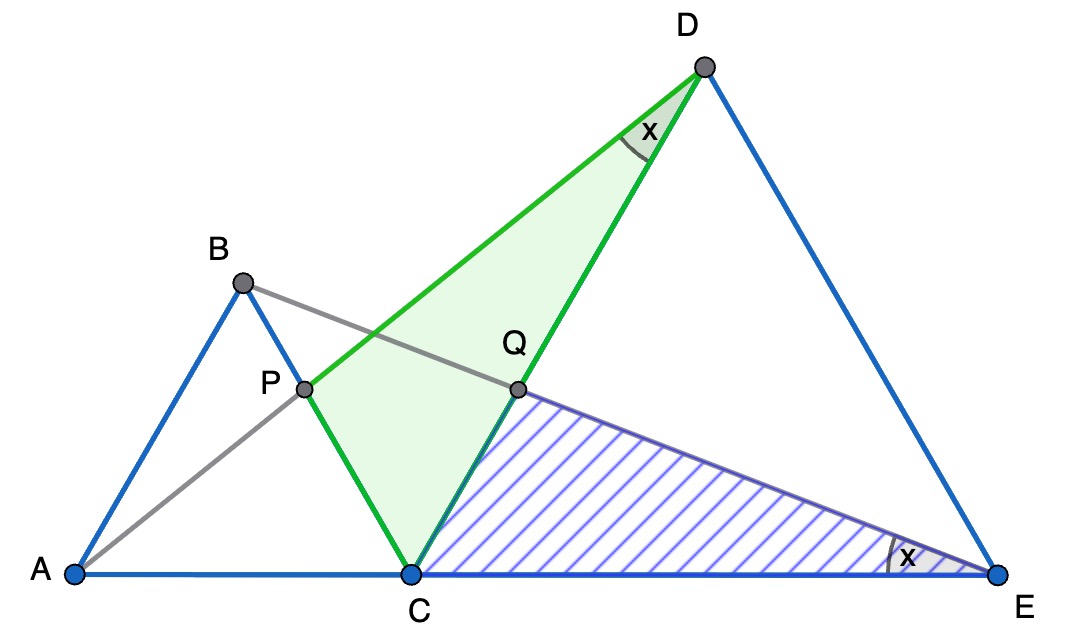
In the diagram triangles ABC and CDE are equilateral, with points A, C and E lying on a straight line. The problem is to prove CP and CQ have the same length.

There are probably many proofs - for example using coordinate geometry or complex number - but here is a short one using Euclidean geometry.

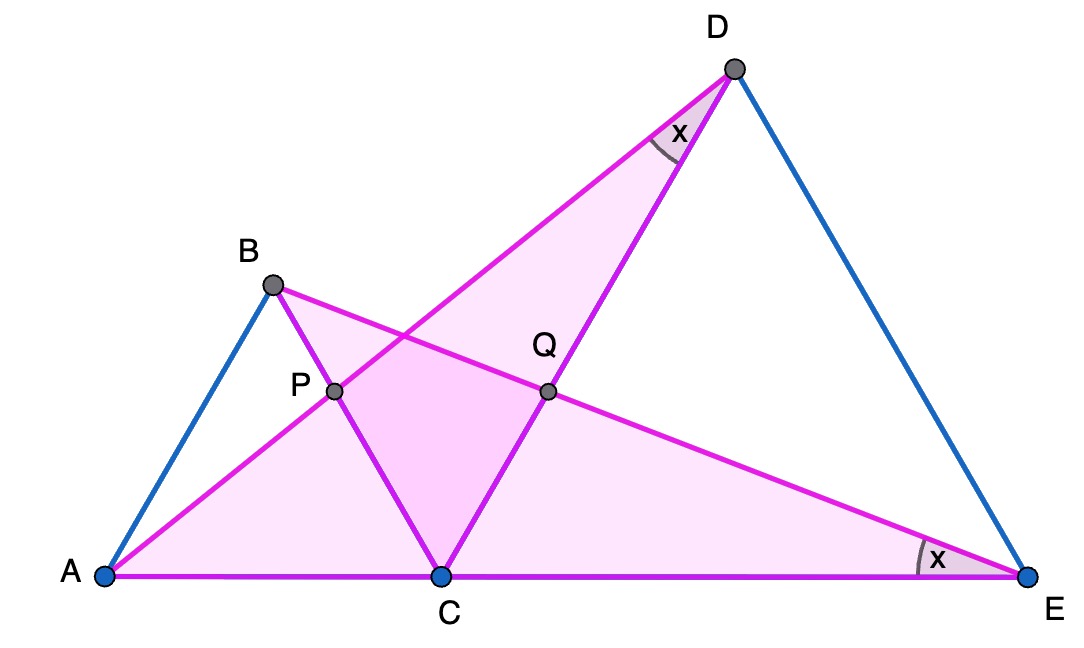
In the second diagram the coloured triangles ACD and BCE are congruent ('two sides and the included angle'), because AC = BC, CD = CE, and angle ACD = 120° = angle BCE . The two angles marked x are therefore equal.

In the third diagram the coloured triangle CPD and the shaded triangle CQE are congruent ('two angles and the included side'), because angle PCD = 60° = angle QCE, angle PDC = x = angle QEC and side CD = side CE.

Consequently CP = CQ which was to be shown.

Permalink
Share post
Richard Walker

Covering One Triangle with Another - An Elegant Proof

Visible to anyone in the world
Edited by Richard Walker, Tuesday 5 May 2026 at 22:55

Covering problems, which ask how a shape can be covered with other shapes, are part of what's called combinatorial mathematics. They often appear in recreational mathematics. have applications to real-world problems such as siting mobile phone mast to get adequate coverage, and are a subject of active current research.

Covering problems are often easy to state but even in simple cases the answers can be difficult to establish, because when you are arranging a bunch of shapes it's hard to be sure all the possibilities have been thought of.

One I thought of the other day and posted in this blog is 

What is the smallest equilateral triangle that can cover every triangle whose longest side has length 1?

This is about as simple as it gets but it's not trivial. The first idea you might have, an equilateral triangle with sides of length 1, turns out not to be the answer; a bigger triangle is needed.

I haven't proved to my satisfaction what the smallest possible answer is but I can prove the following.

Any triangle whose longest side is 1 can be covered by an equilateral triangle of side length two solidus Square root of three almost equals 1.155 .

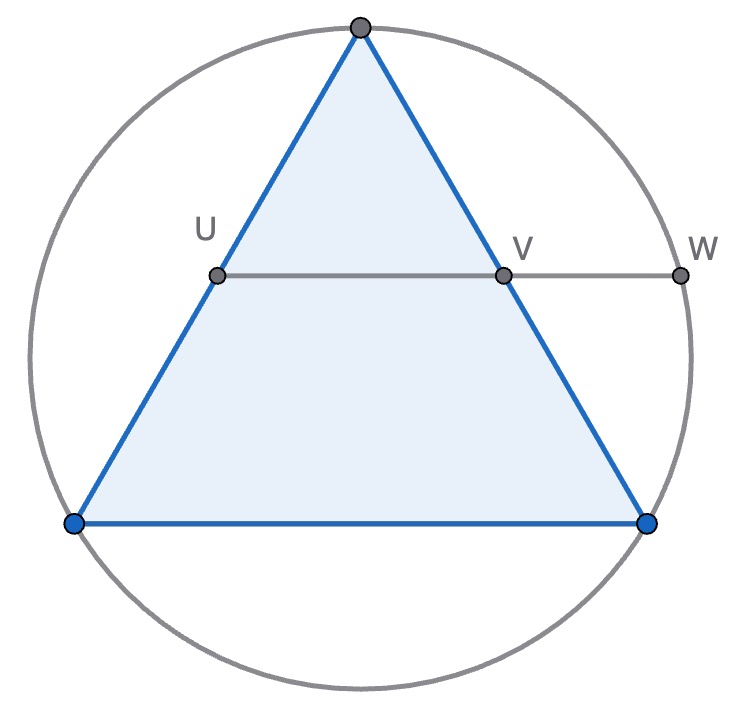
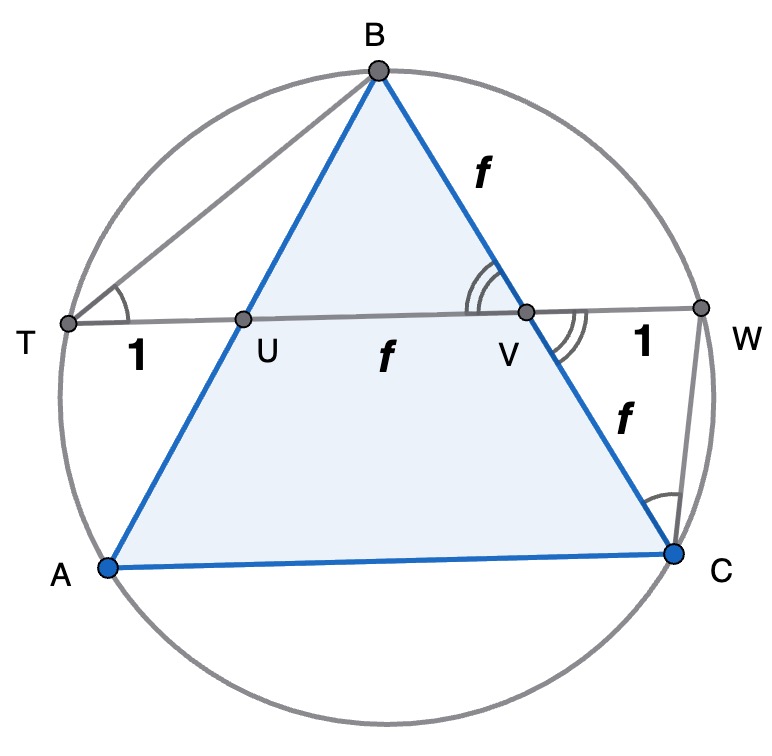
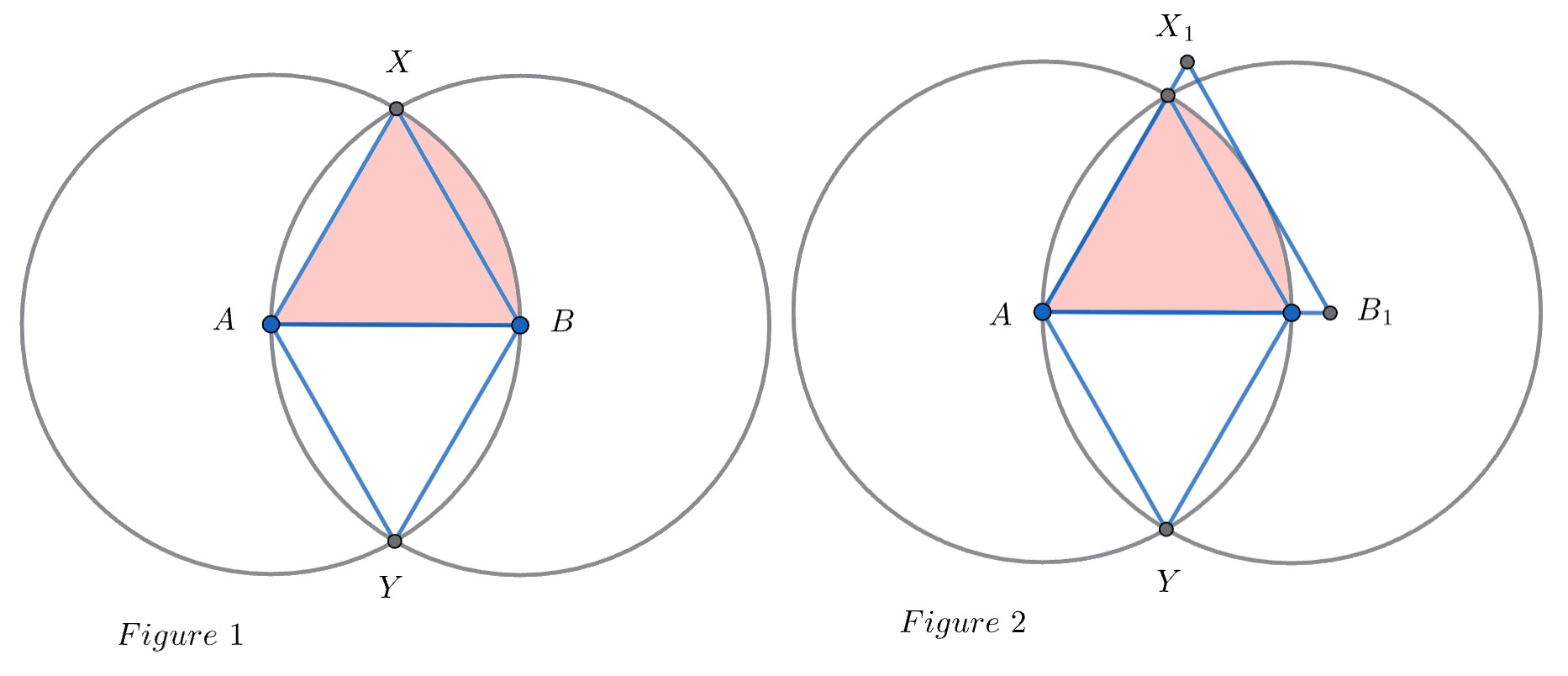
To see this consider Figures 1 and 2 below.

In Figure 1 AB is the longest side of the triangle we wish to cover, so its length is 1. Where can the third vertex of the triangle, call it C, be located?

If we draw circles of radius 1 centered at A and B then C must be in the lens-shaped region AXBY; if not, C would be more than 1 away from at least one of A and B , contradicting AB being the longest side.

From symmetry it is enough to just consider the shaded sector in Figure 1. In Figure 2 we see this sector is covered by equilateral triangle AX1B1, which therefore covers all three vertices of the triangle we want to cover and thus covers the whole of that triangle. 

The side length of AX1B1 is two solidus Square root of three almost equals 1.155 , which completes the proof.

Permalink
Share post
Richard Walker

A Stunning Equilateral Triangle Problem

Visible to anyone in the world
Edited by Richard Walker, Wednesday 15 April 2026 at 22:10

I saw this problem on Mind Your Decisions.

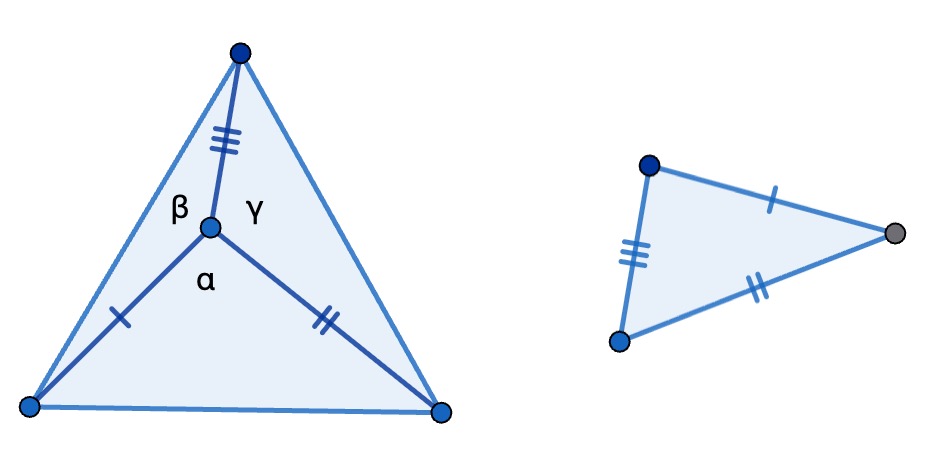
At left is an equilateral triangle. From an arbitrary point in its interior we draw line segments to its vertices, making angles alpha , beta and gamma as shown. If now we construct a second triangle (right) whose sides are equal in length to these three line segments, as indicated by the tick marks—What will the angles of the new triangle be?

I have never seen this before and have not viewed the solution. But I have worked out what the answer must be, just not proved it yet. And it's a truly beautiful result.

I wonder if it can be generalised to non-equalateral triangle? Or to a square?

Permalink
Share post
Richard Walker

Move Over Napoleon, Here's A Different Theorem!

Visible to anyone in the world

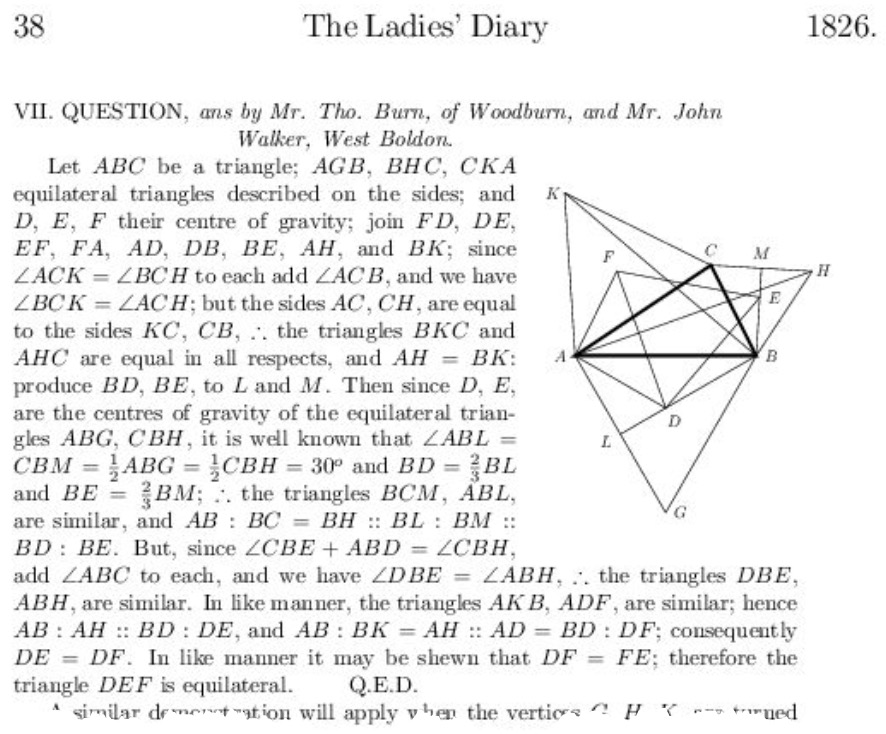
Napoleon's Theorem says that if we draw an arbitrary triangle and erect equilateral triangles on its sides, the centres of the triangles will form a equilateral triangle. Here is what may the first publication of this fact, in the 1826 edition of The Ladies Diary, which was very strong on mathematics at the time[1]. As you can see the proof is quite verbose and many shorter proof have been found. It's doubtful that Napoleon actually had anything to do with it but presumably somebody attributed it to him and it stuck.

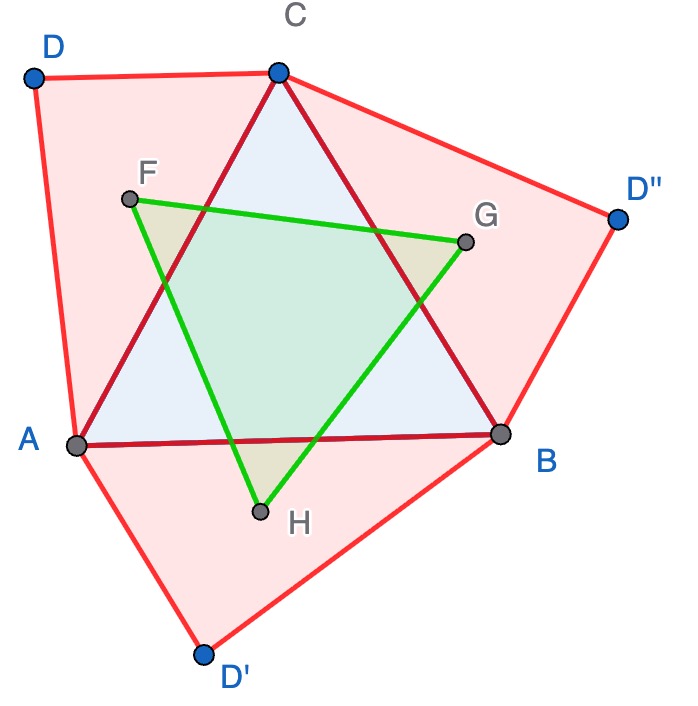
The equilateral triangle formed is DEF in the diagram.

I was musing about Napoleon's Theorem because I really like pretty theorems in plane geometry and it occurred to me that I could reverse the roles of the arbitrary triangle and the equilateral one.

If we draw an arbitrary equilateral triangle and erect equilateral triangles copies of an arbitrary triangle on its sides, the centres of the triangles will form a equilateral triangle.

Here it is

Which is rather neat! It's actually quite easy to see why it must be true, because each copy of the irregular triangle represents a 120° rotation of the previous one about the centre of the original equilateral triangle ABC, the whole figure has 3-fold rotational symmetry, any three corresponding points, for example D' D' and D'', are the vertices of an equliateral triangle.

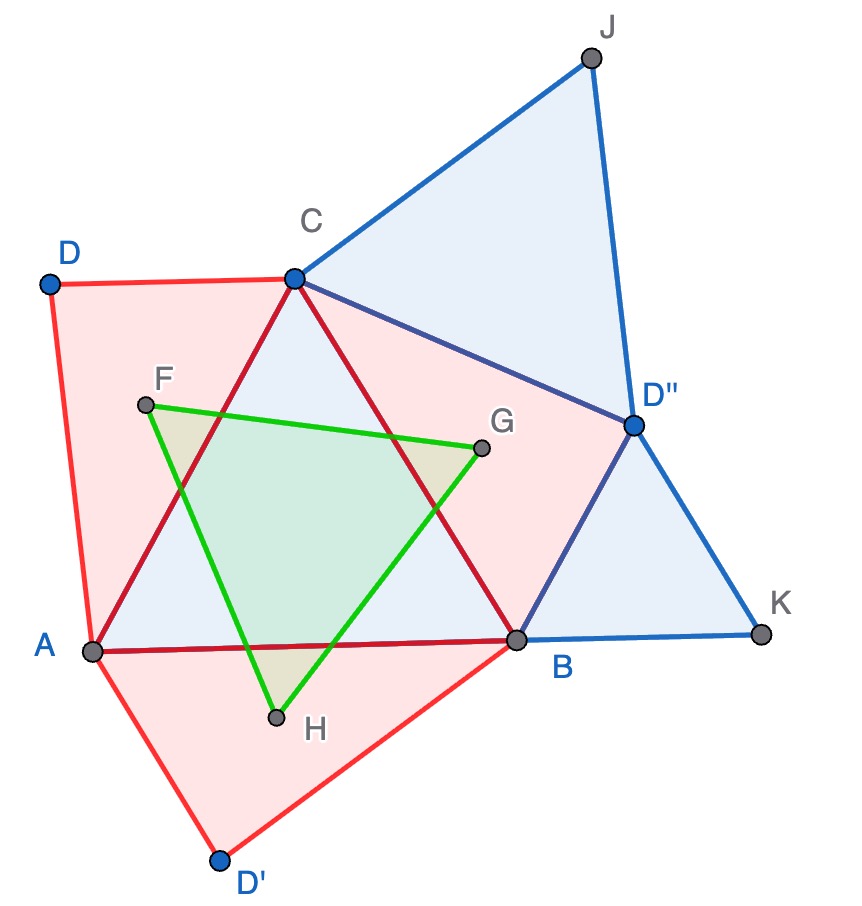
Now what if we go for a sort of hybrid: start with the figure above and erect equilateral triangles on the two free sides of one copy of the irregular triangle, like this

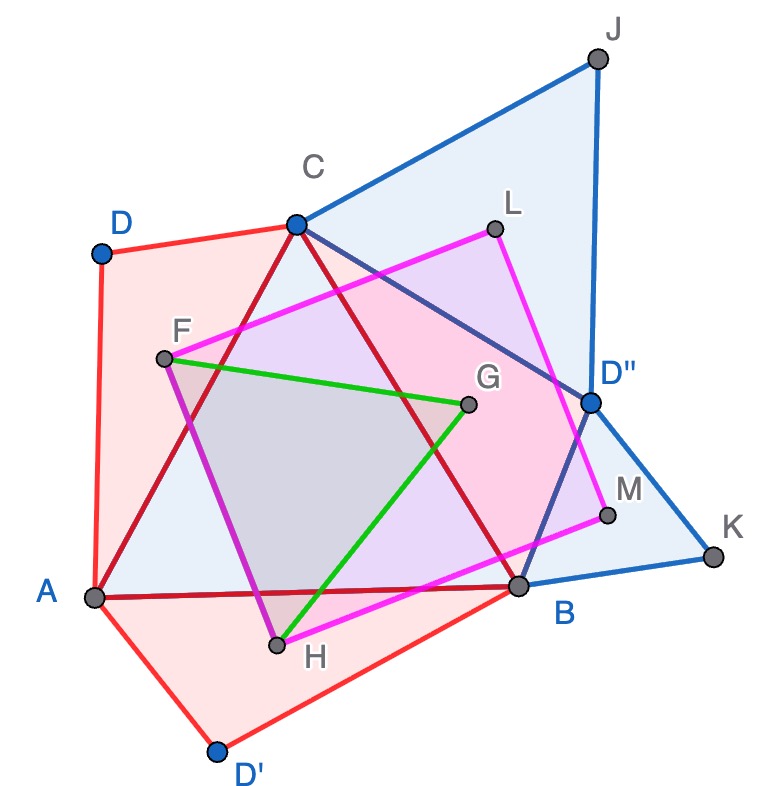
Now let's draw some centres and join them up

I bet you weren't expecting the rectangle, well, I wasn't anyway! There are no other right angles anywhere in the diagram and it popped out of nowhere.

I haven't proved it mind you. I think I could do it with vectors for example but it would rather messy. I'll see if I can do it just using a Euclid-style proof.

Permalink
Share post
Richard Walker

Another Geometric Puzzle

Visible to anyone in the world
Edited by Richard Walker, Thursday 4 March 2021 at 13:49

This is from the "Azimuth" website of John Carlos Baez, a mathematician and physics professor at the University of California. He found it at Brian McCartin, Mysteries of the equilateral triangle.

Here is a sketch of the problem. My solution to follow in the Comments on 4 March.


Incidentally John Baez is the cousin of Joan Baez, a progressive and a famous folksinger. Her father, John's uncle, was a con-inventor of the electron microscope.


Permalink 5 comments (latest comment by Casper Smith, Thursday 4 March 2021 at 05:40)
Share post
Richard Walker

A Quick Geometric Problem

Visible to anyone in the world

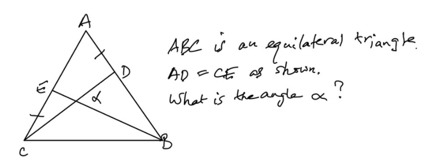
Michael Penn put this up on his YouTube channel earlier today, and it is indeed an elegant little problem. Here it is


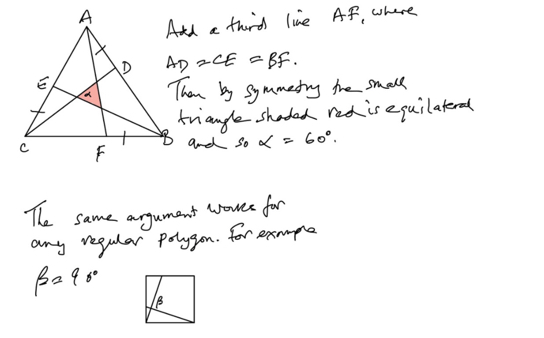
Michael Penn solves this using congruent triangles, the angle sum of a triangle (180 °) and angles on a straight line (180 °). α is always 60 °, whatever the length of AD and CE. It's not that obvious and I was quite surprised.

However thinking about it later, I saw we can solve the problem using symmetry and the solution is super-nice. Here's how - just add a third line.


Permalink Add your comment
Share post

This blog might contain posts that are only visible to logged-in users, or where only logged-in users can comment. If you have an account on the system, please log in for full access.

Total visits to this blog: 6145093