OU blog

Personal Blogs

Design Museum

Are You a Lifelong Learner? An Open University Reflection

Visible to anyone in the world

If you’re reading this as a current or former Open University student, there is a fair chance you already know the answer.

You probably are.

The more interesting question is why.

For me, lifelong learning has never really been a choice. It has been a way of making sense of the world. Long before I became an Open University student, I was the child who was forever asking why? Why does that work? Why is that there? Why do people behave as they do? My parents found it exasperating at times. Teachers sometimes found it challenging. But curiosity was never something I could switch off.

Decades later, it was that same curiosity that eventually brought me to the Open University.

Like many OU students, I arrived carrying a great deal of life experience. By then I had already worked in advertising, television production, corporate communications, online media and training. I had spent years producing educational and corporate films, managing projects and helping organisations communicate more effectively. Yet I felt there were questions I still wanted to explore and ideas I wanted to develop more rigorously.

The Open University gave me something I hadn’t fully appreciated I was missing: time and structure for serious thinking.

Studying for the MA in Open and Distance Education wasn’t simply about acquiring knowledge. It was about learning how to think more deeply about learning itself. Reflective practice became one of the most valuable habits I developed. Instead of merely doing things, I found myself examining why I did them, how I learned from them, and how my understanding changed over time.

One of the great strengths of the Open University is that it attracts people who are learning not because they have to, but because they want to. That creates a very different atmosphere from much conventional education. Many of my fellow students were balancing careers, families, caring responsibilities, health challenges and financial pressures. Yet they were also some of the most motivated learners I have ever encountered.

There is something quietly inspiring about people studying at eleven o’clock at night after a full day’s work, or writing assignments at the kitchen table while the rest of the family sleeps.

The OU also reinforced something I have observed throughout my life: learning rarely travels in a straight line.

I struggled with French at school, yet years later I found myself living and working in France, interviewing people in French, translating and even dreaming in the language. Technology transformed industries I worked in several times over. I learned on manual typewriters, moved to early personal computers, embraced websites, blogging, social media, online learning and now artificial intelligence. Every decade seemed to demand a new set of skills.

The alternative would have been standing still while the world moved on.

Yet lifelong learning is not simply about keeping up with technology. Some of the subjects that interest me most today would have surprised my younger self. Philosophy. Politics. Town planning. Educational technology. The psychology of learning itself. Often one book leads to another, then to an article, a podcast, a discussion, an online course and eventually a practical project. Curiosity has a habit of opening unexpected doors.

The Open University understands something that many educational institutions overlook: mature learners bring experience with them.

When I studied with the OU, discussions were enriched by people drawing on careers in nursing, engineering, teaching, business, the armed forces, social work and countless other fields. Learning became a conversation between theory and experience. Sometimes the most valuable insights emerged not from the course materials but from fellow students applying those ideas to their own lives.

Teaching and coaching have reinforced this lesson for me. Whether mentoring colleagues, supporting learners online or coaching young swimmers, I have repeatedly discovered that teaching is another form of learning. Every question reveals assumptions. Every explanation exposes gaps in understanding. Learning and teaching are not opposites; they are part of the same continuous process.

Over the years I have become less interested in qualifications as endpoints and more interested in learning as a lifelong habit.

Qualifications matter, of course. They provide structure, challenge and recognition. But the deeper reward lies elsewhere. It lies in remaining curious. In refusing to become intellectually complacent. In being willing to change your mind when new evidence appears. In recognising that however much you know, there is always more to discover.

One lesson the Open University taught me particularly well is that learning requires engagement. As someone who has spent much of his career around educational technology, I was once convinced that technology itself might transform learning. Computers, online courses, interactive media, mobile devices and now AI have all promised educational revolutions.

What I have come to appreciate is that while technology can support learning brilliantly, it cannot replace the essential ingredients. Learning still requires effort. Reflection. Experimentation. Failure. Discussion. Persistence. The most effective educational technologies help us engage more deeply; they do not do the learning for us.

Perhaps that is why so many OU graduates continue learning long after their formal studies have ended.

The habit becomes part of who you are.

You start an OU course because you want a qualification. You finish it with something more valuable: the confidence to tackle subjects you once thought beyond you.

Looking back, I realise that lifelong learning has shaped every stage of my life. It helped me adapt to changing careers, embrace new technologies, learn languages, coach others, understand history, engage with contemporary issues and make sense of my own experiences.

At sixty-four, I am still studying, still reading, still asking questions and still finding new subjects to explore.

The older I get, the less I feel that learning is about accumulating knowledge.

Instead, it is about remaining open to the world.

And if there is one thing the Open University taught me, it is that it is never too late to begin. Nor, thankfully, is there ever any need to stop.
Permalink Add your comment
Share post
Design Museum

This convinces me that increasingly prodution process, like basic web creation before, will increasingly be in-house

Visible to anyone in the world
Edited by Jonathan Vernon, Friday 2 November 2012 at 14:19

This clip serves two purposes.

1) It convinces me that companies want e-learning production skills in house. Only the exceptional project, because of its scale and desired impact, will go to specialists with superior craft and technical skills. Everything else will be in house.

Of the 135 training videos that I've produced or directed I believe that all the magazine programme from employees/stakeholders, probably those for shareholders too, as well as most 'how to' training can be done in house.

This leaves the 'wow' factor impactful, persuasive, big budget, commercial and conference opener to the external supplier or the corporate or government department with deep pockets.

2) This clip also convinces me the the OU needs to update H807 'Innovations in E-learning.' If the material being viewed doesn't demonstrate what is currently possibly it can hardly claim to be illustrating anything innovative.

Adobe e-learning suite used by Toshiba Learning & Development

Permalink
Share post
Design Museum

LT2:7 Learning Technologies. The challenge for RBS

Visible to anyone in the world
Edited by Jonathan Vernon, Sunday 30 January 2011 at 15:12

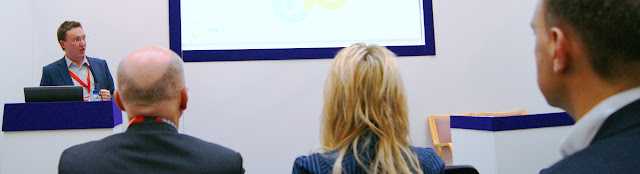
Andrew Spencer from Royal Bank of Scotland gave a talk on the development of an MBA programme for senior RBS staff with Harvard Business Publishing

DSC00662.JPG

The relationhship was established with HBP prior to the economic crisis or the banking collapse. The challenge was to produce a global programme that would meet the needs of a diverse audience.

DSC00656.JPG

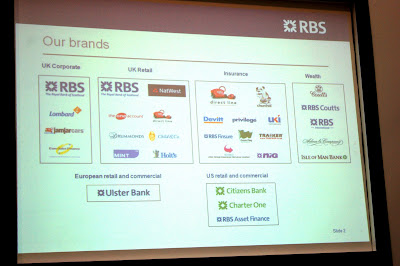
The RBS group of companies spreads far.

I loved the way he put it. RBS came up with two kinds of L&D offering:

'Ready Meals and ingredients.'

Perhaps there's a place for cooking related anaologies. Mark Wagner has a podcast to an American Conference in which he calls a wiki a 'pot lunch.' In this respect a blog entry might be a Pot Noodle and a Twitter the last Hula-Hoop in the bag (a broken one).

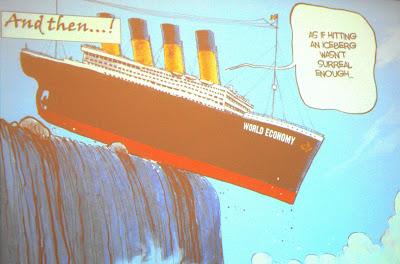
RBS%20World%20Economy.JPG

In less corporate company Andrew might have said that the 'shit hit the fan' in this case it was the ship.

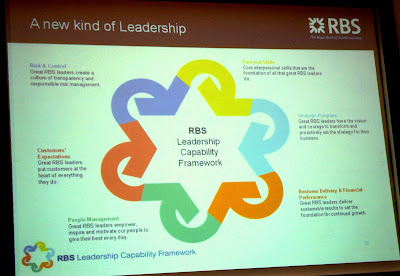
Some things would have to change.

DSC00664.JPG

They way RBS put it is that 'burning desire would have to transform into a desire for results.'

The cynic may say this is like saying greed had to be replaced by need?

Why HBP? For the brand and content and a previous working relationship.

A series of microsites were built so that people could find their way into the information. Andrew described this as a person finding the right door to go through. I'd go back to food and talk of a smorgasbord.

Once through this door a variety dishes are offered: insight videos, articles and indepth reports.

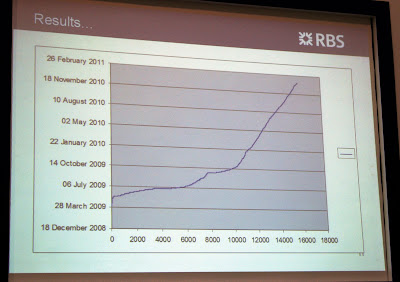
DSC00661.JPG

Take up of the offering picked up.


Permalink
Share post
Design Museum

H800:1 A warming introduction (or simply a warm up)

Visible to anyone in the world
Edited by Jonathan Vernon, Saturday 18 October 2014 at 16:10

I've just read the introduction to H800.

This is a gentle, caring, thoughtful 'laying out of the OU stall.' No jargon, clearly written in a reassuring and friendly tone. Even the lay out is more magazine article than academic abstract, I like this. Don't scare new folks on day one. Or me. And old hand now.

Were we gathered in the real world this is the equivalent of tea and cake with the course team and future student colleagues.

Even though this is now my third module towards the MA in Open & Distance Education I begin with trepidation as pressures on my time mount; professionally I am now incorporating the contents of H807 and H808 into my daily life and activities - evangelising about all things to do with e-learning (and the OU), while developing projects and talking to prospective clients and sponsors, employers and potential employees.

Personal Development Planning wrapped up the H808 ECA and is now, along with reflective blogging and use of MyStuff (the OU e-portfolio) very much part of my weekly routine.

I struggled through H807 on an old iBook, succumbing to printing off far too often. With H808 I acquired a new laptop and barely printed off a thing (the ECA and evidence being the exception). Everything went into MyStuff.

(I tried Pebbelpad for several weeks then gave up. Having paid an annual sub of £20 for this I will give it a more thorough try in H800. I sense a need to have an alternative e-portfolio as the OU abandons or replaces MyStuff).

With H800 I feel the need, professionally, for a Smart Phone.

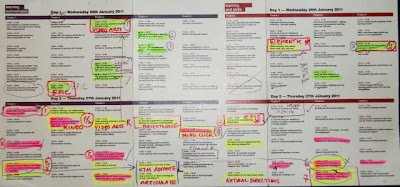
Returning from Learning Technologies 2011 I came away with one conviction - mobile learning and a number of trends (more video, less text; more chunking, easy create software and platforms; the creative/planning/production process being brought inhouse; shake up in higher education; significant investment/development in learning & development departments/functions; thorogh, comprehensive evidence of effectiveness with detailed analytics a key driver ... a list I will continue to develop this week as I finish going through my notes. See below for my take on Learning Technologies 2011)

Going mobile doesn't simply mean learning on the commute, or during a lunch break or riding a chairlift in a ski resort if only), but using the device at a desk, around the house, in corridors. Think of is this way, why do so many of us work from Laptops at a desk, when surely a desktop computer would do a better job. I feel a Smart Phone will simply offer an alternative way to work, as if on a micro-computer ... on a bench overlooking the English Channel. Stuck in traffic (as a passenger) .. even while making supper.

We will see.

Perhaps a Smart Phone and the next peice of business will go hand in hand.

I'll no doubt often using sports related analogies, so I'll treat week one and two as a warm up, rather than a sprint. In previous modules I've been like a pace setter at the start of the four minute mile, dashing off quickly only to retire before the end.

My key thought for H800? Pace.

In any case, I've got a self-assessment tax form to submit, more job interviews, client meetings too - even seeing a Venture Capital organisation. This and some swim coaching and quite a bit of swim club managing/organising (internal training, submission to a national audit, final assessment for the Senior Club Coach certificate). As well as time with family, children, our dog and the guinea-pigs 'E', 'C' & 'A'.


Permalink Add your comment
Share post

This blog might contain posts that are only visible to logged-in users, or where only logged-in users can comment. If you have an account on the system, please log in for full access.

Total visits to this blog: 21038594