In the world of triangle we find a rich etymological heritage, with most words having old roots, with many going back to Proto-Indo-European (PIE), the 5000-ish year old ancestor of most European languages and many from Northern India and the Iranian region.
Triangle is from Old French, from Latin triangulum. The tri- is from PIE *treyes, 'three' obviously, but -angle is less obvious; the PIE root is *ang or *ank, 'bend', which is also the source of ankle.
It also seems the Angles (as in East Anglia) took their name from the same root, perhap in reference to a bend in the coastline of their original homeland, or alternatively because the hooks they used to catch fish, so they would be 'The people of the fishing-hook' according to this theory.
Triangles come in many flavours and I've sketched some below. Triangle can be classified by the size of their largest angle, or by how many equal sides they have. In this post I'm only looking at the first classification, by angle, and I'll look at classification by equal sides in another post.
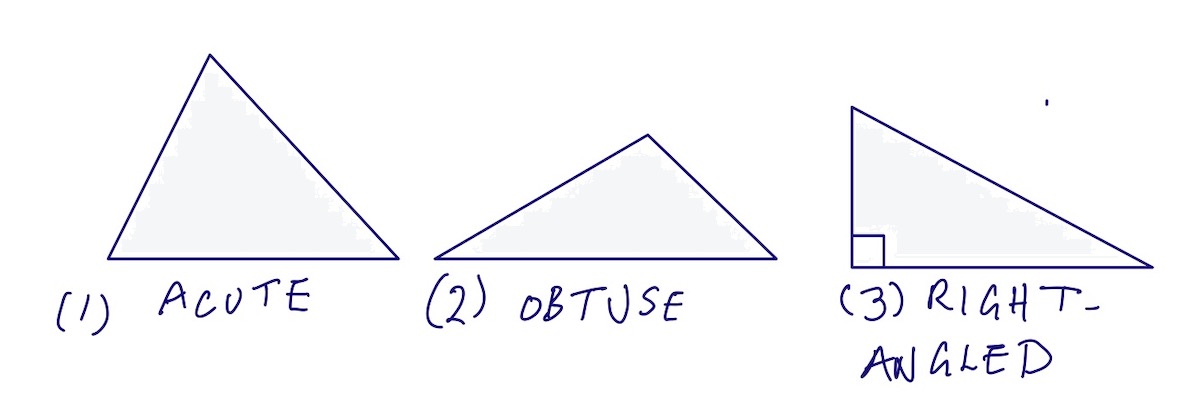
Number 1, the Acute, has all angles less than 90 degrees, so they are 'sharp'. Acute is derived from Latin acutis 'sharp', from PIE *ak-, 'sharp' or 'pointy', from which we get many words, such as acid, acropolis, acupuncture, eager and oxygen.
Number 2, the Obtuse, has an angle greater than 90 degrees. Obtuse means 'not sharp', from Latin obtusus, 'blunt', from PIE *(s)teu-,'beat' or 'push. This is the source also of type (from being struck), stupid (as in struck insensible), student (students push forward keenly) and stupendous (stunning).
Number 3, the Right-Angled, has a 90 degree angle, and sits right (!) on the cusp between (1) and (2). The right part is a translation of Latin rectus, 'upright', into Old English riht, 'straight', which both descends ultimately from PIE *reg-, the root of a whole host of words around being correct or regulated, or reigning, or being a maharajah, or being reckless, or being regal.
And it is the first element of my given name Richard!This is a so-called dithemic name, a compound of two Germanic elements meaning 'strong ruler' but with the ruler element first. So my name has the same PIE origin as right as in right angle.
Finally an old joke. See if you can spot how this ties in with PIE *reg-,
Did you hear about the king who was only 12 inches tall? He was a lousy king but a great ruler.
 The story goes that the Nobel Prize winning physicist Richard Feynman was introduced to this theorem at a dinner following a talk he gave at Cornell University. Feynman was apparently disbelieving at first, and even sought to disprove it, because the combination of nu