OU blog

Personal Blogs

Richard Walker

Painting The Sphere Red. Why 90% Guarantees A Red-Cornered Cube.

Visible to anyone in the world
Edited by Richard Walker, Monday 6 April 2026 at 21:42

A cube is inscribed in a sphere if all its vertices lie on the sphere's surface (Figure 1).

Figure 1. A cube inscribed in a sphere

If we colour a sphere's surface so 90% of it is red, then amongst the population of cubes it is possible to inscribe in different orientations, there must be at least one cube with 8 red vertices.

We can prove this rather surprising fact by a clever statistical argument.

From the given information we know that a randomly chosen point on the sphere is coloured red with 90 percent equals 0.9 probability.

Now let's introduce a so-called indicator variable which is 1 if a point is red and 0 otherwise. The mean average of this across all points must be equation sequence part 1 0.9 multiplication one plus 0.1 multiplication zero equals part 2 0.9 plus zero equals part 3 0.9 .

There is a very useful principle called Linearity of Expectation, which says that given the average value of a number of variables, we can find the average of their combined value simply by adding together the individual averages and this will be true even if they are not independent of one another. 

So we can add together the expected averages for the 8 vertices to get eight multiplication 0.9 equals 7.2 as the expected value for the whole cube, and this is the average number of red vertices across the whole population of inscribed cubes.

But if 7.2 is the average, some cubes must have a higher value and because the number of red vertices for any particular cube is a whole number, this means some cubes must have 8 red vertices.

This just proves such cubes must exist. It doesn't say where they are or how we might find them. In particular cases it may be possible but it's conceivable no general procedure exists.

See the Comments for notes on the origins of this inscribed cube problem.

We can apply the same ideas to show that if more than 75% of a circle is coloured red, there must be a square with 4 red cornes. What about 4D and higher dimensions? Leave your answer in the comments.

Permalink 1 comment (latest comment by Richard Walker, Monday 6 April 2026 at 21:28)
Share post
Richard Walker

Cube in Tetrahedron

Visible to anyone in the world
Edited by Richard Walker, Saturday 1 June 2024 at 16:20

Some more geometry! 

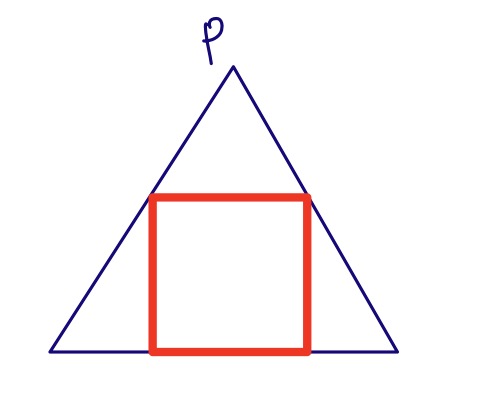
We can inscribe a square in an equilateral triangle so that all itas corners lie on the sides of the triangle. How? Well, consider this sketch.
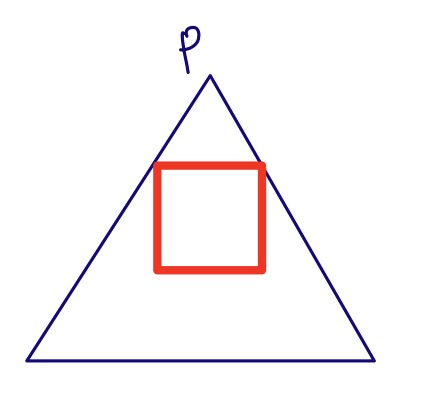

We draw a chord of the triangle parallel to the base and draw a square with the chord as one of its sides. Then we move the chord vertically downwards, keeping it parallel to the base and with its ends on the sides of the triangle and progressively enlarging the square, until the base of the square lands on the base of the triangle, and we are done.
We can extend the idea to three dimensions and inscribe a cube in a regular tetrahedron.
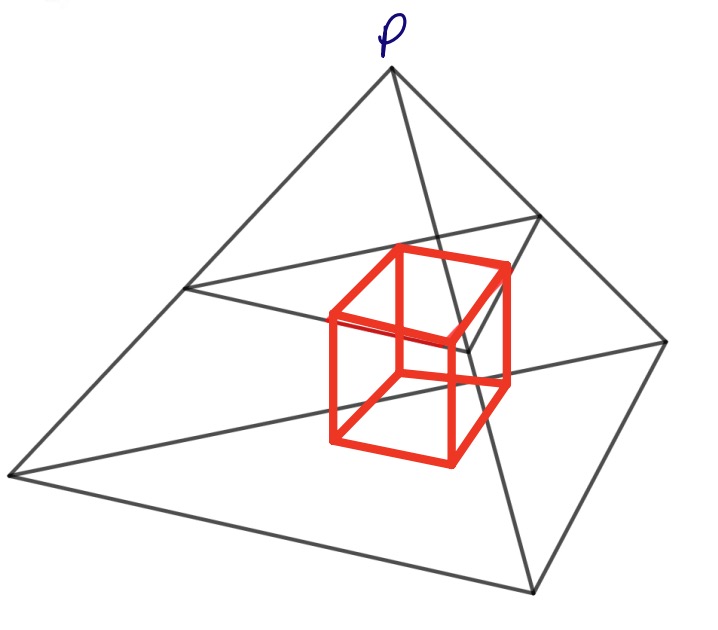

We take a section parallel to the base and in this equilateral triangle inscribe a square using the method described above, and construct a cube with this square as one of its faces. Then we move the section vertically downwards, keeping its vertices on the sides of the tetrahedron, progressively enlarging the cube, until the base of the cube lands on the base of the tetrahedron, and we are done.

It's conjectured, but I don't think proved, that this gives the largest cube that can be inscribed in a regular tetrahedron, see here.

Rather neat, and It seems to me that an analogous construction would be possible in dimension and beyond, a hypercube in a 4-simplex and so on, but I can’t prove it and drawing a picture of even the four dimensional case feels quite a challenge.


Permalink 1 comment (latest comment by Lili Pochnell, Saturday 22 June 2024 at 20:36)
Share post

This blog might contain posts that are only visible to logged-in users, or where only logged-in users can comment. If you have an account on the system, please log in for full access.

Total visits to this blog: 5861576