OU blog

Personal Blogs

Richard Walker

Solution to Earlier Problem with Two Equilateral Triangles

Visible to anyone in the world
Edited by Richard Walker, Monday 18 May 2026 at 23:25

This is a solution to the problem I posted 16 May 2026.
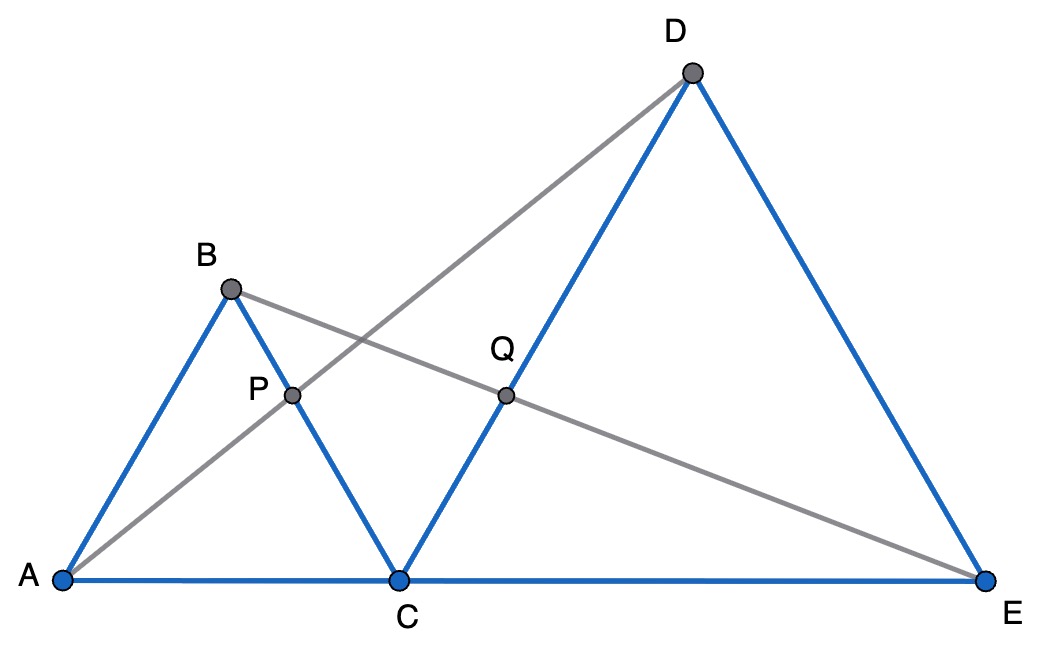
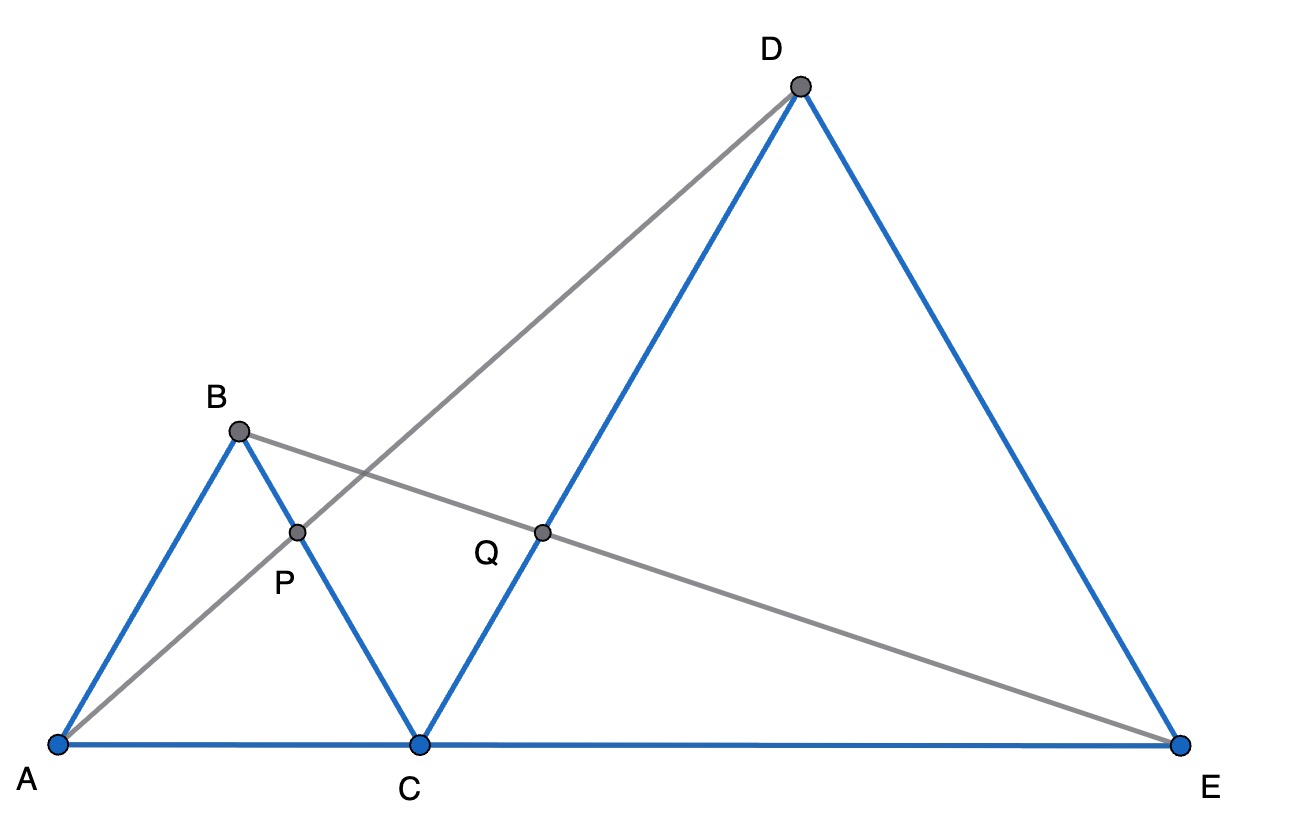
In the diagram triangles ABC and CDE are equilateral, with points A, C and E lying on a straight line. The problem is to prove CP and CQ have the same length.

There are probably many proofs - for example using coordinate geometry or complex number - but here is a short one using Euclidean geometry.
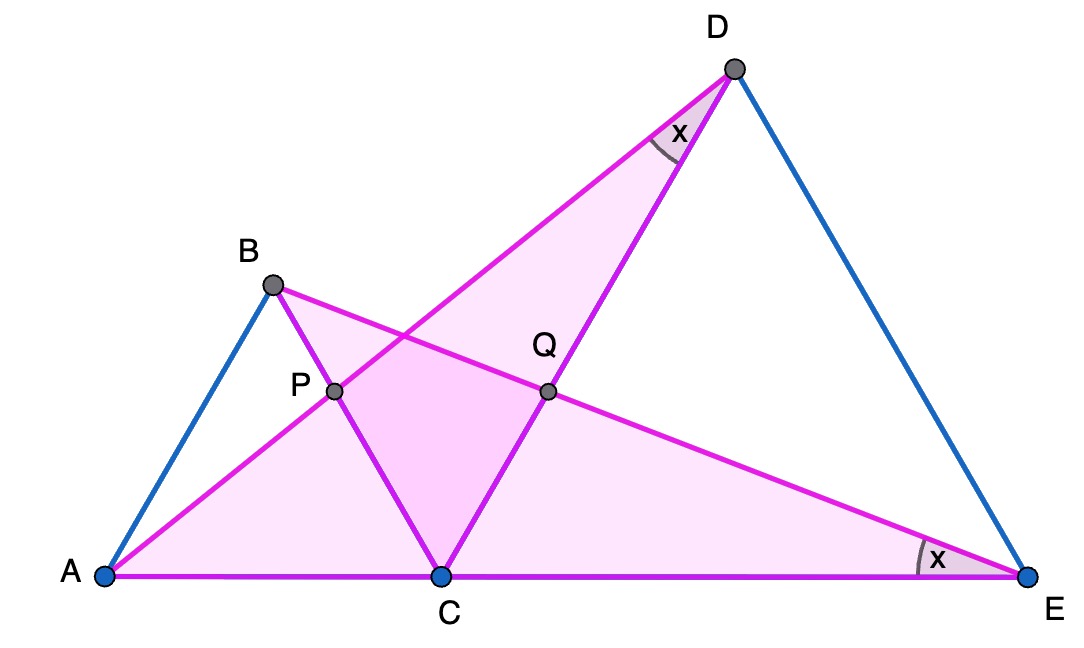
In the second diagram the coloured triangles ACD and BCE are congruent ('two sides and the included angle'), because AC = BC, CD = CE, and angle ACD = 120° = angle BCE . The two angles marked x are therefore equal.

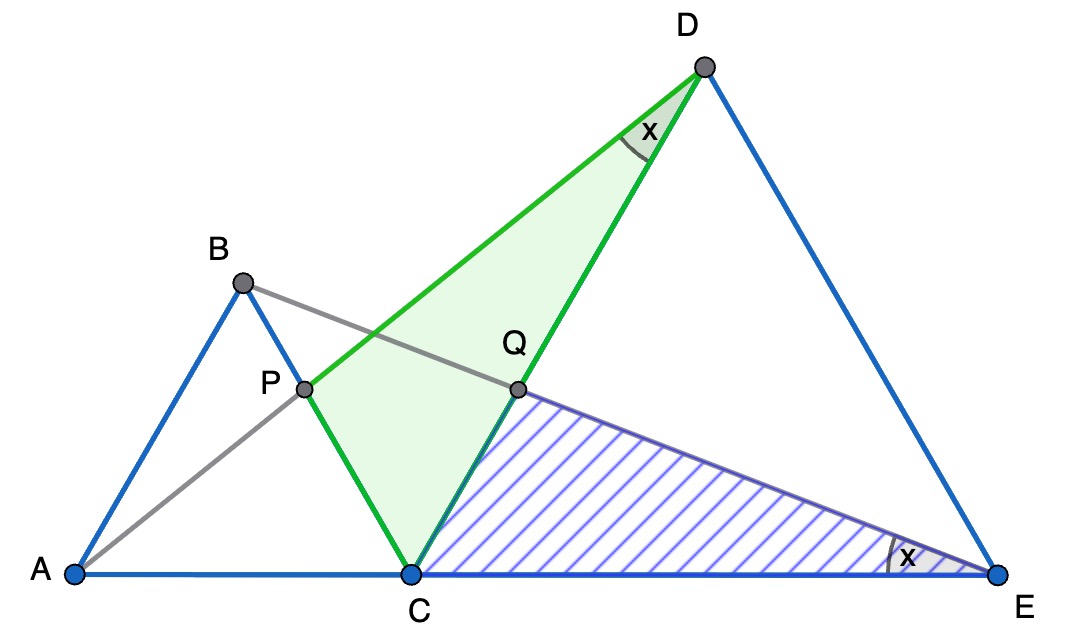
In the third diagram the coloured triangle CPD and the shaded triangle CQE are congruent ('two angles and the included side'), because angle PCD = 60° = angle QCE, angle PDC = x = angle QEC and side CD = side CE.

Consequently CP = CQ which was to be shown.
Permalink
Share post
Richard Walker

A Nice Problem with Two Equilateral Triangles - Can You Find a Proof?

Visible to anyone in the world

Here's a nice problem I found on math stack exchange (question 1182471).

ACE is a straight line and triangles ABC and CDE are equilateral. Prove that CP = CQ.

If you have a solution do put in the comments. I imagine there are a number of different solutions. I'll post mine this Monday coming.

Permalink 1 comment (latest comment by Darren Menachem Drapkin, Monday 18 May 2026 at 21:21)
Share post
Richard Walker

Nice Geometry Problem

Visible to anyone in the world
Edited by Richard Walker, Thursday 6 April 2023 at 18:04


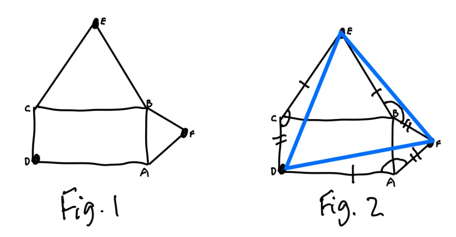
Suppose we take a rectangle and erect equilateral triangles on two of its side, as shown in Fig. 1. Show that pointsC, E and B are the vertices of an equilateral triangle.

Here is my proof: If we draw in the sides of the triangle (Fig. 2) we can see triangles DCE, BEF and DFA all have

a side of length | and one of length ||
an angle of 150 degrees included between those sides.

Consequently the three triangles are all congruent (the same as on another) and DE = EF = FD, so DEF is equilateral as required.
Permalink Add your comment
Share post

This blog might contain posts that are only visible to logged-in users, or where only logged-in users can comment. If you have an account on the system, please log in for full access.

Total visits to this blog: 6007688