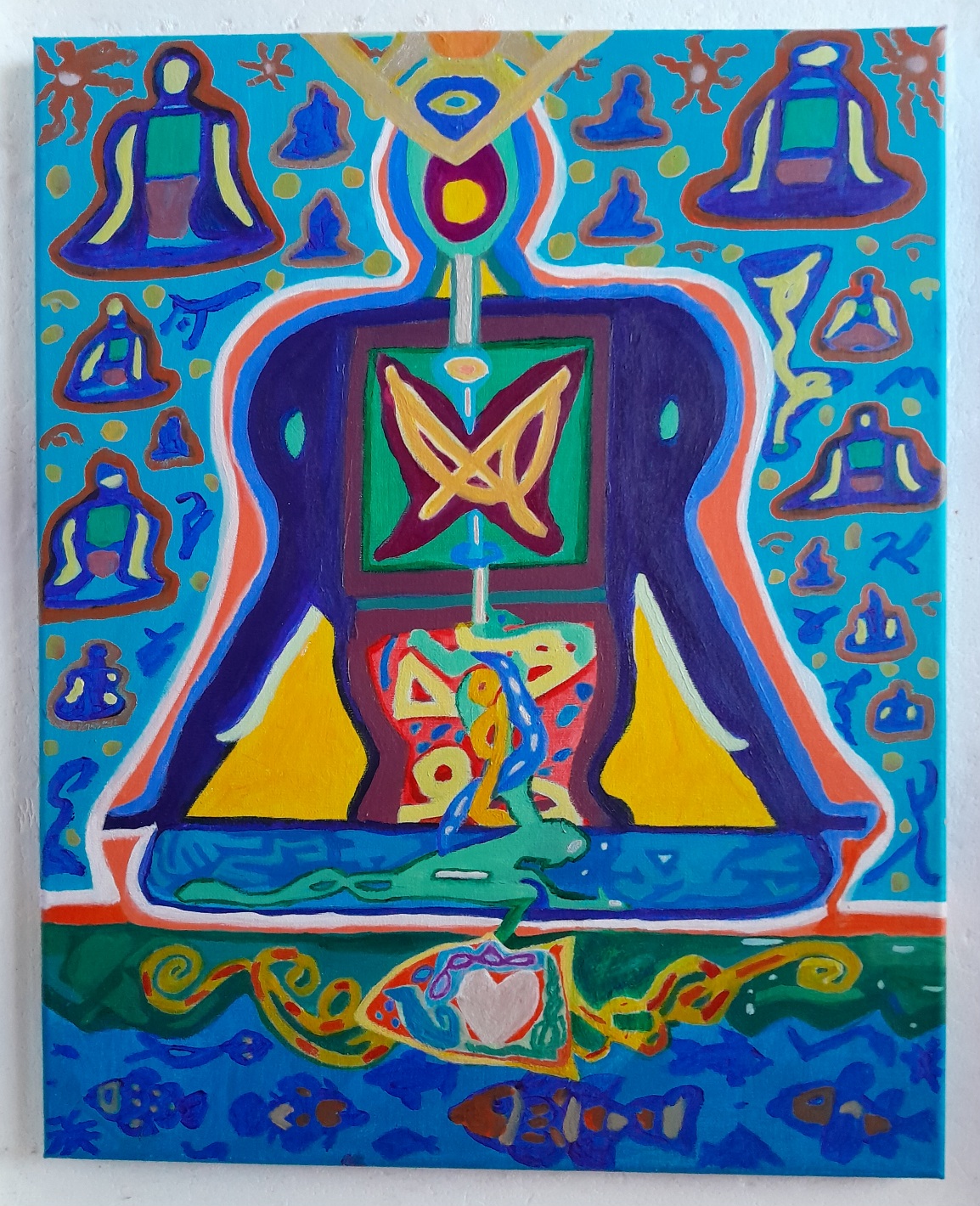
Acrylic on canvas (40×50 cm)

Acrylic on canvas (40×50 cm)
Be like a broken gong when it comes to the opinions of the world. The words may strike the mind but they don't have to reverberate inside. Let the opinions of fools be like water falling off a duck’s back.
Perceive the voice of a worldling as if it is the wind blowing through leaves, or the strange vocalisations of a creature that arises and ceases. Just sound, nothing more.
One doesn't have to follow the herd if it's going in the wrong direction. Choose your own way.
The world judges by outward appearances.
But it's what's on the inside that counts.
...
This world is not easy. Poverty is hard. It is so challenging to make ends meet these days. The cost of living is high, and finding a way to generate an income feels impossible. Every door I open seems to get slammed in my face. Especially when suffering with health problems, it is hard to put in the hours needed to survive. The gig economy is a joke, working for peanuts, and the competition is fierce.
It has been a dark few days within this fathom length body.
This morning I was once again pummelled by the dark forces of the kilesas (greed, hate, conceit, and delusion). They have become my relentless teachers these days. They hit me with everything they got today. Brought me to tears if I am honest.
Revealing to me just how much work there is still left to do on this mind.
I attended a dharma inquiry this evening that really seemed to hit the nail on the head of how I was feeling. I left seeing things more clearly.
I now understand this Buddhist practise is not just about the intellect, it is as much about the heart. Both work together. Complement one another.
Cool head, warm heart.
Friendship is important, as challenging as it can feel at times to relate to others, it teaches me things I miss when practising alone. I think I am a mix of classical Buddhism and Zen, although not the authoritarian kind of Zen. The friendly Zen (-:
I am not really into the Bodhisattva vow, though I respect it. I just feel uncertain about vowing.
I have decided I want to go for full enlightenment, and if I reach that, it will be impossible to help all beings then; but that does not mean I don't feel love for them, I feel compassion, and when wise enough I will try to keep the true dhamma alive for future generations, if I live that long. I want to help as many beings as I can. But not proselytising, not conceited, just living from the heart, and out of compassion teaching those who ask, and only when asked.
But I am getting ahead of myself, I still have much to learn before I realise that lofty aspiration.
I have a three hour exam tomorrow on the topic of cyber security. I am not looking forward to it. Wish me luck!
May all be safe, well, peaceful, and 😊
Four Bases of Psychic Power (satara iddhipada)
Desire or zeal (chanda)
Effort (viriya)
Mind (citta)
Investigation (vimamsa)
The onus is very much on
oneself to do the work, no one else can do it for us. None but ourselves can
free our mind. One must make effort.
Bear in mind it is said there are 84 0000 dhamma doors that lead to nibbana. The Buddha taught many paths and skilful means over his 45-year teaching career. We are all different, with different interests and dispositions, and so we must make our own raft out of the huge amount of teachings passed down to us over the ages, find the ones that suit us. There isn't one size that fits all.
In the metaphor of the raft, it isn't a fancy raft that gets us to the other shore. It is just a bundle of sticks placed under the arms to keep us afloat while we paddle across the flood using the four limbs of right effort.
We don't have to know it all. Just grab a bundle of
teachings from the huge pile handed down to us, those that resonate with you
and make those into your raft.
And gently paddle, pace yourself, tune, and balance the energy of right effort:
‘ Thus, have I heard. On one occasion the Blessed One was dwelling at Sāvatthī in Jeta’s Grove, Anāthapiṇḍika’s Park. Then, when the night had advanced, a certain devatā of stunning beauty, illuminating the entire Jeta’s Grove, approached the Blessed One. Having approached, he paid homage to the Blessed One, stood to one side, and said to him:
“How, dear sir, did you cross the flood?”
“By not halting, friend, and by not straining I
crossed the flood.”
“But how is it, dear sir, that by not halting and by not straining you crossed
the flood?”
“When I came to a standstill, friend, then I sank;
but when I struggled, then I got swept away. It is in this way, friend, that by
not halting and by not straining I crossed the flood.”
~ S 1.1 (Bhikkhu Bodhi trans.)
The reason Buddhist teachings are often in the form
of numbered lists is because at the time of the Buddha things weren't written
down. The Buddha and the monks couldn't read or write, so they memorised the
teachings. Making them into numbered lists made them easier for memory and
recall. Then on their own, a person would contemplate and reflect on their
meaning, unpack them, investigate them, fill in the details through their own
practise and experience of life.
The reason we can't go straight to the deathless, why we need to study and practise, is because the concept of letting go is easy enough to see intellectually, but we are all conditioned and have formed habits that get in the way and make it hard to let go. That's why one must undergo training to decondition the conditioning. Then old habits gradually fall away, and new ones develop that help us to realise the state of non-clinging, or non-attachment. The end of suffering.
The intellectual thinking part is also important as it helps us understand where we are going and what the teachings are for, why we are practising and what the practise is leading towards. Another translation of right view is right understanding.
But it is a gradual process. Which involves making the five aggregates into a path, the noble eightfold path. The robe of liberation. The Buddha likened the path to the continental shelf of India, that gradually slopes down, and eventually reaches a point where it suddenly drops off into the abyss. That's what the path does, it gradually leads us in the direction of nibbana (the end of suffering). And when the path factors are sufficiently developed, there comes the sudden insight, the Eureka moment, were we see something we cannot unsee - that's the drop-off point, enlightenment. From there, there's no going back, one will never see things the same way again.
It doesn't mean one is separate from the world though, it just means one stops clinging to it, stops yearning for things. The pain of wanting is gone. Craving is extinguished. Conceit is seen through, and the involuntary movements of the mind cease - which brings profound relief. A peace and happiness not dependent on conditions, independent of the world. And because it is not dependent on conditions, it lasts, and doesn't end.
But love and compassion for other beings is still
there. Friendship and connection are still there. That doesn't go. If anything,
it grows. Loving-kindness becomes unlimited, immeasurable, abundant.
Without the ego placing limitations on it, one's compassion becomes
boundless.
The whole process is illustrated nicely in the ten Ox-herding pictures in Zen.
...
The Buddha noted that dependent co-arising and the causes of suffering are like a tangled skein.

Painted in acrylic. Prints available from here.
© Asoka Richie 2023 (all rights reserved)
" When angry states of mind arise in meditation, balance
them by developing feelings of loving-kindness. If someone does something bad
or gets angry, don’t get angry yourself. If you do, you are being more ignorant
than they. Be wise. Keep in mind compassion, for that person is suffering. Fill
your mind with loving-kindness as if he were a dear brother.” -Ajahn Chah
Anger is suffering. It feels unpleasant. Like a sickness. A poison. Harming the body.
Metta (loving-kindness) feels good. It feels pleasant. Like a medicine. It helps heal the body. Metta fosters connection and friendship. Is good for our health and wellbeing, as well as everyone else’s.
Anger harms the body; metta heals it.
Anger harms society; metta heals it.
It can feel extremely challenging to go from anger to metta
(loving-kindness) though. Sometimes I can't just snap myself out of an angry
state.
Something interesting about feelings: a neutral feeling feels pleasant after a
painful feeling. Knowing this can be helpful.
It takes a bit of effort, and some will power at first. One must refuse to enter into any dialogue with the mind. Ignore thoughts. This is not an intellectual matter. For me, anger is a state of emergency, a dangerous fire I need to put out ASAP.
I must forget the past, forget the future, forget the self, forget what the anger is even about, forget it all, words are not what’s needed. There’s no reasoning with a mind absorbed in anger. Keep attentive to the neutral feeling, which becomes easier to do as the mind notices it feels more pleasant than being angry
Let what is sensed be just what is sensed, without adding anymore to it.
Awareness of space. Of the elements, earth, water, or air.
The touch of clothing on the skin.
A cool breeze can also help.
Half-closing my eyes reduces the visual information coming in.
Which can ease agitation. It is amazing how much difference half-closing one’s
eyes makes. It helps reduce sensory input, which can be calming.
Pacing back and forth, and gradually slowing my pace down, till it becomes a calm serene walking pace. Imagining myself walking like a Buddha.
Walking can feel good, because it has this feeling that you are
walking through stuff, walking it out of your system. I like the feeling of
motion, the sensations in the feet, the feeling of the space around the body.
When the mind is calm, metta is easier to practise which brings pleasant
feelings.
The neutral feeling like a bridge from anger to loving-kindness.
There's a quote I remember, but not sure who said it. (I can't
find it anywhere online.) But it was by a forest monk (I think). Someone asked
him if greed, anger, and conceit still arose in his mind. He answered 'yes, but
there isn't anywhere for it to land, so nothing becomes of it.'
Sometimes I can centre on an empty space within. When I go there the fire of
anger can’t take a hold and goes out. Same with wanting, conceit and delusion.
They don’t affect me when I am centred with emptiness. It all just stops,
ceases before it can take a hold. There’s a lovely feeling in the heart space
then. It becomes a place of no fear and can feel freeing and peaceful.
…

Sati-sampajanna means mindfulness with clear comprehension (or knowing).
It is a useful exercise to practise while one goes about daily life. It can help calm and centre the mind and bring insight into dependent origination.
Basically, whatever activity one is engaged with becomes one's meditation.
One is aware of what one is doing, where one is. Of one’s behaviour, of that which is appropriate.
Aware of what is non-delusion. Abandoning the wanting, the angst, and the clinging.
Fully here in this present moment, with life as it is -- our dhamma teacher.
One can get into a light samadhi doing this. It can be a refuge from difficult thoughts and emotions. A way of releasing the past and the future by being fully present to whatever task one is doing here and now, without the self-centred dream blinding us to what is real.
There are many ways to practice this. Sometimes it's nice to have an expansive open awareness. Other times it's nice to keep attention fixed on one thing. Depends on the mood, and this is where one must use wisdom and discernment to know what is needed in each given moment. This wisdom and discernment grows with experience. We are all unique, we have all been conditioned differently, no two people are exactly the same. Each one of us must tweak the practice to suit us.
Try to find something in awareness that brings some relief to the mind, even if it just seems like small relief, stay with it, it will grow.
Each situation and circumstance are different. Different objects of meditation work better at different times.
For example, sometimes I will just stay with the feeling of my feet on the ground. When I first did this, the sensations in my feet were quite dull. But after many hours of practise, the soles of my feet have now become very sensitive to the point where I swear I can feel vibrations in the ground, can sense things I couldn’t sense before.
I also like the feeling of the whole body moving as one.
The feeling of movement, how the body feels when it is in motion.
Or the feeling in my hands when holding an object. Is it hot or cold, smooth, or rough, heavy or light etc...
I also like to pay attention to the feeling of the air element in the space immediately around me. Or remain centred with the breath, whilst also aware of everything else happening in peripheral awareness. Where I am, what I am doing.
Sometimes I like being anchored in the spine, that can feel very good. Or the top of my head, the face, the neck, the heart, the belly, the arms, the legs.
The touch of clothing on the skin.
The natural elements are great too. The solidity of earth. The fluidity of water. The cool invisible changing touch of air. The light and warmth of fire, the sun.
The expansive and open feeling of the space element.
The knowing of consciousness, of awareness itself.
Other times I will contemplate interdependence, change, impermanence.
Sometimes I will pay attention to two things at once, such as the breath in my belly and the breath in my nostrils at the same time. Or my feet and hands, or the air element around me as it touches the skin and the sensations in the body caused by breathing.
Sometimes I centre with the emotion of goodwill. With peace and calm. With equanimity.
It depends on what feels good at the time. Take any guidance and make it your own. Find what helps you. Each of us must be our own refuge.
It is not easy; it can be challenging to keep bringing the mind back over and over. One may sometimes need to talk oneself into doing it. Or use the voice of another if really stuck. Read a book, an article or listen to a dhamma talk.
Learn to recognise the hindrances when they are present in the mind: craving, ill-will, fatigue, worry, doubt.
Notice how we talk to ourselves, and how it feels when the hindrances are present in the mind. For me I start feeling unpleasant feelings and notice I am stressed, that for me is a clear sign I am absorbed in unwholesome thoughts. That craving is present in the mind.
During the day, notice if you are stressed. Pause and ask yourself, am I suffering? What is the cause of this suffering? What can I do to ease that suffering? What can I practise to bring relief?
Whenever suffering is present, the five hindrances will also be present.
Applied and sustained attention to something wholesome secludes consciousness from the five hindrances.
When the hindrances are absent, one will feel great relief. When that happens it can help to note how much better it feels when they are absent from the mind, this can help to train it to see the difference and become more willing to abandon unwholesome states of mind, knowing that they are causing suffering, and that it feels much better to let go of them.
Practising sati-sampajanna complements sitting meditation and makes it easier to transition from daily life to sitting, and from sitting to daily life. It keeps the samadhi going and keeps the sign of peace steady in the mind throughout the day.
Sometimes though I do like to think and ponder and reflect on things. Thinking isn’t wrong. It can be a helpful tool. The way we talk to ourselves is a powerful tool. We can talk ourselves into different states of mind.
It depends what mood I'm in. Thought can be used as a meditation object, and used to seclude consciousness from the hindrances by thinking on a topic that is wholesome and staying with that topic.
Repeating a mantra over and over can also do it, or singing, or chanting.
It is the seclusion from the five hindrances that's important. That's what leads to joy, serenity, unification of mind, and equanimity.
It is hard to put into words.
It is an embodied feeling. One is anchored in the body, the subtle body as it feels from within. There's a safe space in the centre of us that is empty. One can anchor the centre of awareness there and still be present to everything else happening, but free from it at the same time, not clinging, not affected negatively by the changing vicissitudes of life. It is the empty seat at the centre of one's being. The inner cave.
Why is it empty? Because there's nobody there. No person. No self.
One can see this directly by playing around with the six senses: sight, sound, taste, smell, touch, mind (thoughts, memories, and ideas).
Divide each sense impression up into three different parts.
1. The object being sensed.
2. The contact with the sense organ.
3. The sense consciousness that arises from that contact.
One can see dependent origination in this. Notice how sense impressions arise dependent on conditions, and when those conditions cease so do the sense impressions.
Am I the object being sensed?
Am I the contact at the sense organ?
Am I the sense-consciousness that arises from that contact?
When I touch an object, I feel sensations. When I stop touching that object the sensations cease.
When my foot touches the ground there are sensations. When the foot is lifted off the ground the sensations cease. Am I the ground? Am I the sensations? Am I the consciousness which arises whilst contact is made, then disappears after?
Am I the sights, sounds, tastes, smells, touches, the thoughts, and ideas?
Where do thoughts and ideas come from? Mostly from the world, from books, articles, podcasts, videos, the media, our memory of the past, from the people we associate with.
Am I any of those things?
Who is this ‘I’ ?
...
This is a gradual training.
Find somewhere secluded where one won't be disturbed.
Putting aside longing and dejection in regard to the world.
Setting aside all worldly concerns.
One trains thus:
Mindfulness of the body
1. To begin just simply notice if the breath is long or short.
2. Then pay attention to the whole of the breath from start to finish.
3. Become sensitive to the body as you breathe in and out.
4. Breathe calming the body.
Mindfulness of Feelings
5. Breathe sensitive to joy.
6. Breathe experiencing pleasure.
7. Breathe sensitive to thoughts.
8. Breathe calming thoughts.
Mindfulness of mind states:
9. Breathe sensitive to one's state of mind.
10. Breathe satisfying and gladdening the mind.
11. Breathe steadying the mind.
12. Breathe releasing the mind.
Mindfulness of dhammas:
13. Breathe contemplating change. (impermanence, anicca, dependent origination).
14. Breathe contemplating the fading of craving. (Dispassion)
16. Breathe contemplating cessation. (of suffering).
17. Breathe abandoning greed, hate, and delusion. (renunciation).
...
Sometimes I feel alive, enthusiastic, full of excitement and wonder. Other times I am like a flat battery that can't seem to hold its charge or see much hope in anything. Other times there's an odd mix of brain chemistry that is so horrible I can't put it into words.
It is helpful for me to remember the brain is the body. It is dependent on conditions largely outside my control, meaning it will change. It won't always function in the way I wish it would, and eventually it will cease when the conditions it depends on cease.
That is the way of things with dependent origination. Conditioned phenomena is impermanent. It isn't gloomy to think this way. It can be a helpful tool to bring some equanimity to the mind. It helps me let go of the clinging and aversion towards things, and to stop taking it personally. Which decreases the suffering somewhat.
Sometimes difficult things happen that are outside our control. And sometimes it’s our own fault, we behave in unskilful ways and reap the kamma for it. Whatever it is, we then go and add more suffering to the situation with the longing, aversion, and taking it personally. This is the mental pain we add to physical and worldly difficulties. This is what makes us suffer.
I remember one night I got stranded on the mainland after missing the last boat back to the island. I had just completed a lengthy 10-hour journey coming back from my dad’s funeral. And I arrived at the ferry terminal late due to a delay with the coach. I felt exhausted and a bit unwell. There was nowhere to stay, and a long wait till the next ferry in the morning. So I went to sit on the beach, tried to roll a joint to make myself feel better. And I'd almost finished rolling it, when there was a huge gust of wind that blew it all away, and then it started raining. I felt like the person off the Hamlet advert, but without the cigar.
Then the day of the funeral all came back to me, and I burst into tears. It all just gushed out. I felt so lonely.
Then I saw my dad’s face in the sea. And I said I was sorry for not getting chance to speak to him before he died. I wished him well and told him he was loved.
Then the wind and rain became unbearable, so I went to find some shelter. I spent the rest of the night alternating between walking, standing, and sitting meditation.
I went through so many mood swings in that one night. Like the mind was changing, morphing into all sorts of different shapes and patterns. I was even seeing things that weren't there. It was challenging.
Through it all I tried to remain still and not get disturbed by the changing psychic weather. I just kept bringing my attention back to the breath and body to calm and centre the mind. Not engaging with anything else. Meditation felt like a refuge. There were strange eerie sounds at times like banshees wailing. (They turned out to be seabirds, the tunnel making their calls echo in ghostly ways).
Eventually after many hours of this, the mind converged into a oneness, and it all disappeared. The psychic weather passed. Leaving behind a stillness and beautiful emptiness that I can't put into words.
I was greeted at sunrise by a friendly pigeon watching me intently with smiley eyes. Then it vocalised a set of patterns, and some moments later another pigeon responded in the distance with a different set of vocal patterns.
The pigeon flew away.
The wind and rain outside had stopped. It also dependent on conditions.
I went to get a coffee and my card was declined by the reader. I laughed, and the cashier laughed as well. She said that happens to her all the time, and that she keeps a supply of cash with her just in case.
Luckily, I had a few coins on me and managed to buy the coffee.
...
Something I find helpful as I go about my day. Is to just suddenly stop and notice how I am feeling. The mind, the emotions, the body. Whatever it feels like in this moment.
It feels like this.
It can be helpful to stop sometimes and do that. It creates a bit of space. A pause in the story. The thoughts are still present but I am not absorbed in them anymore. I am centred in emptiness. Sounds strange, and difficult to put into words. The emptiness is not a negative thing, it feels freeing and expansive. It contains everything that is happening in the moment, yet it isn't the things it contains. It is not a dry, detached emptiness. It just feels safe. If that makes any sense...
I have been reflecting a lot on the four noble truths, thinking about craving (tanha).
Craving for sense pleasure (kāma-tanhā);
Craving for existence (bhava-tanhā),
and craving for non-existence (vibhava-tanhā).
The second noble truth says that craving is the cause of suffering and gives the instruction for it to be abandoned. But that sounds a bit harsh, so I am trying to find a better word than 'abandonment'.
One way I do it is. When I notice my mood is a bit off and there is a lack of peace. I stop and inquire. I notice craving in its three aspects. Note how the craving creates a feeling of unease in the mind, a restless anxiety, fear, discomfort, yearning, and discontent. Craving is stressful.
Thoughts to do with longing, resentment and conceit are unpleasant. They don't feel good. They feel toxic and make the mind an unhappy place. I notice how craving creates tension in the mind. How it creates a feeling of lack and dissatisfaction. A feeling of compulsion. How it divides the mind against itself. How all the wanting becomes delusion. The mind gets absorbed in the stories it tells itself about the world and the things it wants, and the things it doesn't want, takes it all personally. The self-centred dream.
I notice this and stop following it. I don't judge it, or identify with it. I feel compassion for it, understand it for what it is. let it be there, and notice how it all feels without the story. How the body feels in this moment. How the mood feels. How this present moment feels. Accept it all for what it is, as it is. And just breathe in, breathe out.
Not pushing anything away, nor chasing after it. Not seeing anything as self or other. Just breathing through it. The whole body absorbed in the feeling of the cool air going into the nostrils and the warm air going out. Like when one steps out onto a balcony and breathes the fresh air, and it feels soothing. That feeling of invigoration. The body still, calm, open, and at ease. The breath energy filling every part of it. Uplifting the mind, freeing it from concerns, bringing relief.
The craving settles. The involuntary movements of the mind cease and there is peace for a time.
Then the craving comes back again.
Rinse and repeat.
But do the work gently, with good humour. With kindness. Don't take it all too seriously. Joy is part of the path too.
***
This blog might contain posts that are only visible to logged-in users, or where only logged-in users can comment. If you have an account on the system, please log in for full access.