OU blog

Personal Blogs

Steven Oliver

Enlightened chocolate

Visible to anyone in the world
Edited by Steven Oliver, Thursday 7 May 2026 at 13:55

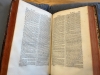
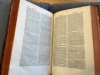
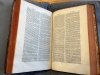
Thought I'd share some pictures from a trip to the archives [2/4/2025]. Whilst digital access is fantastic I do find the opportunity to interact with original objects is really exciting and motivating.

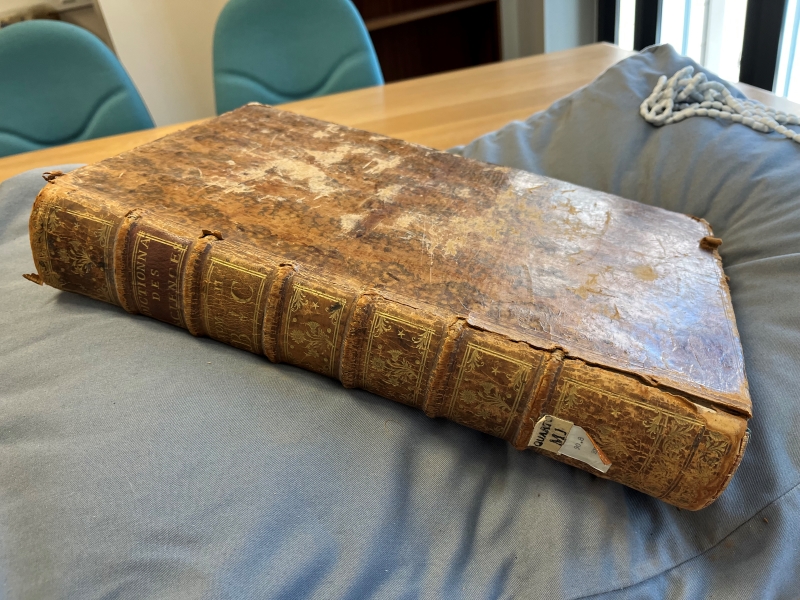
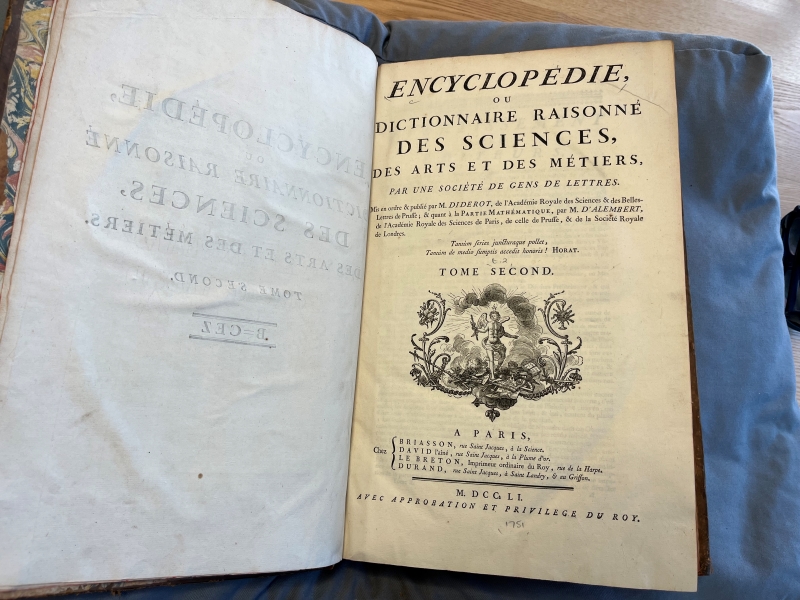
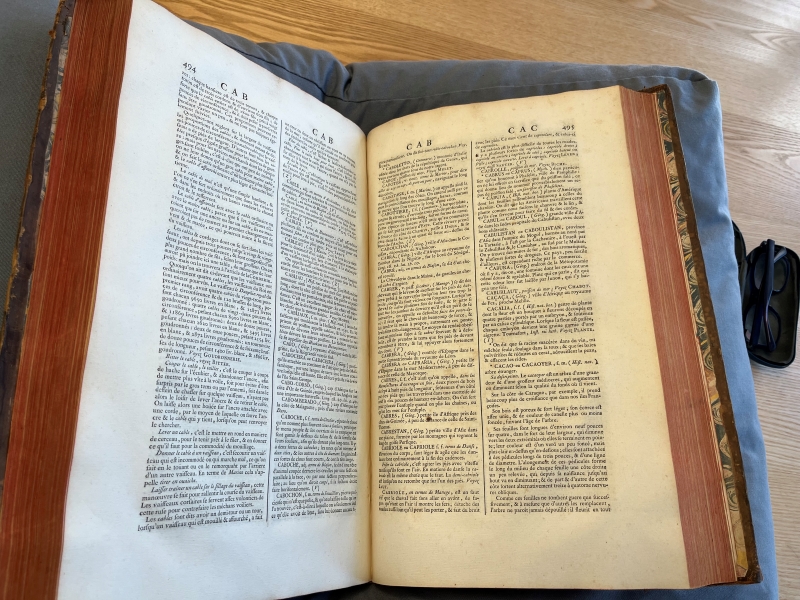
This is volume two of the Encyclopédie (B to CEZ) from 1751

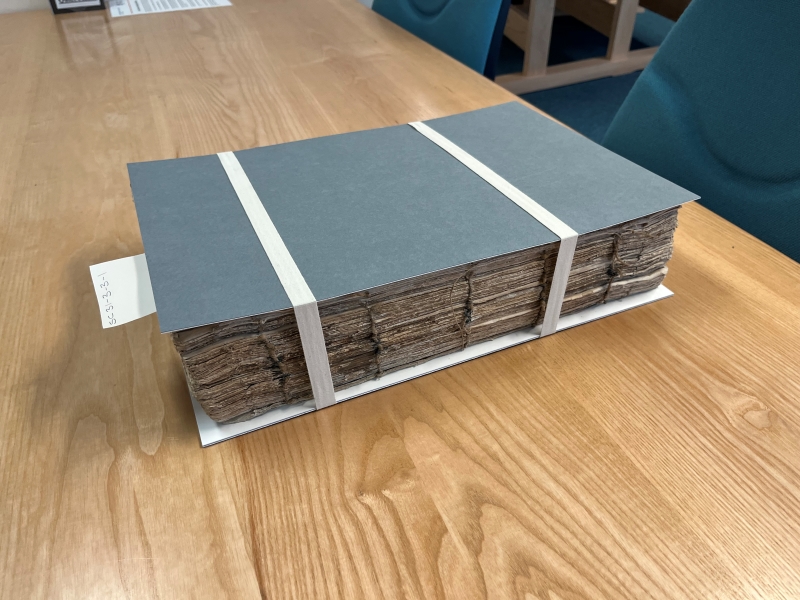
I'd originally asked if I could see volume one - but as you can see below, the archivist discovered that that hadn't fared quite so well over the last 274 years! They were happy for me to look at it, but I just wasn't brave enough (plus I thought it really ought to be saved for someone who really needed to study it). At least my requesting it meant the conservator cut some boards to better protect it.


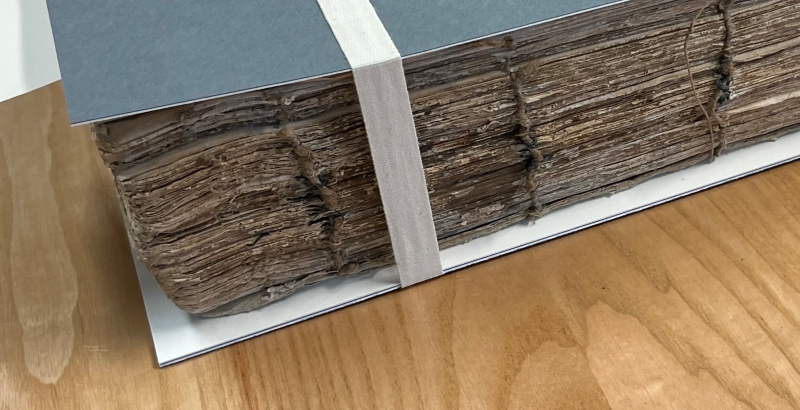
Plus there was a chance to see how the binders had originally stitched the pages.


Looking inside took me straight back to being a child, when the 'Reader's Digest Encyclopedic Dictionary' (only 3 volumes 😀) was a fixture on my parents' bookshelf - and the basis for quite a bit of homework! It did feel like the original 'information superhighway'!


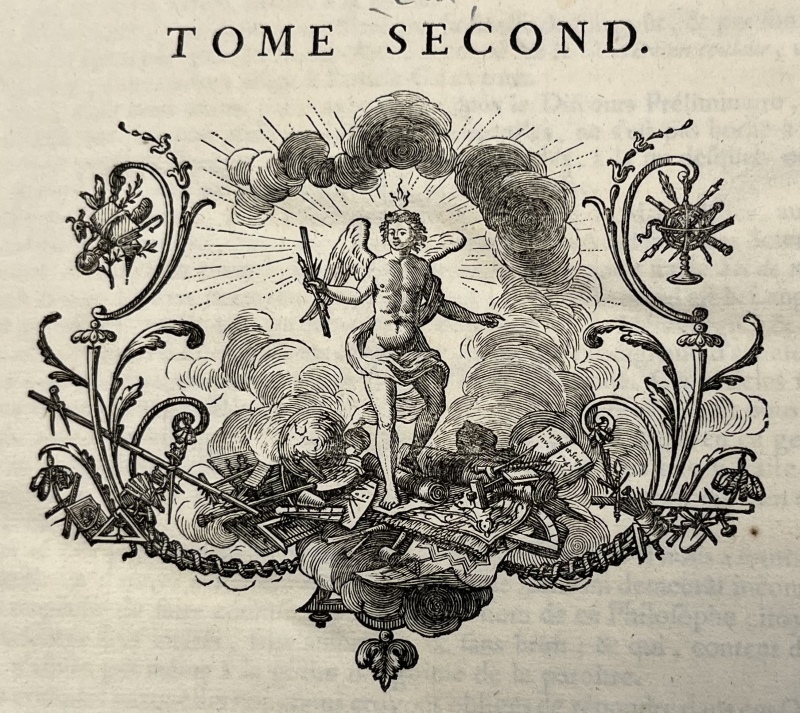
I think illustrations came in separate volumes, but the title page does have this fascinatingly enlightening angel, advancing on a foundation of measurement, scholarship and science.


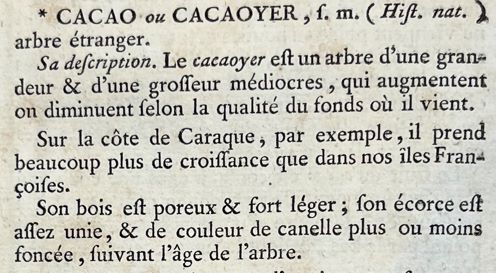
My school French only gets me so far (and there were only words from B to CEZ 🙂) but given chapter 20 of A223 I was pleased to find the entry for cocoa...


Plenty of evidence for interest in that topic - 8 pages (!!) on everything from how to grow and ship it, to using cocoa-butter as a skin cream.


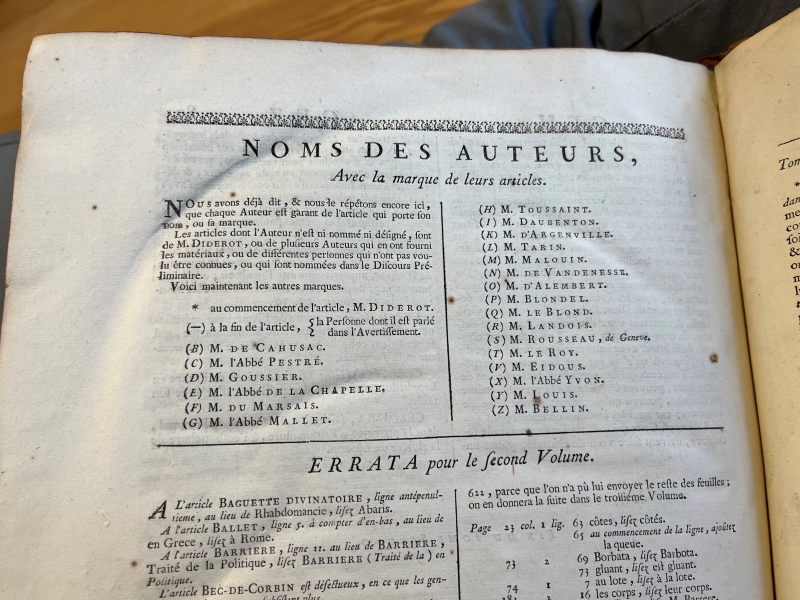
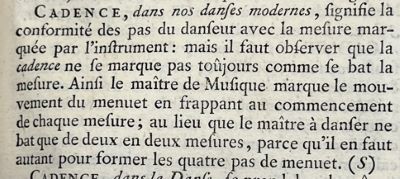
The entries are linked to their author by a letter - so I spent quite a while trying to track down something by (S), M. Rousseau of Geneva.....

Here he is explaining 'cadence' in modern dances (good to see he knew he was 'modern' 😃), and the tricky business of fitting dance steps to the beat! Apparently along with some important entries on political economy he also covered a lot of the music entries.


Whilst I guess it is an indulgence to seek these objects out largely for enjoyment - I do find it adds something to studying (even if it is partly just an excuse to avoid TMA planning 😆). 

[Home Page]
Permalink
Share post
Steven Oliver

Clandestine catholics in York

Visible to anyone in the world
Edited by Steven Oliver, Thursday 7 May 2026 at 13:55

Thought I'd share another fascinating York building that picks up on some aspects of the A223 module chapter covering the theme of religious (in)tolerance in the early modern period.

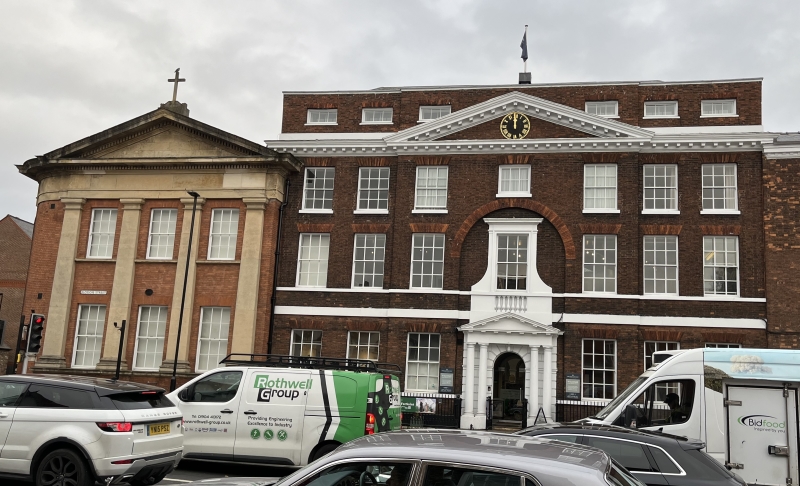
This is the frontage of the Bar Convent that stands just outside the walls of the city by the Micklegate Bar. The openly religious building on the left is a 19th century addition, built at a time when the catholic school which it housed could be openly acknowledged. The 18th century frontage was however designed as a grand, but entirely secular, town house (1786-9) - with nothing to indicate the interior.....

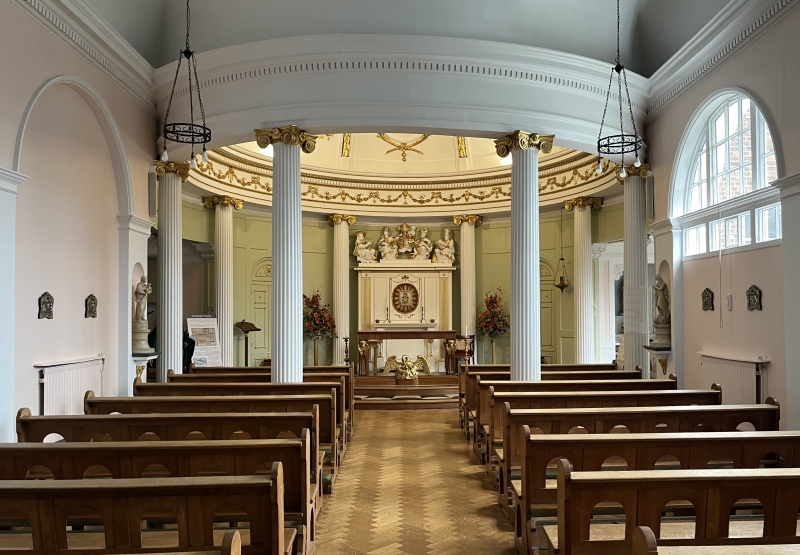
...which contains this beautiful chapel. 


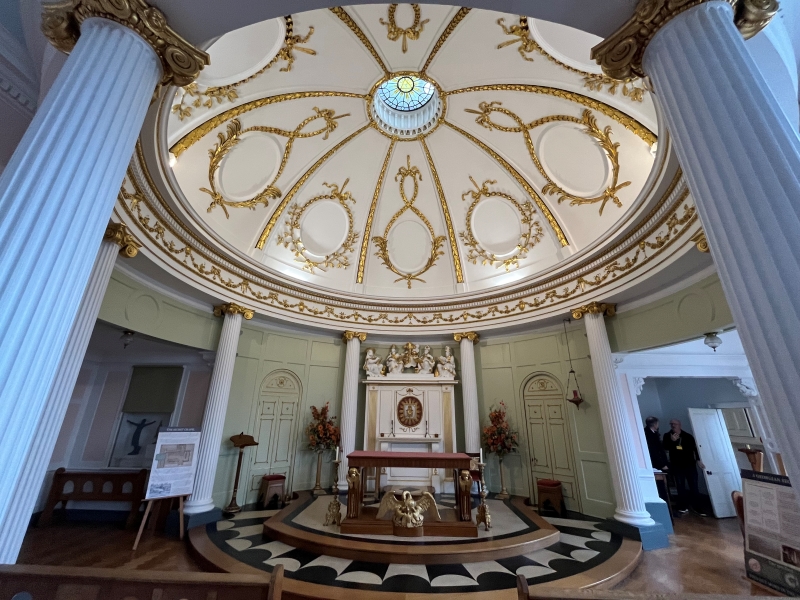
Apparently the dome was designed to be entirely invisible from outside view. 

The convent was established in 1686 as the basis for a catholic school - with the chapel being being built in the 1770's. By that time the convent must have been an open secret within the city, but not something that could be too publicly visible.

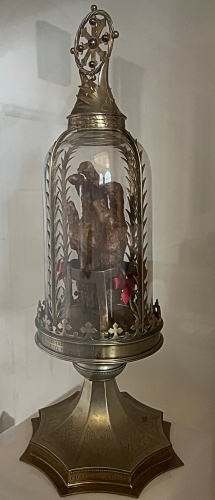
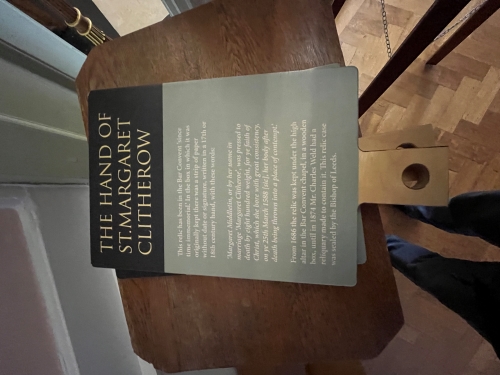
The chapel also contains a gruesome reminder of 16th century religious persecution - in the form of a sacred relic, the preserved hand of St Margaret Clitherow. Margaret was the wife of a York butcher and lived on the Shambles, which is probably York's biggest tourist trap after the Minster (almost no-one notices or explores the house, which is now a religious shrine - too busy looking for Harry Potter merchandise!! 😂) When accused of harbouring catholic priests (she had been imprisoned previously for failing to attend protestant services) she refused to enter a plea and so was 'pressed' under rocks until she died. 


If you're ever in York, do think about checking out the Bar Convent as it's a hidden gem - it has an excellent museum and exhibition.

[Home Page]
Permalink
Share post
Steven Oliver

To be a pilgrim...

Visible to anyone in the world
Edited by Steven Oliver, Thursday 7 May 2026 at 13:56

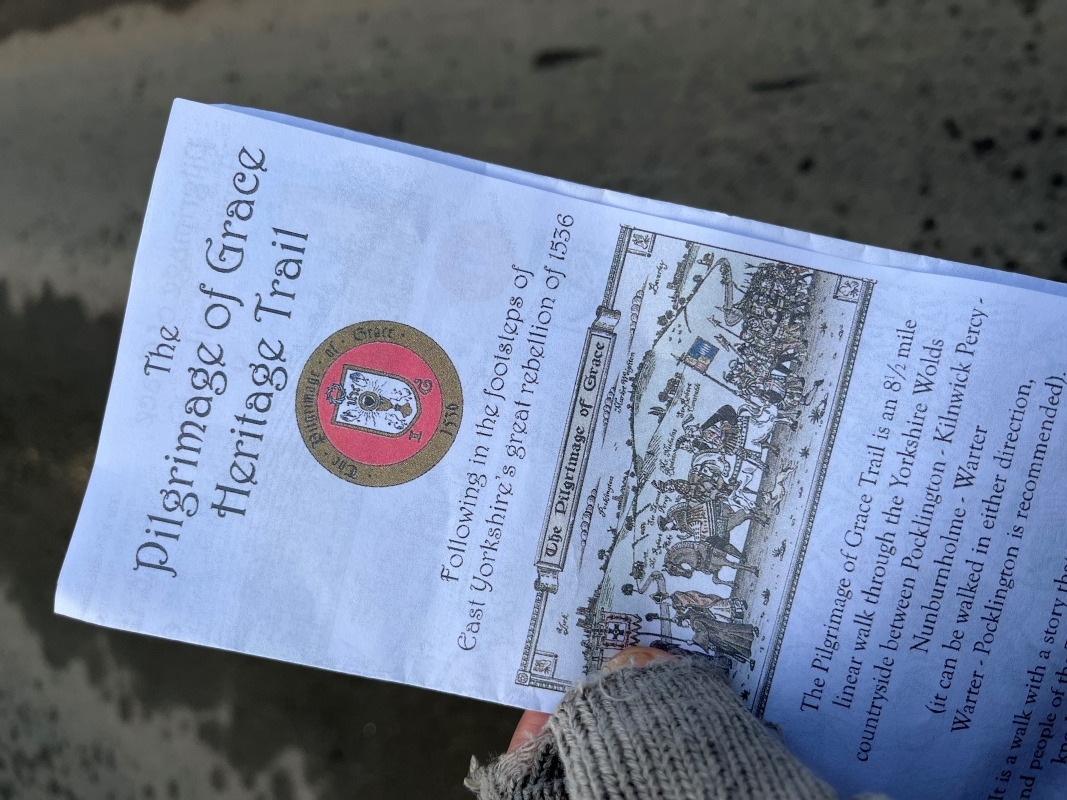
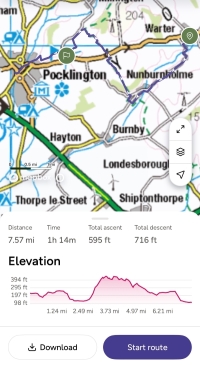
Chapter 13 of A223 'The Reformation and local communities', or at least part of it, is literally on my doorstep. The 'Pilgrimage of Grace' of 1536 is mentioned in the materials as an example of resistance to the Reformation, and a few years ago a local history group in my nearby market town of Pocklington set up a walking trail to commemorate it. 

Like many trails, the actual route is determined by available access, and the connection with paths taken by anyone in 1536 are perhaps a little tenuous - but it was a lovely way to spend a Sunday morning.

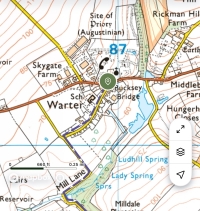
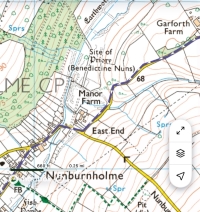
The logic of the trail is that it connects a couple of monastic sites with one of the locations that East Yorkshire rebels stopped at on their way towards York. The path runs from the village of Warter, which was the site of an Augustinian priory, through Nunburnholme, which had a small Benedictine nunnery, and ends in the town of Pocklington. Both the religious houses at Warter and Nunburnholme had been dissolved earlier in 1536 and the 'Pilgrims' reinstated them during the rebellion.


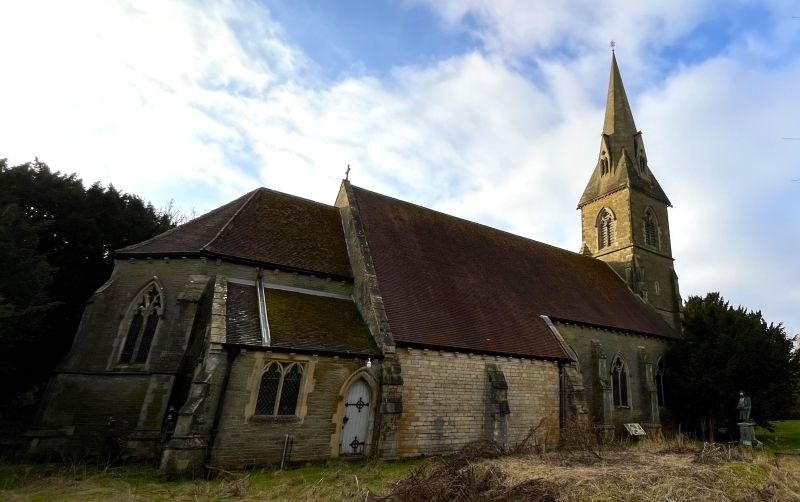
This is the church of St James in the village of Warter, it stands on the site of the former priory church. It was recorded that there were 12 canons resident at the time it was suppressed in August 1536; there are records of fine vestments, plate and jewelry and a holy relic, 'St James hand'. The sub-prior and the kitchener of the priory (their names aren't recorded) participated in either the 1536 'Pilgrimage' or the subsequent rebellions of early 1537 - they were executed in York in February of that year.  

The walk takes you along quiet back roads to the village of Nunburnholme, the Benedictine priory there was one of the smallest and poorest religious houses in the county - six nuns had been living on the site at the time of dissolution (Warter priory had been valued at £140, Nunburnholme only managed £10 3s 3d). 

There is nothing left to see of the nunnery, but it was located to the right of the beck as you look eastward up the valley.

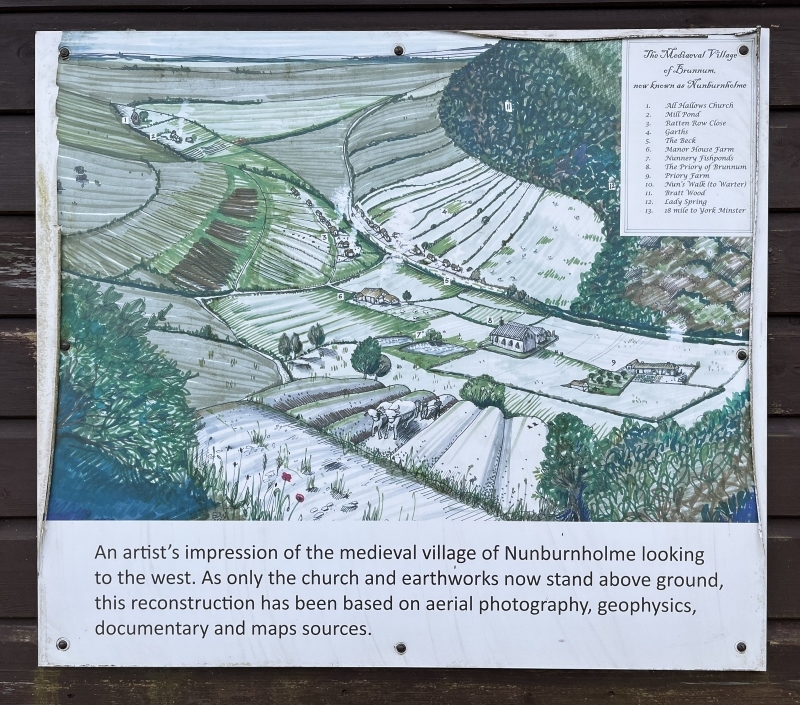
Fortunately there's a very handy sign attached to the bus stop, which gives an idea of what the village might have looked like!

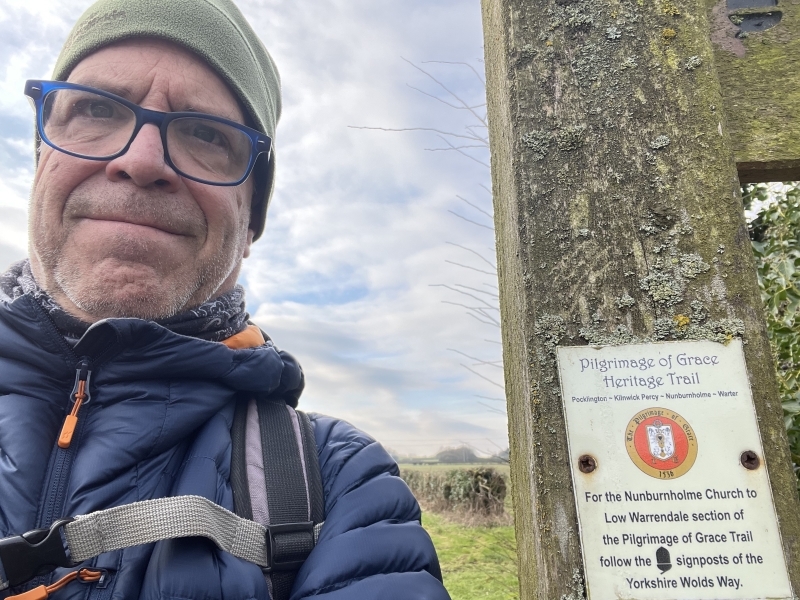
The path doesn't really need much signage, but if you look closely on the signpost you can possibly pick out the banner of the five wounds of Christ that was used by the rebels and is the logo for the trail. 

(This is a really grim looking selfie - promise I was enjoying this a lot more than it looks 🤣)

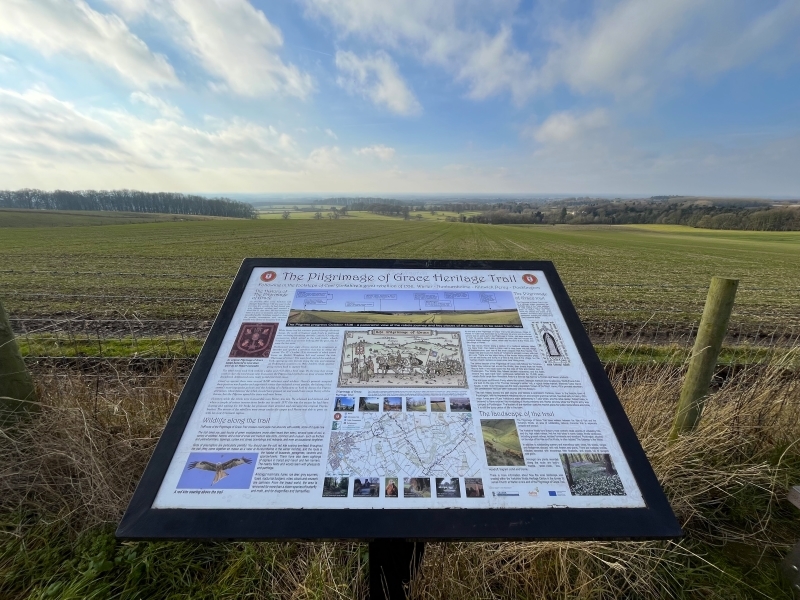
The picture below is taken looking south-west from the edge of the Yorkshire Wolds, out over some of the area from which many commoners were drawn into the rebellion. There were a number of separate groups forming across East and North Yorkshire; the body of men that stopped at Pocklington were on there way to York under the leadership of the one-eyed lawyer Robert Aske, who would have a key role in drafting their oath as well as the '24 Articles' that we look at in the module materials. 


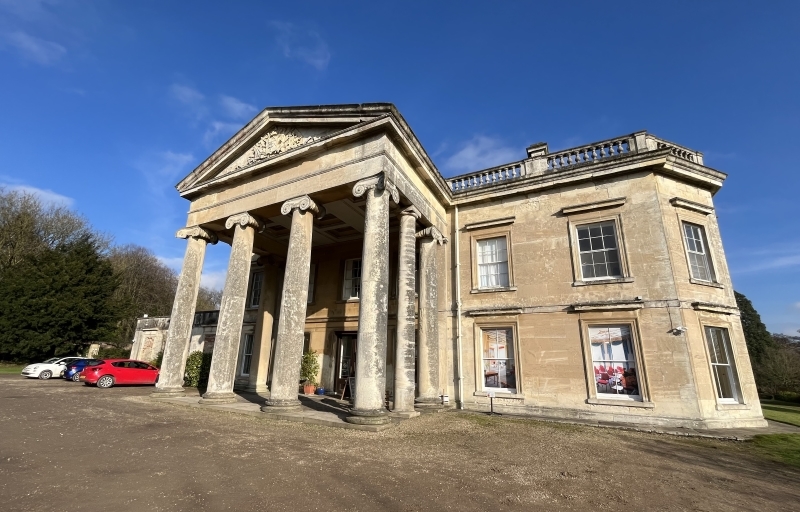
The trail stops off at the Georgian mansion at Kilnwick Percy, shown below. There is a slight link with Henry VIII (if not the Pilgrimage of Grace) as it was built on the site of a tudor manor house owned in 1536 by Sir Thomas Heneage, who had just been appointed as the king's 'Groom of the Stool'!


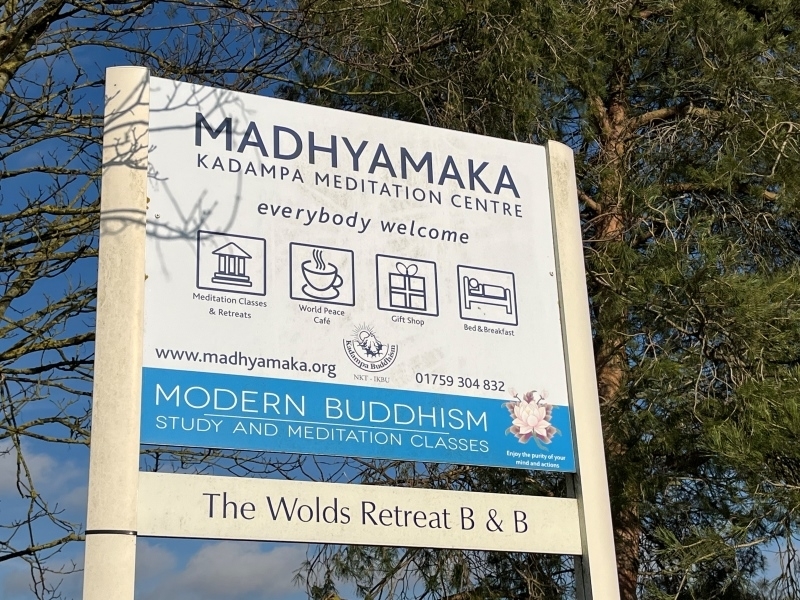
As we probably all got to module A223 via module A111 (with its chapter on Buddhism and compassion) I couldn't resist highlighting that Kilnwick Percy is now in fact a Buddhist retreat - I had a hot chocolate at its 'World Peace Cafe' (to be honest with things as they are at the moment, every little helps!!)


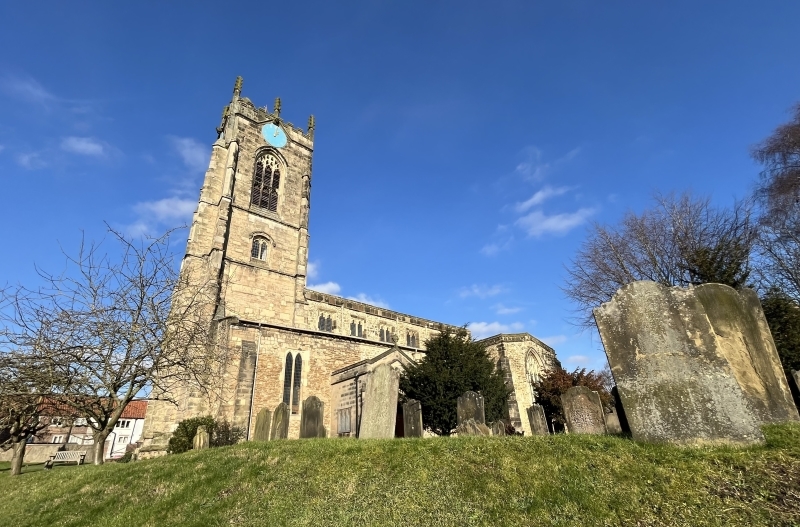
Finally, after about eight miles, the walk ends up at All Saints church in Pocklington, which was looking very impressive in the sunlight today. 

The Pilgrimage of Grace was a complex rebellion, with a mixture of aims and objectives, some about religion, some about political and economic tensions between 'North' and 'South' - but provides a fascinating 'what if...', it does feel that for a short period in 1536/7 the 'top-down' English Reformation was in very serious trouble.

[Home Page]
Permalink
Share post
Steven Oliver

In praise of Yorkshire ale!!

Visible to anyone in the world
Edited by Steven Oliver, Thursday 7 May 2026 at 13:56

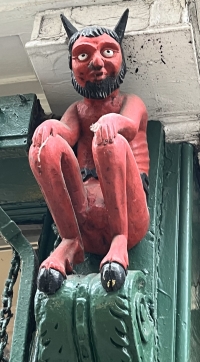
 In folklore, 'printer's devils' caused mischief by misspelling words and inverting and removing type. It became a nickname for printers' assistants, who might also make mistakes! This little devil has only been perched here in the centre of York since 1888, but marks the entrance to an alley that served a print workshop active in the early modern period.

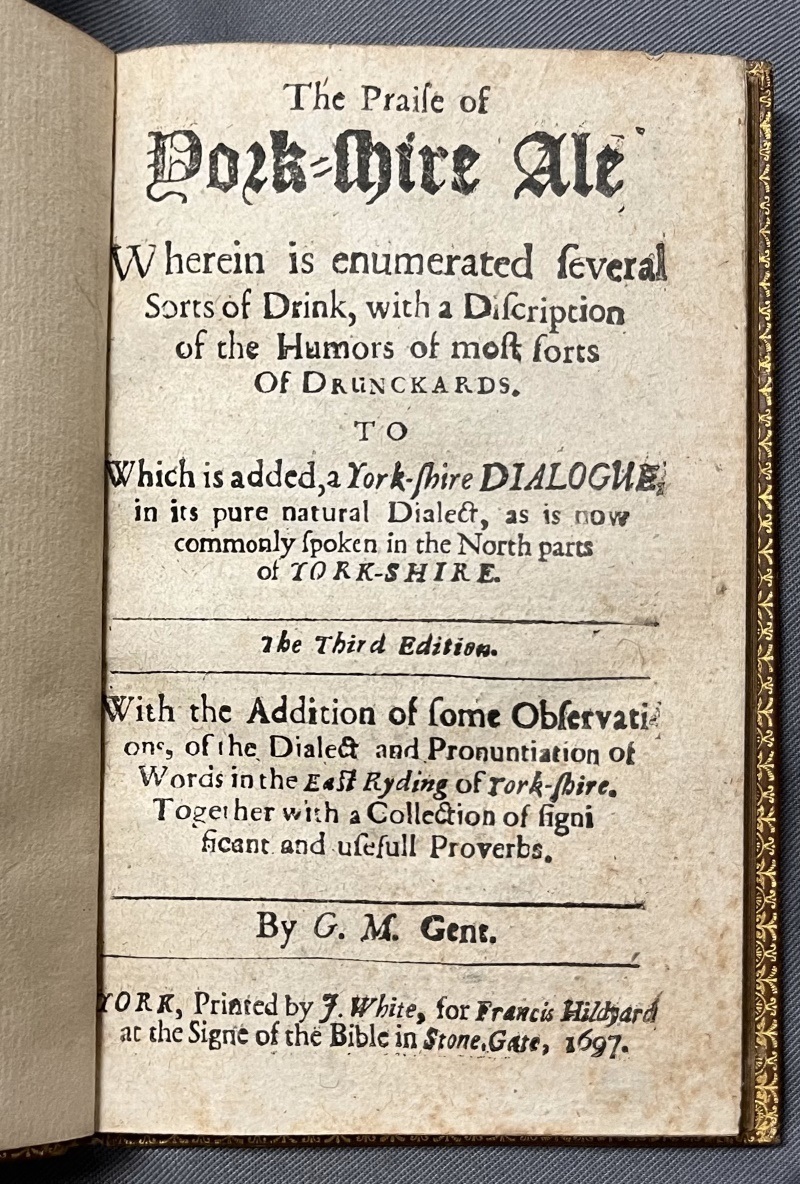
I was keen to see if I could find any locally printed books in the University archives and was delighted when I discovered a copy of something titled...

"The praise of Yorkshire-Ale, wherein is Enumerated several Sorts of Drinks, with a Description of the Humours of most Sorts of Drunkards."

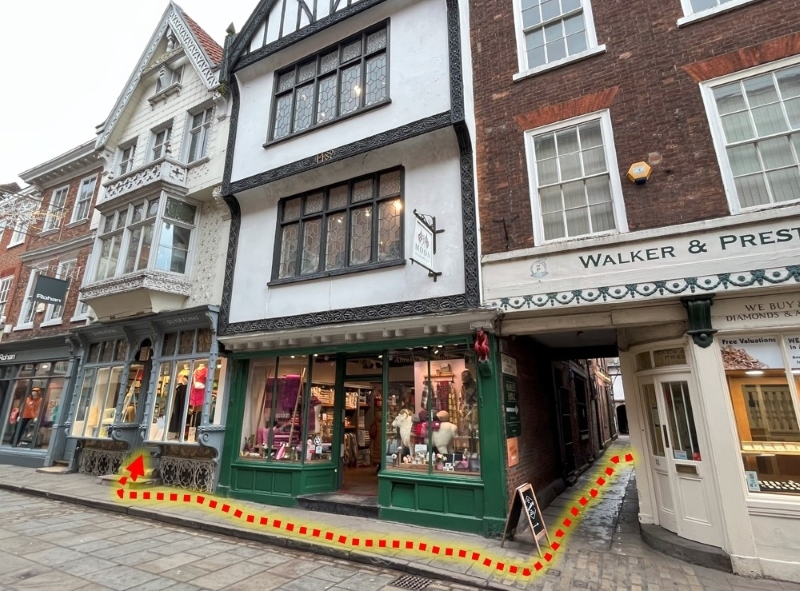
It was printed in 1697 by John White at a press just off Stonegate, for sale in Francis Hildyard's book shop that stood on the street - still marked out today by the 'Signe of the Bible'. As you can see, book printing and retail were physically very closely associated.

I found the book fascinating and a real miscellany. (We can access the text via the OU library and the Early English Books Online EEBO resource - there's a link that should work here if you were really interested)

The first part is a long and rambling poem in which the god Bacchus is taken on a pub crawl round Yorkshire, stopping off at 'Madam Bradley's' in Northallerton, then 'Nanny Driffield's' in Easingwold and ending up in York at 'Parkers Coffee-house i'th Minster Yard', where...

"They call'd & drank till they were all high-flown,

And could not find their way into the Town,

They staggar'd too and fro, had such lite heads,

That they were guided all unto their Beds:

And in the Morning when they did awake,

They curst and swore that all their heads did ake;

O Yorke-shire Yorke-shire: thy Ale it is so strong;

That it will kill us all, if we stay long..."

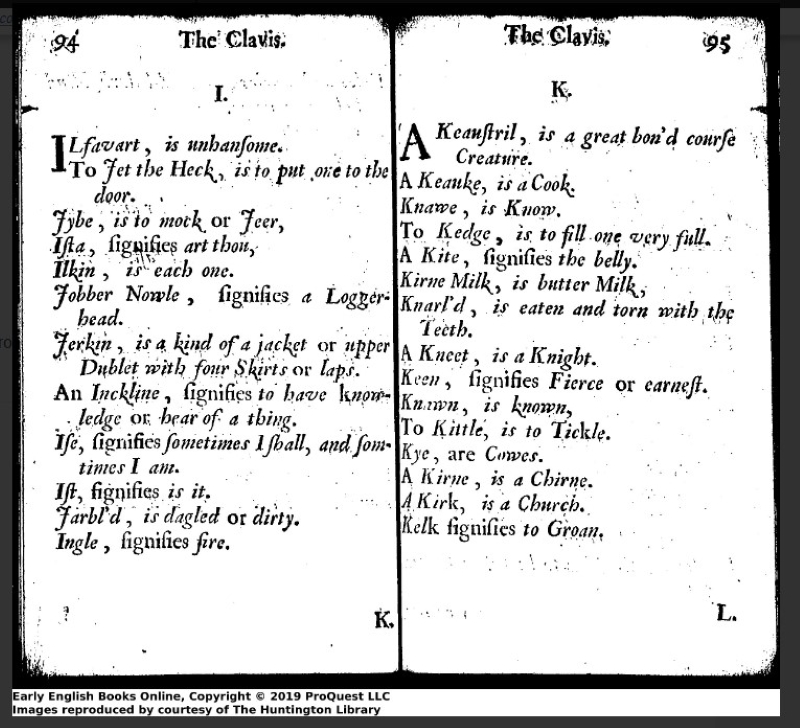
After that comes a section written in East Yorkshire dialect, followed by a 'translation' of what individual words mean. I've included a screen grab from EEBO to show what it looks like (plus I want to try and remember the phrase 'Jet the Heck' 😃). Apparently this is a very early (perhaps even the first) record of Yorkshire dialect.


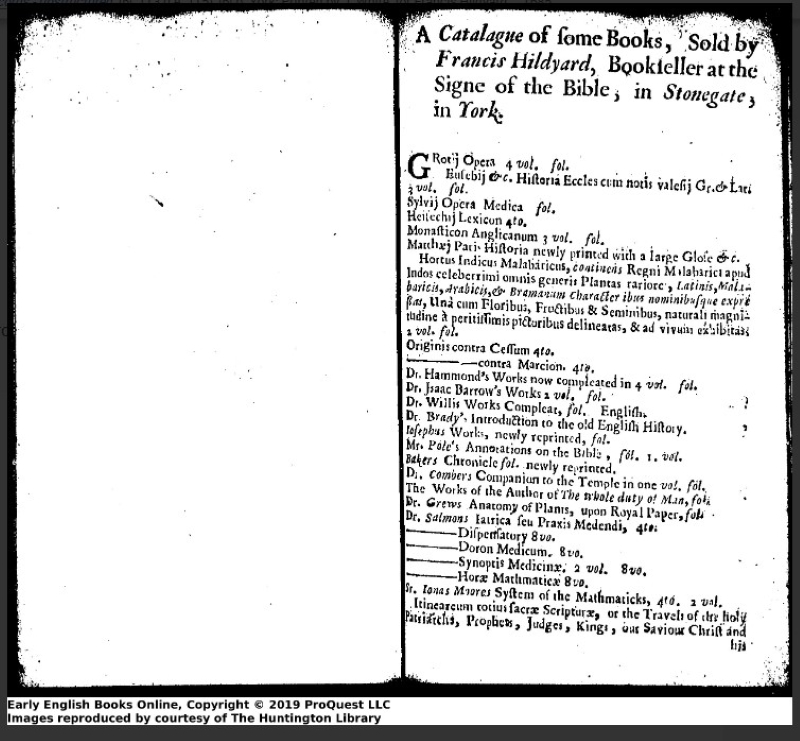
Finally there's a section listing some of the other books on sale at Francis Hildyard's bookshop - something that seemed a good end to a posting in the 'literacy' week!

[Home Page]

Permalink
Share post
Steven Oliver

Some early modern buildings on an early Sunday morning

Visible to anyone in the world
Edited by Steven Oliver, Wednesday 6 May 2026 at 20:45

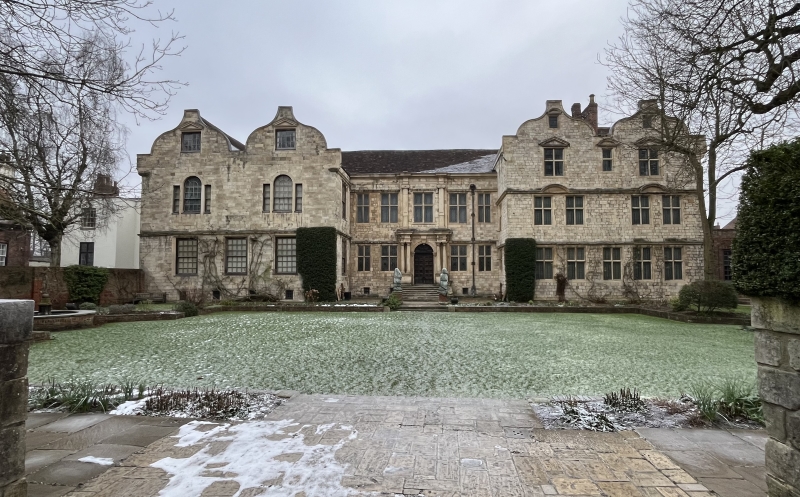
A223 had a fascinating chapter on urban environments, which really helped me to better understand my nearest City of York. This was a record of 'early modern' buildings in central York that I took one morning [12/1/2025] on a quick 'field trip' - plus some pictures which show what the period did to older ones.

It's not easy to avoid the crowds in York, but a cold, overcast, early Sunday morning in January is perhaps ideal - if not hugely photogenic! 😀


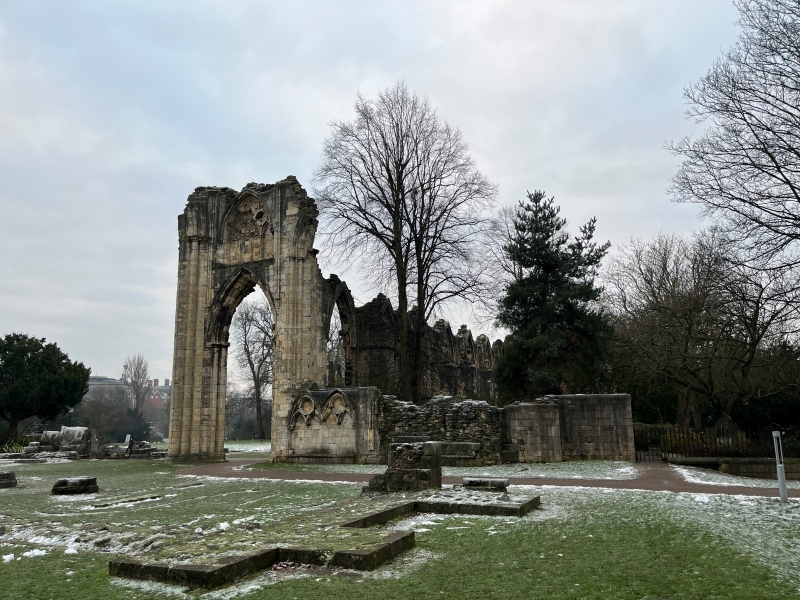
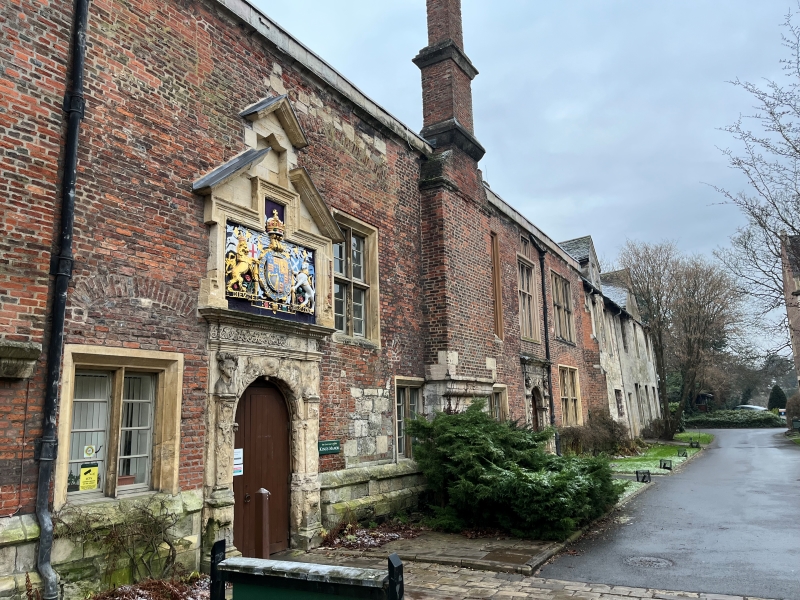
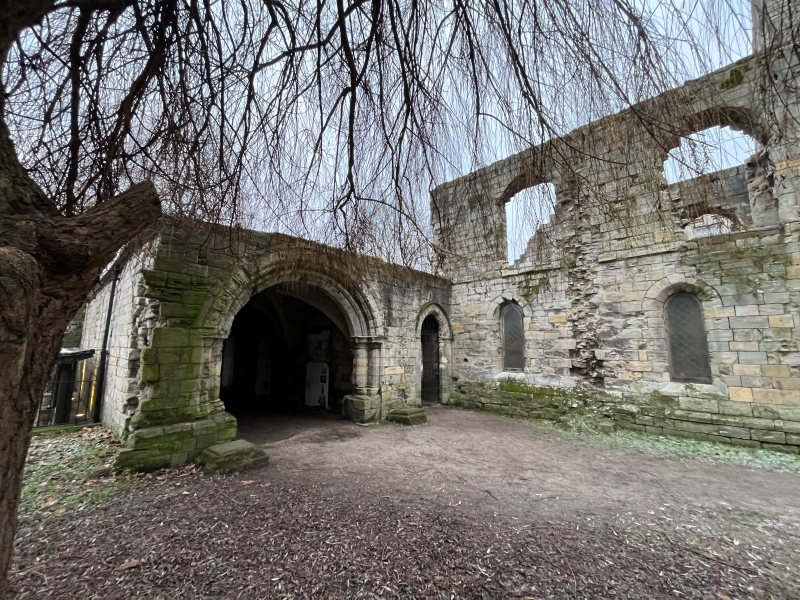
Firstly, St Mary's Abbey church, once a building on a similar scale as York Minster, but dissolved in 1539. The Reformation had a very significant impact in York, as much of its power and significance came from the church. Looking at the map of Avignon in the module materials made me think how similar the two locations must have been at one time. There are no doubt 'bits' of St Mary's in many early modern buildings in York, as the site was effectively a quarry for many years.


The Abbots house survived however and was taken over by the Crown, it was repurposed as a site for regional government - the location for the 'Council of the North'. It was known as the 'King's Manor' and was briefly the Royalist 'capital' during the Wars of the Three Kingdoms.


Not much remains of St Leonard's Hospital - once one of England's largest medieval hospitals. The loss of church 'welfare' provision through the Reformation was probably felt more in York than the loss of the Abbey.


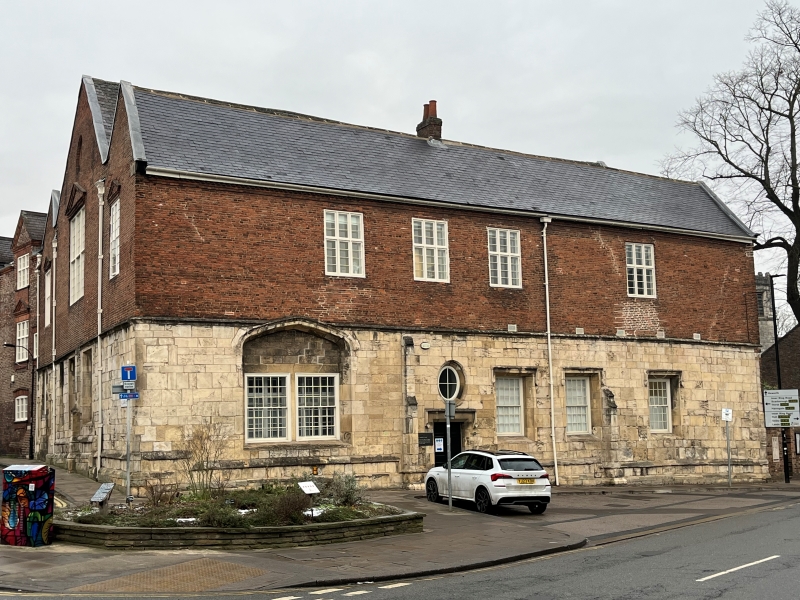
Many buildings in the Minster precincts found new owners/uses after the Reformation. This had been the house of the Minster's Treasurer - and was sold back to the Archbishop and eventually became a private residence. 


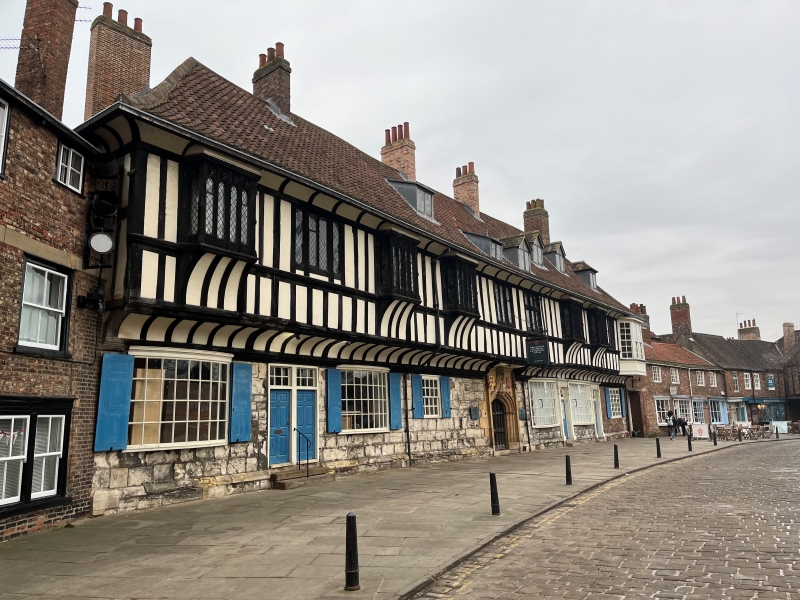
St William's College had been a residential complex for chantry priests at the Minster - there were 24 of these, all out of a job with the Reformation. This building went into private ownership, at one point it was the Royal print works producing propaganda for King Charles I.


Mendicant Friars had funded the building of St Anthony's Hall shown above. It was taken over by the city governors after the Reformation, becoming at different times a site for a variety of local guilds, a workhouse, a house of correction and a charitable school. It now partly houses a Presbyterian church group.


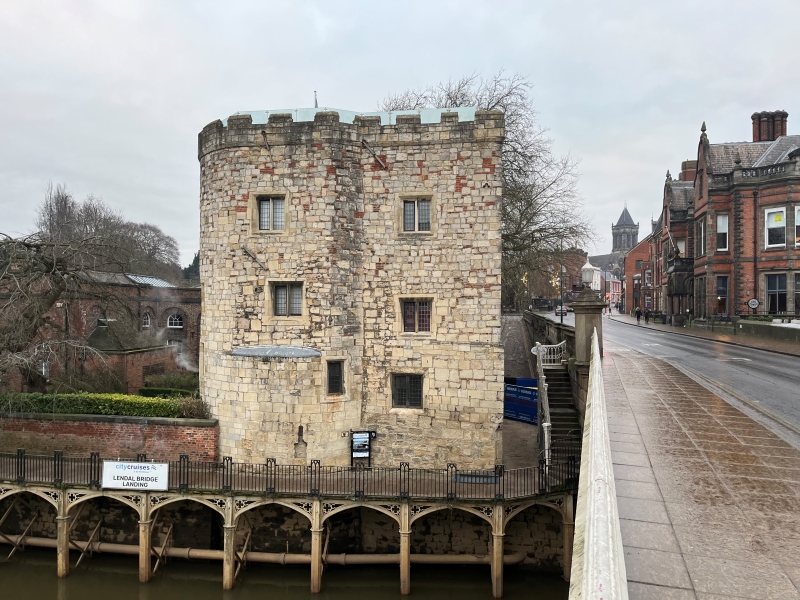
This is probably my favourite early modern 'makeover'. This was originally a medieval riverside defensive structure, housing one end of a chain across the river Ouse that was raised to control shipping. By 1631 it had become the 'Waterhouse' and was essentially a water tower supplying the city, a system that was augmented with a steam engine in 1780. (Pumping York's polluted river water into its houses ensured the city fared particularly badly in the 1832 cholera outbreak, but that's a different module 😀)


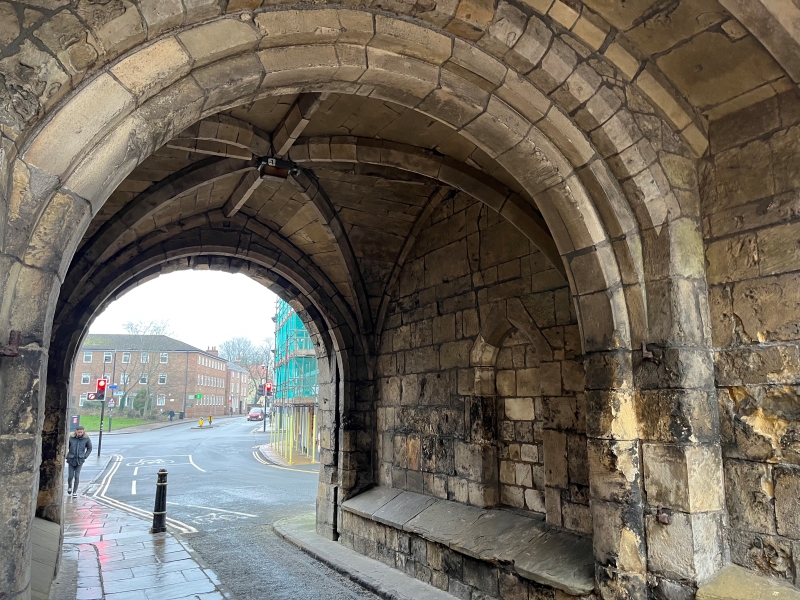
This is York's medieval 'Monk Bar' - (the city's gates are called 'bars' and, confusingly for some, many of the streets are called 'gates'). You can make out a number of the 'control' features it provided, the hinges for wooden gates are visible, as are the tips of the portcullis that could be lowered, but in more common use would have been the (now bricked) window at which toll-collectors sat enforcing local taxation on goods entering the city.


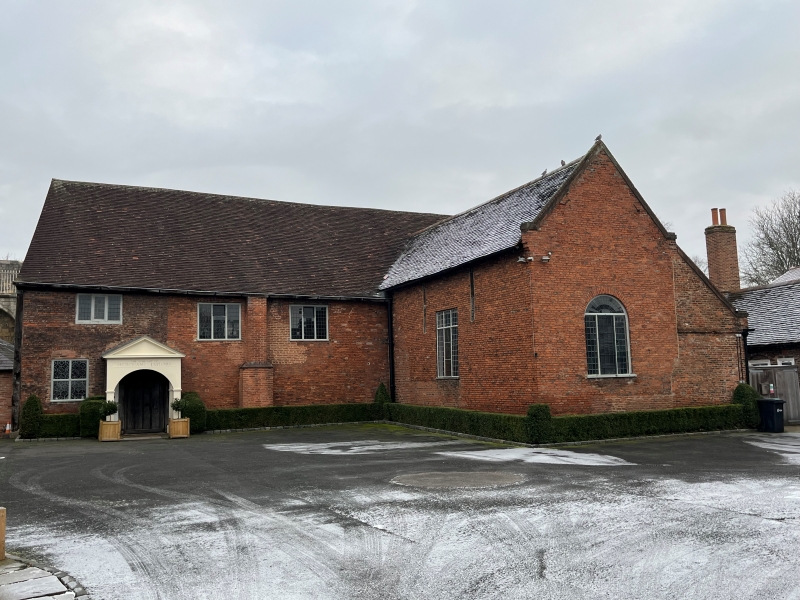
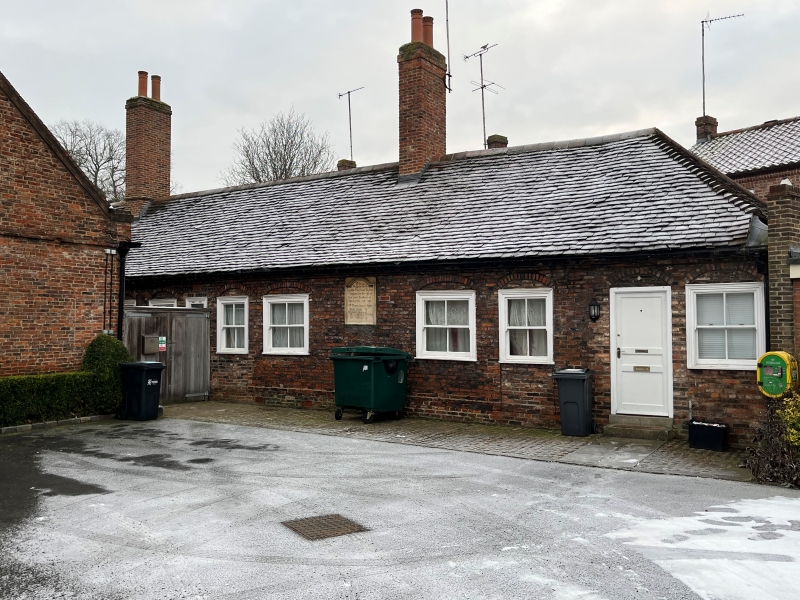
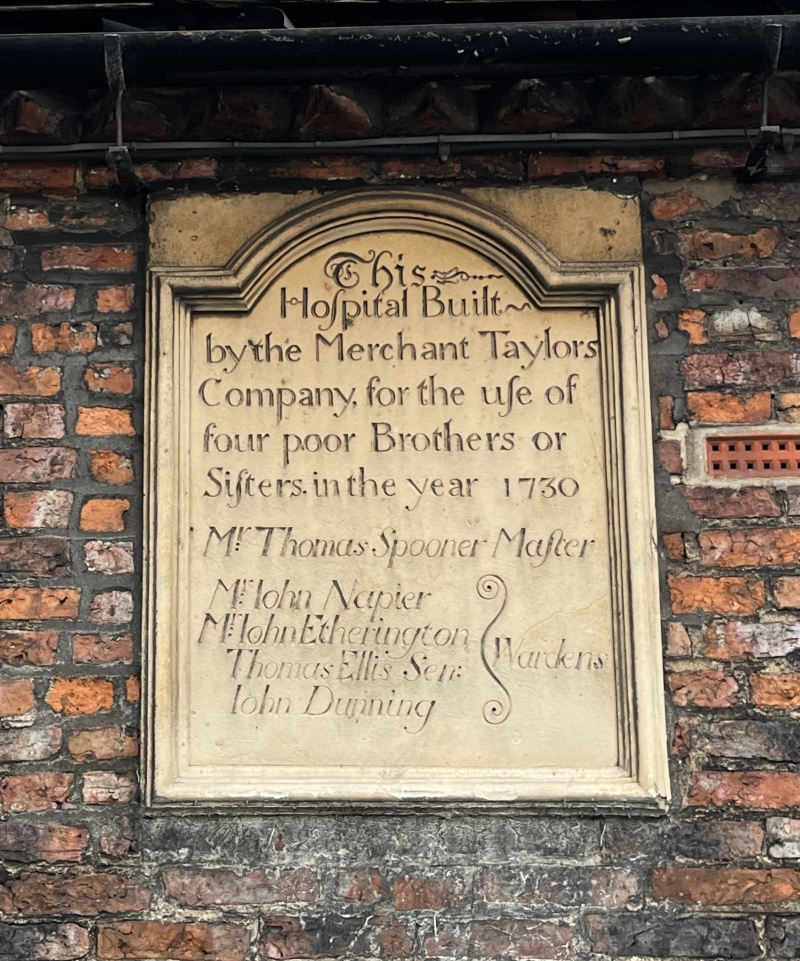
There are a few remaining guild halls in York - this is the location of the Merchant Taylors. This had been established in the medieval period, the guild added a hospital in the early modern period 


Time for some early modern 'new builds'...


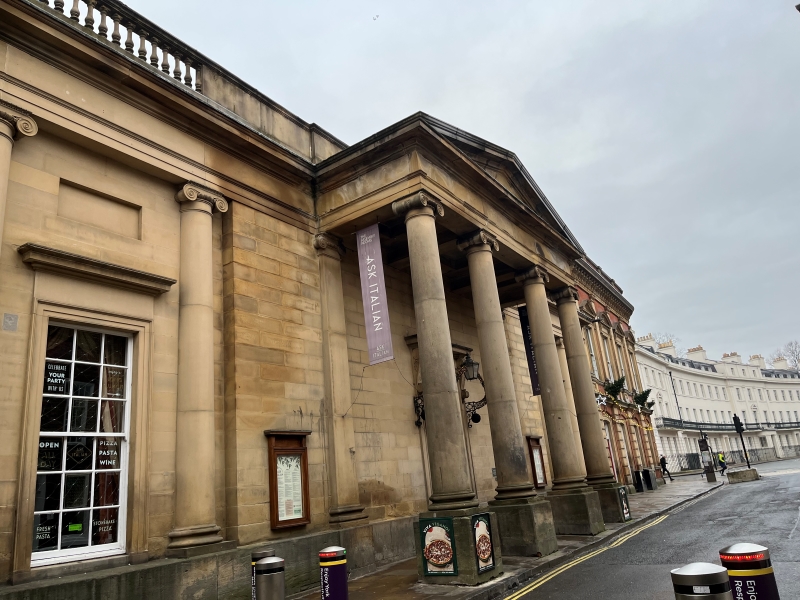
Finished in 1735, these are York's Assembly Rooms. It was too early in the day to eat today, but I have been for a meal in the past and the interior is a stunning location in which to eat pizza!


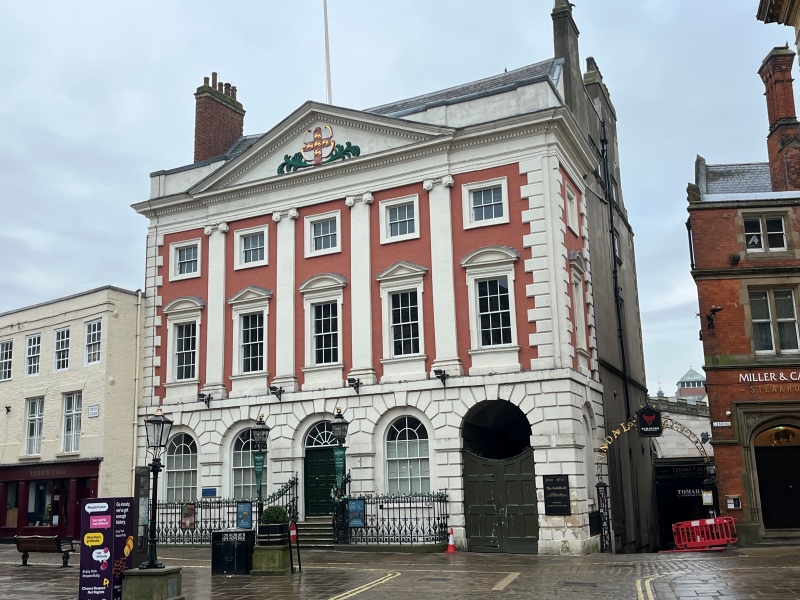
It was the city council that kicked off the idea of building Assembly Rooms as an entertainment venue - and they also funded this residence for the Lord Mayor - the Mansion House finished in 1732. The house sits directly in front of the guildhall, which you can enter via the big green doors - or can't when they're shut like they were this morning! 😠


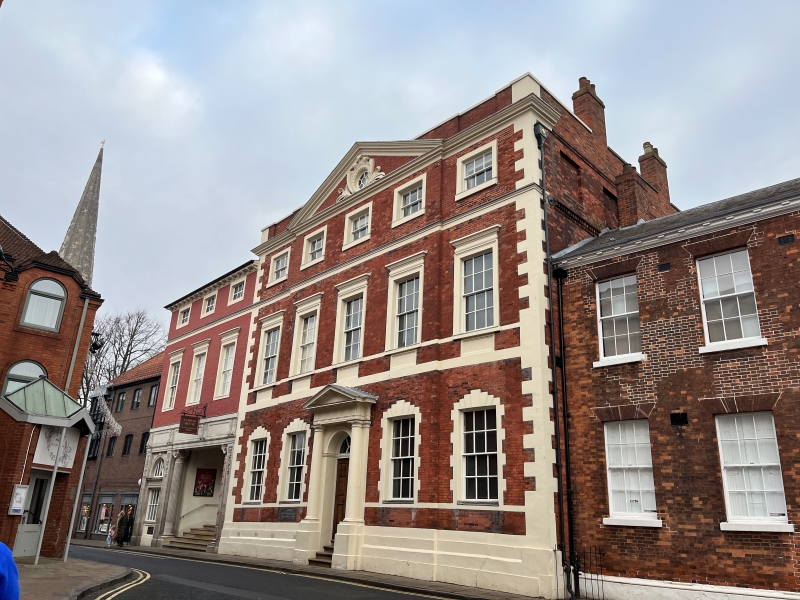
This is a great example of the early modern aristocracy buying into urban living. Fairfax House was bought by Viscount Fairfax of Elmley in 1760 as a gift for his daughter Anne, a place to hang out rather than living in their 'country seat' at Gilling Castle. 


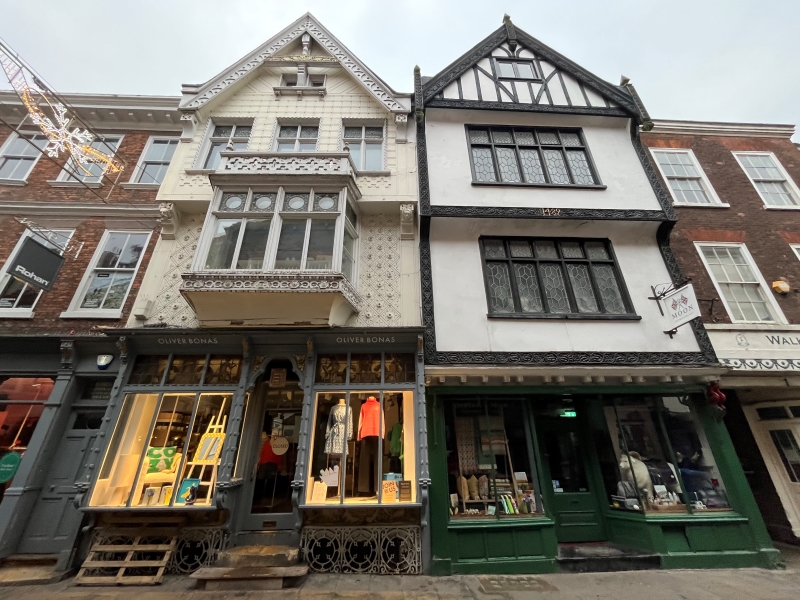
I guess Anne's leisure pursuits might have included a bit of shopping...
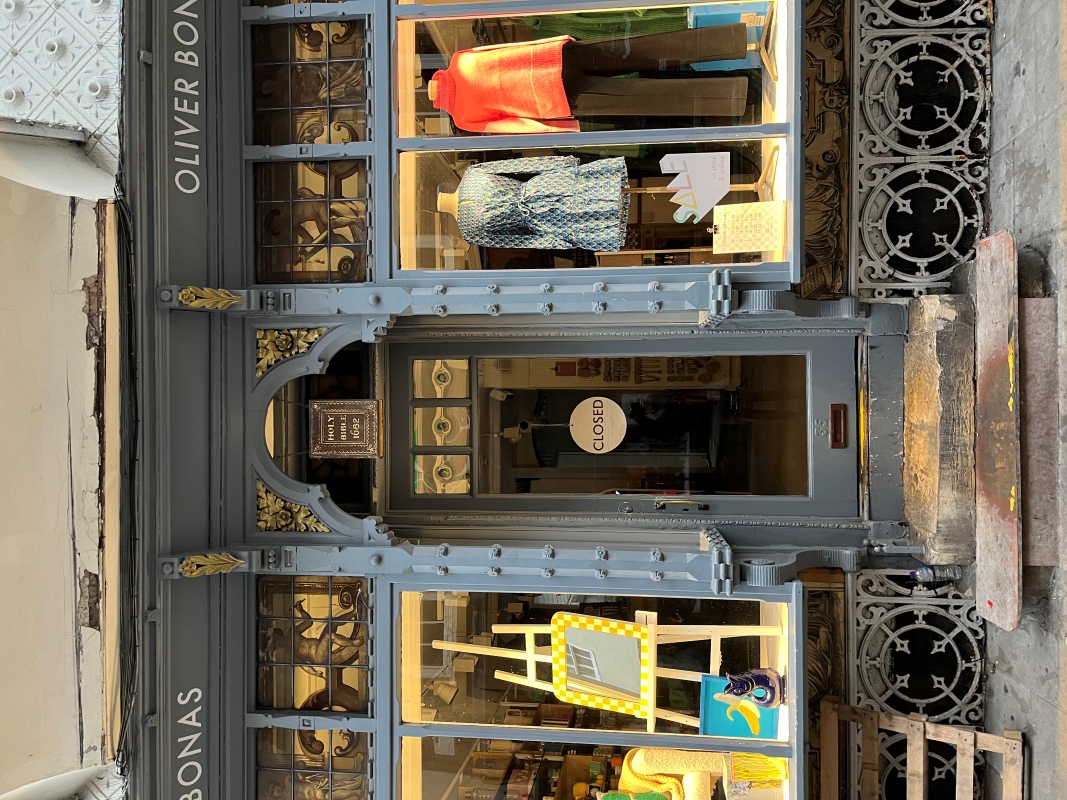
In 1759 the shop on the left was a booksellers, advertising itself “At the Sign of the Bible” as it had since the late 17th century, and it was the place that Laurence Sterne sold the first 200 copies of his first volume of 'Tristram Shandy which he had printed in the city.


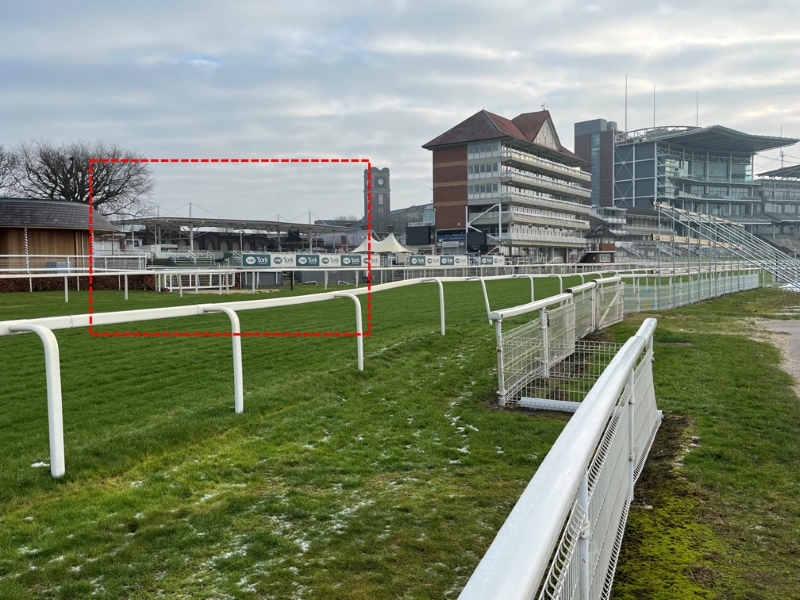
Not so sure Anne Fairfax would have been off to the track, but you never know...


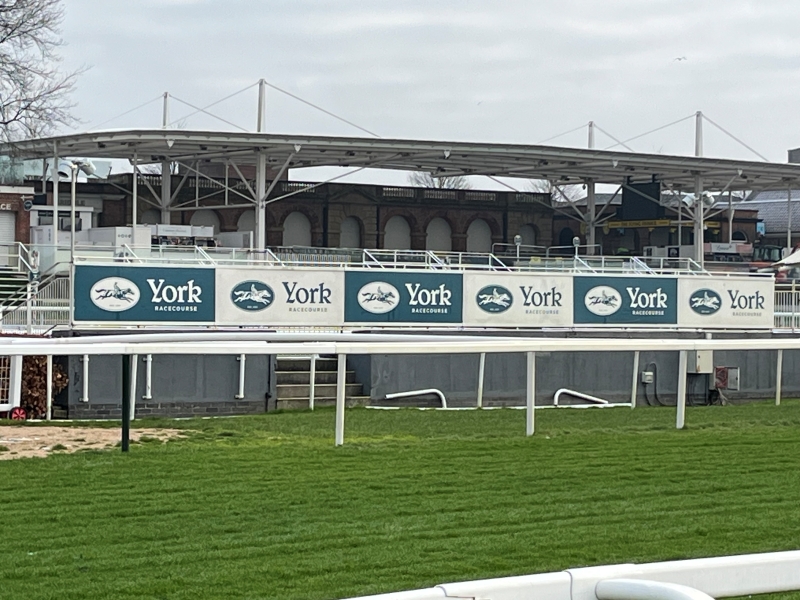
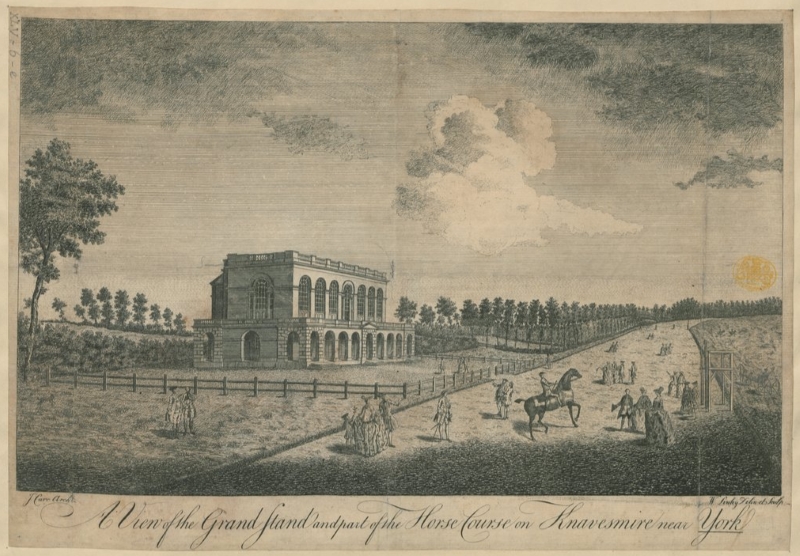
This early modern building at York's Knavesmire racecourse is not that easy to spot, and takes a bit of imaginative 'reconstruction'. But it contains the remaining lower storey of the world's first 'grandstand', built in 1756.


.
It helps perhaps to know what it originally looked like...


Courtesy British Library (Maps K.Top.45.6.e)

Of course early modern life couldn't all be fun though.


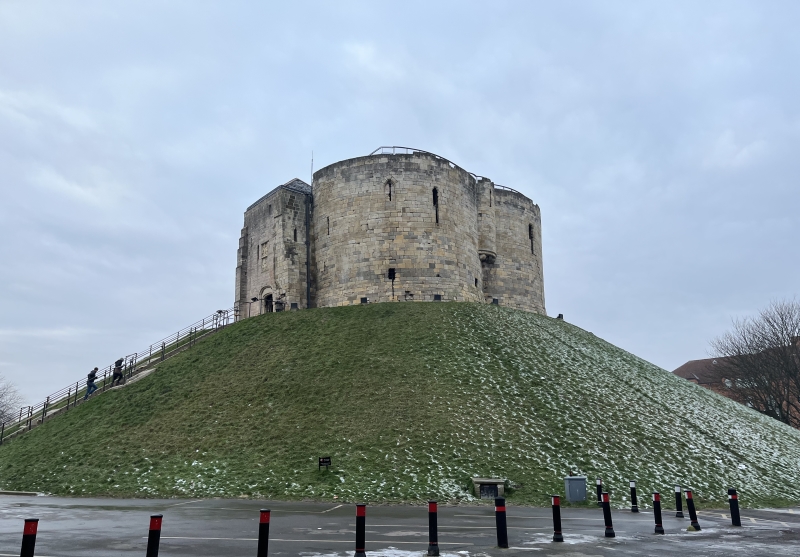
Robert Aske, who we will meet in a couple of weeks rebelling at the head of the 'Pilgrimage of Grace', ended up hanging in chains from Clifford's Tower here in 1537. 

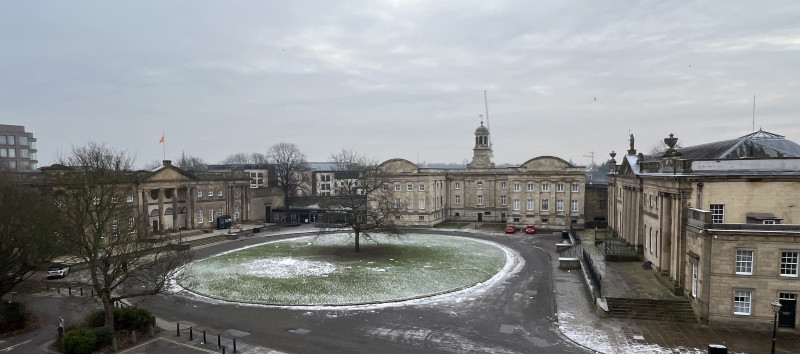
A walk up the castle mound gives good views of three new 18th century buildings...

From left to right these are: the Female Prison - built in 1780 to partly relieve the overcrowded...Debtor's Prison - built in 1701 and finally the County Court built in 1777. The court is still in use, the prison buildings now house a museum.


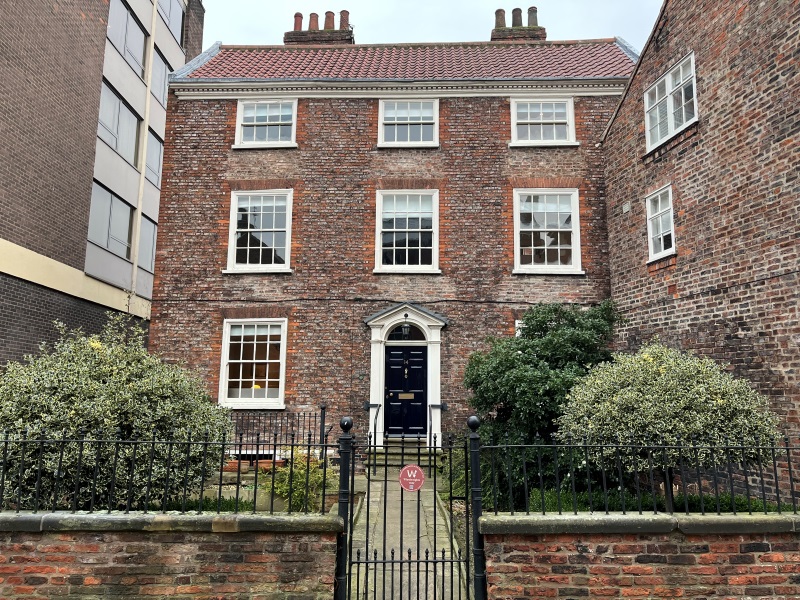
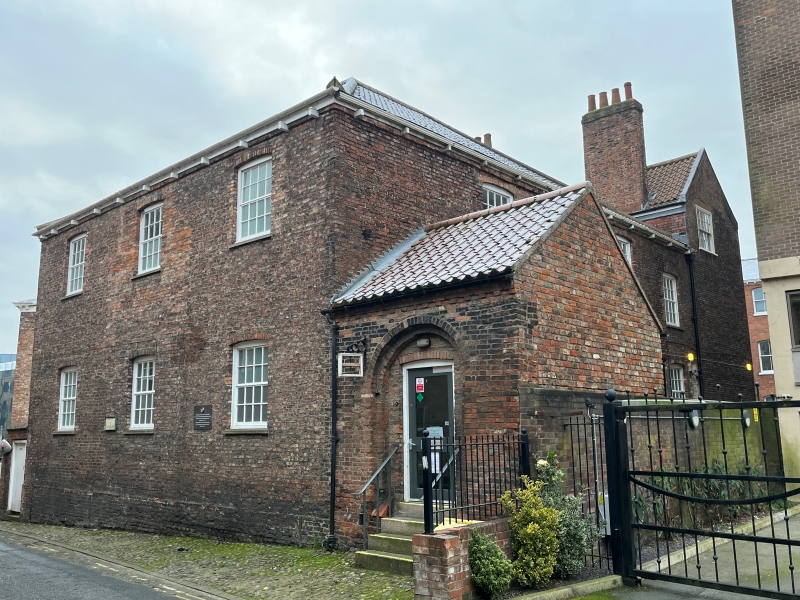
This building was the manse for a newly built Methodist Chapel, John Wesley was a regular guest and preached at the opening of this new religious building which backs on to the house.


There were a range of non-conformist groups active (and building) in York. Quakers still continue to meet on the site they have used since 1674, but now in a Victorian structure.

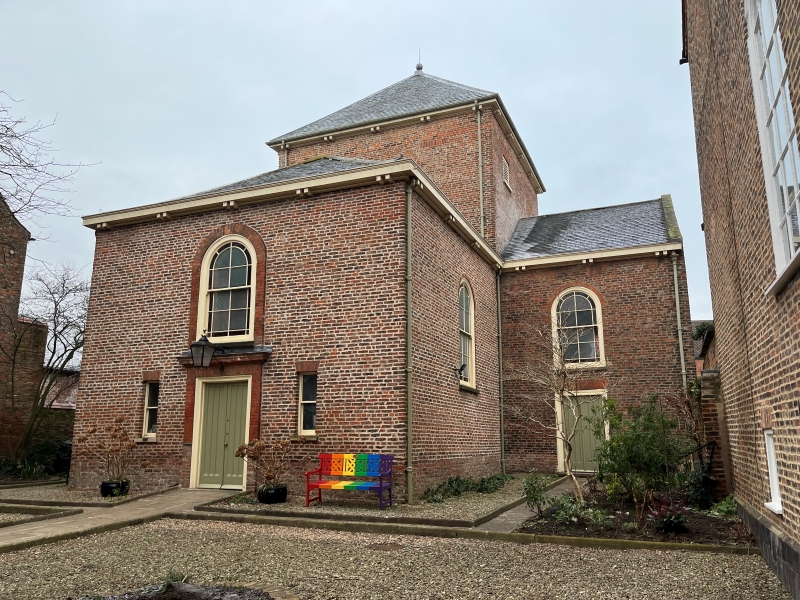
The image below is of York Unitarian Chapel which was built in 1693 only a few years after the 'Toleration Act' of 1688 allowed some Protestant nonconformist groups in England to worship publicly. It was initially a Presbyterian chapel (non-trinitarian beliefs like those held by 'Unitarians' were not then legal).


I'd only paid for a couple of hours parking so had to draw the line somewhere 😀, but ended up at another impressive 'new build' ...


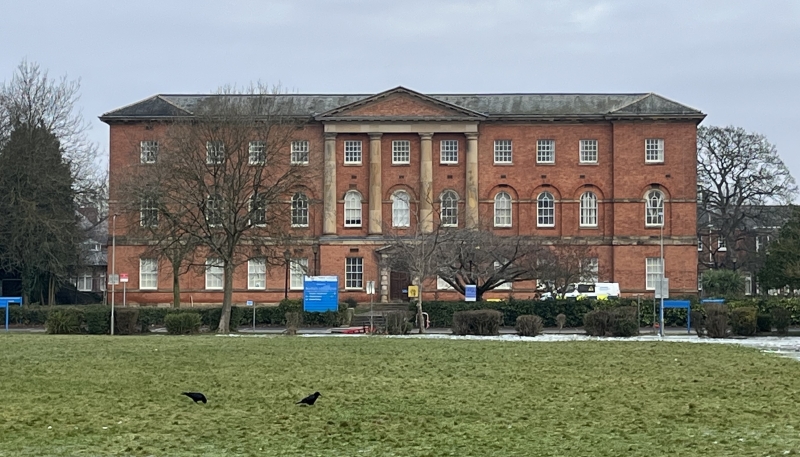
Bootham Park Hospital was built as York Lunatic Asylum in 1777. Impressive on the outside, the misery caused inside and in particular the treatment of a Quaker woman, Hannah Mills, led to the creation of the city's second hospital in the early modern period for those suffering with mental illness. The Retreat, funded by local Quakers, pioneered more humane treatments.

Which is perhaps a positive place to end, but then I realised I'd missed what has long been York's major building and was so in the early modern period despite a lot of change going on - it is particularly hard to ignore on a Sunday morning! 🔔🔔🔔

(The current Minster bells were all actually cast in the 20th century, but whilst changes might be being rung the sound seems to me to be all about continuity.)

[Home Page]

Permalink
Share post
Steven Oliver

Trade, charity and poverty

Visible to anyone in the world
Edited by Steven Oliver, Wednesday 6 May 2026 at 20:45

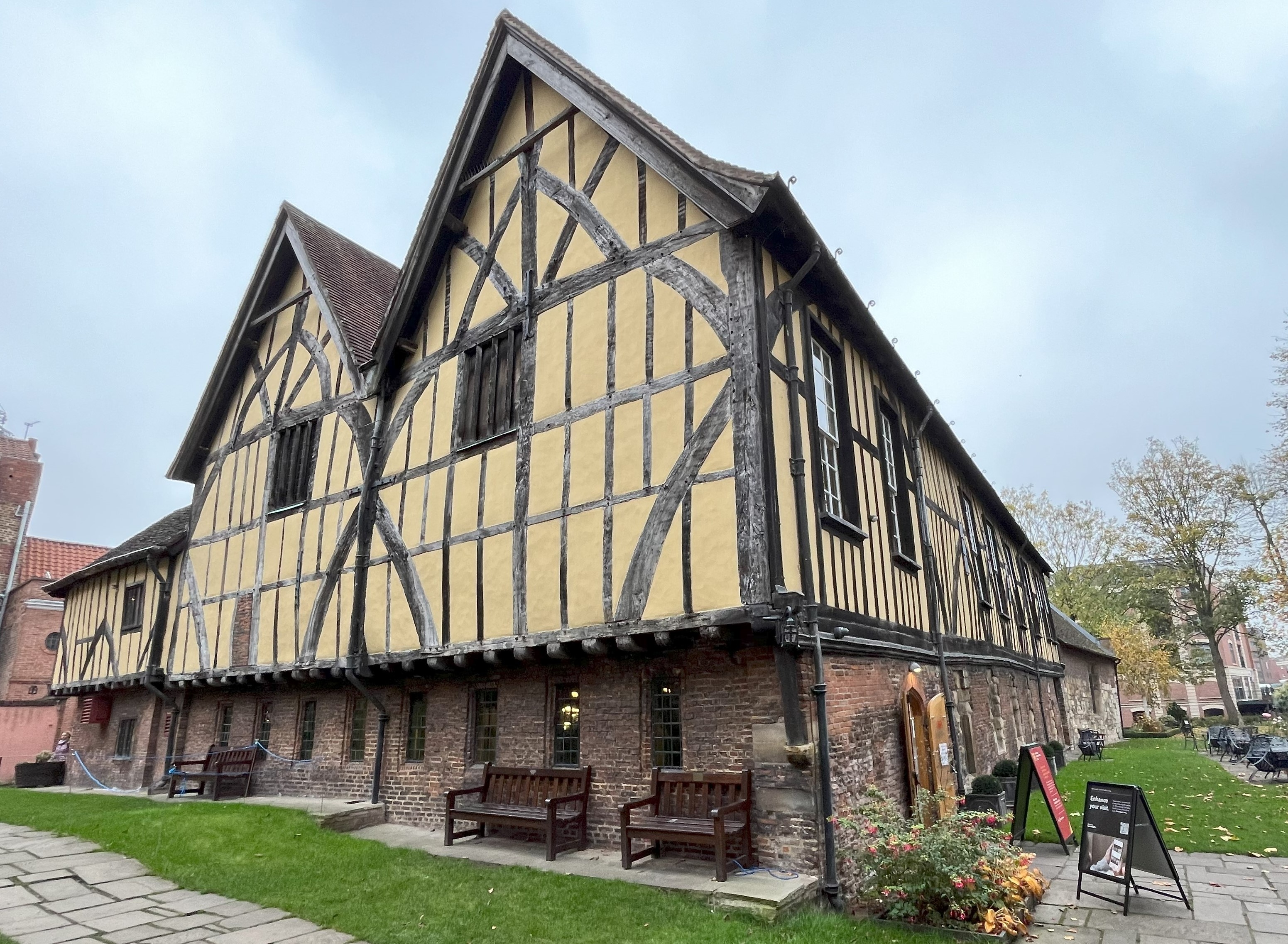
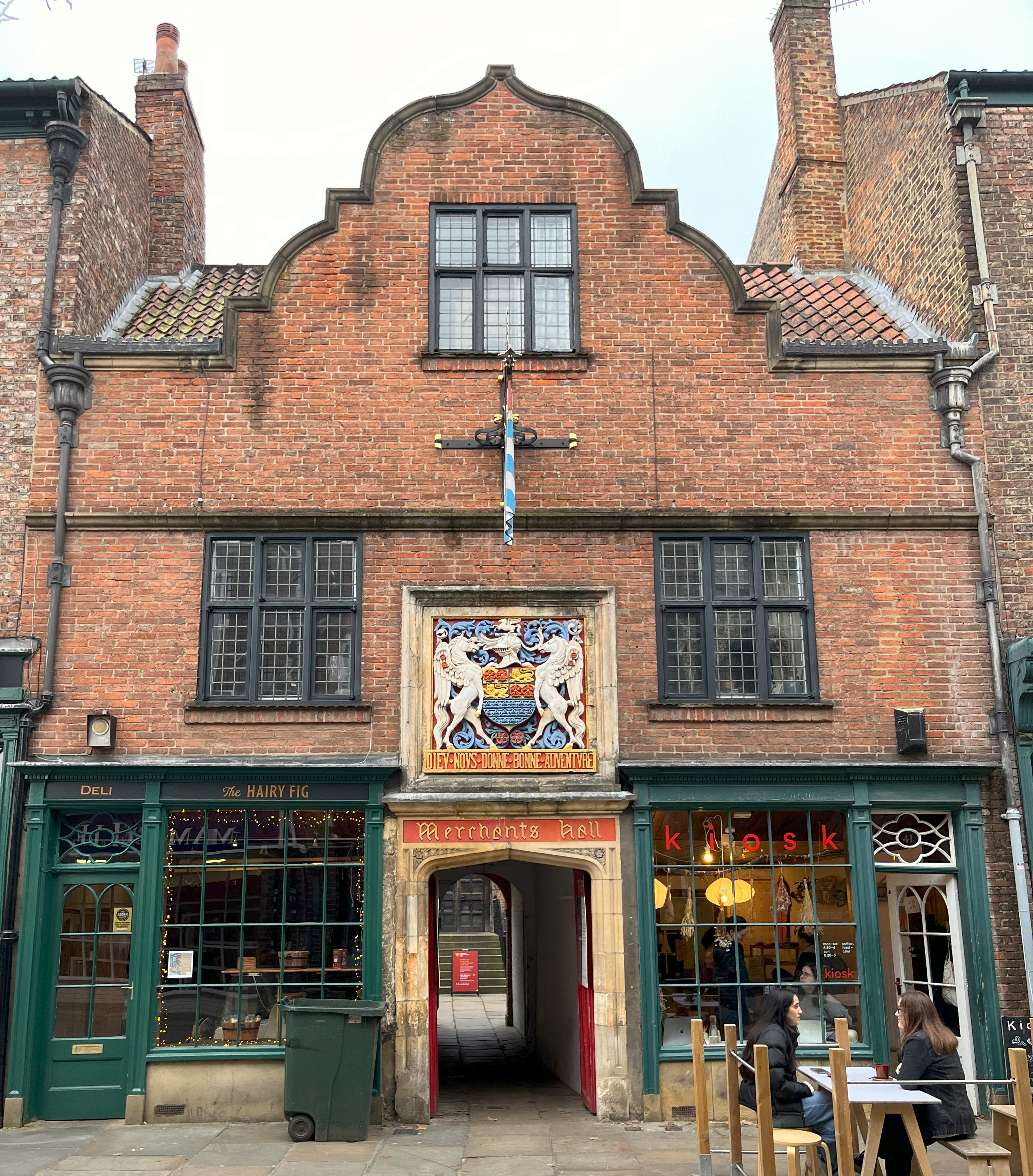
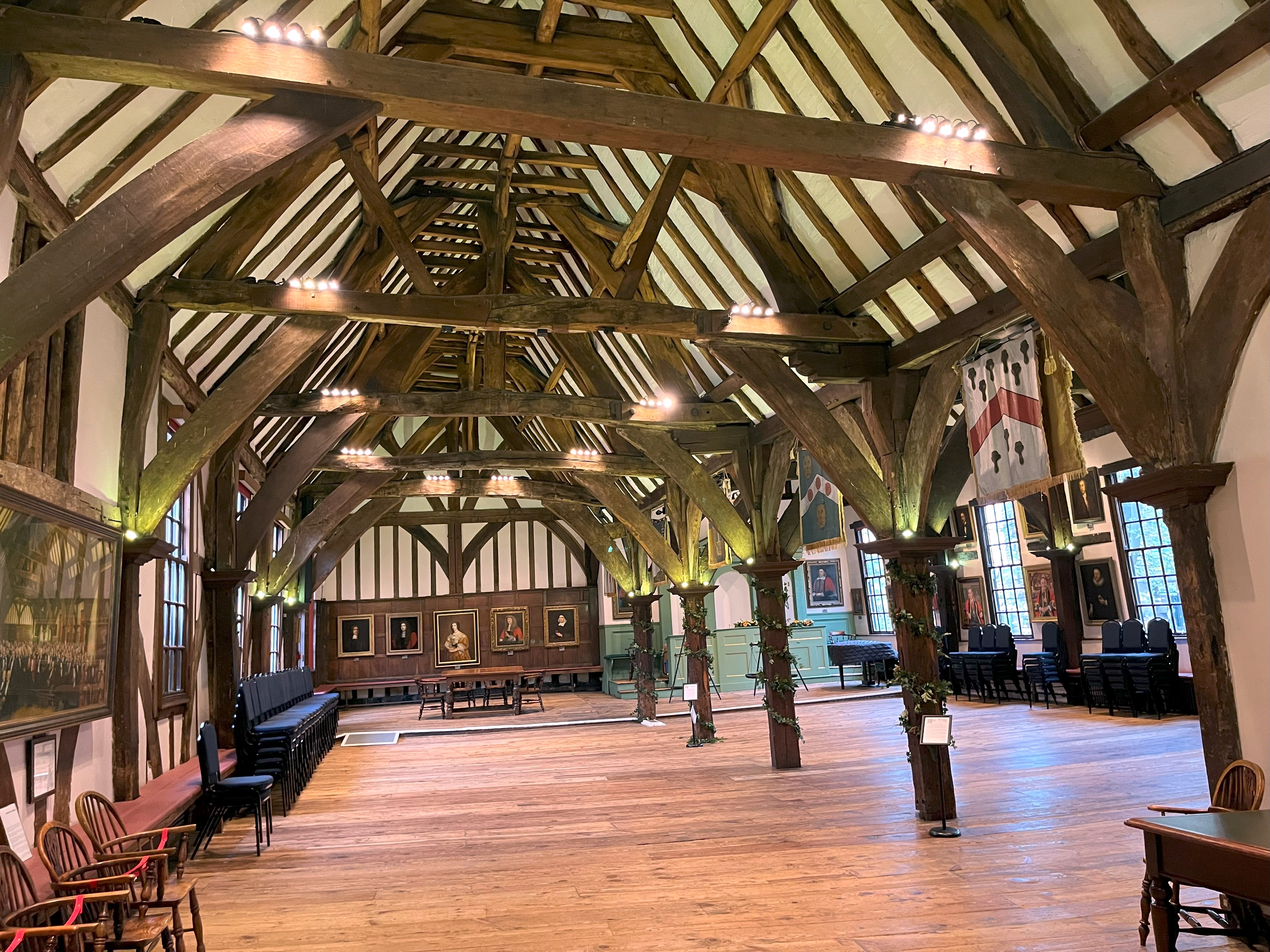
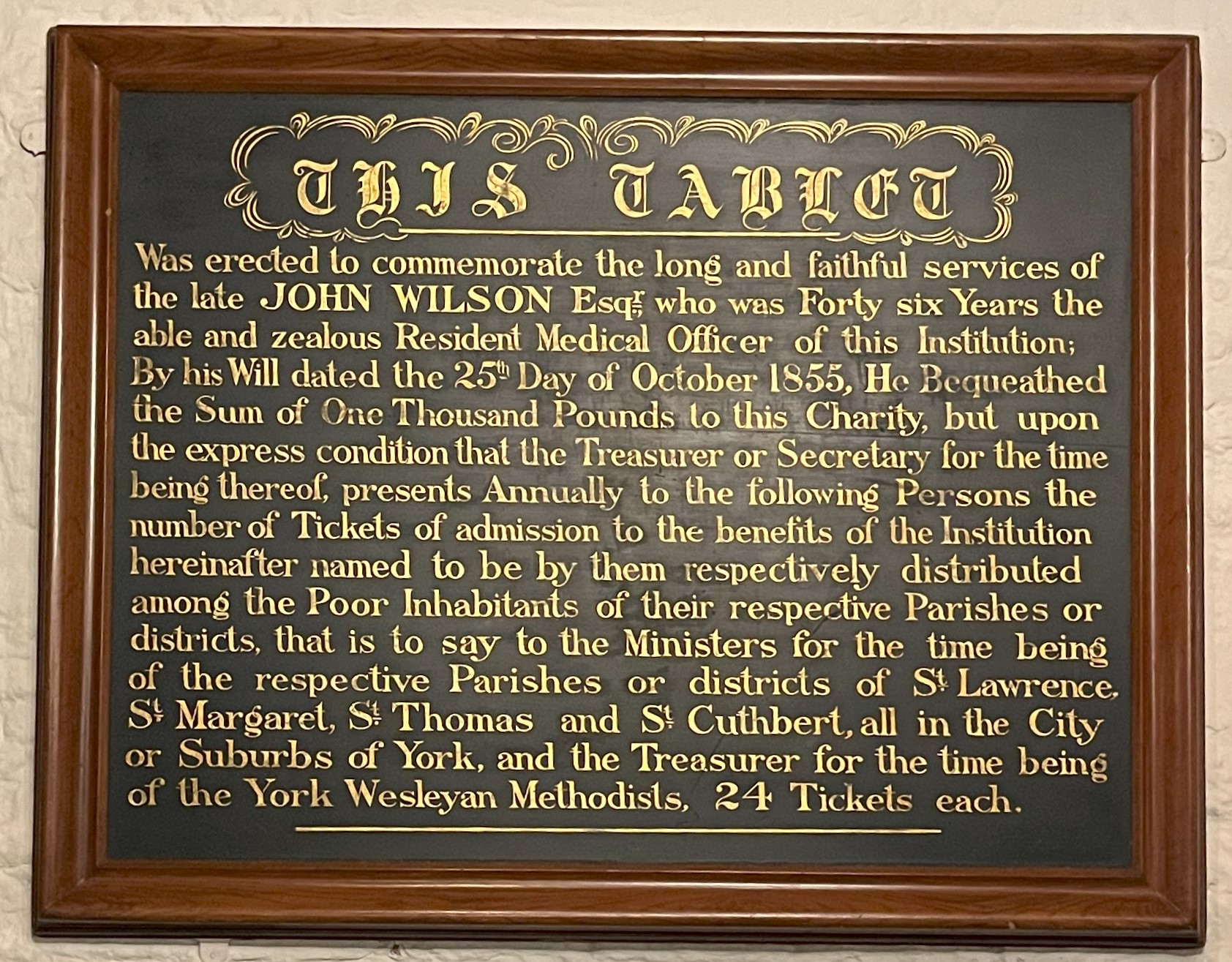
This was a great place in York to think about both A223 chapters on work and poverty. It's the Merchant Adventurers' Hall, the oldest bits of which which date back to 1357.

Upstairs is the Great Hall, a place for ceremony and feasting for the City's merchants (often traders across the North Sea).

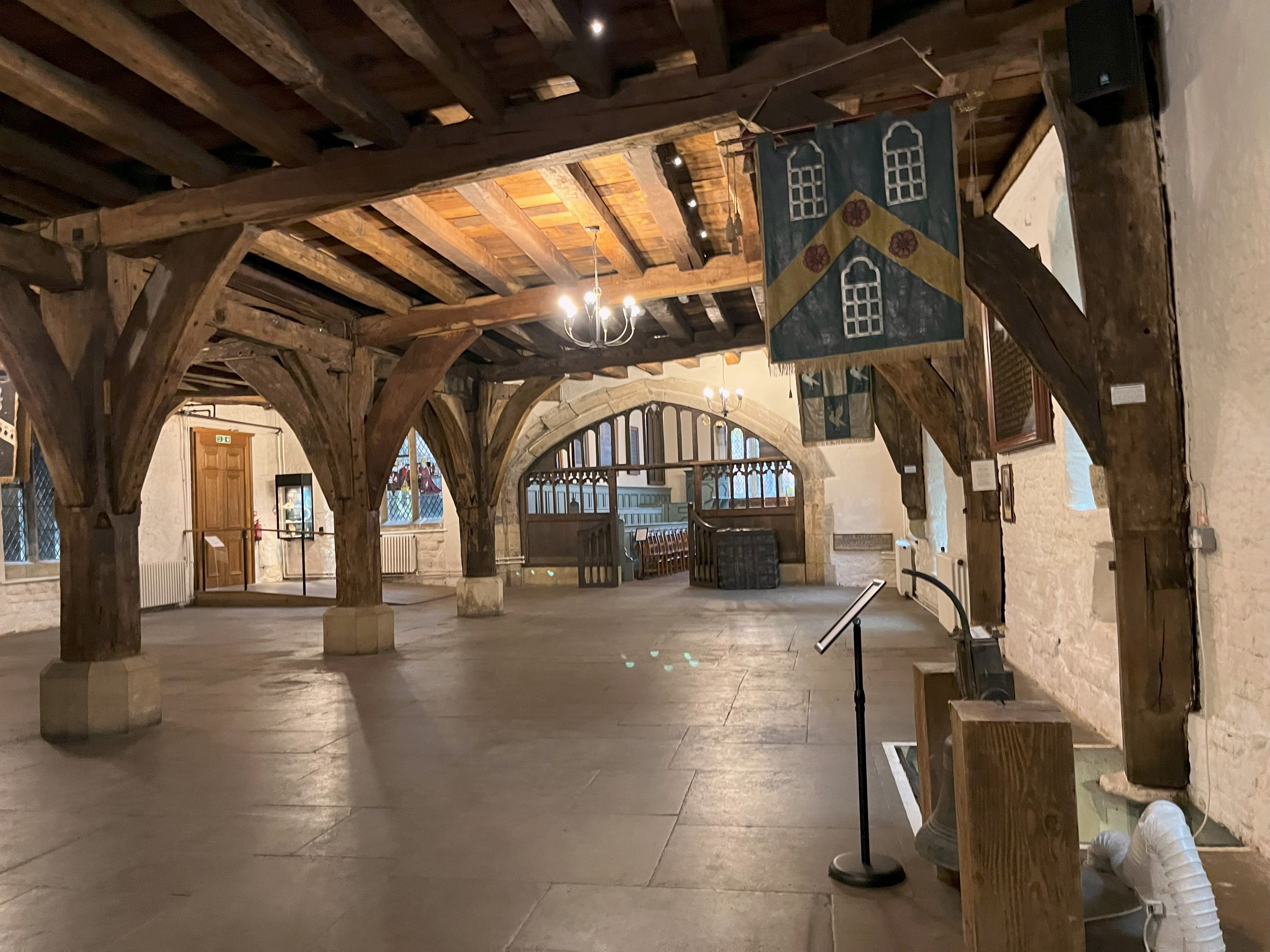
Downstairs has always been more strongly associated with alms and charitable welfare support. It has served as a dwelling place for impoverished local people, initially in the context of a religious fraternity (you can see a chapel at the far end). There are other halls in the city where the poor were put to work at different times, but I'm not sure if that was the case here. It was a prison briefly, but only in the context of the civil war when parliamentary soldiers were kept here whilst the city was under royalist control. 

By the end of the early modern period  it had become the location of a dispensary for the (deserving!) poor - apparently pensioners were still housed in this area until the start of the 20th century. The wealthy could donate to the charity and this in turn supported 'tickets' distributed through religious groups (including non-conformists - though I think York's Quaker population may have made different arrangements) which could be exchanged for treatment and support.

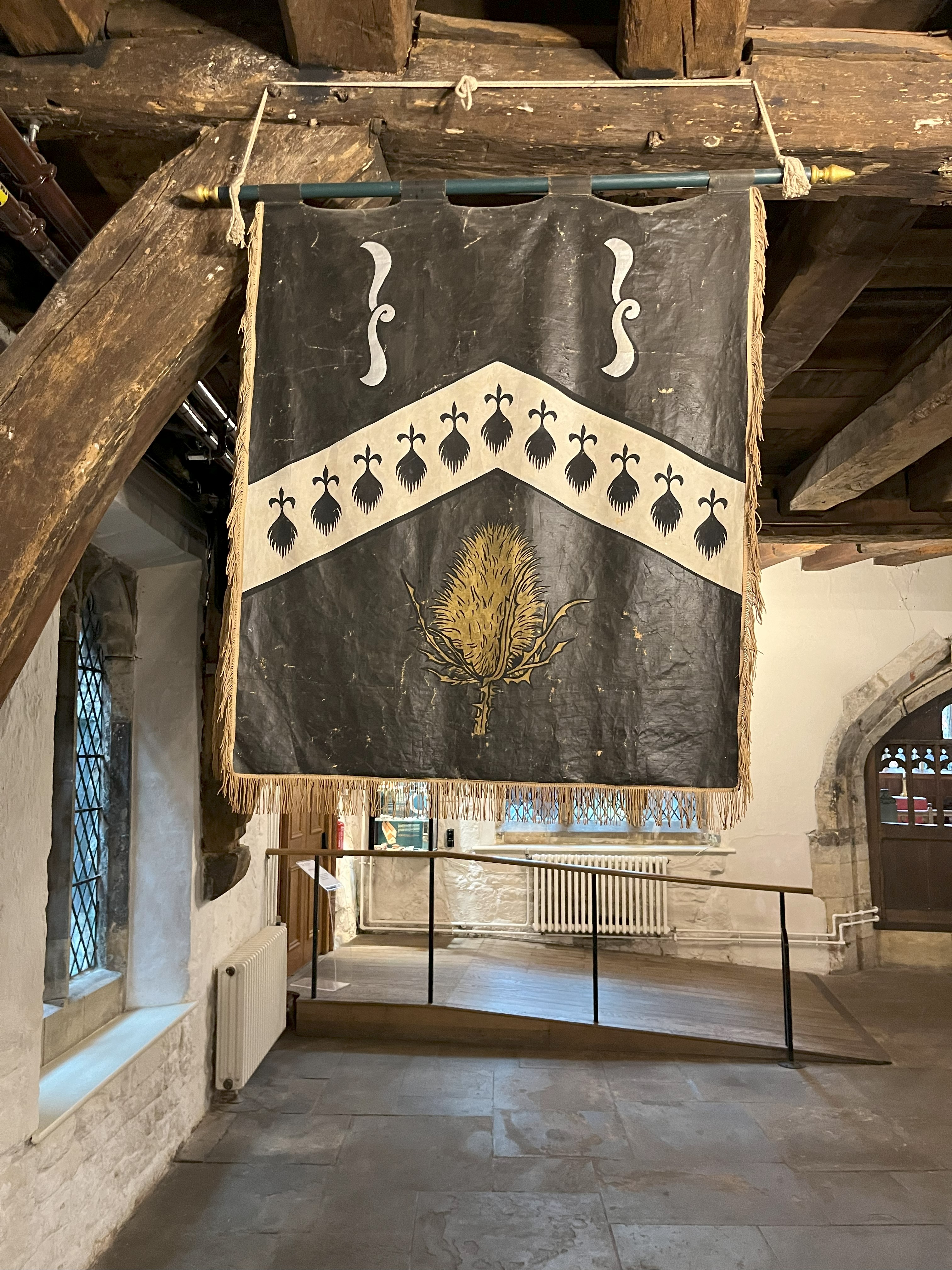
A set of Guild banners are displayed across the hall and it's fun trying to guess the trade from the coat of arms - the teasel in the banner below is probably a bit of a give away that these were the 'Clothworkers', but I learned the devices above are 'habicks' that were some sort of spring to hold cloth under tension. 

Of course, like a lot of York, these banners are a bit of a cheat 🙂 actually only dating back to 1909 and a 'Pageant' that included some dressing up to commemorate the city's relationship with King Richard III (although the arms are all the real-deal).

I was interested to discover that the Company of Merchant Adventurers still looks after 13 'deserving older members of York’s community' - under a licence that dates back to Edward III in 1373!

[Home Page]
Permalink
Share post
Steven Oliver

Nobility on display

Visible to anyone in the world
Edited by Steven Oliver, Wednesday 6 May 2026 at 20:46

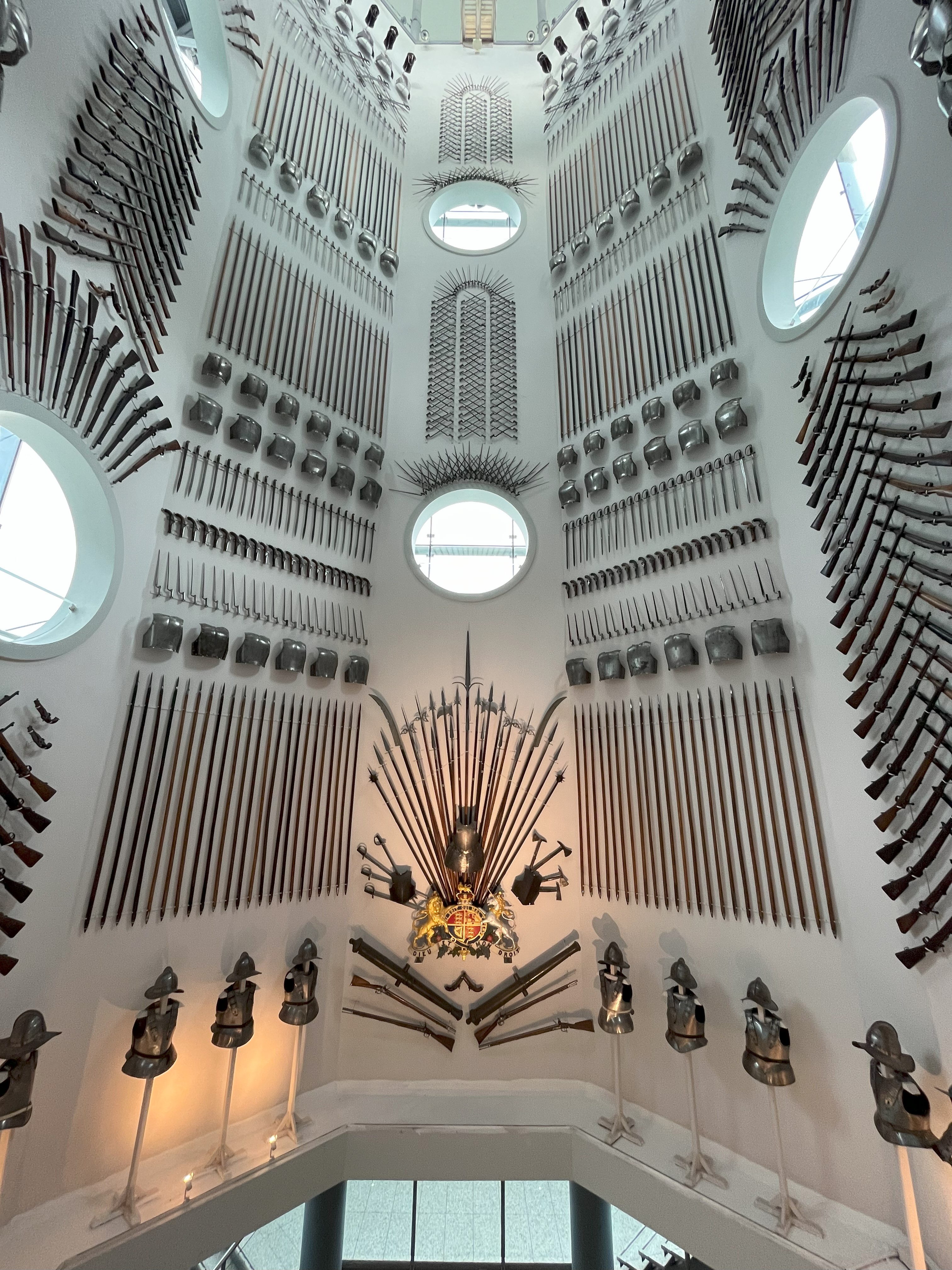
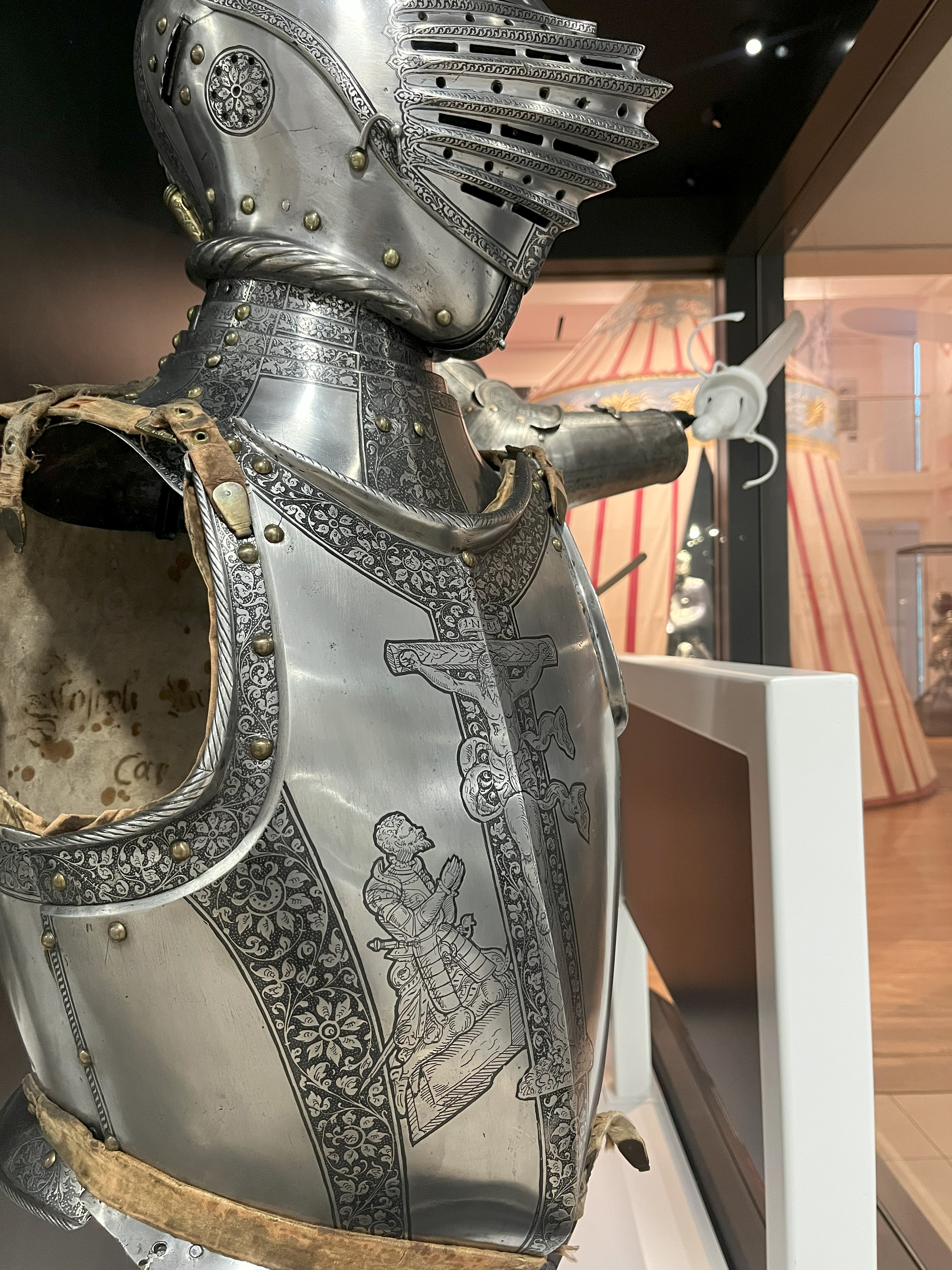
Having watched Neil Younger's video about noble armour in the Wallace Collection, I was prompted to visit the Royal Armouries Museum nearby in Leeds.

The museum has a couple of rooms dedicated to tournaments in the early modern period, centering these on the 'Field of the Cloth of Gold' when Henry VIII of England and Francis I of France engaged in a massive and extravagant tournament in 1520. (Meant to inaugurate and celebrate a treaty of 'Universal Peace' in Europe they were at war within 2 years!)

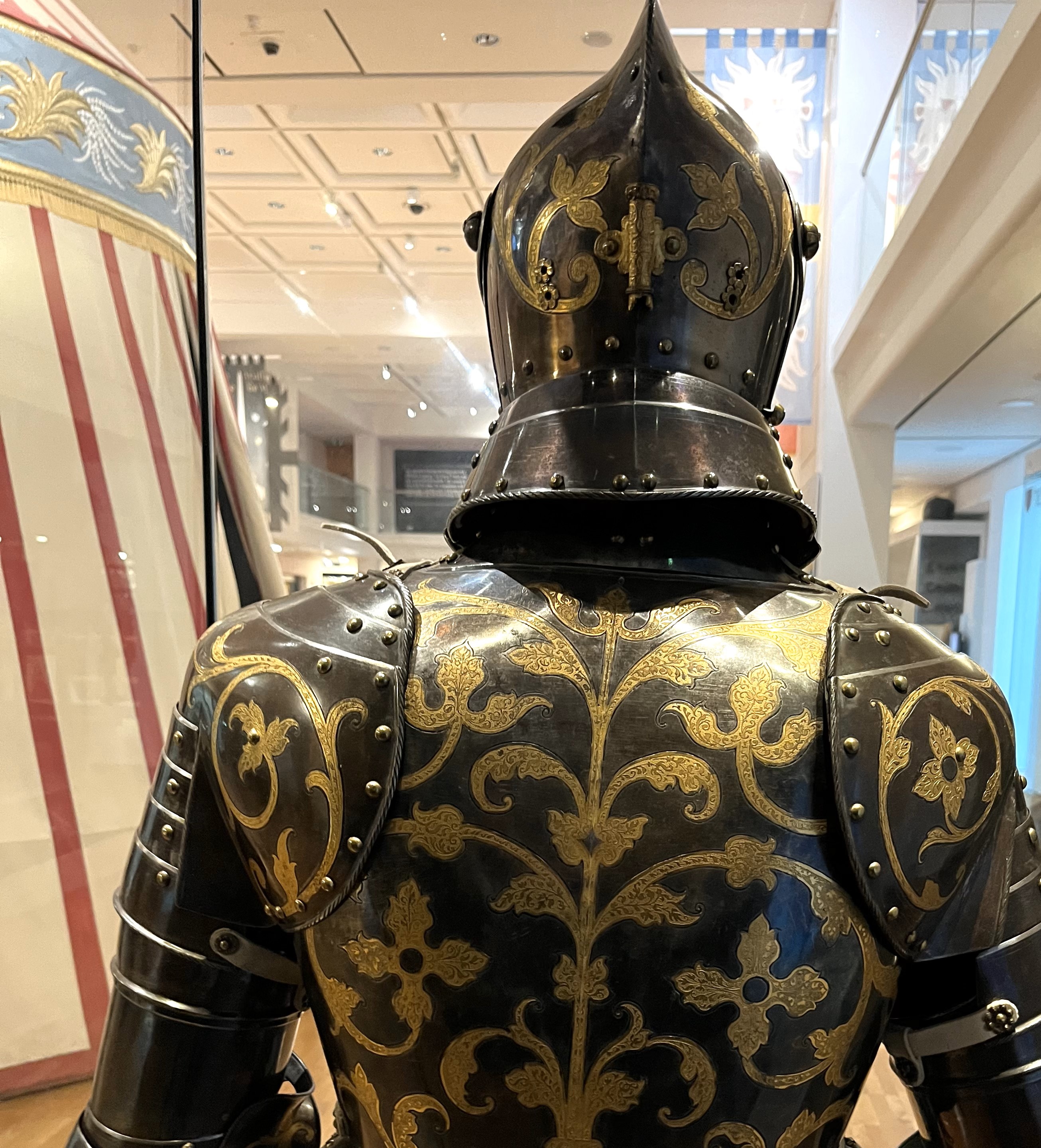
Armour of Christian I, Elector of Saxony. Made in Augsburg 1590

Like the armour in the OU video, the decoration on display is stunning and must have been astoundingly costly.

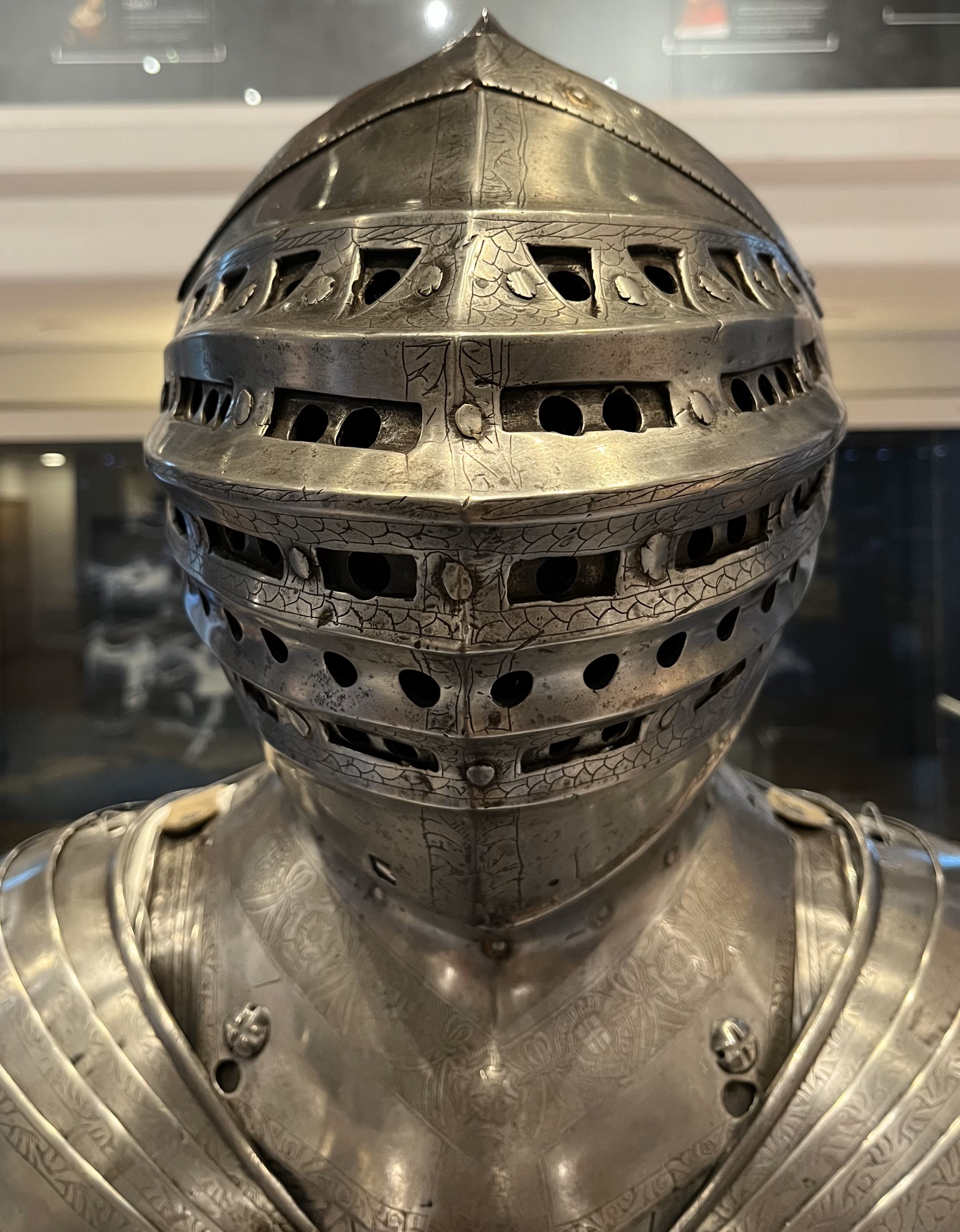
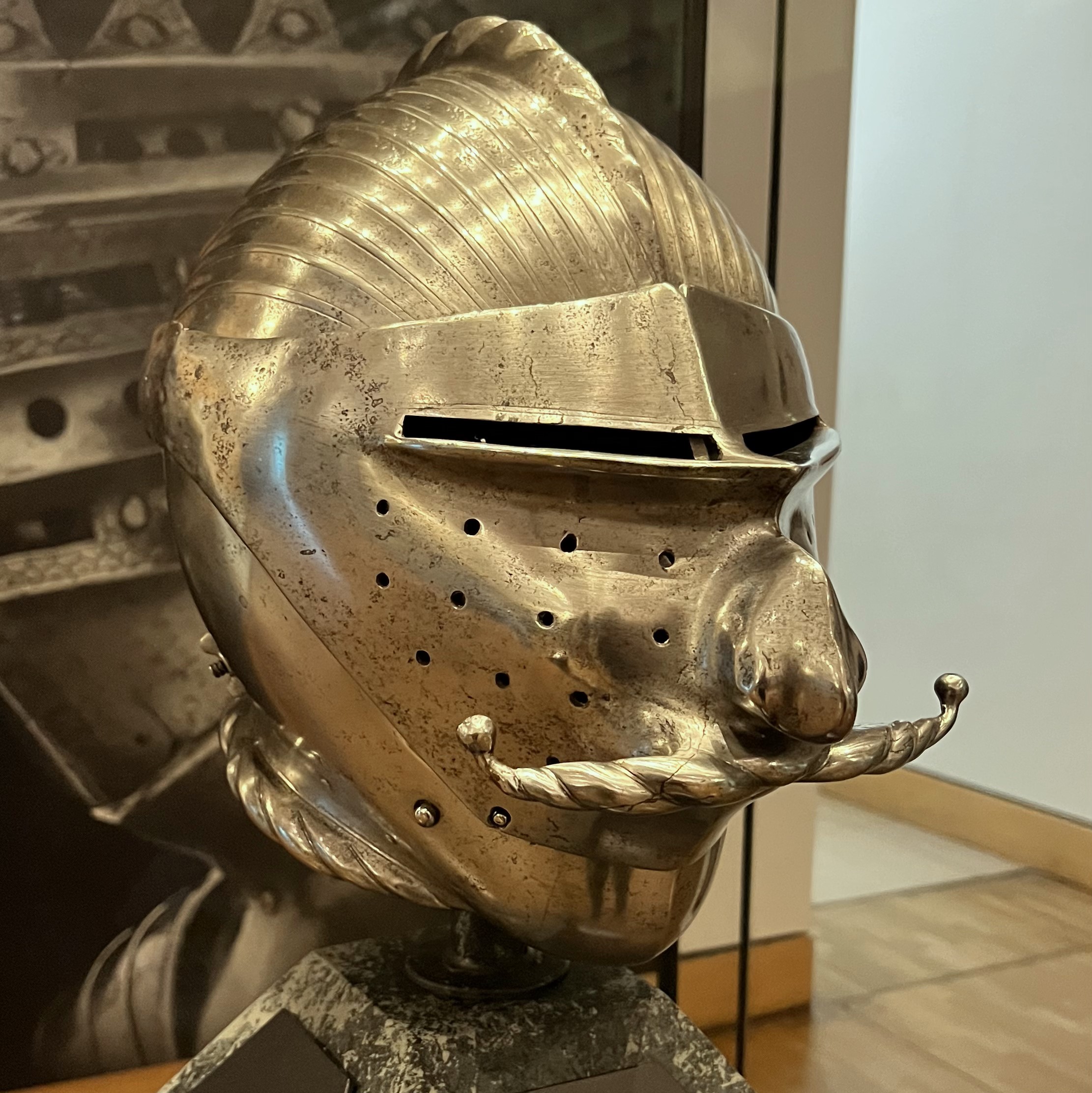
Henry VIII's tonlet armour, made for the Field of the Cloth of Gold tournament, 1520 Close helmet with grotesque visor incorporating a moustache


The exhibition discusses the role of nobles within what was a hugely choreographed diplomatic spectacle, and their relationships with their monarchs. Their get-ups and entourages were crippling expensive and fell on the nobles to fund. At the last minute (well with 3 months to go) Francis changed the tournament rules and Henry had to commission a completely new set of armour.

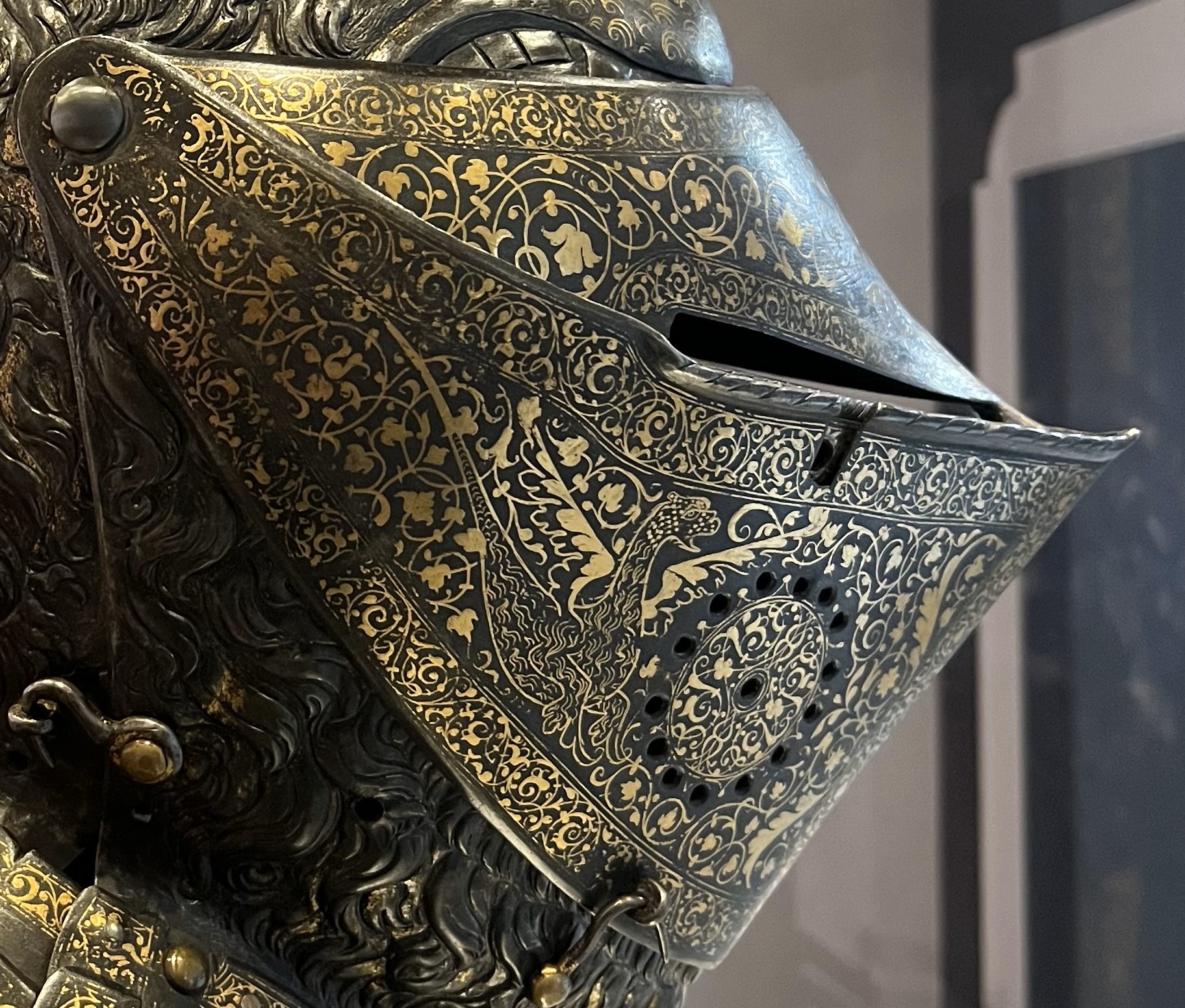
I loved the 'metal moustache'!! This was from a different tournament, and illustrated just how much display and spectacular costume was part of these events.


King Henri II of France's 'Lion Armour' - About 1550

This is just an astoundingly beautiful and intricate piece artwork - and to imagine that you were rich enough to allow the possibility that someone else was going to hit it with a poleaxe! 😱


Armour for combat on foot, c. 1560

I thought this was a nice image to end with. Armour for a mercenary in the service of the Holy Roman Empire, fighting in European 'wars of religion' across the early modern period. 

[Home Page]
Permalink
Share post
Steven Oliver

Coffee and flapjack with Lady Anne

Visible to anyone in the world
Edited by Steven Oliver, Wednesday 6 May 2026 at 20:47

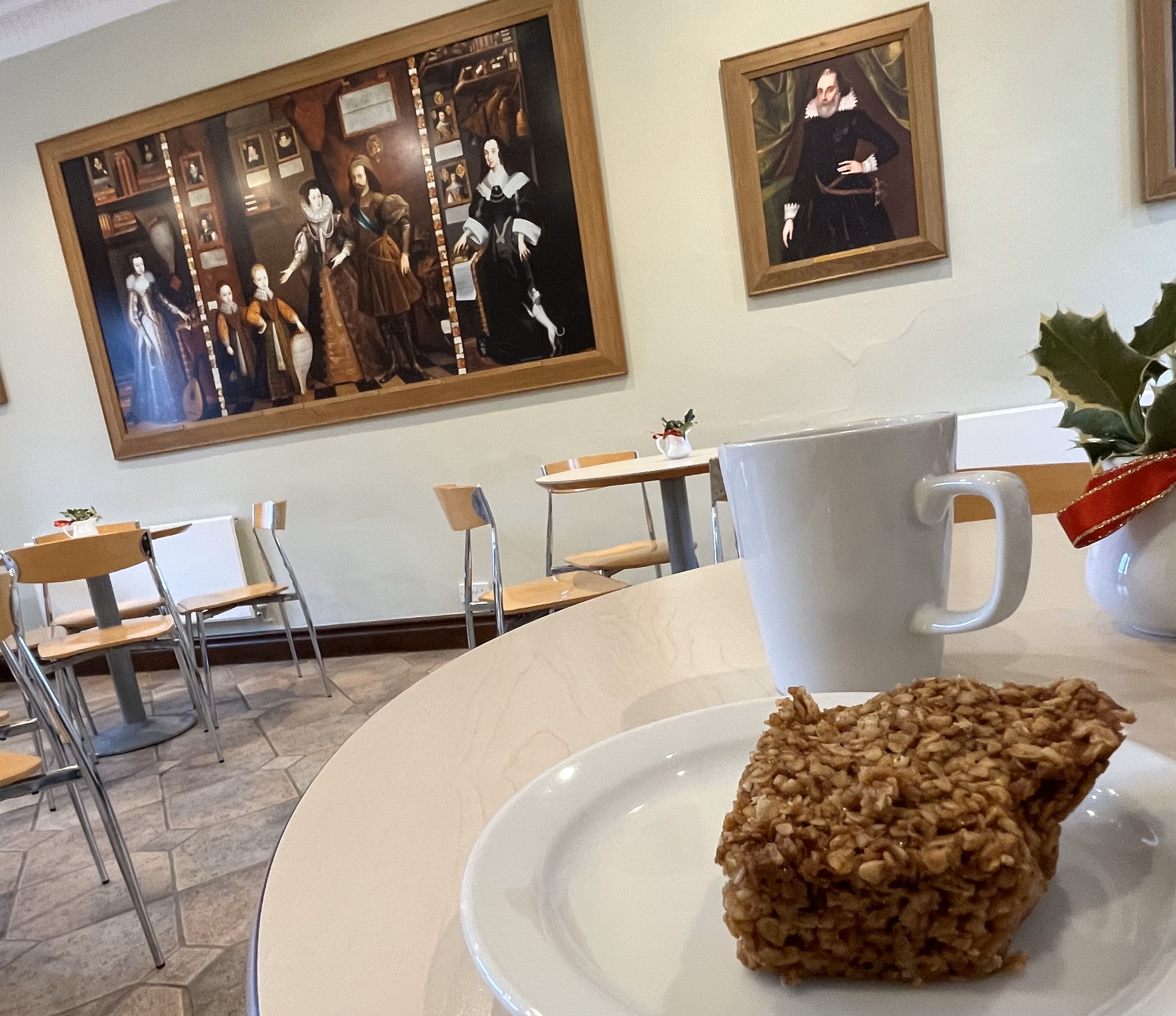
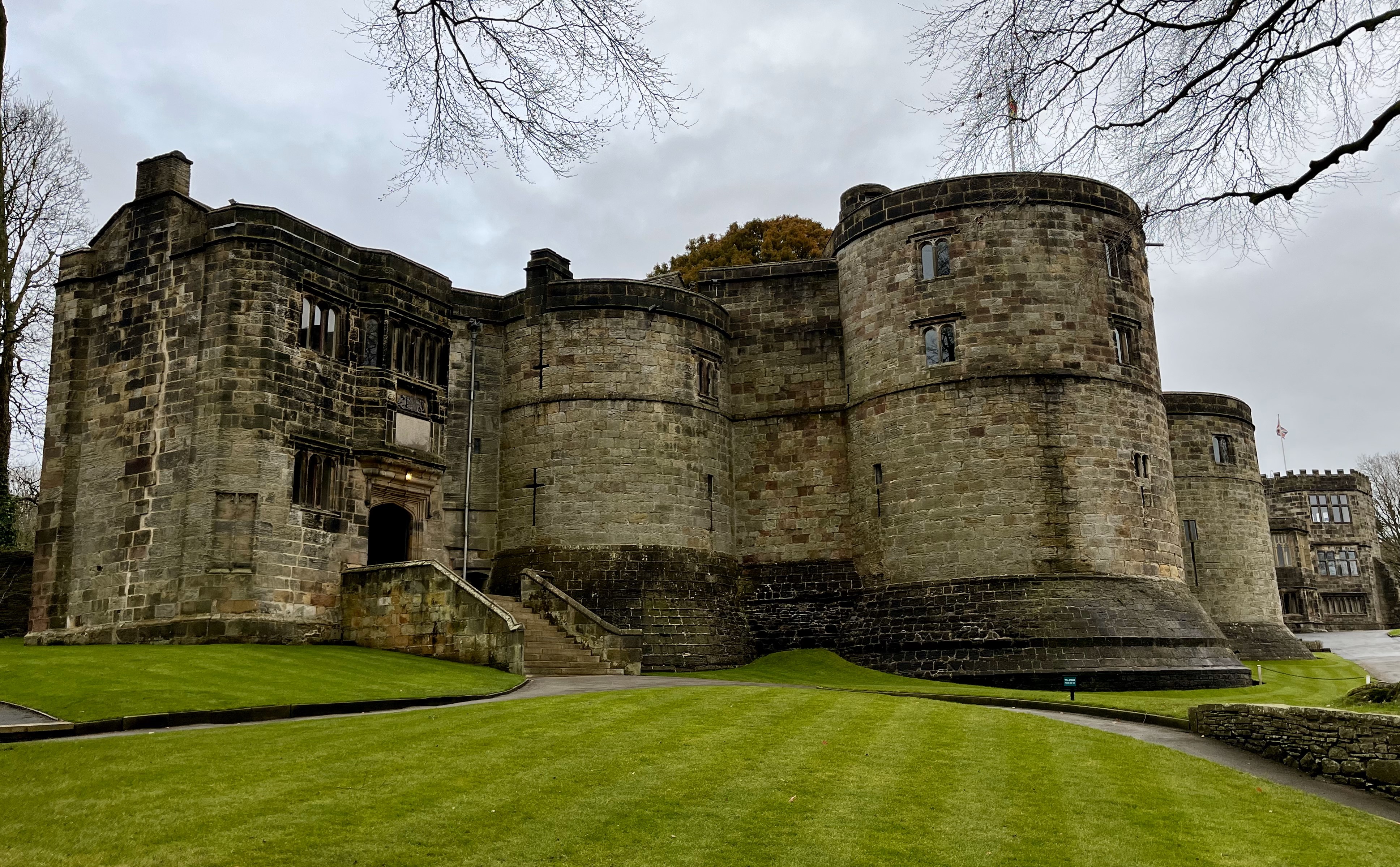
Not sure if Book 2 of A223 will be as 'Yorkshire-centric' 🙂, but had a lovely (and tasty) 'Chapter 8' visit to Skipton [5/12/2024], with a chance to have some excellent flapjack whilst looking at a replica of 'The Great Picture' in the castle tearoom.

As the chapter explains, Lady Anne invested in a lot of rebuilding of her reclaimed properties after the Civil War. The second level of these towers were reconstructed, but had to be built too thin for the roof to support cannon! (The castle had very successfully resisted Parliamentarian siege during the war)

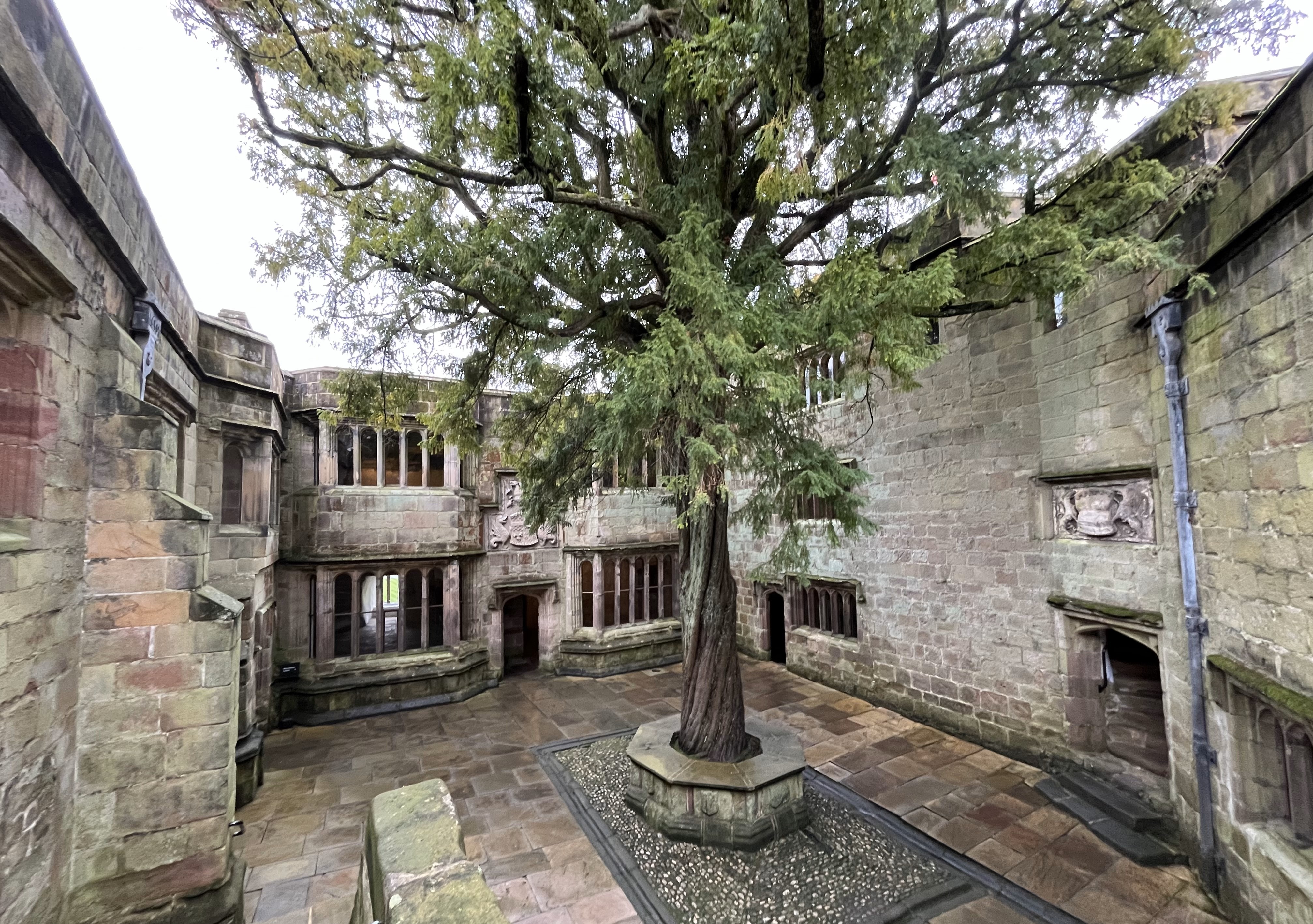
One very tangible measure of the passage of time is that Anne had a yew tree planted in the central courtyard to mark the completion of the rebuild. It is now quite a spectacle.

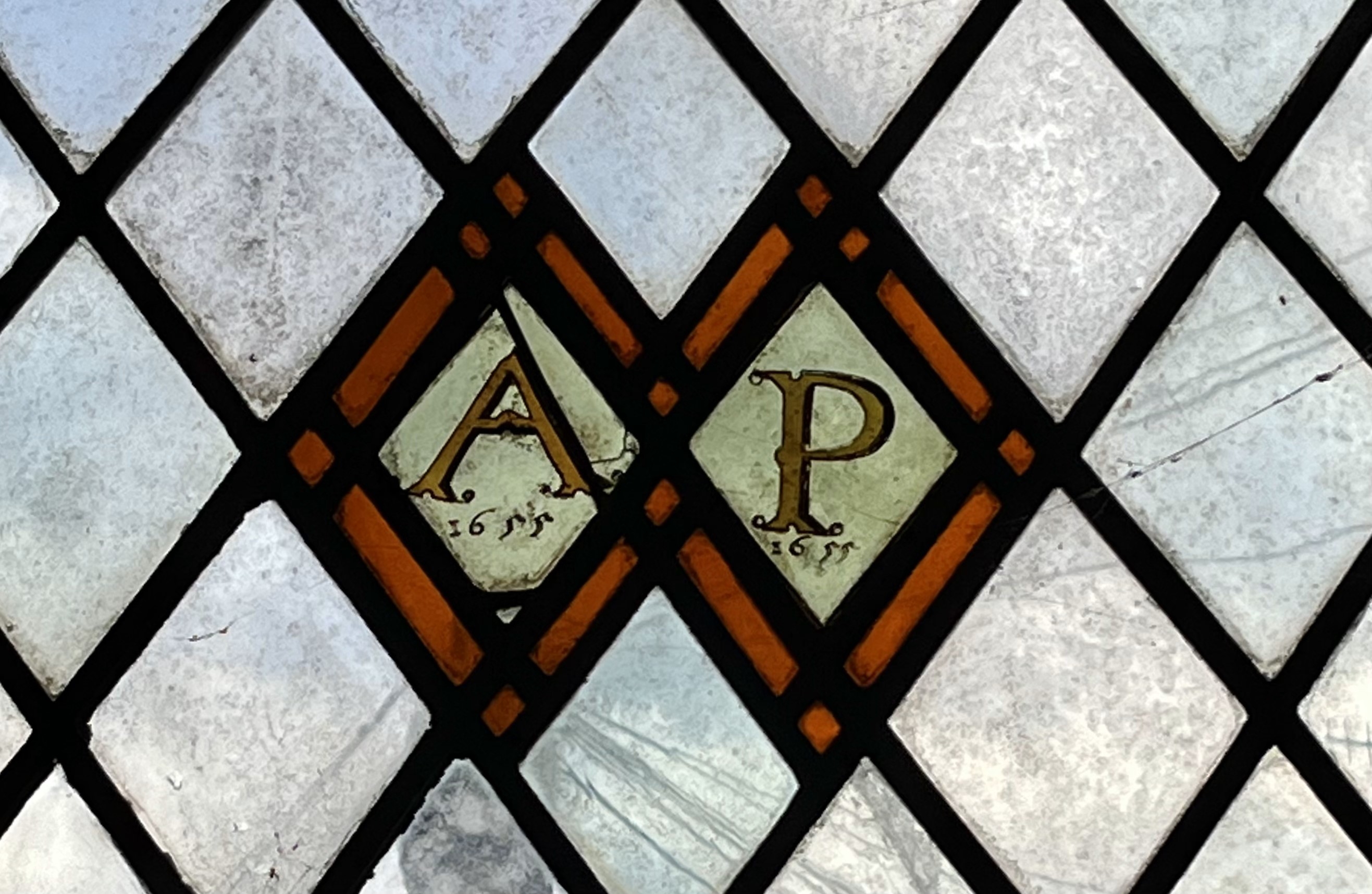
She also had the local parish church repaired, those windows she had replaced were marked with the date and her initials - by then in 1655 after her second marriage - Anne, Lady Pembroke.


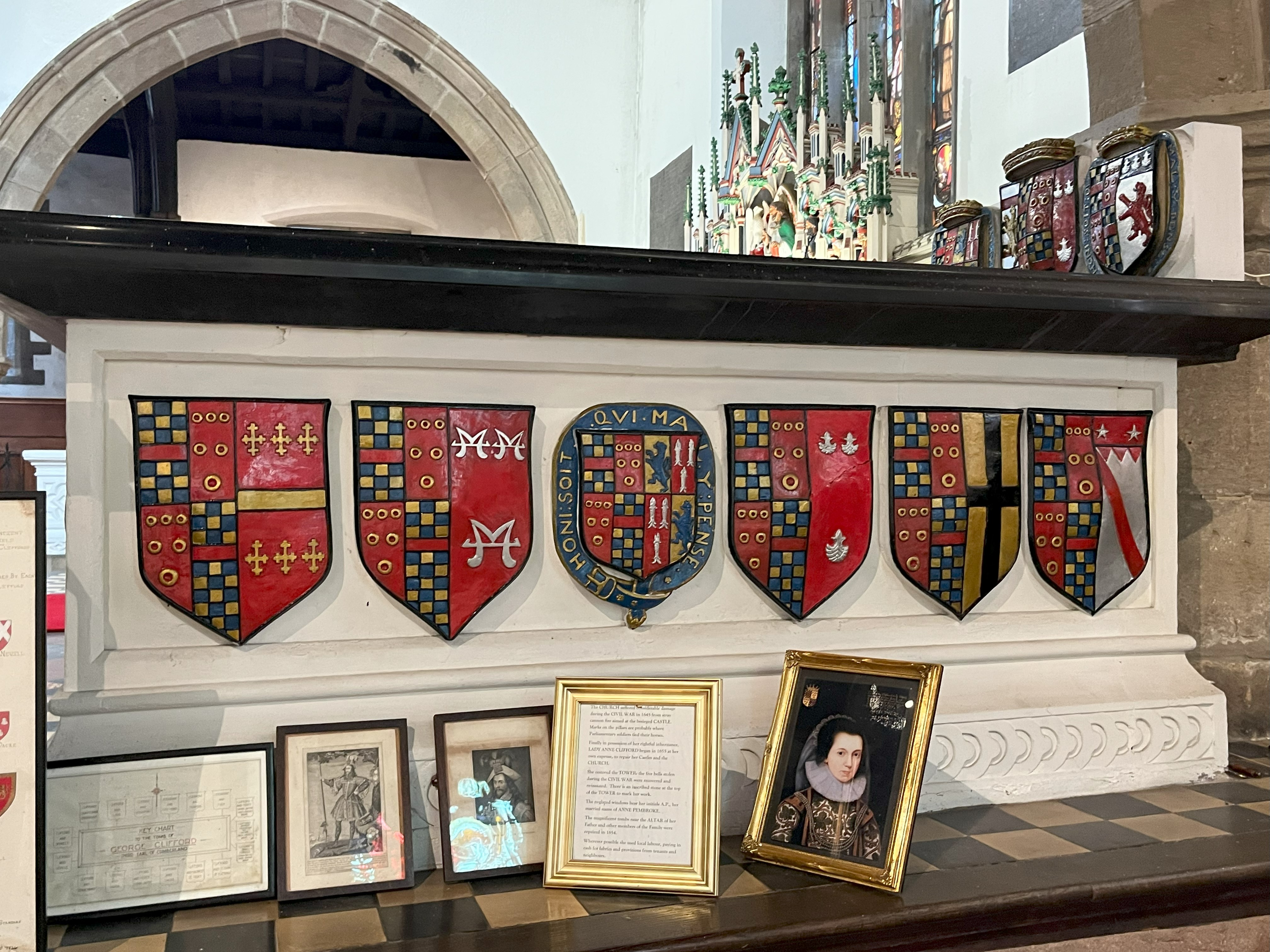
She also paid for the magnificent tomb in the church for her father George - despite the will he made and all the trouble it caused her. 

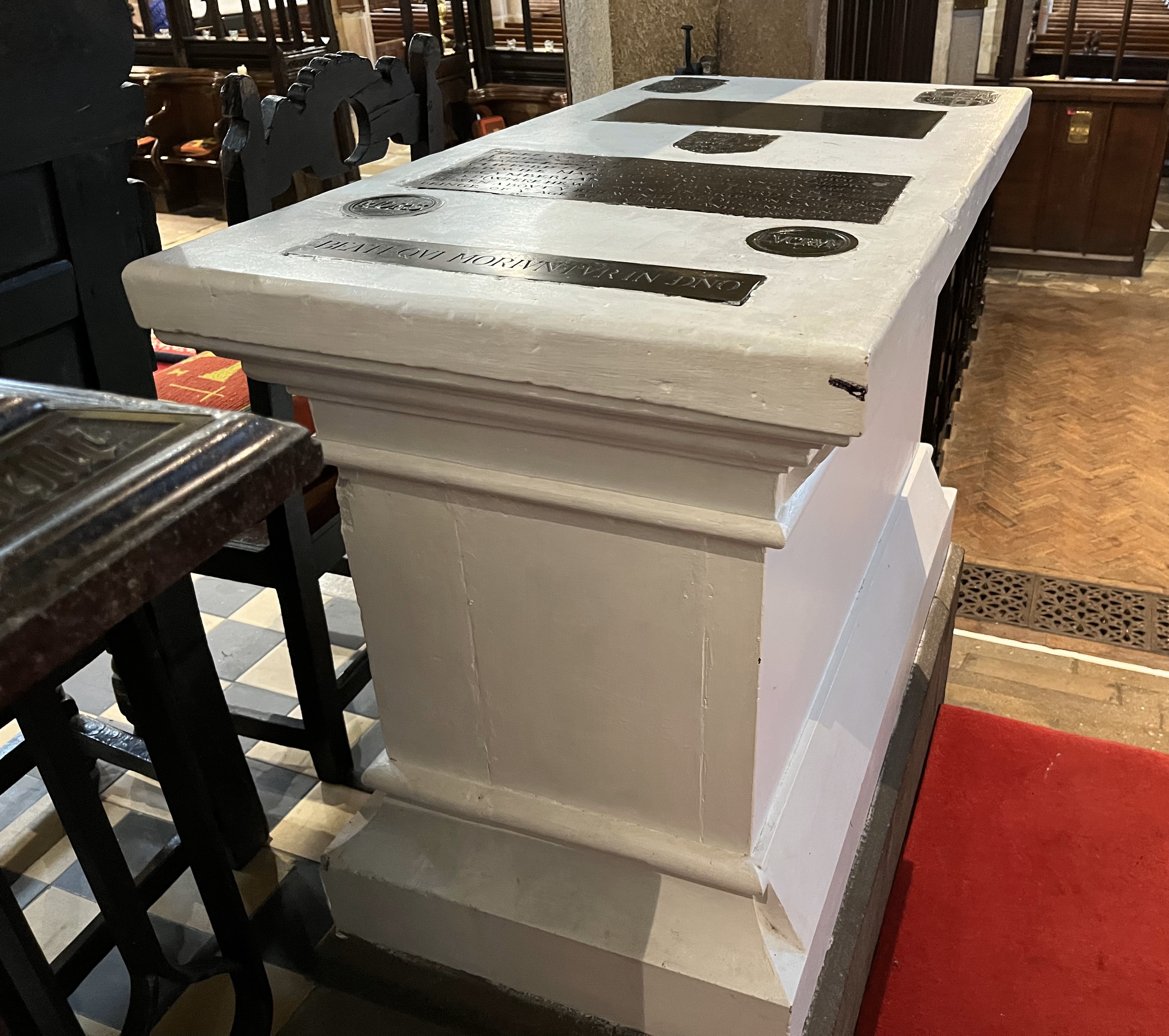
This smaller tomb is for her younger brother Francis (the taller boy in the picture) who died aged 5.

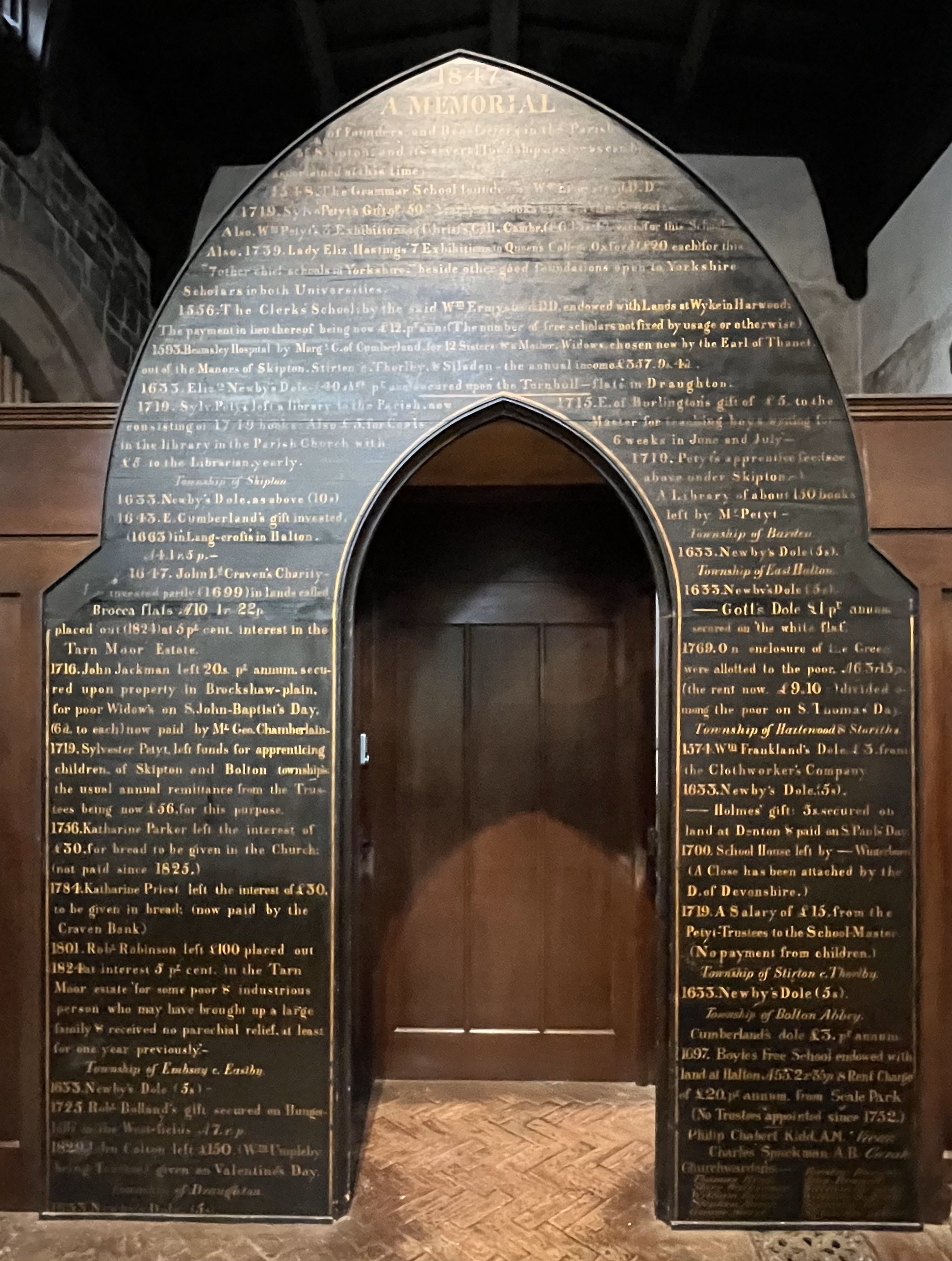
There was a striking memorial board in the church to all the charitable donations that supported the poor of Skipton, which was a timely reminder of a TMA I needed to complete on the 'economy of makeshifts'!


[Home Page]
Permalink
Share post
Steven Oliver

Early Modern Yule in York

Visible to anyone in the world
Edited by Steven Oliver, Wednesday 6 May 2026 at 20:47

"Oyez! Oyez! Oyez! We command that the peace of our lady the Queen be well kept by night and day but that all manner of whores, thieves, dice players and other unthrifty folk be welcome to the city, whether they come late or early, at the reverence of the High Feast of Yule till the Twelve Days be past. God save the Queen!"

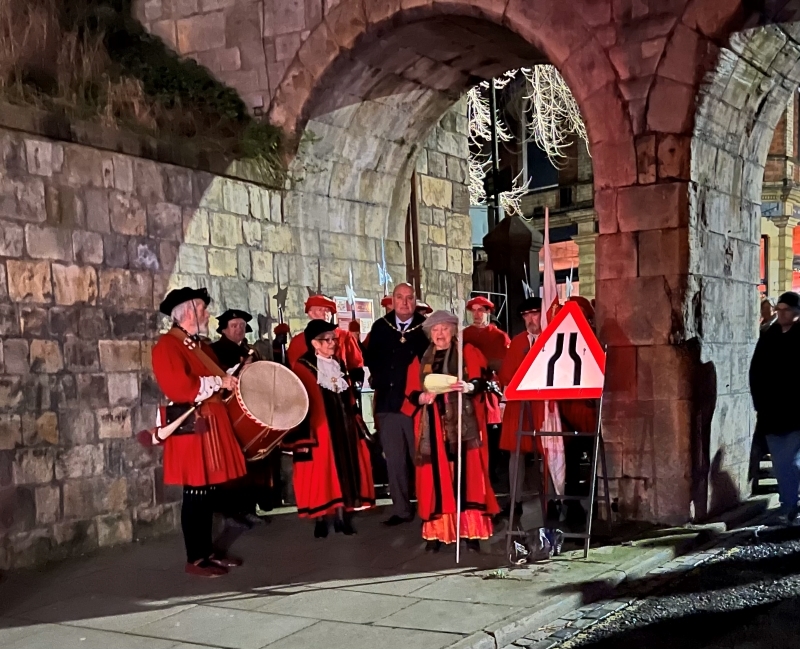
On 21st December the Sheriff of York gave the annual 'Yulegirthol proclamation' beneath the Micklegate Bar...

The crowd then set off in a properly Early Modern fashion to get the party started and make a bit of noise on the longest night.

I'm sure the costumes and regalia will turn out to be an early 20th century 'reinvention' of tradition, but the celebration of 'Yule and Yule's Wife' in York have a proper historical basis. This link from the Borthwick Archives in York gives some fascinating primary sources for the conflicts that arose in the 16th century over what was clearly a suitably rowdy time! (Have to say there were still plenty of 'unthrifty folk' thoroughly enjoying York City centre that night 🤣)

[Home Page]
Permalink
Share post
Steven Oliver

Munich

Visible to anyone in the world
Edited by Steven Oliver, Wednesday 6 May 2026 at 20:49

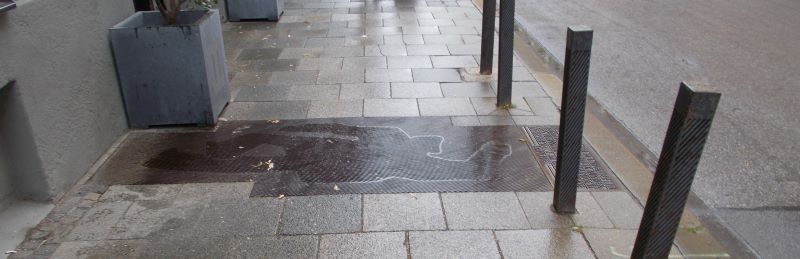
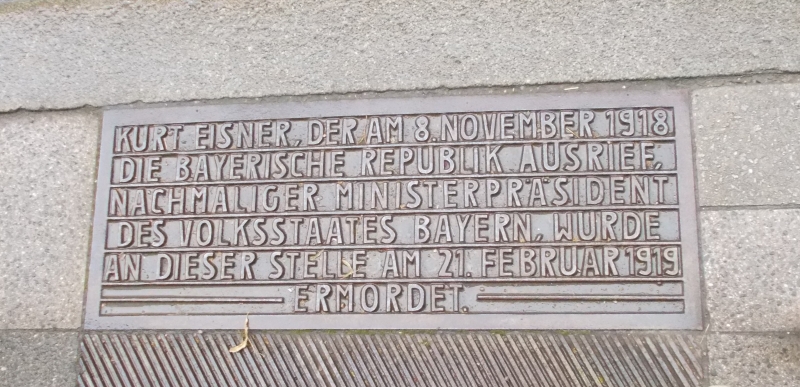
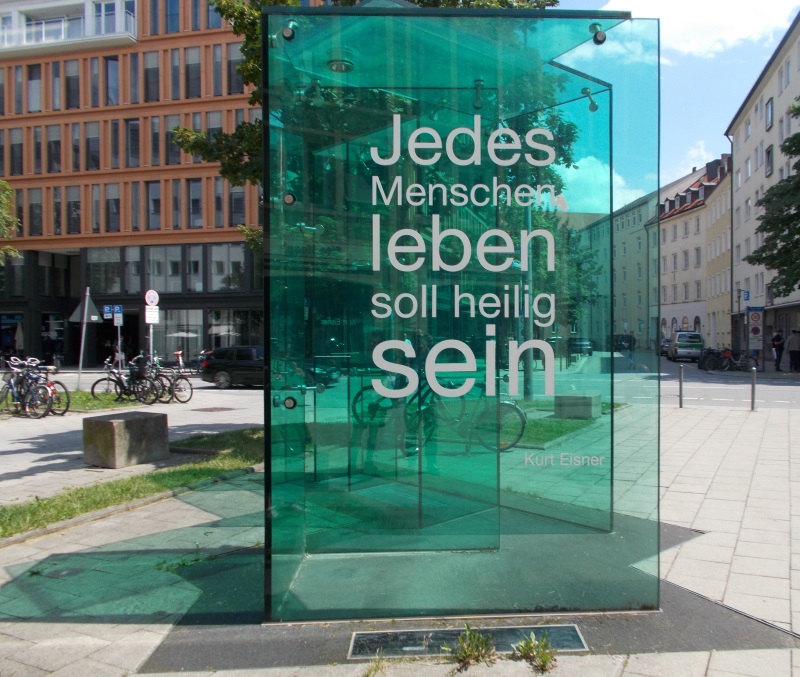
I thought I'd post a few photos from a recent holiday in Munich that have an A113 link. They are of a couple of memorials in the city to Kurt Eisner. He was the leader of the U-SDP in the city, and seized the initiative in declaring a socialist republic in Bavaria during the German Revolution. The first memorial is on the site of his subsequent assassination in February the following year. He was shot by a far-right sympathiser whilst walking through the street - he was actually on his way to resign following national elections in which the U-SDP had gained very limited support. The memorial itself is of a shape on the ground, like the 'chalk outline' of a murder victim. The second memorial is also in the city centre, set up more recently in 2008 - I'm not sure the location has any particular significance - the quote translates as 'every human life should be sacred', taken I think from the initial manifesto for the republic. 

I found it fascinating to see what is, and isn't, memorialised in Munich - and how the city is going about acknowledging and responding to its 20thC history in particular.

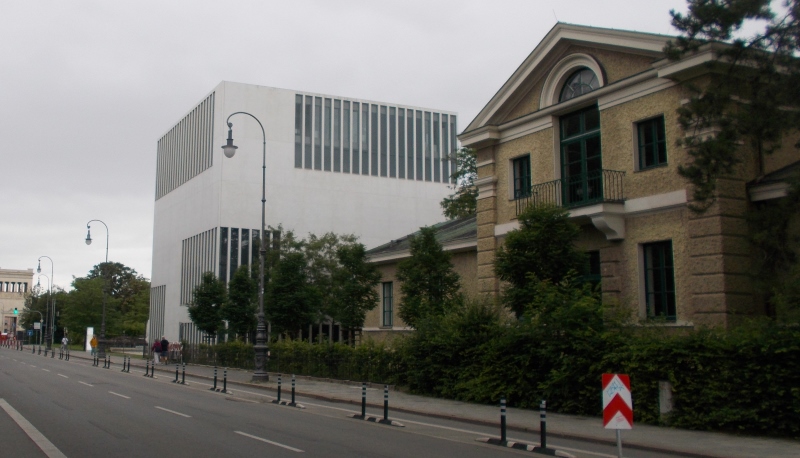
The modern building below is the NS-Dokumentationszentrum München, Munich's Documentation Center for the History of National Socialism. It's location has particular significance as it stands on the site of what was the 'Brown House', the original headquarters of the National Socialist Party. 

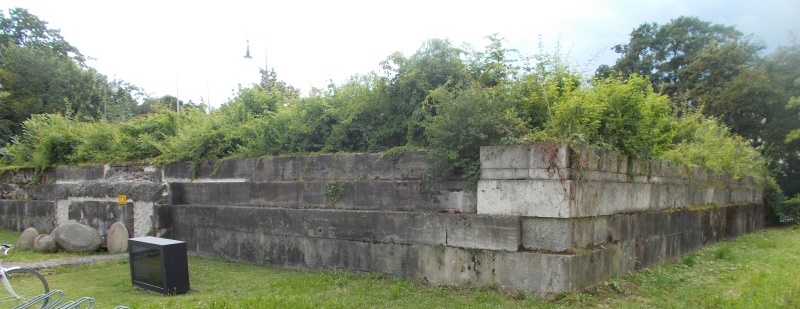
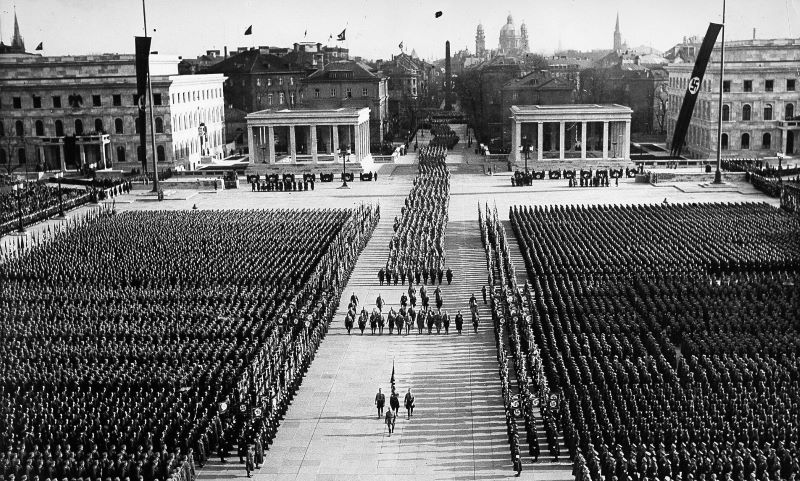
Just beside the Documentation Centre are the remains of one half of the two 'Ehrentempeln', 'Temples of Honour' built to house the coffins of the Nazi members killed during the 'Beer Hall' putsch in 1923. These were the site of annual memorial parades once the national socialist party came into power in Germany. The majority of these structures was destroyed in 1947 as part of a policy of 'denazification', and the remains were going to be built over in the 1980's. However, following a campaign for more open examination of the city's role in the rise of national socialism a decision was reached to preserve these sites, and to establish the Documentation Centre.

The image below shows a Nazi Party parade on Königsplatz, November 9, 1936, the Ehrentempeln are the pillared structures at the entrance to the square.

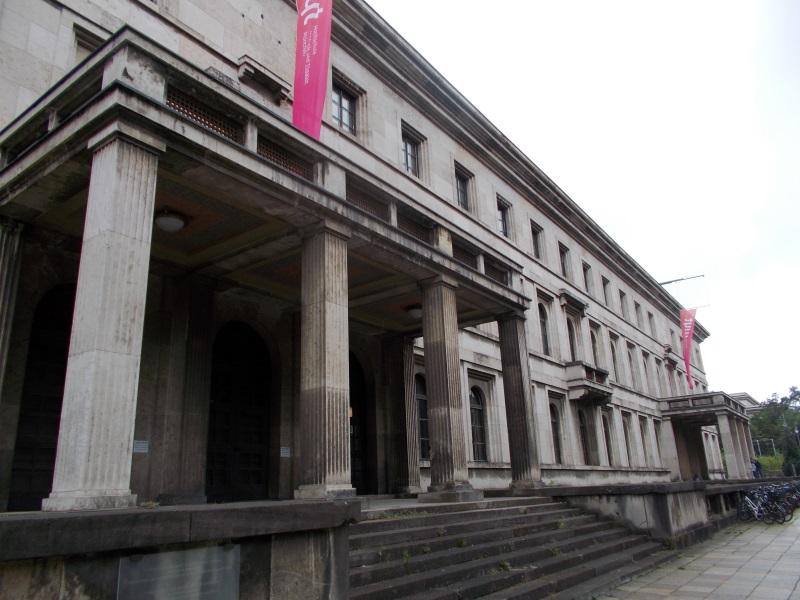
Other elements remain of what was a distinct 'Party District' - the building below was the 'Führerbau', Hitler's specially built residence in Munich, the location for the signing of the 'Munich Agreement' that sealed the fate of Czechoslovakia in 1938. After being taken over by the occupying American forces at the end of WWII this has now become the location of a performing arts college.

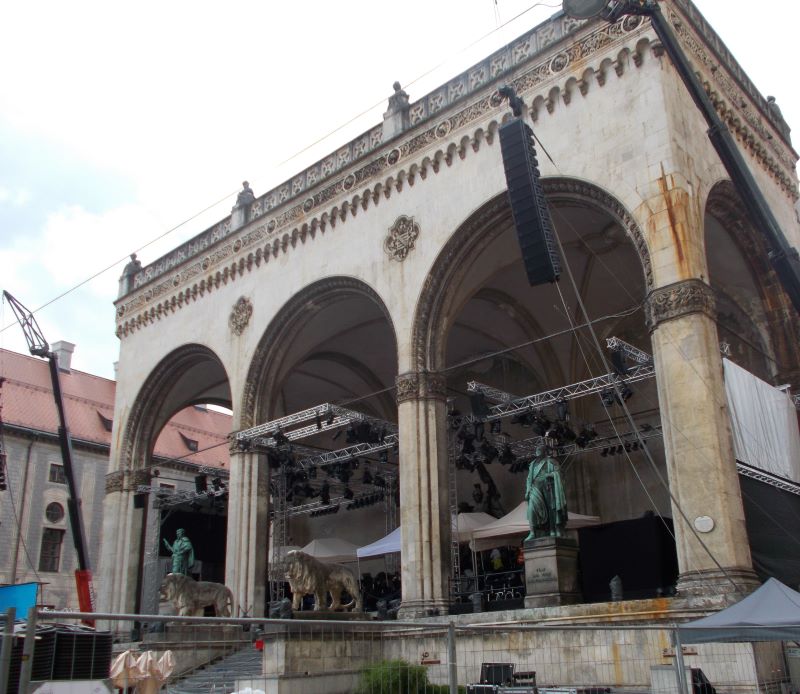
The 'Hitler Putsch' in 1923 ended at the Feldherrnhalle (Field Marshalls' Hall) on the Odeonsplatz in central Munich and it was here that a brief gunfight resulted in the deaths of four policemen and sixteen putschists. The site was made into a memorial to the Nazi 'martyrs' and passers-by were required to honour then with the Nazi salute.

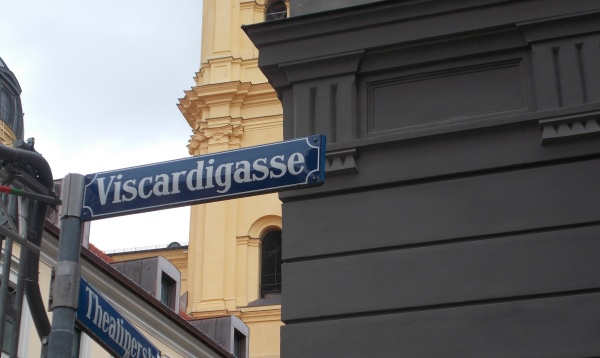
To avoid having to pass the memorial it was possible
to cut through an alley at the rear of the Feldherrnhalle called the Viscardigasse and this street acquired the nickname of 'Drückebergergasse' or 'shirker's lane'.

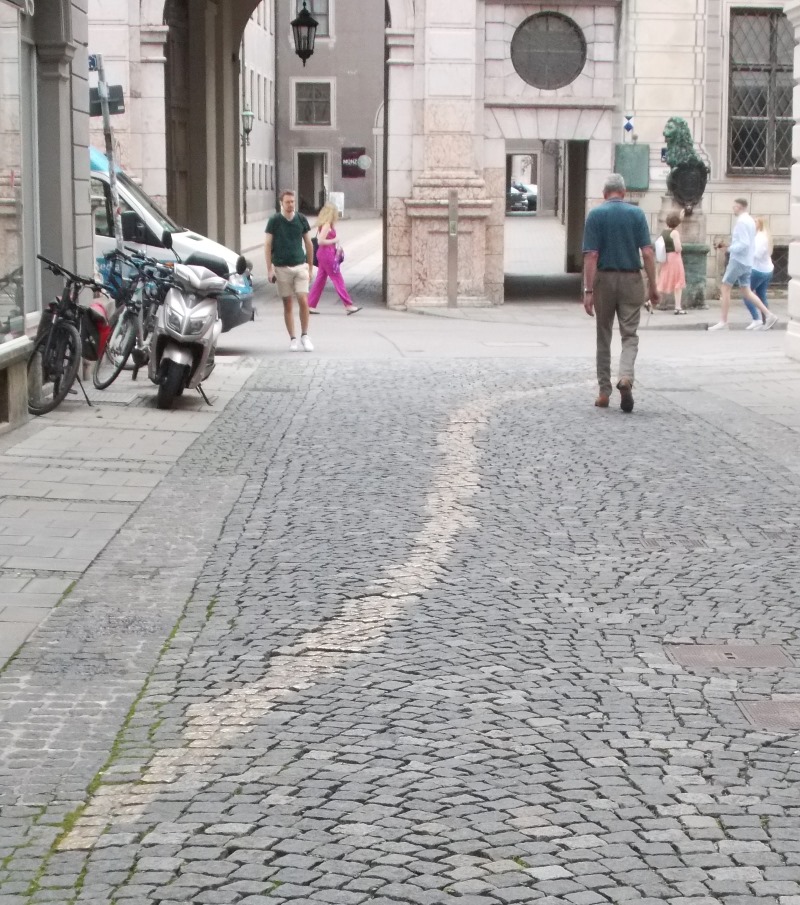
These small acts of resistance are now celebrated rather than mocked, in 1995 a line of bronze cobbles was set into the street as a memorial to those individuals who resisted Nazi rule. 


[Home Page]
Permalink
Share post
Steven Oliver

Going Underground

Visible to anyone in the world
Edited by Steven Oliver, Wednesday 6 May 2026 at 20:50

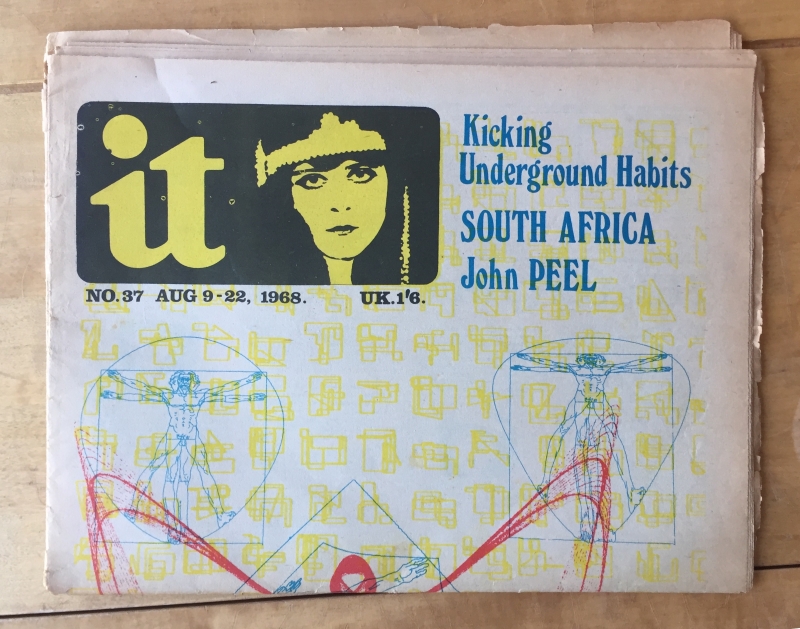
☮️ 🌻 ❤️ 🎵 To help you get into the revolutionary '60s cultural scene - some text and images from a UK underground paper - the International Times (IT). I picked a copy up secondhand (wish I could say I'd been a subscriber, but I was only 3 in '68 😀) and enjoyed dipping in as I went through the 1960s unit of A113.

There was a lot of music content - most were advertisements, but John Peel had a regular column, this week he was extolling the virtues of what must have been Leonard Cohen's first album and the Doors LP 'Waiting for the Sun'.


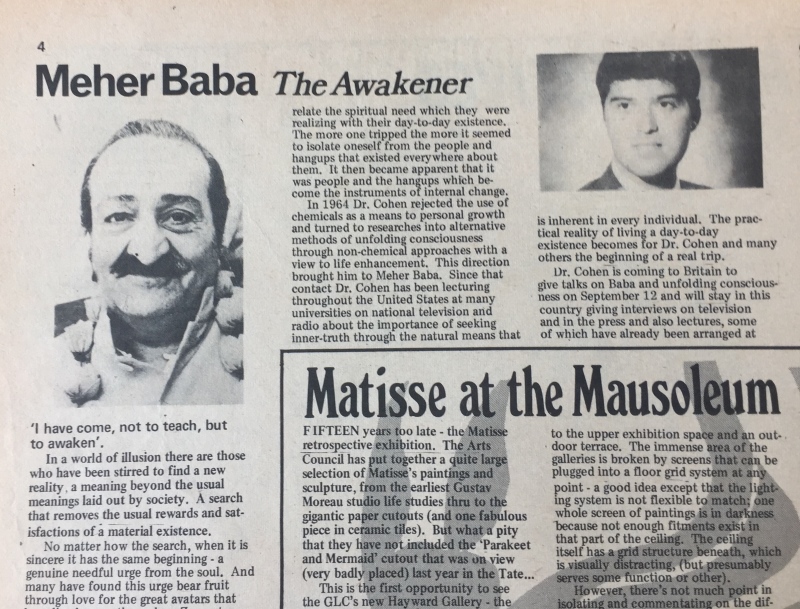
There was quite a bit of interest in mystical mind expansion...


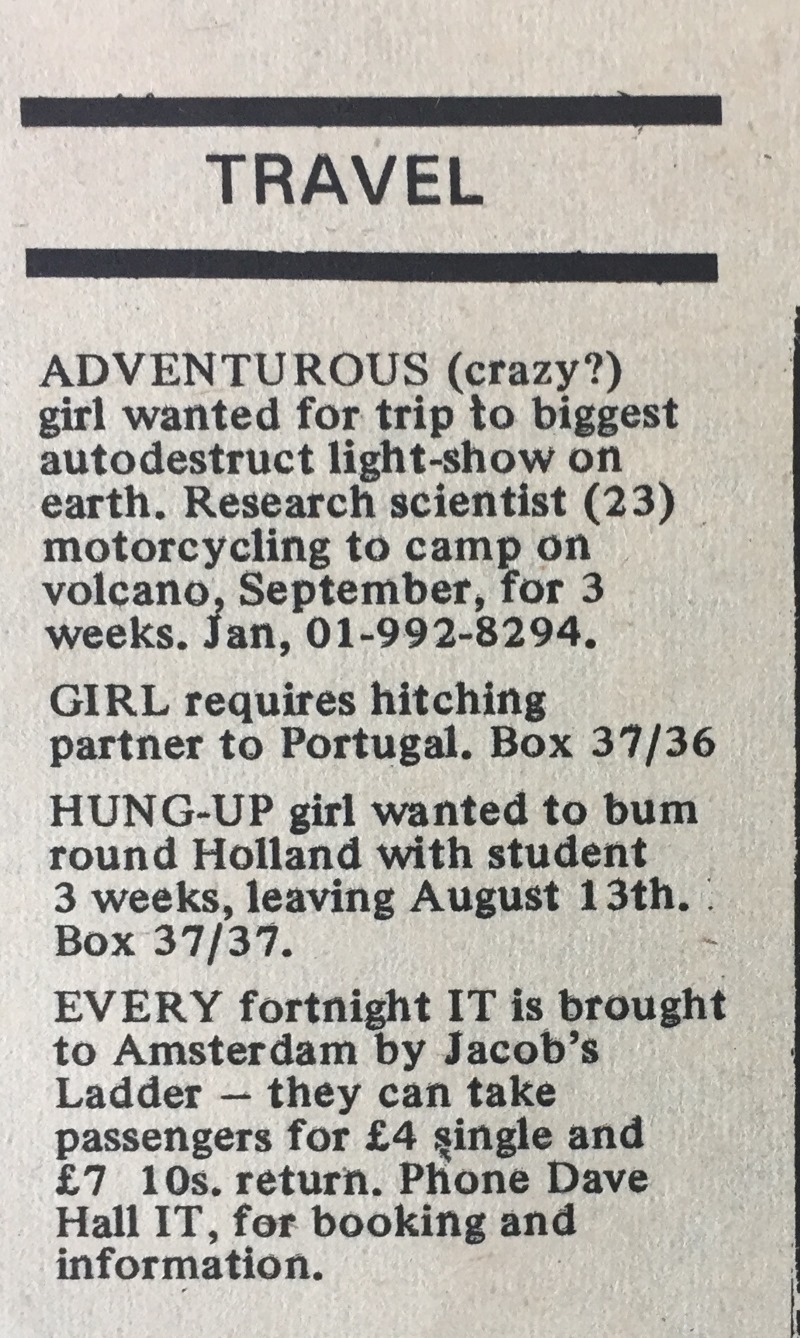
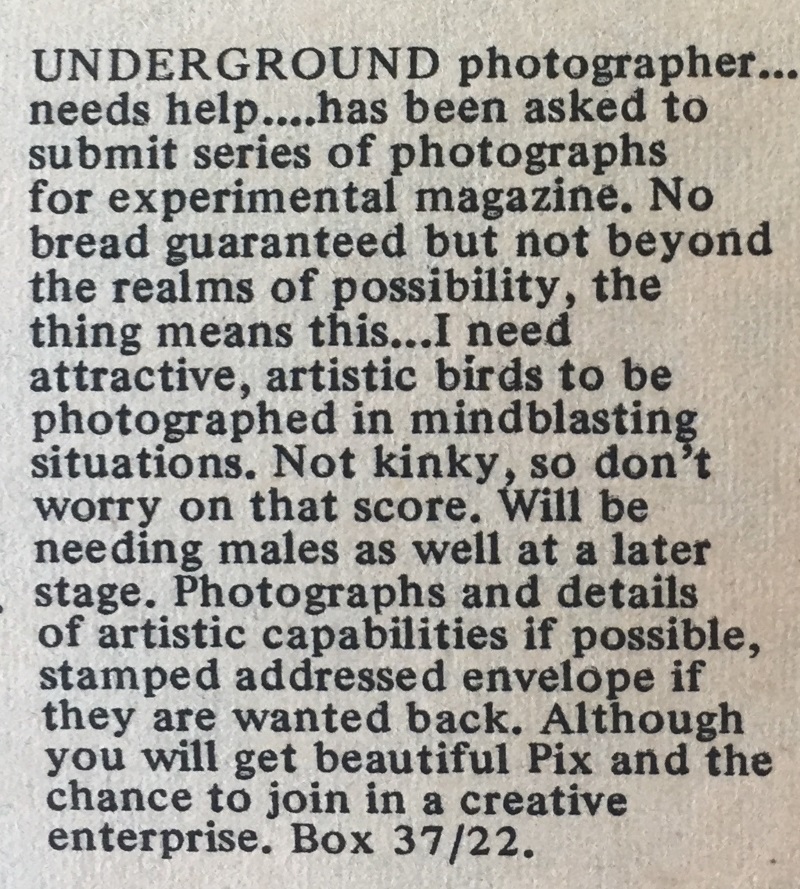
The personal ads were obviously an earner for the publication - there were a few messages seeking gay male contacts, but most seemed to be aimed at discovering 'adventurous' women - the one from the 'underground photographer' made my skin crawl 😬  


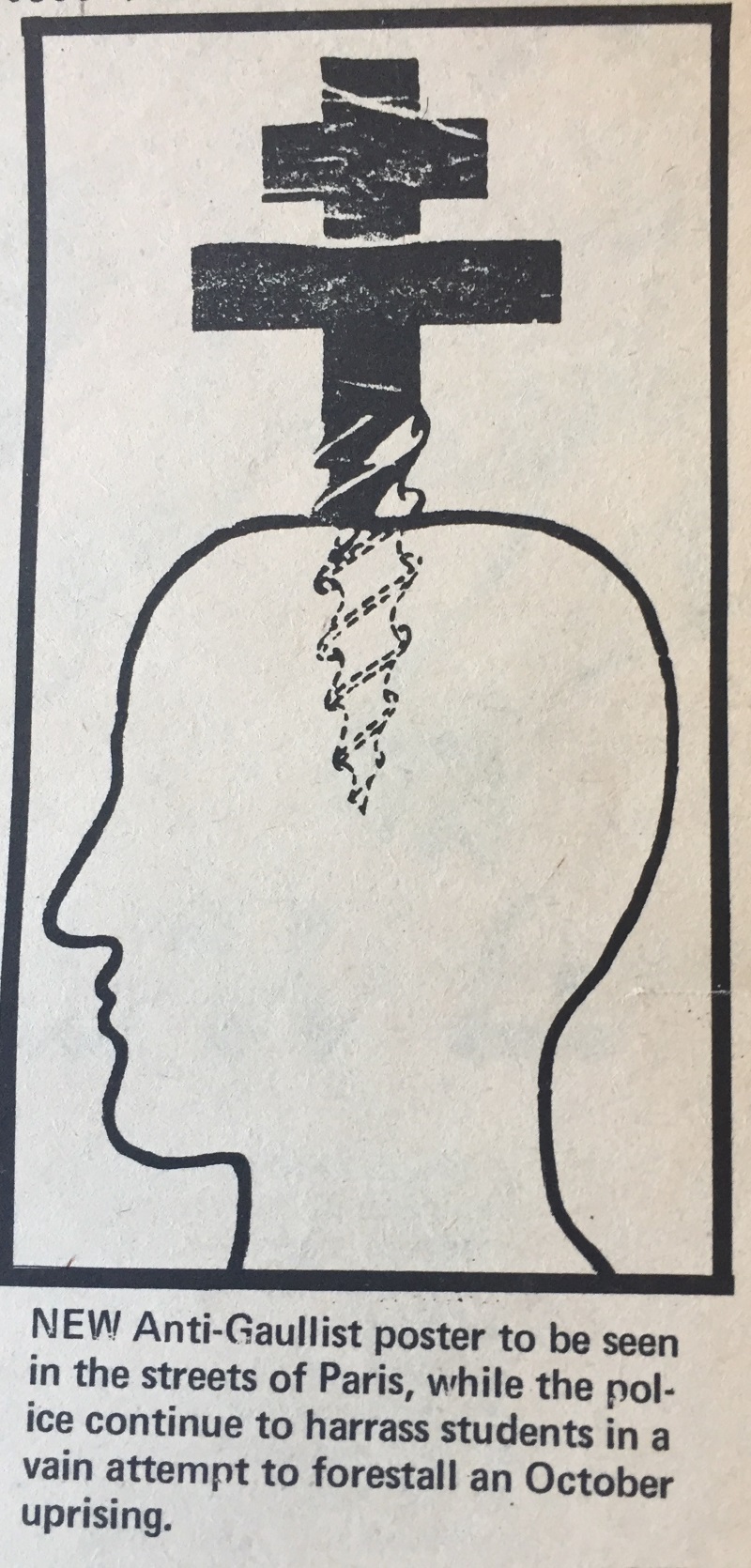
There were articles on students in South Africa, anti-Vietnam War protests in London and this reference to events in France...


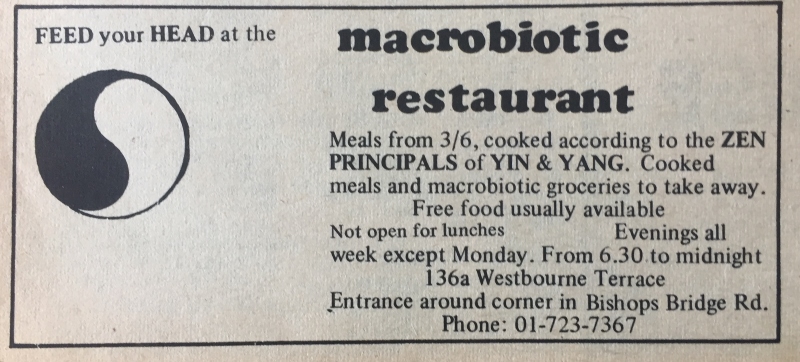
I was interested in the following bit of drug 'health information' - it was produced by the charity Release which had been started the year before, providing information and legal support to people with drug problems - it's still going! The macrobiotic restaurant advert made me think about how much food culture has changed - and whether that's another area where 'counterculture' in part became 'mainstream'?


I became more interested in the cover art as my reading about the counterculture and links with the birth of personal computing developed. The 'spirographic' images and the distortions of the 'Vitruvian man' were 'computer generated' as part of the Cybernetic Serendipity exhibition at the ICA in London.


This video footage shows the curator Jasia Reichardt discussing the exhibition on the BBC 2 programme Late Night Line-Up


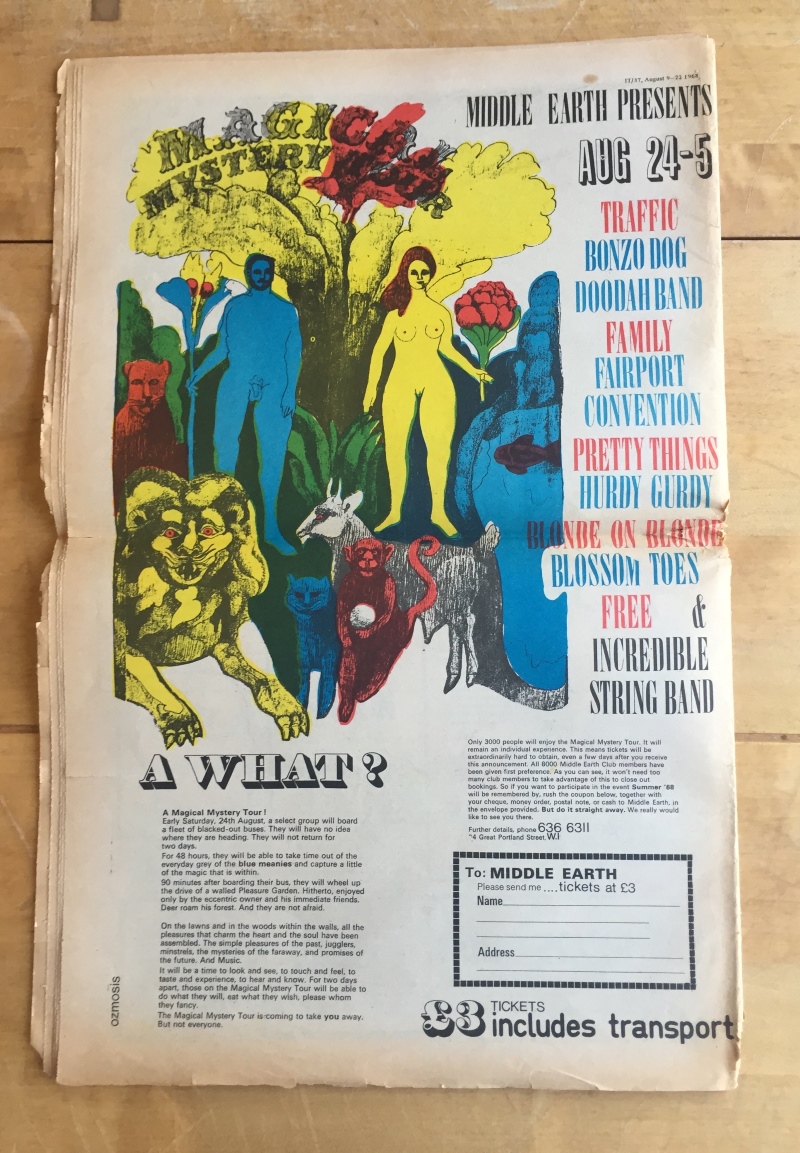
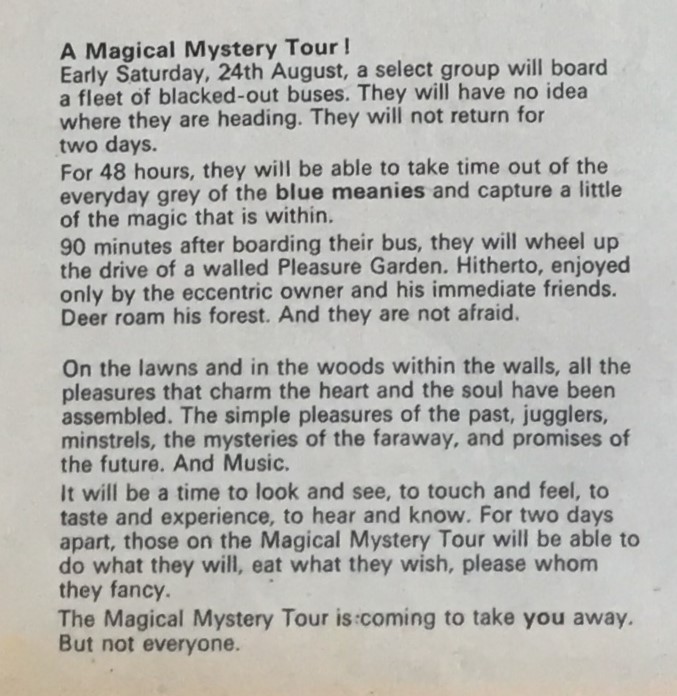
Finally the back page is this fantastic advert for a classic sixties 'happening'....(£3!!!)


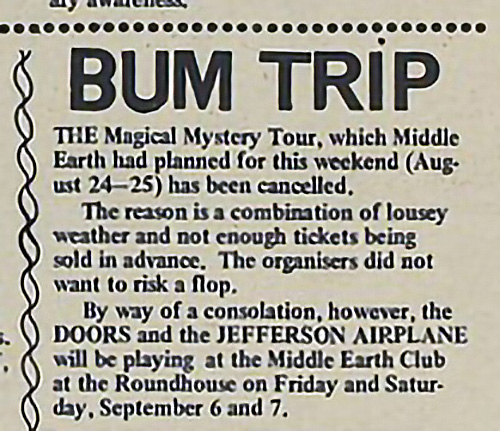
Don't worry if, like me, you'd never heard of this event - some further research revealed that the following message had to run in the subsequent edition of IT..... ☹️

[Home Page]
Permalink 1 comment (latest comment by Jan Pinfield, Wednesday 24 April 2024 at 16:07)
Share post
Steven Oliver

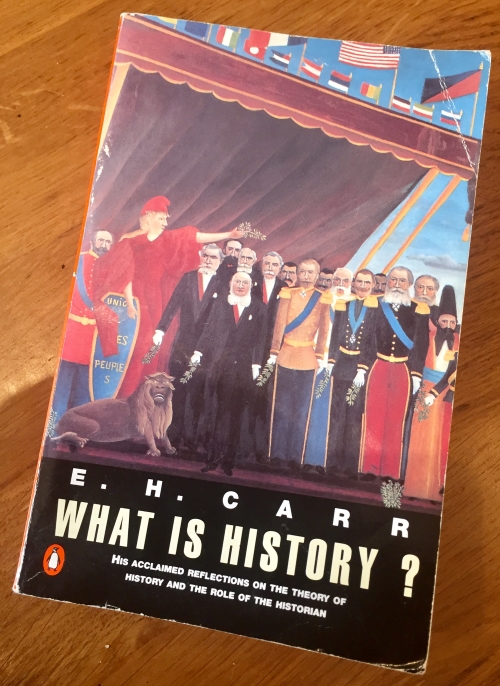
'What is History?' by E.H.Carr

Visible to anyone in the world
Edited by Steven Oliver, Wednesday 6 May 2026 at 20:50

Edward Hallett Carr (1892-1982) was first a diplomat and then a historian, most notably of the Soviet Union. He has been described as left-leaning, Arthur Marwick categorises his history as 'Marxist'. 

In January-March 1961, whilst a Fellow of Trinity College Cambridge, he gave the G.M.Trevelyan Lecture Series of six lectures - these were subsequently published in book form as What is History? later that year. I've read the second edition, which was first published in 1987, this contains a preface that Carr had written for a second edition, and some notes that existed for a revision that was not completed. 

These notes try and summarise and reflect on some of the key points he raises in his six lectures.

1.       The Historian and his facts

Inevitably the first point has to be that historians are exclusively masculine throughout the book - a reflection no doubt of the make-up of the profession at that time and of social norms, but also Carr seems largely disinterested in any issues of gender. 

He questions what distinguishes ‘historical’ facts from everything else in the recorded past and presents the idea of 'selection' as central to the work of the historian. Carr decries what he sees as a fetishism of both facts and archives, he sees such an approach as core to 19thC history, but now outdated. He is unconvinced by what he describes as 'empirical' approaches that collate 'facts' and anticipate that history will flow from them. Carr argues that empiricism was valued above theory in the 19thC as this was a ‘comfortable’ and successful time in Western Empires, everything observed just confirmed the accepted order. When 20thC chaos starts to break out, historians were having to start thinking about bigger questions of historical philosophy.

He gives an excellent example of how selection operates using the records of Gustav Stresemann (German Foreign Minister and Chancellor). The editor who first compiled and published his records retained more which related to his 'western' diplomacy, which was seen as highly successful, and less from his 'eastern' activities - which were not. This collection was further abbreviated when translated to English. When the National Socialists came into power they destroyed much of the primary material, but fortunately copies were retained and it was possible to subsequently the establish how selection had previously operated. Carr points out the biases that would have been present if all primary records had been lost, and historian could only rely on the English translated material. He ends with the final reflection that Stresemann was his own first editor, and that the German primary records chiefly capture what he said and thought in any meetings, whilst the voices of others are less distinct. Carr argues that selection is inevitable in history.

When discussing the influence of the contemporary on views of the past Carr highlights writing by Benedetto Croce ('seeing the past through the eyes of the present') and R.G. Collingwood ('facts refracted through the mind of the recorder').

The writing and opinions of multiple 19th and 20thC historians are touched on and Carr emphasises that the reader of a history book's  ‘...first concern should be not with the facts which it contains but with the historian who wrote it.’
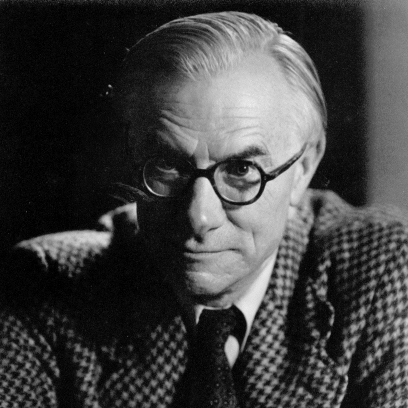
Whilst agreeing with some of Collingwood's points on the importance of contemporary influences on any historian he suggests this carries the danger of relativism i.e. ‘history is what the historian makes’. Carr believes not all explanations are as good as each other and argues against the judgement of ‘rightness’ being its suitability to any present purpose, but I wasn't convinced I got a clear idea of the basis on which he thought we should judge what made for better explanations. 

The chapter ends with a section on the iterative process of creating history, a circling round of reading and writing in which the historian moulds facts to interpretation and moulds interpretation to facts. However, for me, he fails to be clear about when this process concludes and what indicates a settled account. It concludes with the classic quote that history is ‘an unending dialogue between the present and the past’. There is no doubt plenty to think about in the way in which such an abstract conversation could ever occur - and the spurious agency it gives to both 'present' and 'past'. 

2.       Society and the Individual

Carr seeks (at some length!) to establish that you can’t separate an individual from their society, ‘The cult of individualism is one of the most pervasive of modern historical myths’. He quotes Burckhardt, to suggest that individualism comes out of the Renaissance, before which people saw themselves as group members. Carr doesn’t disagree with this hypothesis, but sees this as a social process, one of ‘advancing civilization’.

Returning to his points about understanding historians, he talks about needing to understand a historian in their historical and social context, both their ‘standpoint’ and that their position is rooted in a social and historical background. 

Carr surmises that the historian ‘most conscious of his own situation is also more capable of transcending it’.

When considering the role of 'great' (or 'infamous') individuals Carr points out 'all effective movements have few leaders and a multitude of followers’ and that both are essential to their success.

Further expanding his original argument Carr says history is 'a dialogue between present and past societies.'

3.       History, science and morality

At the end of the 18thC Carr sees a desire for a ‘social science’, a science of human society to which history contributed. He quotes J.B. Bury declaring history is ‘a science, no more and no less.’

Whilst appreciating that there had been a marked reaction against this view, Carr argues that science was now (1961) getting more like history. He claims scientists have largely abandoned a search for ‘Laws’ that govern and now seek ‘how things work’. He claims that history, like science, proposes and tests hypotheses - but he is silent on how these are in fact tested in history.

The chapter largely concerns itself with debunking what Carr says are reasons given why history is not a science. There are no sources given for who or where such claims are made and I can personally see other and possibly stronger arguments.

  1. History deals with unique circumstances, science with generality
  2. History teaches no lessons
  3. History is unable to predict
  4. History is necessarily subjective, since man is observing himself
  5. History unlike science involves religion and morality

Carr's main points are:

History deals with unique circumstances, science with generality - he simply says that historians generalise all the time.

History teaches no lessons - he claims this also isn't true, the ‘function of history is to promote a profounder understanding of both past and present through the interrelation between them

History is unable to predict - suggesting that science ‘does not claim to predict what will happen in concrete circumstances' (which I think can be contested) he argues history is not fundamentally dissimilar, although accepts that the predictions may be less precise.

History is necessarily subjective, since man is observing himself - I found the argumentation complex here, Carr basically seems to argue that 'classical' distinctions between an observing subject and observed object have now broken down and new forms of philosophical thinking are required.

History unlike science involves religion and morality - Carr talks at length about morality, he argues that historians can’t make moral judgements on individuals in past, but then implies they can and should do this for events/practices etc. - I'm not clear how he justifies this distinction. He makes what seems a good point about how supposedly ‘absolute extra-historical values’ are actually rooted in history.

He suggests that those who want history not to be a science are following an outdated distinction in which: 

  • Humanities are knowledge for the ruling classes
  • Science is for the technicians who serve them

Carr believes history and science fundamentally seek similar ends: ‘to increase man’s understanding of, and mastery over, his environment

4.       Causation in history

Carr states simply that, ‘the study of history is a study of causes’ and then goes on to identify what he sees as some particular features of 'historical' causes:

Historians:

  • Assign several causes to the same event
  • Establish a hierarchy of causes – looking towards ‘the cause of all causes’

Carr sees historians as simultaneously widening and attempting to simplify their explanation, ‘the historian must work through the simplification, as well as through the multiplication, of causes’ he doesn't however. to my mind. explain why the latter is necessary.

He picks up two arguments (straw men?) which he says are used to undermine discussion of causation in history:

  • Determinism in History - which he relates to, then, contemporary articles by Karl Popper and Isiah Berlin 
  • Chance or 'Cleopatra’s Nose'  (i.e. Antony loses at Actium because Cleopatra is so beautiful)

I’m not sure I agree with Carr’s take on Popper’s ‘historicism’ – but clearly this term was not well defined by Popper. Carr seems to think that Popper rejects events having 'causes' whilst I always thought Popper’s concern was with the idea of a purported set of forces that drove history to a *specific* determined end; the following quote is from Stanford Encyclopedia of Philosophy Popper page

'Historicism he identified as the belief that history develops inexorably and necessarily according to certain principles or rules towards a determinate end'

Carr’s argument is mainly that events have causes and that outcomes aren’t ever ‘free’, which he sees as Popper's contention – however he mainly argues with Berlin’s addition of the need for a recognition of individual ‘free will’ and responsibility. Carr argues that you can be a determinist and still allow for moral judgements of individuals choices.

The role of chance is something Carr accepts, but makes the argument that, as it can’t be given any meaning, it can essentially be ignored in the historian's search for ‘meaningful’ causes. 

Returning to his view that history is selection, the historian will select relevant causes and discard the irrelevant (like Cleopatra's attractiveness).

The chapter ends with what feels like another key idea for Carr, that the historian works with an ‘end in view’, that they reason towards that end with reference to personal values. I think this means he believes that the actions of the historian are purposeful, that their search for meaning is in the cause of something - presumably that something varies between individuals.

5.       History as progress

Carr wants to avoid history either trending towards theology and an ahistorical final end or a 'cynicism' in which history is entirely relative or a litter of inconsequential meanings. He says that concerns that a society is in decline may miss the fact that another society is progressing. As it says this chapter talks about 'progress', but I find some of the arguments obtuse and nebulous - evolution for example is seen as progress when I would consider it adaptation - sometimes Carr's 'progress' could simply be 'change'. 

Carr makes some complex points about a view of the future being central to an understanding of the past. I've found this set of ideas difficult to grasp, I'm unsure whether these are views of desired futures or ways of saying that the historian looks for processes that have future consequences. One route in may be to follow up on his quote from Lewis Namier which Carr references imagine the past, remember the future’ (cryptic to say the least 🙂)  I think this may mean that historical views of the past are created in response to thoughts about the future, but perhaps a reading of its origin Conflicts: studies in contemporary history (1942) will help!

Carr forms a definition of the 'objective' historian from this argument:

They...

  • rise above the limited vision of their own situation in society and history
  • project their vision into the future to give more lasting insight into the past

Sticking with his initial coinage we get to history being 'a dialogue between events of the past and progressively emerging future ends.'

He questions whether future success is the correct criteria of historical significance, accepting that history is generally not a record of what people failed to do. However, what it was that they 'did' may become clearer over time. He suggests that if you consider the life and actions of Bismarck then across time from 1880 to (a then future) 2000 it is likely there will be an increase in the objective judgement by historians - but doesn't make it clear to me on quite what basis he makes this assessment, other than more possible implications being apparent.

Carr says historians strive for a ‘coherent relation between past and future’ which rings true and talks about how past facts and current values interact, reiterating that values have a history too.

Whilst I'm not convinced that 'objectivity' is ever given an entirely clear meaning, Carr ends by saying that the 'objective historian' is one who 'penetrates the interdependence of facts and values'.

6.       The widening horizon

In his final chapter Carr makes some (as far as I'm concerned) rather contentious claims about the direction the future will take, but there are still interesting points along the way.

‘History is a constantly moving process, with the historian moving with it.'

Carr talks about dramatic changes in the 20thC, changes in 'depth' and 'geography'. People are now ‘self-conscious’, aware of inner as well as outer influences and may now 'transform themselves' as well as the world.

He sees these times as an age when there has been an 'Expansion of Reason' – bringing new groups into the  'realm of history'. There is a deeply problematic argument here about how those apparently excluded in the past are only now coming into real, 'historical' being - presumably the poor, women, non-European people? I'm not sure this stands up to much scrutiny really.

His discussion of a 'new geography' are directed towards the East in particular and come across as quite prescient. He says in conclusion that people shouldn't be insular and argues for taking on bold fundamental challenges not engaging in the 'piecemeal social engineering' that Popper has advocated (never the most inspiring of phrases!). Carr says he worries that he encounters a fear of change – but that change is happening whatever anyone thinks - his final quote is the one attributed to Galileo  ‘and yet it moves’.


**********************************************************************

Some final thoughts:
Like many 'classics' this book is not quite as enlightening or startling as you might hope. I came away unsure if Carr had a completely coherent argument, he certainly misrepresents 'science' and I also felt he fudged some ideas around empiricism and objectivity. Perhaps this is mainly a corrective against 'let the facts speak for themselves' and an encouragement for reflexivity in historical reading and writing?

Here are a few more Carr-related links

Reviews in History (a review of What is History? by 'post-modern' historian Alun Munslow)

[Home Page]
Permalink 1 comment (latest comment by Steven Oliver, Thursday 25 April 2024 at 18:58)
Share post
Steven Oliver

Dublin day-trip

Visible to anyone in the world
Edited by Steven Oliver, Wednesday 6 May 2026 at 20:51

I was lucky enough to manage a day trip to Dublin last week and packed in a fair bit of A111 and A113 😀

The following are just a few snaps from the day.


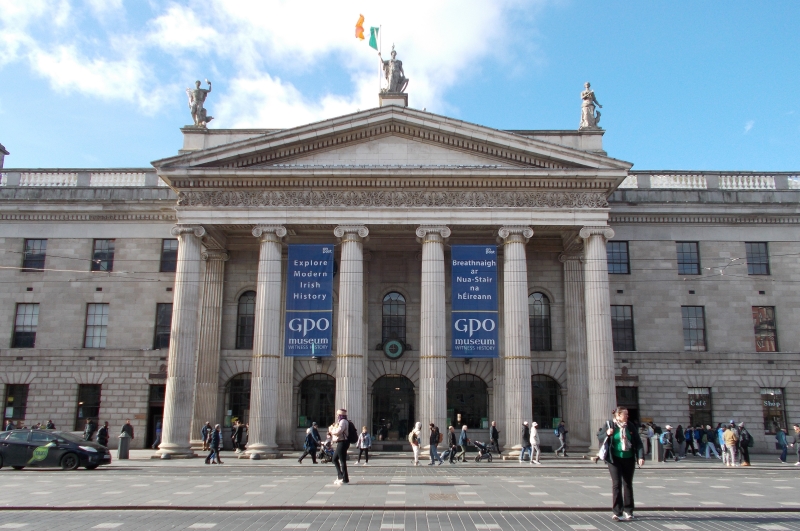
The GPO building where the Republic was proclaimed in 1916 - the museum was good (but pricey at €15) few of video installations featured historians who contributed to OU materials.

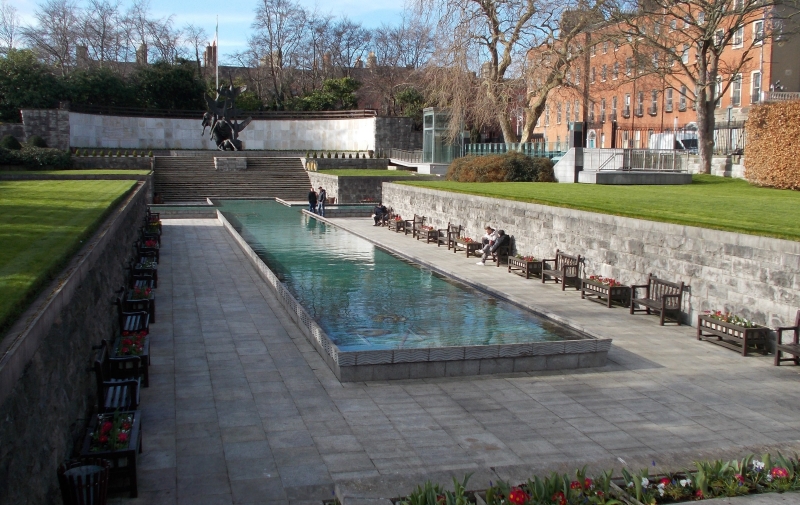
Garden of Remembrance that features in A111 and was opened in 1966

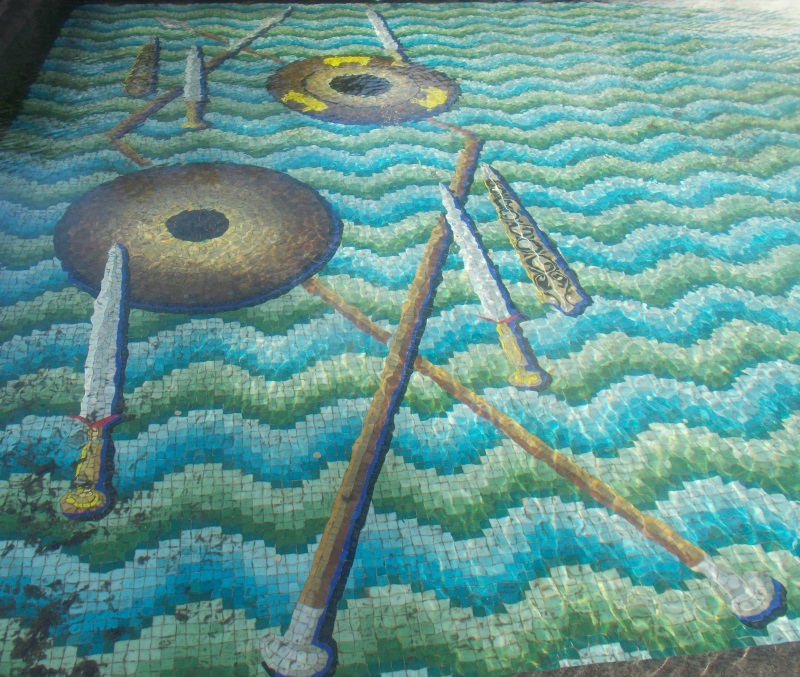
The iconography of 'celtic' weapons broken and cast into water as a mark of the end of hostilities

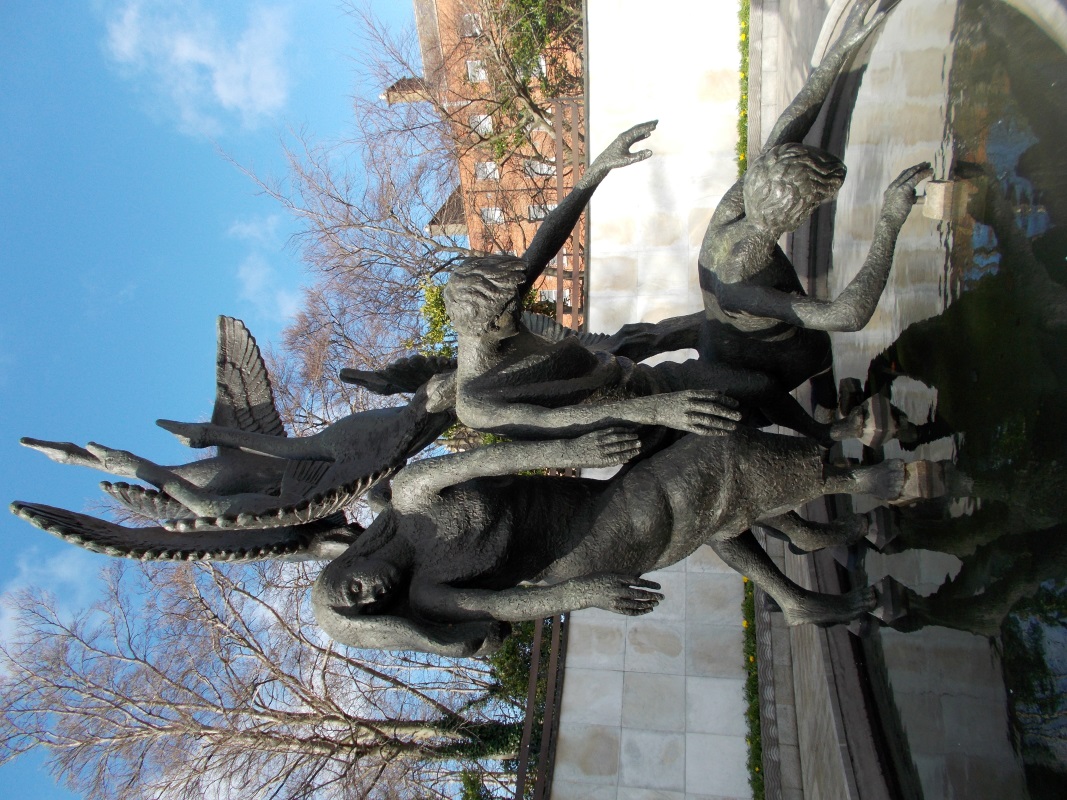
The Children of Lir - rising, resurrected, redeemed, reborn....

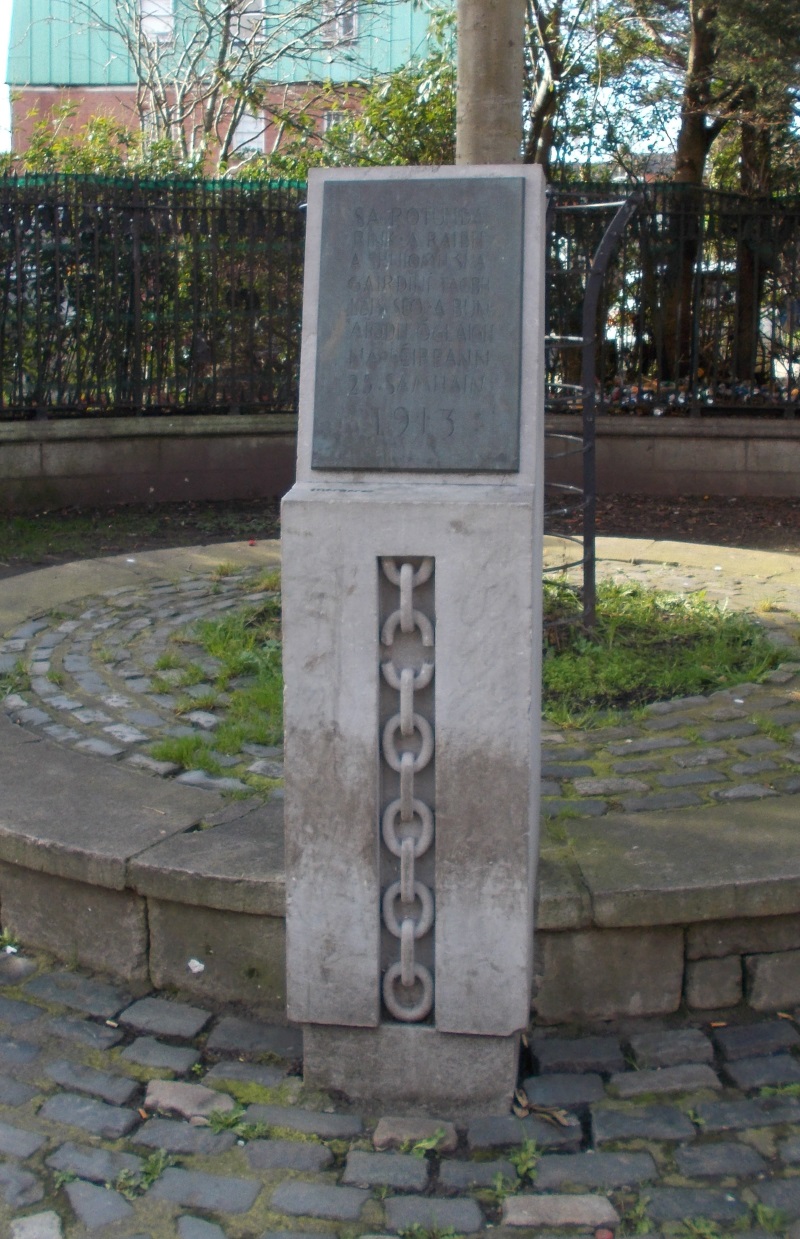
Just outside the Garden is this memorial to the formation of the Irish Volunteer Force on that spot (it was I think an ice rink then) in 1913 - in response to the earlier establishment of the UVF that is discussed in A113. 

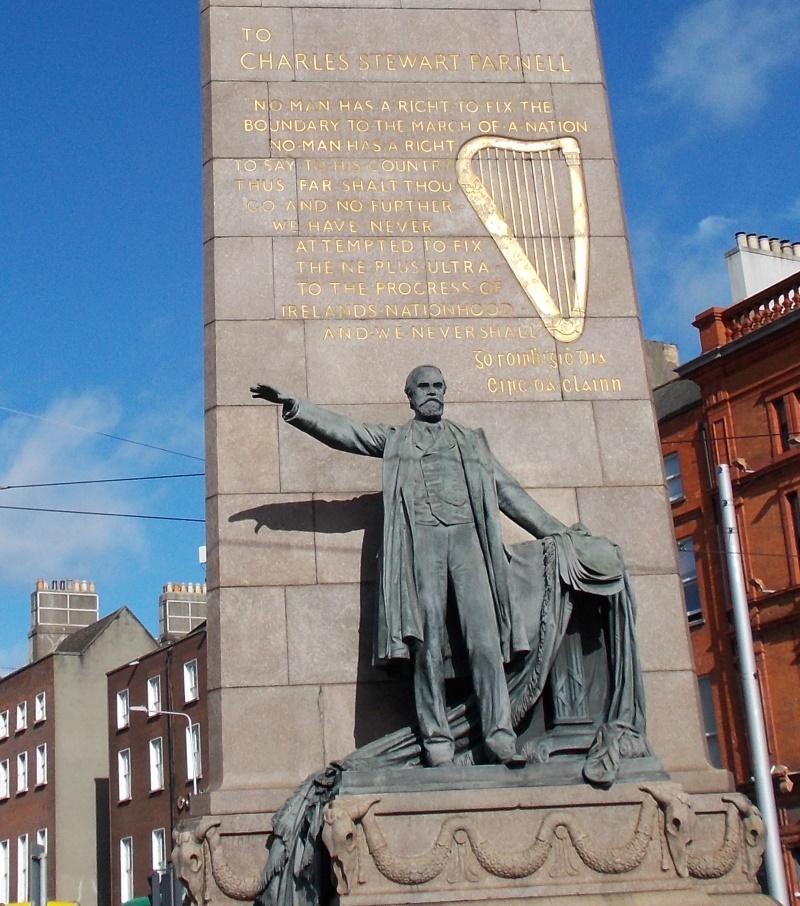
Apparently Parnell's statue caused some controversy when it went up in 1911, I presume because he was then still a divisive figure. Really interested in what I assume are Roman 'fasces' under all the drapes, I think at this point in time they may have been used as a symbol of Republican 'unity'. It's also a classic Roman sculptural pose that we encountered in A111. 

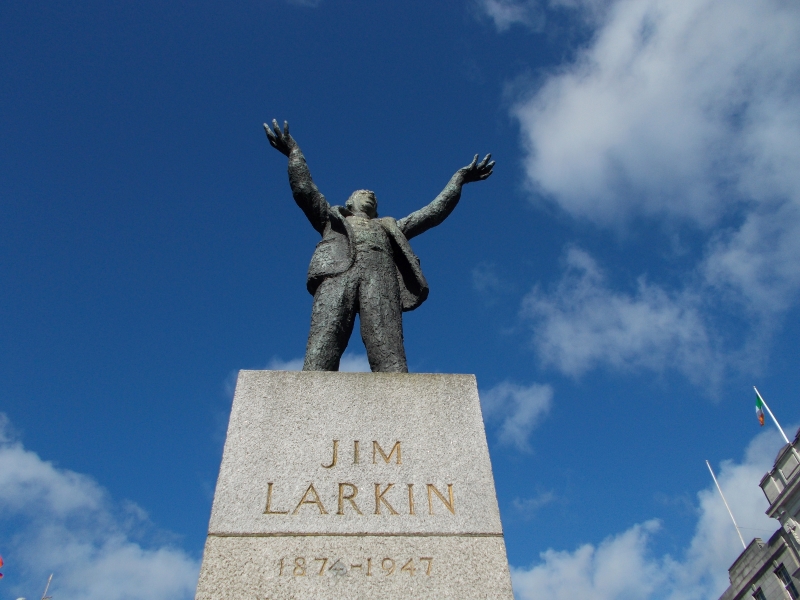
Second sculpture by Oisín Kelly (the first was Children of Lir) - this one of James Connolly's comrade, Jim Larkin. A co-founder of the Irish Citizens Army and a staunch revolutionary socialist. 

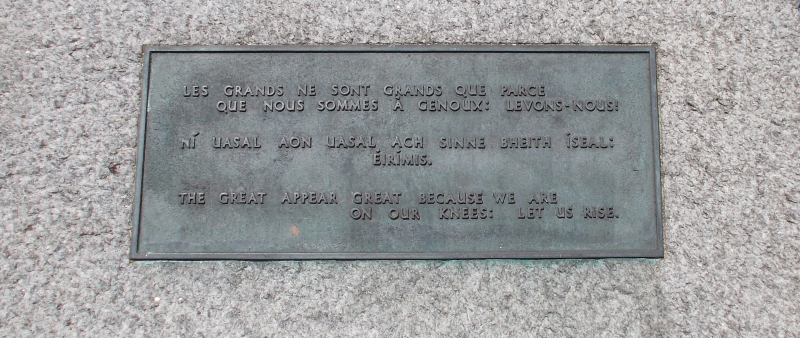
He used the quote below in one of his speeches - it apparently harks back to the French Revolution and is generally credited to Camille Desmoulins.

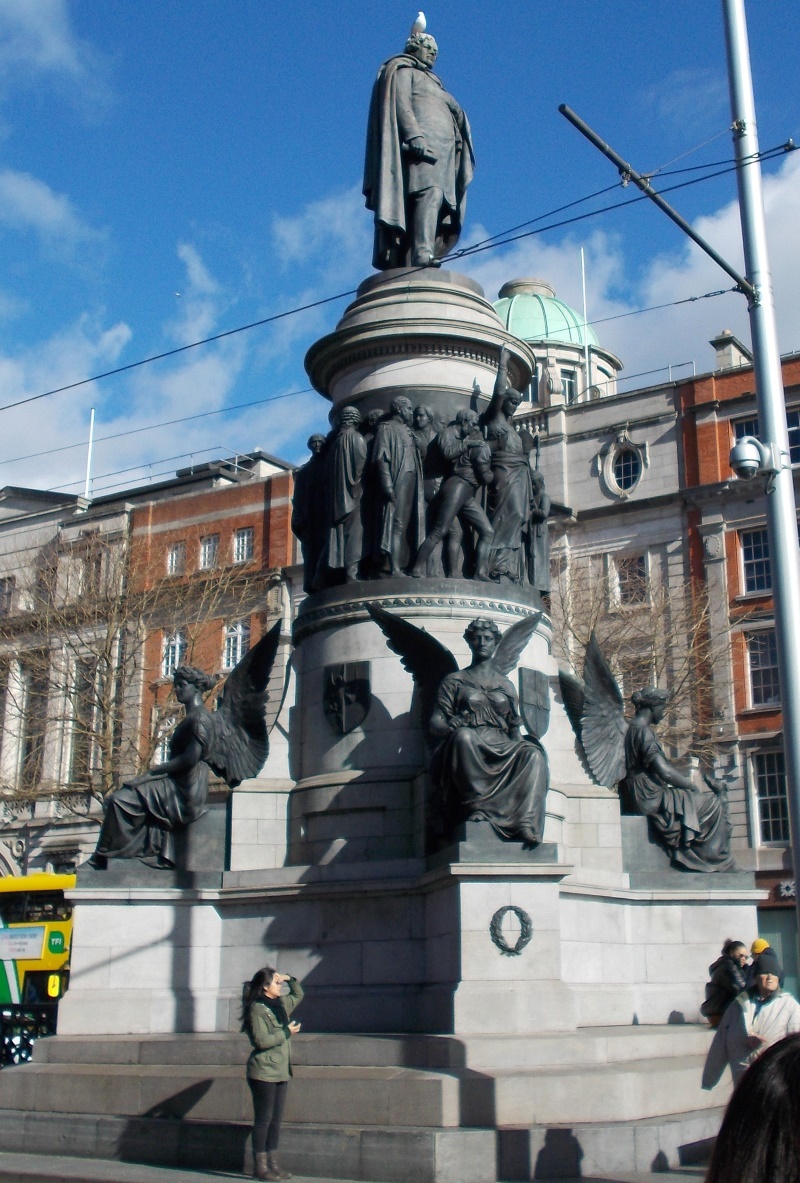
From A113 the 'Liberator' Daniel O'Connell (plus obligatory seagull) gets centre stage with a monument and of course the main street (since 1924)

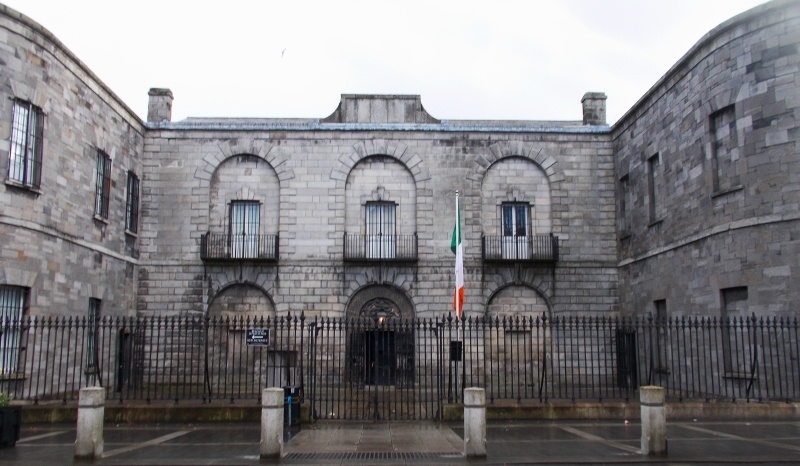
Kilmainham Gaol

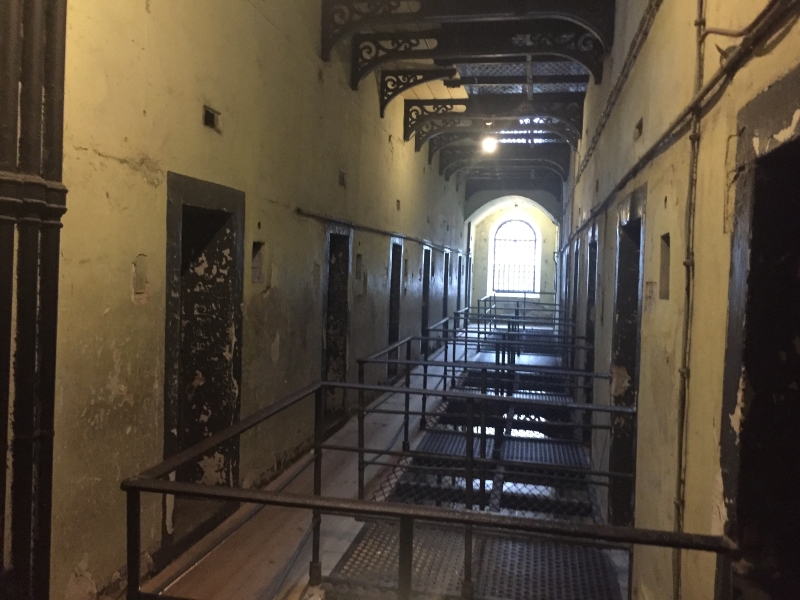
Corridor where most of the 1916 rebels were held before execution.

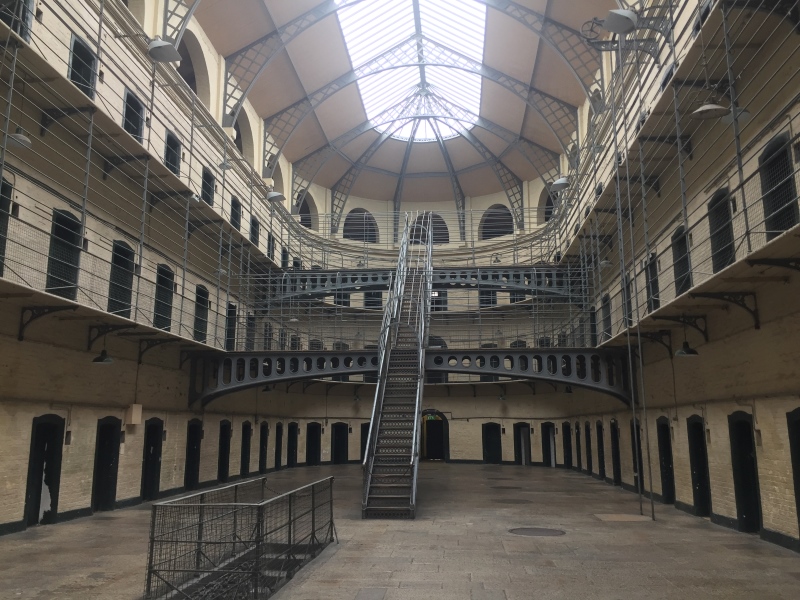
The classic 'panopticon' prison design in the Victorian wing of KIlmainham Gaol. Éamon de Valera was a prisoner here and Hugh Grant danced down the steps at the finale of 'Paddington 2' (Noel Coward also celebrated the apparent achievement of the 'Italian Job' here)

A final look back into the stone-breakers yard and the spot where James Connolly was executed. It was interesting, given the reflection in A111 on contested memories, to hear that the prison wasn't initially promoted in the Free State as a 'hallowed' site - the fact it was also the place of execution of some anti-Treaty rebels made its heritage a difficult one, at least until Fianna Fáil gained power.

[Home Page]
Permalink
Share post
Steven Oliver

'...no empire, no sect, no star...'

Visible to anyone in the world
Edited by Steven Oliver, Wednesday 6 May 2026 at 20:52

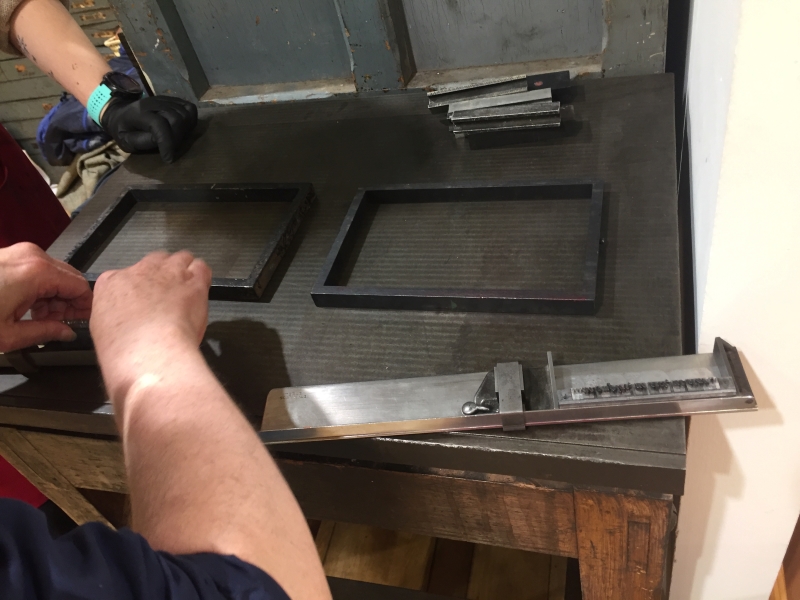
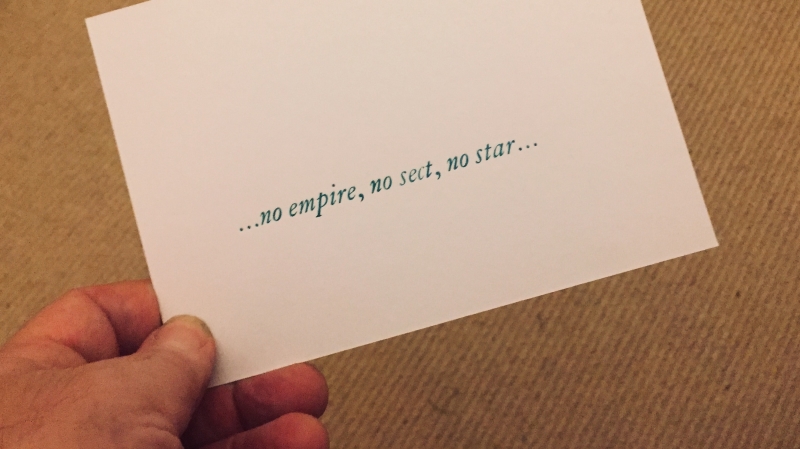
I had a great 'hands-on' experience at a print workshop run by Thin Ice Press in York. A chance to set up a line of type and then print it!

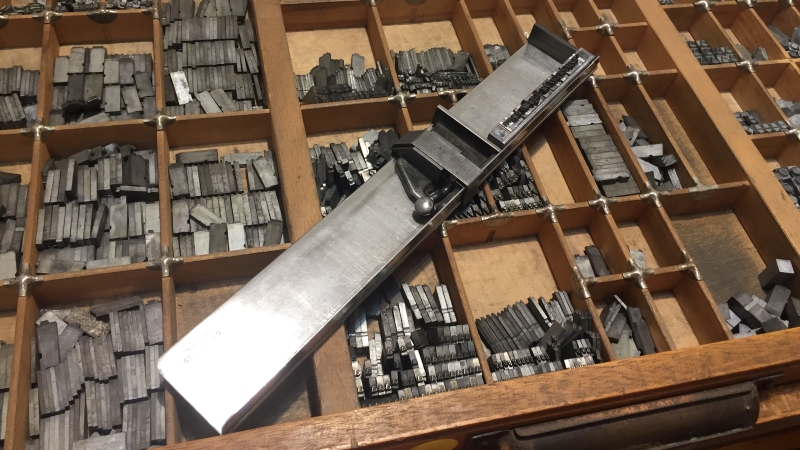
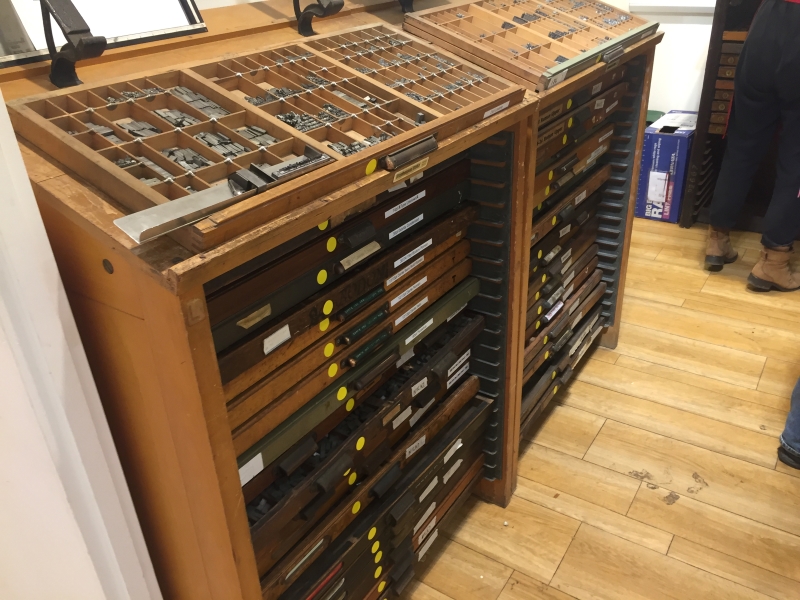
Here's my compositor's stick, lying on the fo(u)nt ... these cases were side by side, not UPPER and lower

There were a number of fonts available, I ended up working with 24pt Caslon italic. William Caslon was originally an engraver, but moved into type design and foundry in the 1720's. He's apparently the first British famous type designer - the Caslon font was used for the first printings of the the American Declaration of Independence.

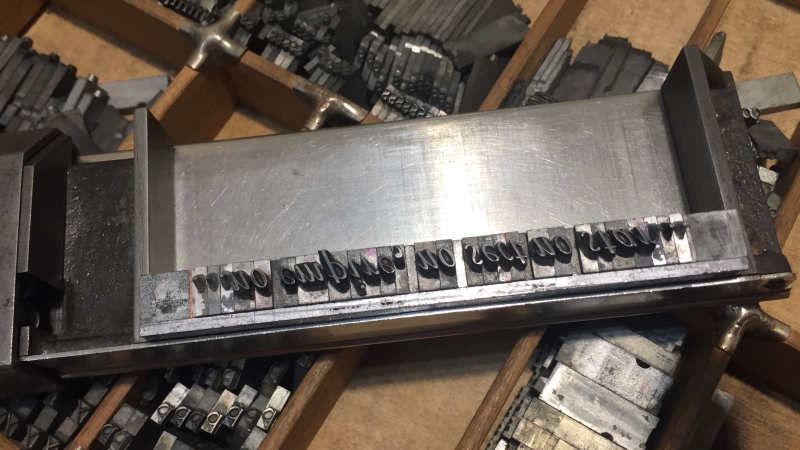
My line of type below is almost finished, but if you look carefully there's a missing comma after 'sect' - so some changes were needed. Made it very clear why a printer might decide to leave some 'typos' and identify them in an erratum, rather than have to take multiple lines of type apart and rearrange. If you look closely you can see the really thin copper spacer strips that you use to make sure the type is really packed in tightly.

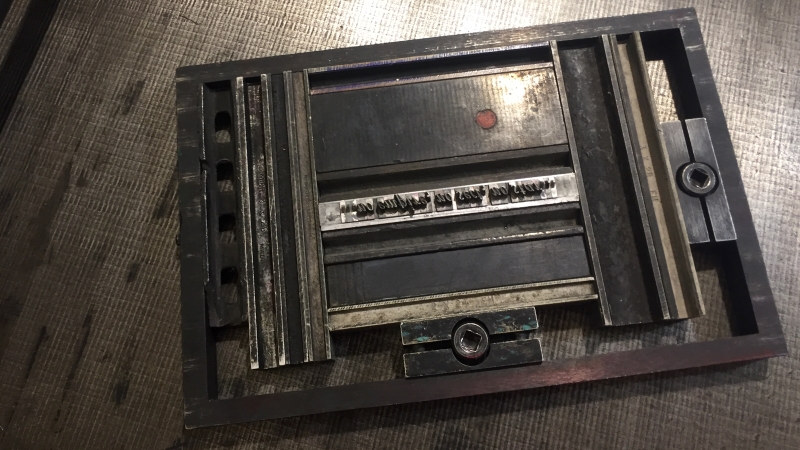
This was the point where you transferred your line of type into a forme, obviously there'd have been much more to do with multiple lines of type to set up on a page.

'Locked in' to a steel forme, spaced with 'furniture' and tightened with 'quoins' and resting on an imposition stone. This was quite heavy and it was only one line of 24pt, struggling to imagine lifting one of the Gutenberg bible pages!

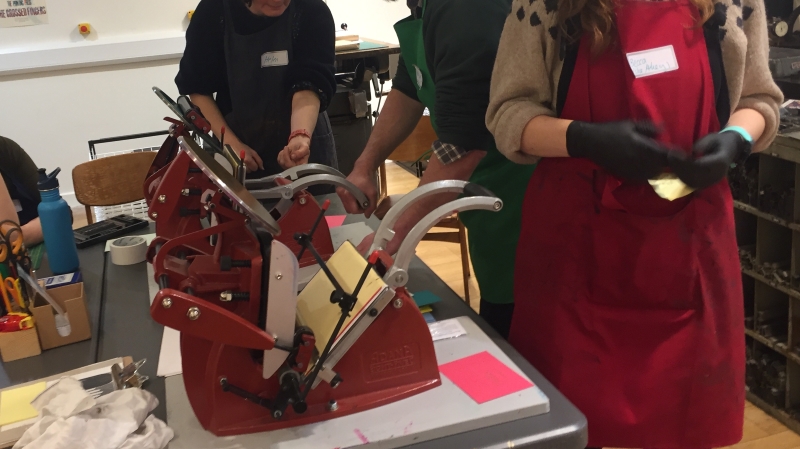
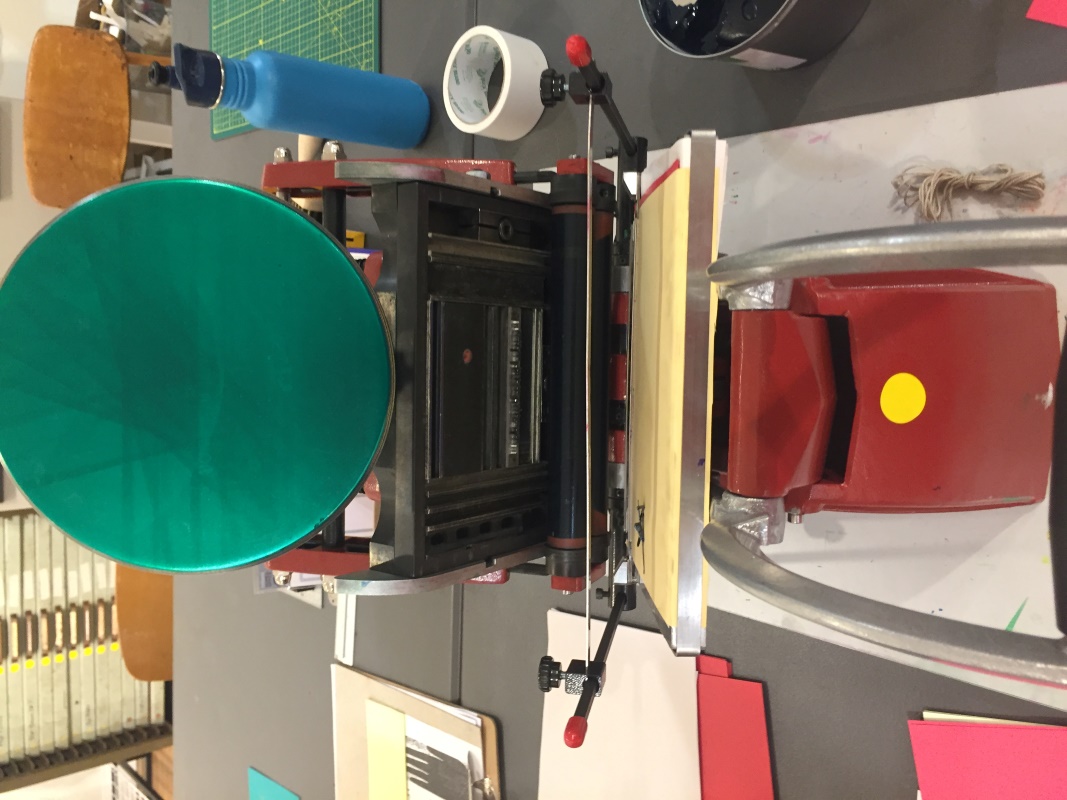
In these machines the paper is pressed on to the type, quite a lot of fiddling to get the pressure and the imprint right.

Someone had chosen a rather lurid green ink (supposedly 'Christmasy') 😀.

Thought I'd go with a fragment of Francis Bacon, '...no empire, no sect, no star seems to have exerted greater power and influence on human affairs...'

Apparently a 16th century estimate for production time worked on 5 minutes per line for all the stages through to the final print - my effort only took a couple of hours .... the print revolution would have been a more drawn out affair with me in charge! 😆

[Home Page]
Permalink
Share post
Steven Oliver

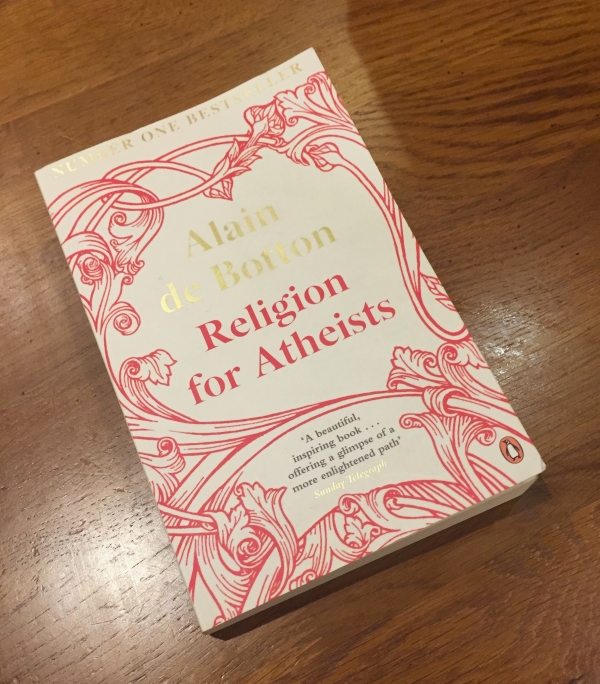
'Religion for Atheists'

Visible to anyone in the world
Edited by Steven Oliver, Wednesday 6 May 2026 at 20:53

This was (IMHO 🙂) a rather lightweight contribution to Unit 7 of A113 on post-Revolutionary experimentation in religion, but I thought I'd just capture some of the suggestions de Botton makes about aspects of religious practice and ritual that might add to a wholly secular life.

They were:

'Community'

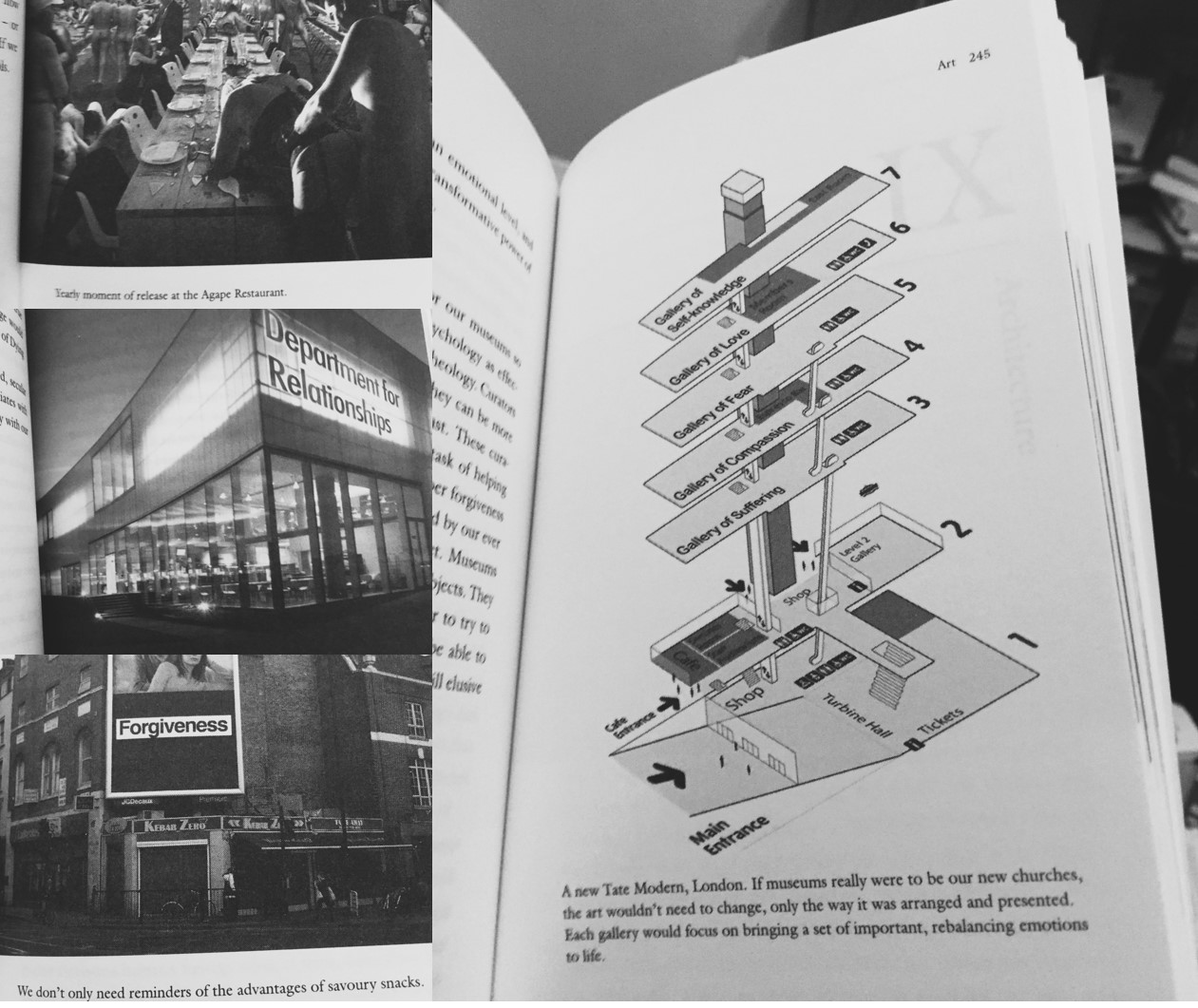
An 'Agape Restaurant' - an open door,all comers welcome venue where individuals are seated separately from any pre-existing relationships and take a meal. Whilst eating, conversation will follow a set of prescribed lines set out in a guidebook at the table - the 'Book of Agape' .... 'What do you regret?'...'Whom can you not forgive?'...'What do you fear?' - effectively forcing a deeper understanding of at least a few more of our fellow humans.

The link here is made chiefly with the Roman Catholic Mass, its foundation around the meal table and aspects of ritual that break down barriers between individuals and establish a new (if ?temporary) community. The conversation guidebook follows from aspects of the Jewish Passover ritual, where a fixed set of questions are asked by the youngest member of the family.

A quarterly Day of Atonement, where we seek out those we have harmed and apologise.

Simply a fourfold expansion of the Jewish ritual.

An annual Feast of Fools at the Agape Restaurant, where we have licence to be as irrational and sexually unfaithful as we like. In this way we acknowledge that maintaining a measured life is hard given our human drives and desires, giving vent to them may help us get through the rest of the year.

The stimulus here is the medieval Christian (?French) 'festum fatuorum' that took place on New Year's Eve when clerics were allowed to get up to all sorts of sacrilegious hijinks. 

'Kindness'

Moral reminders on billboards and adverts and maintaining a tabletop pantheon of model moral role models.

The discussion here was around examples of religions being explicit about repeatedly reminding believers about how to live well, not expecting them to just get on with it. There were also plenty examples of requiring people to reflect on past 'heroes' and their achievements.

'Education'

The ideas here were mainly linked to higher education and a new role for it in accepting a role in teaching 'how to live'. There were a range of suggestions, making lectures into sermons, changing the focus of disciplines : Departments of Relationships; Institutes of Dying, Centres for Self-Knowledge, teaching teachers oratory so ideas would stick, engage with obstructions to acting on what you know - lots of repetition, using the body as part of the experience of education and training.

An interesting aspect of de Botton's argument was about the reasons subjects like art and literature entered the realm of University study - he makes a link with a 19thC crisis in confidence that religion could effectively deliver moral development and that 'Culture' was to be the remedy. However, he claims that whilst Universities seem to suggest they will 'develop' citizens they are not at all explicit about the moral messages that could be drawn from the arts. John Wesley gets a mention for delivering sermons that linked religion very much to the concerns of everyday life. Buddhism does most of the heavy lifting on training the body as a route to learning.


'Tenderness'

We should build Temples to Tenderness - calm soothing spaces, with images of motherhood.
The reflections here were how to respond to human dependence and religion's capacity to deliver on maternal comfort and support for everyone's inner (and ever present) child. Lots of Marian imagery here, but some other religions too, Guan Yin from Buddhism.
'Pessimism'

Share the bad thoughts, doubts and fears of ourselves and others on real time displays so we can recognise our darkness is shared - and weep together

The immediate link was with the wailing wall - but with no divinity to address our concerns. The central argument is that religions accept that life is flawed, ugly and often/usually doesn't turn out right. Of course they often have other future lives on offer, but at least they do not promote an unfounded optimism about life. We should expect to be disappointed and to fail.

'Perspective'

Project images of distant galaxies to provide a perspective on the (un)importance of individual lives within the totality of the universe.

I liked de Botton's idea that religion was a symbol of what exceeds us.

'Art'

We should equip ourselves with instruction manuals on how to take life lessons from art, organise specific educational structures to the display of art - a set of 'stations of life', displays in galleries and museums should be reorganised around our moral needs.

A contrast is made between the way in which art is never without purpose or unexplained when it is displayed by religions, the 'stations of the cross' is an example of a structured contemplation of art in the Christian tradition.

'Architecture'

We should build Temples of Perspective (giant tower to represent time, with a fine line to show human existence), Temples of Reflection where we could contemplate in solitude.

There were multiple examples of how religions use the built environment to enhance their message, there was also an image from Pugin's 'Contrasts' where he was implying that ugliness might harm our souls.

'Institutions'

We need new, possibly corporate, institutions to promote secular values, develop brand identities, commodify atheism.

The examples here were all about the success and scale of the major religions as institutions/corporate bodies. How they have the advantage of scale, recognition and also major earning power.


Many of the salient points are made in this TED talk...

[Home Page]
Permalink
Share post
Steven Oliver

Getting 'hands on' with Reformation printing

Visible to anyone in the world
Edited by Steven Oliver, Wednesday 6 May 2026 at 20:53

Another fantastic opportunity to use my SCONUL access rights and explore the archives at the University of York.

The Rare Books collection holds on long-term loan all those pre-1800 books that were part of the library of the Community of the Resurrection at Mirfield, West Yorkshire. This Anglican religious community for men was founded in Oxford in 1892, and moved to Mirfield in 1898. The library was built up mainly by gifts from members and friends, and contains much valuable early material - including this copy of......

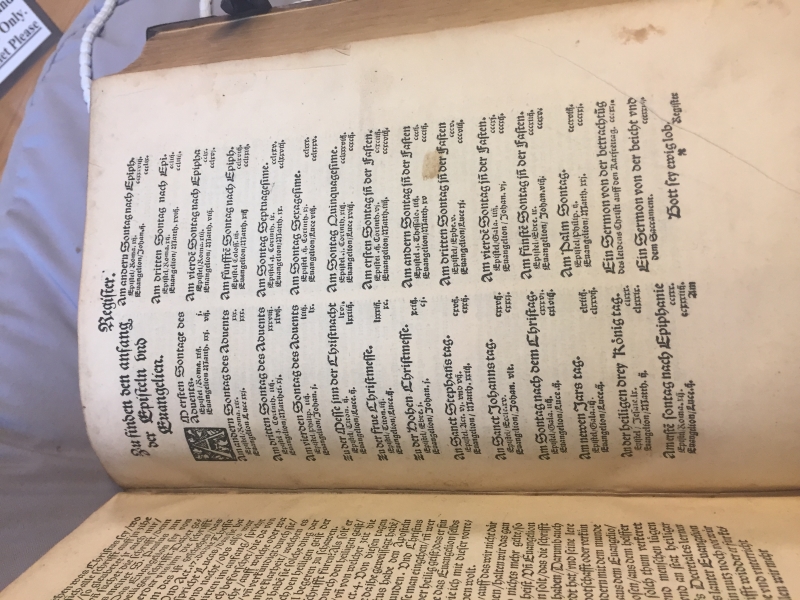
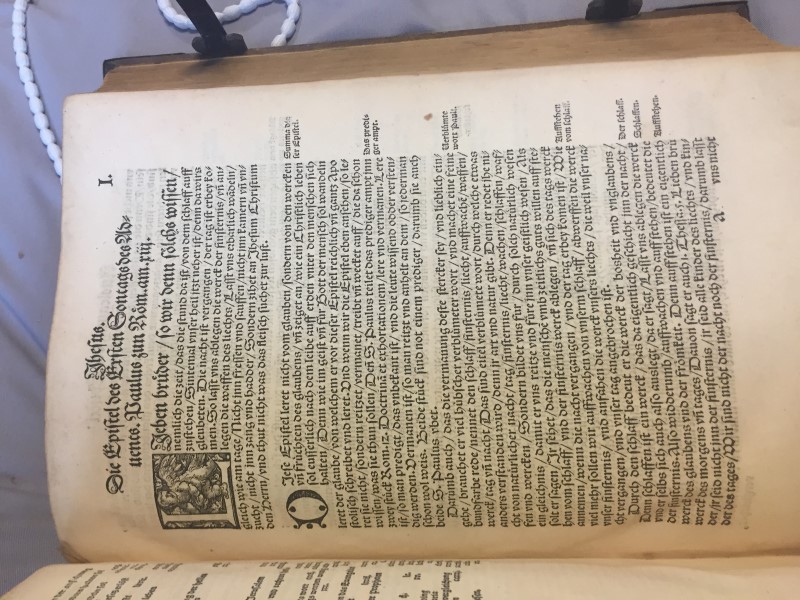
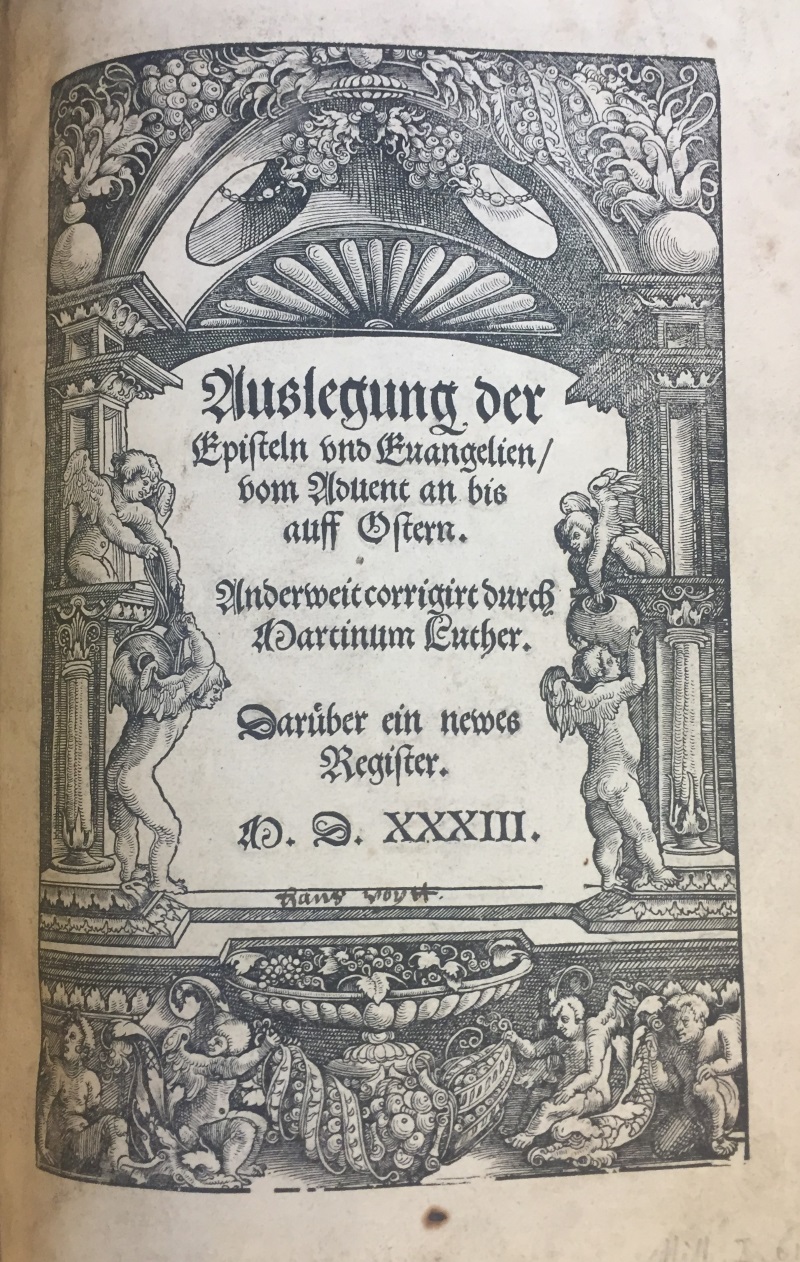
Auslegung der Episteln und Evangelien von Advent au bis auff Ostern, written by Martin Luther and published in the town of Magdeburg in 1533.

It has been absolutely fascinating, and also just an amazing privilege, to examine this nearly 500 year old book - a real primary source from the heart of the Lutheran Reformation!

The book is a postil, a collection of sermons by Martin Luther on each of the prescribed weekly Bible readings from the Gospels and the Epistles in the period from Advent to Easter. Further collections were made of Luther's interpretations of the readings for the rest of the year - eventually collected into what become known as his Church Postil. The term postil is derived from the Latin post illa verba textus ("after these words from Scripture")

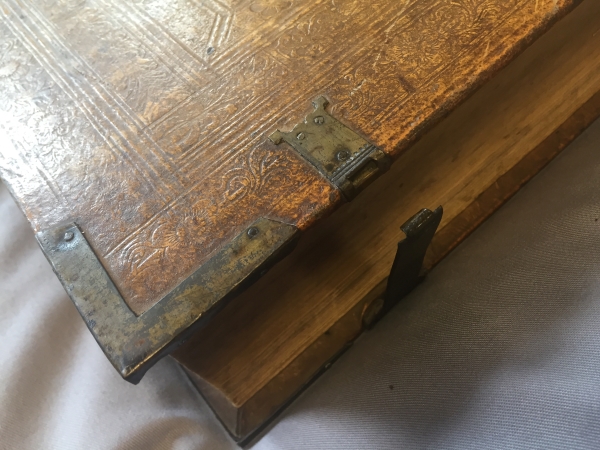
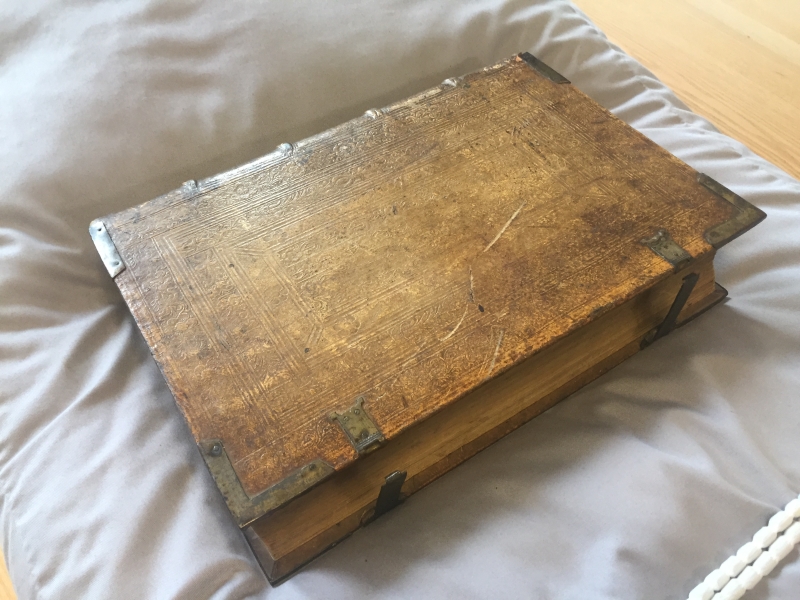
It is a hefty tome, bound in leather - I think it is just 'blind tooled', although perhaps there is some gilt remaining in places. The covers are wooden and there are metal corners and two clasps. There is a little damage by wood worm, both to the covers and some gently nibbled pages.

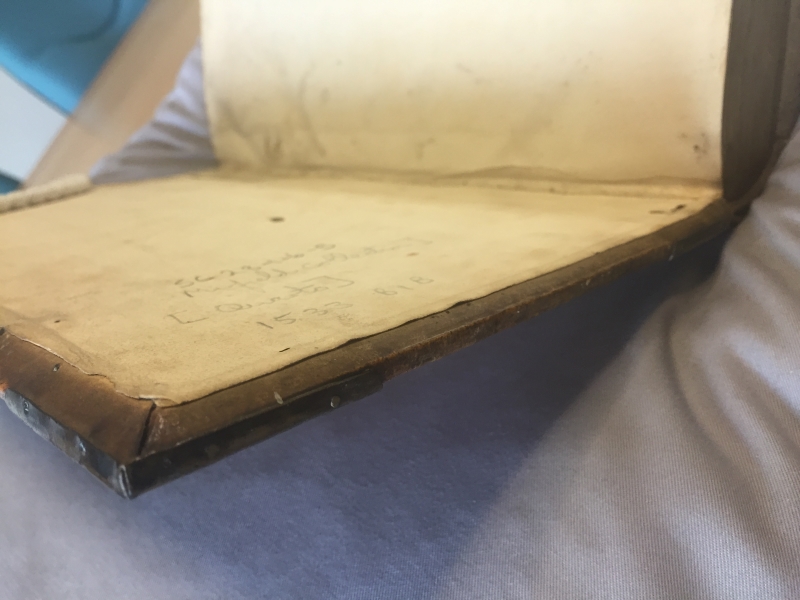
It was once the property of someone called 'Hans Voyt', who has added his name to the ornate title page - which also highlights that the text has been corrected by Martin Luther and contains a 'new register' (essentially an index) - I'm guessing the ability to have a standard page length and numbering in every copy made indexing so much more straightforward in printed books - a 'new feature'.
 

There are lots of points to note on the page layouts and the different printed features in the book. I assume that there was a combination of metal movable type and woodblocks for the decorated capitals and illustrations. There was a side margin printed that summarised key aspects of the sermon text and woodblock pictures were spread throughout the pages. I wonder what the presence of these illustrations tells us about the intended readership - were these pictures 'entertainment', symbols of the added value embodied in a high end gift, did they have an educational objective in addition to supporting the text, was this just 'the fashion'?


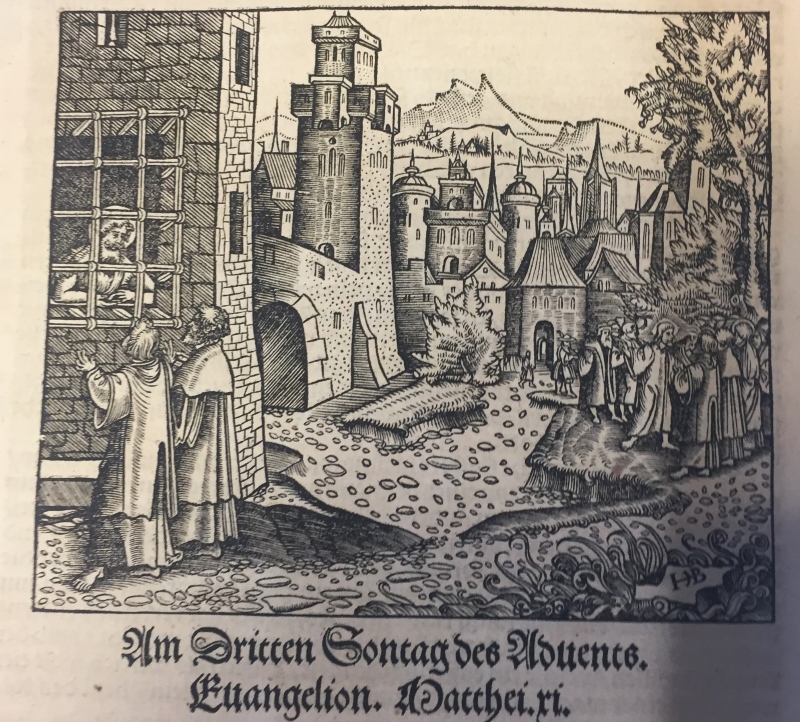
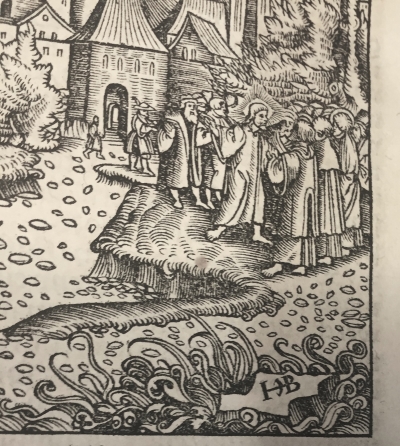
I haven't found any reference anywhere yet to a specific illustrator, but I did find a small monograph in just one of the pictures shown below (John the Baptist is in prison on the left and checking out whether Jesus is 'he that should come?') I think it's probably 'HB'. There is a famous artist, Hans Brosamer, who I've found illustrated a number of publications at that time - but his 'HB' monograph looks different with the H run into B not distinct as in these letters. Something to look into further if I get the chance - but I guess most illustrators went unidentified if they weren't themselves a 'name' that might help sell the publication.
 

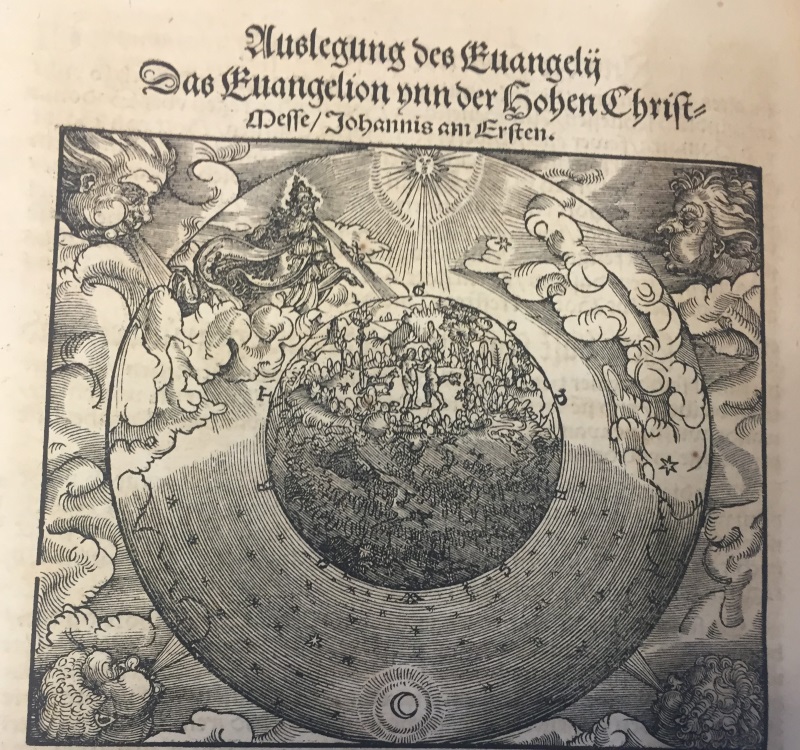
I liked the bit of 16thC cosmology shown below, with sun and moon rotating around the newly formed world - and Jesus sliding down to earth from the mouth of (a very Papal-looking!) God. (I'm struggling with the lettering that circles the world - is it perhaps 'God's Word'?)

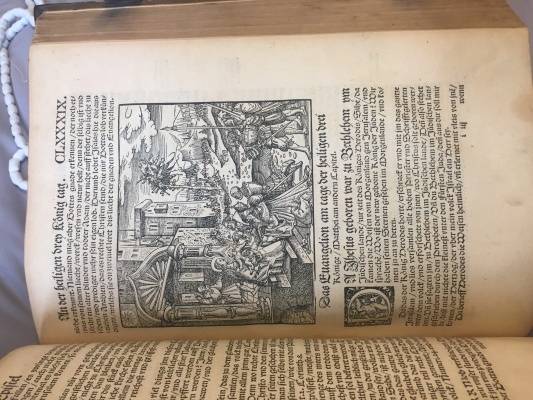
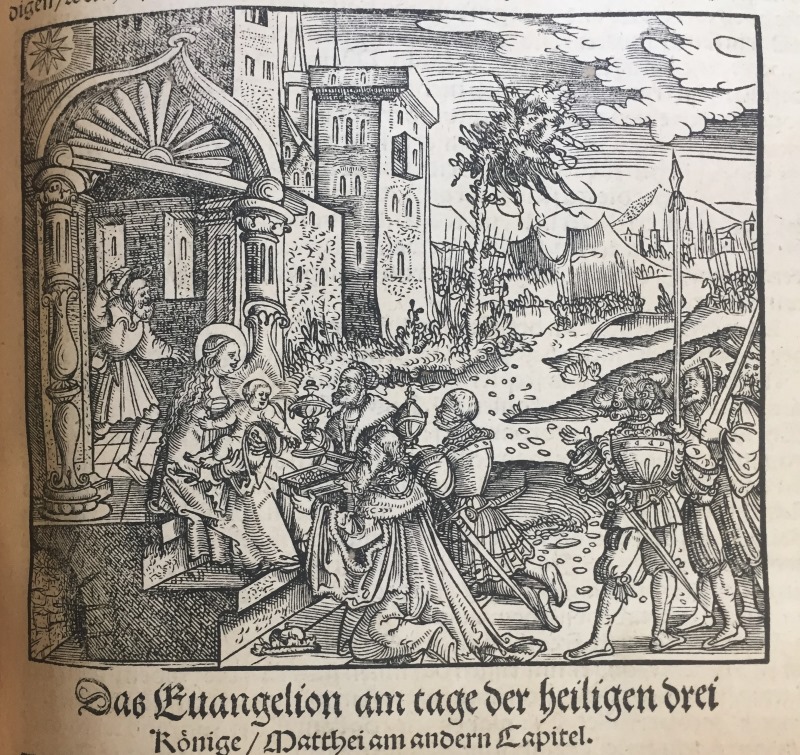
Some great anachronistic knights accompany the three kings on Epiphany - and presumably the agents of King Herod on the way to do no good in the background (the stable has scrubbed up well too 😃)

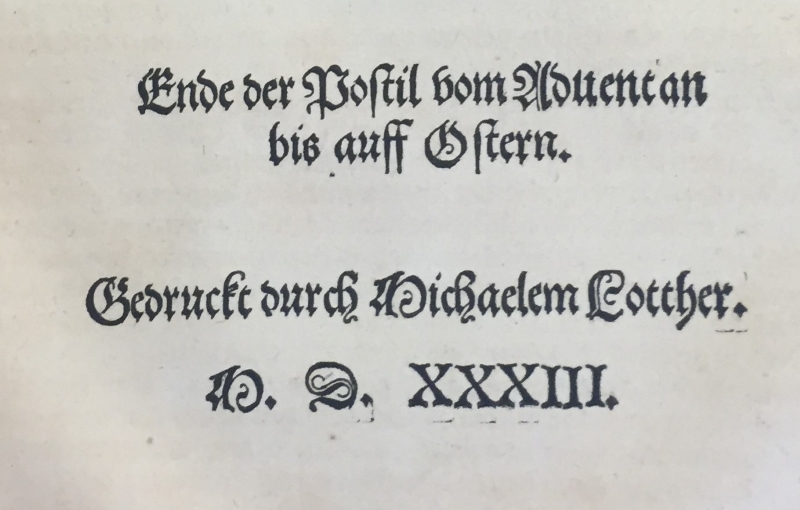
The end of the postil confirms the printer to have been Michael Lotther. The Lott(h)ers were a multi-generational family of printers closely linked to Martin Luther and the Reformation. Luther had supported Melchior Lotther the Elder to set up as a printer in Wittenberg, and his sons Melchior (the younger) and Michael both entered the trade. Michael had moved out of Wittenberg to set up shop in Magdeburg by the time this work was being printed in 1533 - he remained close to Luther though and married into his family.

However, the book doesn't end there. In fact there is a second printed work bound together with it - another Reformation text, produced at the same time - but by a different printer and in a different city altogether.

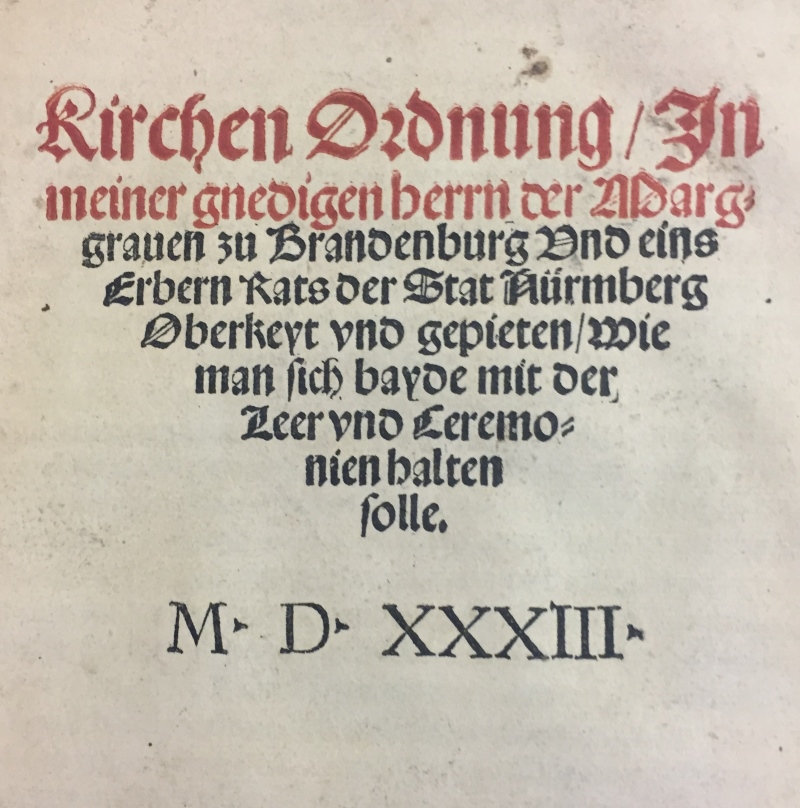
Kirchen Ordnung. In meiner gnedigen herrn der Marggraven zu Brandenburg und eins erbern Rats der Stat Nürmberg Oberkeyt und gepieten, wie man sich bayde mit der leer und Ceremonien halten solle

These are Kirchen Ordnung, Church Orders - basically an agreed set of new 'rules' that a Lutheran church community should follow now that the old Catholic 'ordnung' had been set aside. I think in the early years of the Reformation there were a number of different regional/local formulations of church regulations, these are the set created by the Margraves of Brandenburg and the imperial city of Nuremberg.

They were printed in the city of Nuremberg in 1533 by the Gutknecht press and they helped to produce more uniform and stable approaches to worship amongst Lutheran churches both in that area and across Europe.

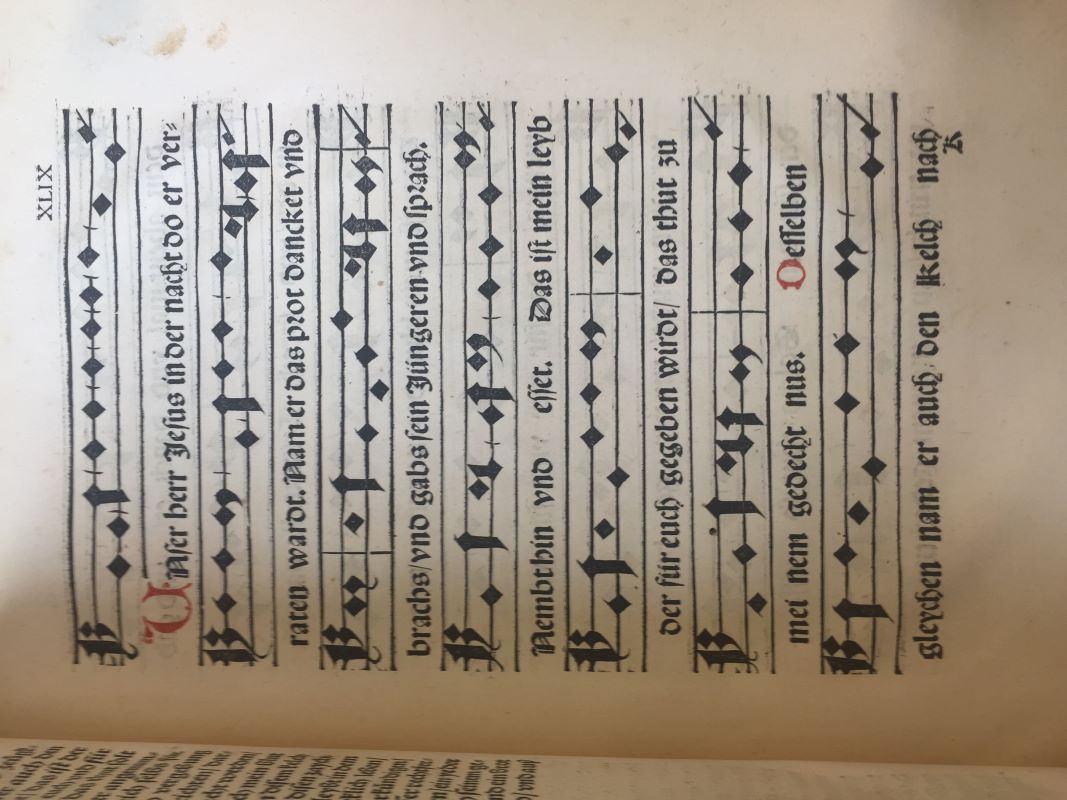
Whilst this part of the book has none of the fine illustration of the postil it does have quite a lot of two colour printing (I assume this was two impressions through the press) - most of this is in the description of the liturgy to distinguish the words of priest and congregation. There were also four pages of musical notation - I eventually worked out that this is plainsong to accompany the mass, 'Our Lord Jesus on the night he was betrayed...' 

These are 'neumes', a way to denote choral chants before the five line staves and notes we are now used to. This style is a specifically German form - 'Gothic neumes' or Hufnagel - 'Horsenails' as they looked like the nails used to shoe horses. 

I'll have to see if I can make musical sense of it - so far I have even't worked out what the clef means! 

Given that this book is made up two separately printed texts I'm left with lots of questions about how and when these were brought together. Whilst there is a discontinuity in the printing style and the page numbering the appearance of the pages looks to have similar wear, the edges look to be discoloured to the same extent. I couldn't distinguish two 'sections' from the 'outside', so perhaps there is evidence that they have been bound together for a long time. Both texts are probably 'working documents', I can imagine how each would be of value to a Lutheran cleric - biblical exegesis and practical summaries of the new Reformed regulations and liturgy - a useful combination within one book.

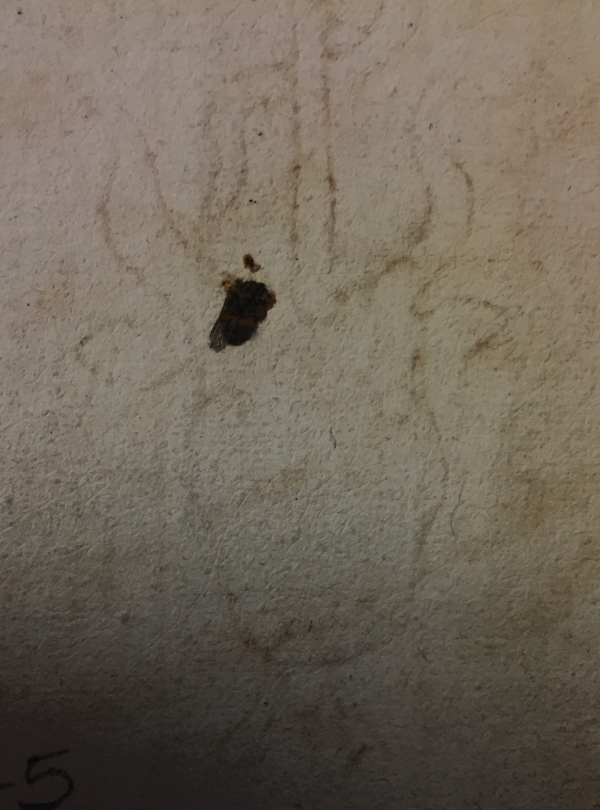
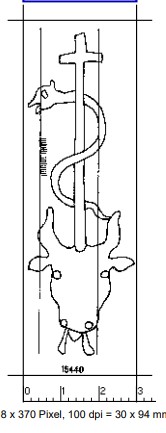
One further observation might be of relevance to dating the book. Both the front and back endpapers have a faint watermark. I spent a long time trying to make it out and subsequently discovering a whole world of scholarship based around collecting and cataloguing paper watermarks. The mark is of an ox's head, with a letter 'M' below its mouth and a cross and entwined snake above. The best match I could find (and I think it is pretty much on the money) is a mark which is recorded in 'Briquet Online' having been recorded in a Copybook in Prague in 1534.


So, on the basis of the watermarks there is some evidence that the two seperate texts may have been bound together not that long after they were originally printed. The information I've found so far about paper watermarks is clear that you have to be very cautious in assuming similarity means that you can 'date' or 'locate' documents - but I think there's at least some basis for arguing that the current book may have been created sometime in the 1530's.

I've been astounded how many different strands of the A113 content came together in just this single artifact: technical aspects of printing (woodblocks/type/colour); printing and music (and the history of musical notation); the role of Martin Luther in 'expert' interpretation of God's word - not something that everyone in the 'priesthood of believers' could be trusted to do; the use of the German vernacular throughout; the challenge of bringing new regulation to control the revolutionary diversity of the new beliefs.

Examining this object was a really valuable experience and one I hope to come back to - perhaps to think more formally about a 'source analysis'.

-------------------------------------------------------------------------------------------------------------------

Bibliography

Primary source:

Luther, M. (1533). Auslegung der Episteln und Evangelien von Advent an bis auff Ostern; anderweit corrigirt durch Martinum Luther, etc. Wittenberg: Michael Lotther. [From an original held at the Borthwick Institute for Archives, University of York (https://www.york.ac.uk/borthwick/)]

To help identify the original documents:

Kirchen Ordnung. In meiner gnedigen herrn der Marggraven zu Brandenburg und eins erbern Rats der Stat Nürmberg Oberkeyt und gepieten, wie man sich bayde mit der leer und Ceremonien halten solle Nürmberg: Gutknecht,1533 [via the digitisation portal of Rhineland-Palatinate dilibri]

Auslegung der Episteln und Evangelien von Advent an bis auff Ostern; anderweit corrigirt durch Martinum Luther [via the Deutsche Digitale Bibliothek]

To help identify the paper watermarks:

Briquet Online (v. 2.1 - 2021-01-23)

Background on the Lotthers:

Reformation Printers: Unsung Heroes Author(s): Richard G. Cole Source: The Sixteenth Century Journal , Autumn, 1984, Vol. 15, No. 3 (Autumn, 1984), pp. 327-339 Published by: Sixteenth Century Journal Stable URL: http://www.jstor.com/stable/2540767

Tillmanns, W. G. (1951) "The Lotthers: Forgotten Printers of the Reformation," Concordia Theological Monthly: Vol. 22, Article 23. Available at: https://scholar.csl.edu/ctm/vol22/iss1/23

[Home Page]
Permalink
Share post
Steven Oliver

Second wave Reformation

Visible to anyone in the world
Edited by Steven Oliver, Wednesday 6 May 2026 at 20:54

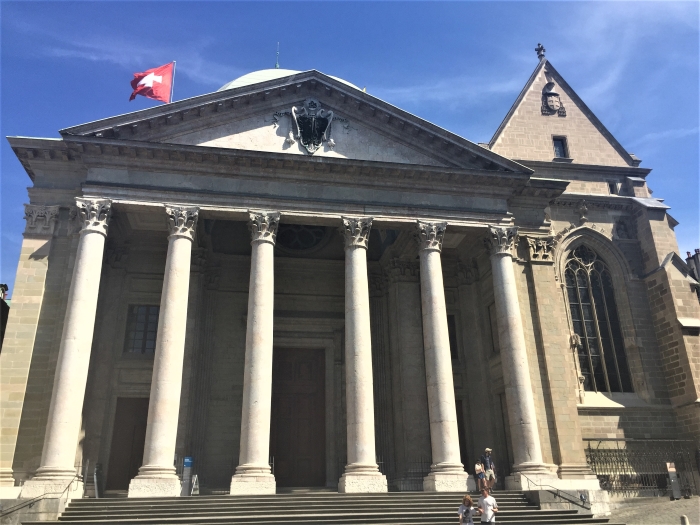
A day trip to Geneva this summer allowed a quick visit to the Cathédrale Saint-Pierre and some 'pre-work' for A113. This was home to Jean Calvin's 'second wave' of Protestant Reformation.

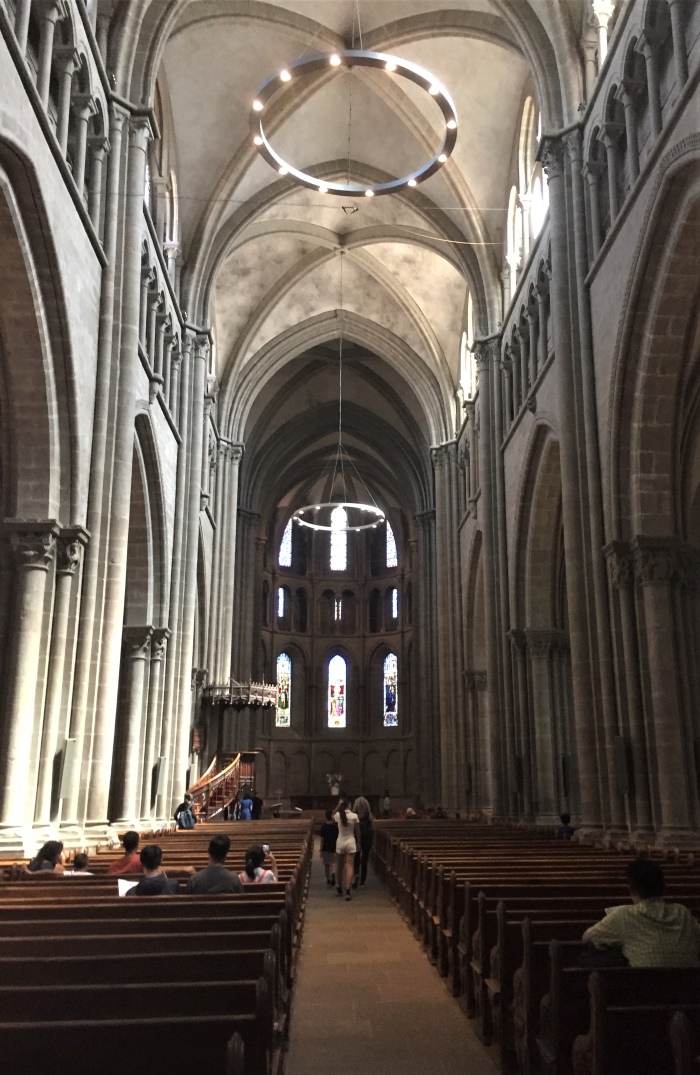
The building has been reworked many times since being established in the 12th century, the austere neo-classical front is an 18th century reconfiguration. The interior is stripped down, largely, to bare stone - there is nothing between the simple wooden altar and the congregation.

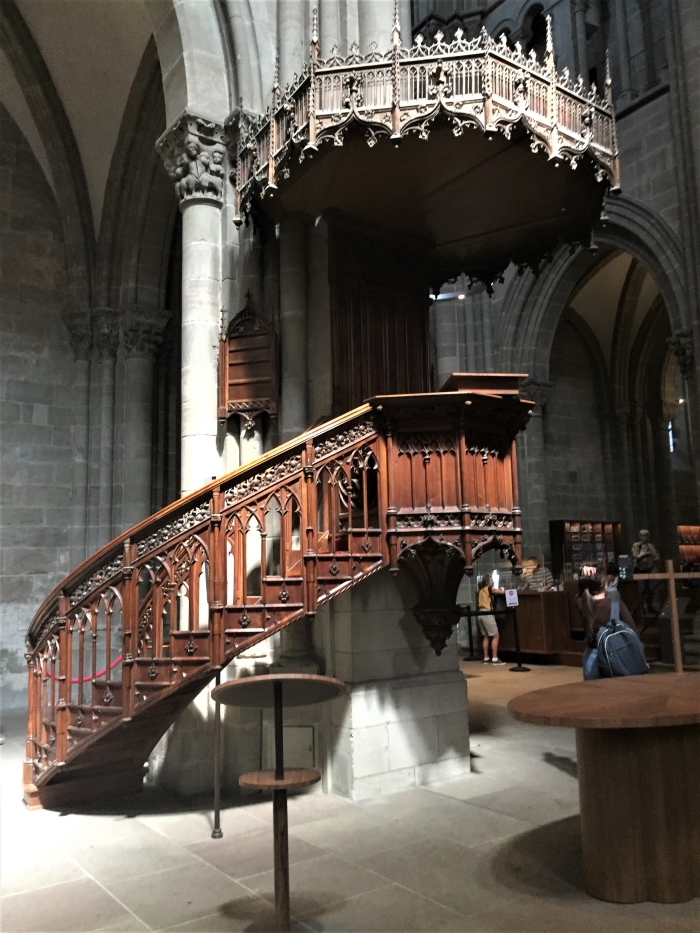
Apparently the ornate wooden pulpit was one survivor of the iconoclastic purge that accompanied Genevan's adoption of a 'Reformed' religion in 1535. The importance of 'The Word' in the new version of Christianity presumably kept this from the bonfire.

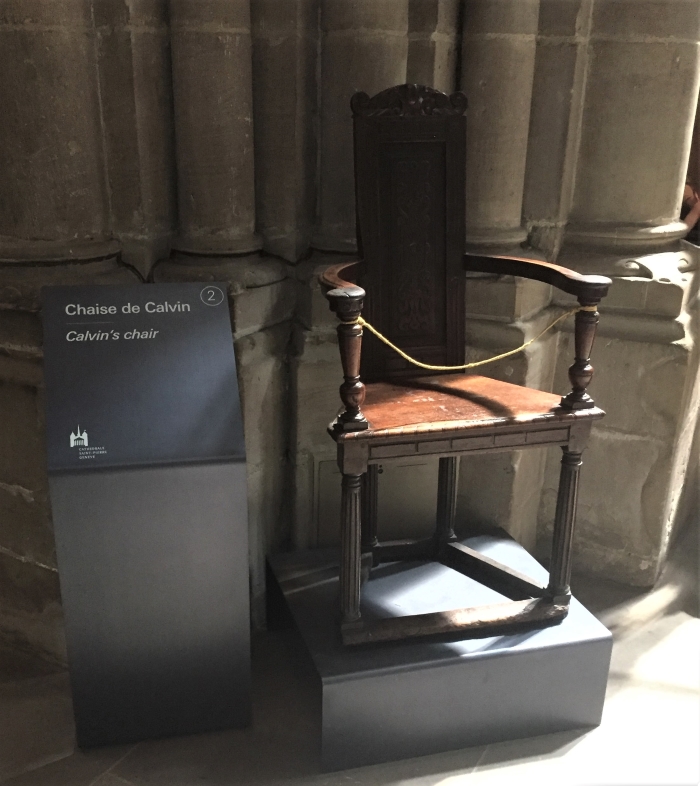
I'm not quite sure what the provenance of 'Calvin's Chair' is - it's a famous object, and presumably his seat when not in the pulpit. But I don't know if it was a possession, whether it moved with him when he arrived, left and returned to Geneva - or whether it was a fixture at Saint-Pierre? It fits the bill in having a functional and rather uncomfy look. 

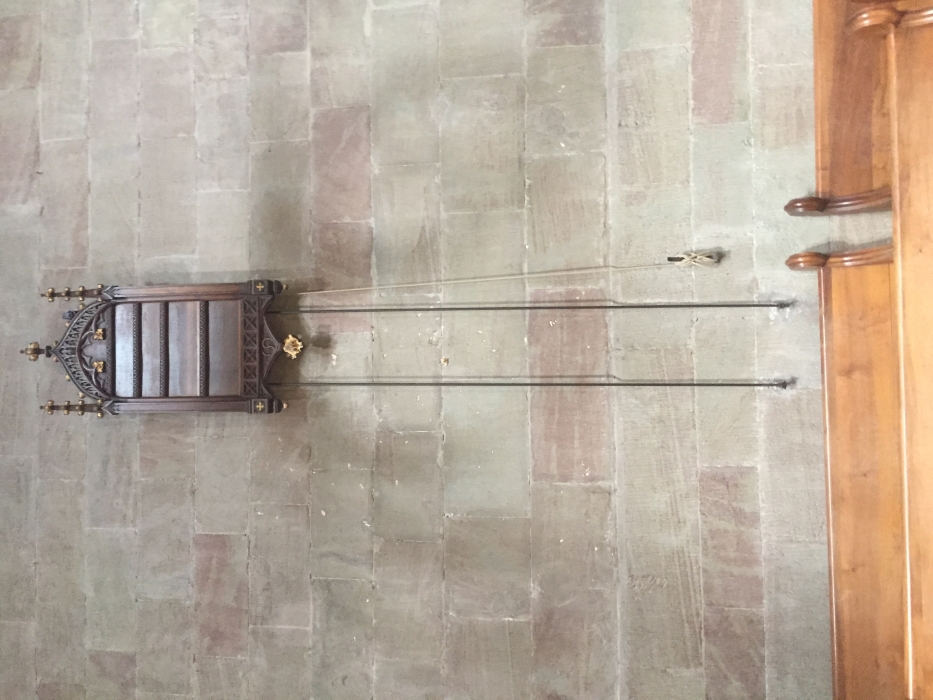
A link with A113, the 'Hymn Board' (or perhaps sung-Psalm board?) was one of the very few features and fittings in the church (there was another above the pulpit). A marker of one of the distinctive new features of Protestant worship.

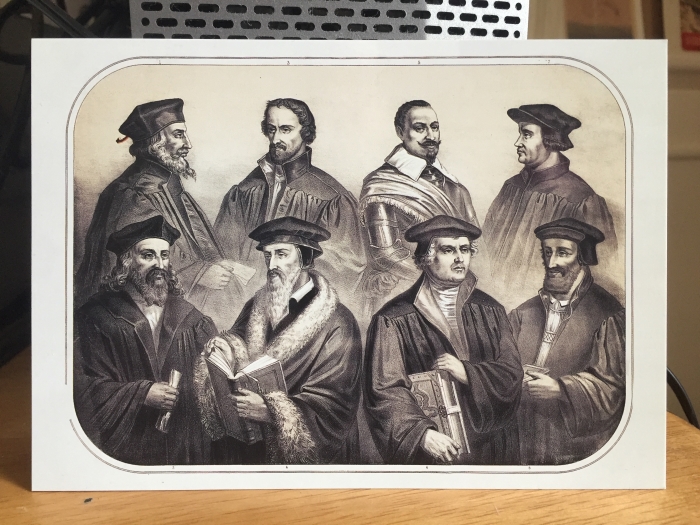
Not a great range on offer at the 'gift shop' (surely the Godly would be doing some serious grave-rotating at the very thought!😆), but here is a role-call of Protestant notables all on the one postcard - no doubt they'd have been laying into each other hammer and tongs had they been trapped together in person!

Les hommes de la Réforme

Huss - Melanchton - Gustave Adolphe - Zwingli

Heronimus - Calvin - Luther - Wiclef

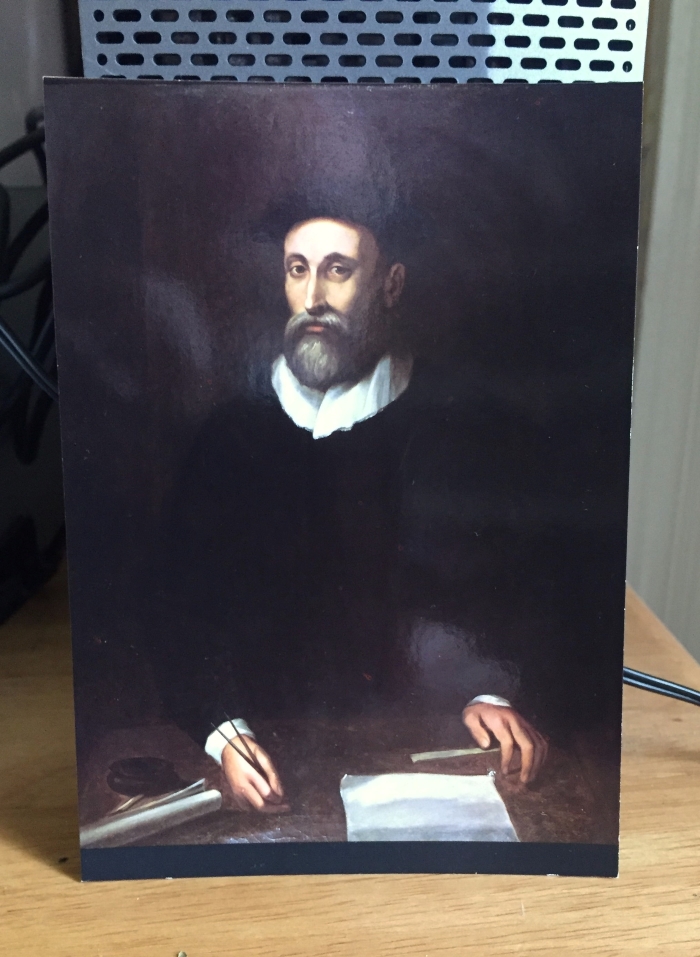
Finally an image of John Knox - who took this flavour of strict Genevan Reformation and, if anything, ramped it up for Scottish consumption. I'm really interested in what he is holding in his right hand, I assume it is some sort of writing implement - there are other writing paraphernalia on the table - but I've not seen anything like it before. It looks almost like a pair of calipers, but held upside down. Something to try and track down as the course goes on.

[Home Page]
Permalink
Share post
Steven Oliver

Marc Bloch at Montluc

Visible to anyone in the world
Edited by Steven Oliver, Wednesday 6 May 2026 at 20:54

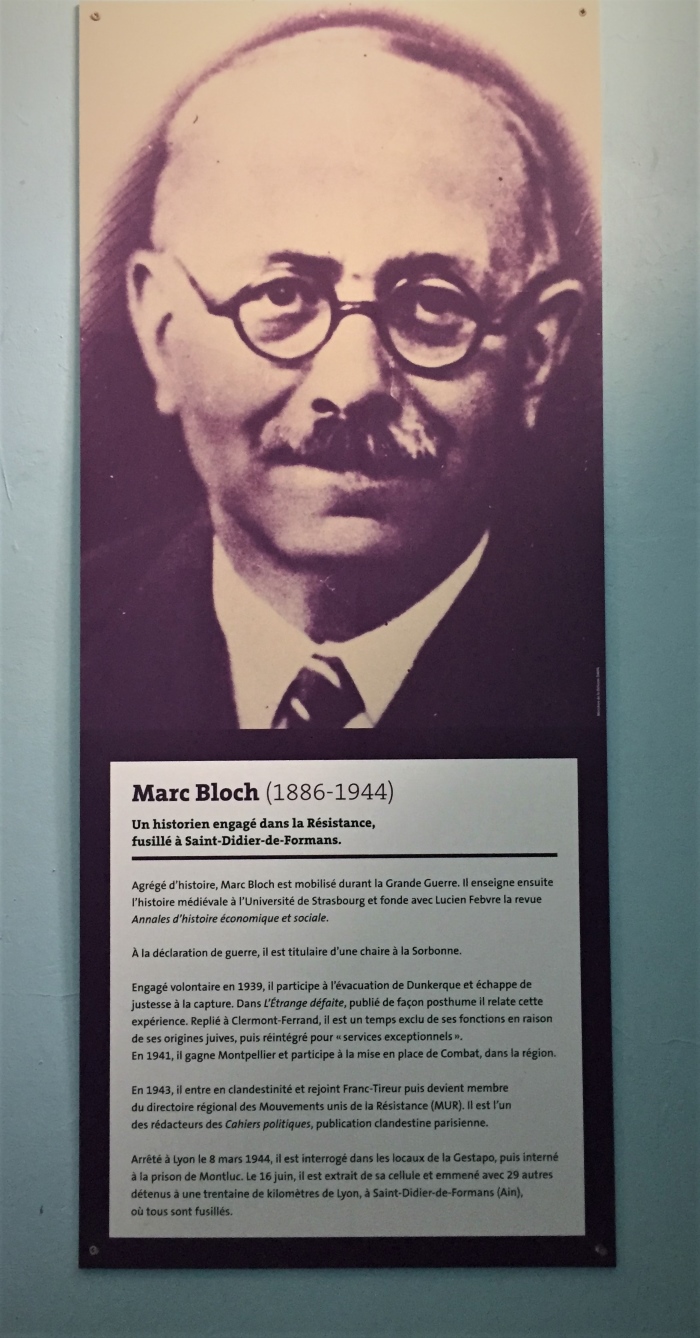
Marc Bloch (1886-1944)

A historian engaged in the Resistance, shot at Saint-Didier-de-Formans.

"A graduate in history, Marc Bloch was mobilized during the Great War. He then taught medieval history at the University of Strasbourg and founded with Lucian Febvre the journal Annales d'histoire économique et sociale.

When war was declared, he held a chair at the Sorbonne.

A volunteer in 1939, he took part in the evacuation of Dunkirk and narrowly escaped capture. In 'Strange Defeat', published posthumously, he recounts this experience. Withdrawn to Clermont-Ferrand, he was for a time excluded from his duties because of his Jewish origins, then reinstated for 'exceptional service'.

In 1941, he went to Montpellier and took part in setting up Combat* in the region.

In 1943, he went underground and joined Franc-Tireur, then became a member of the regional board of the 'Mouvements unis de la Résistance' (MUR). He is one of the editors of 'Cahiers politiques', an underground Parisian publication.

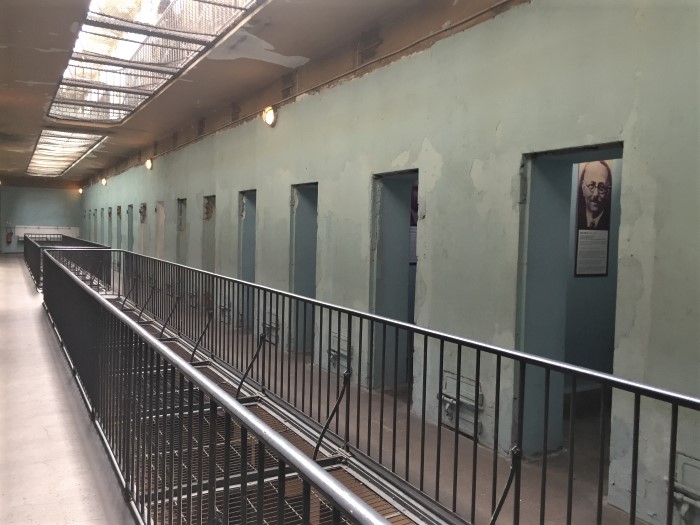
Arrested in Lyon on March 8, 1944, he was interrogated in the headquarters of the Gestapo, then interned in the prison of Montluc. On June 16, he was taken from his cell and taken with 29 other detainees about thirty kilometers from Lyon, to Saint-Didier-de-Formans (Ain), where all were shot."

*(Combat was a large movement in the French Resistance created in the non-occupied zone of France/)

¶(Created by the merger of the three major non-communist movements in the southern zone (“Combat”, “Franc-Tireur” and “Liberation-Sud”), chaired by Jean Moulin.)

_______________________________________________________________________

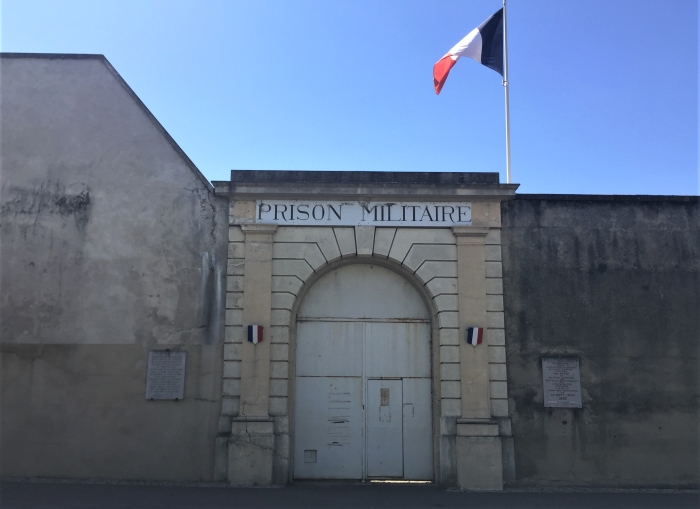
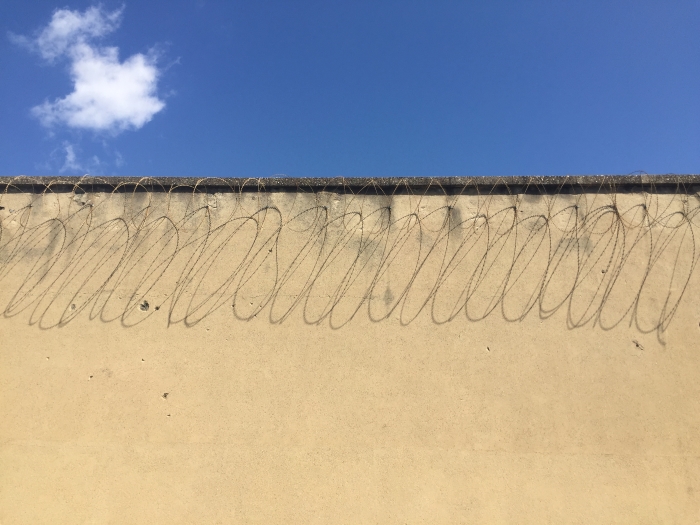
Took an hour or so out of 'holiday-mode' in Lyon to visit Montluc Prison. It was a military prison that became a holding site for members of the WWII French Resistance, Jewish people and other 'undesirables' before execution or deportation to the death camps.

Almost immediately on liberation of Lyon in late August 1944 it became a prison for German military, Gestapo and French collaborators. 

It had further incarnations as a prison for members of the Algerian independence fighters (the site of 11 executions) and then for women - it closed finally in 2009.

The commemorated and memorialised history was limited to the 'positive' stories of French resistance, though (as far as my school French could take me) accounts of individual prisoners were not sensationalised - there was material available that covered the entire history of the site.

I went out of curiosity chiefly, my son is a student of medieval history and had mentioned the story of the historian Marc Bloch - there are accounts (I don't know their validity) that Bloch spent some of his time at Montluc in teaching French history to other inmates. 

It was a somber and serious site and a real relief to walk back out through the gates.

[Home Page]
Permalink
Share post
Steven Oliver

Basilica of Notre-Dame de Fourvière in Lyon

Visible to anyone in the world
Edited by Steven Oliver, Wednesday 6 May 2026 at 20:57


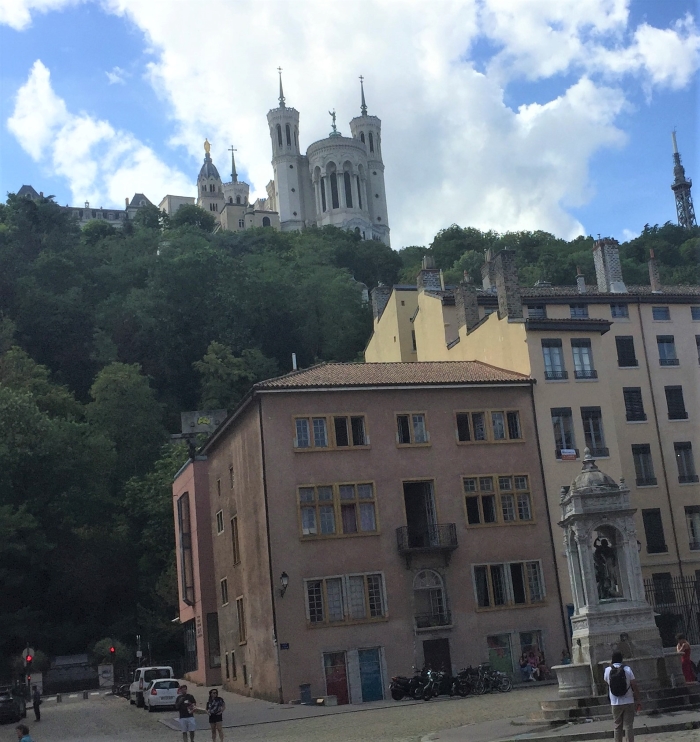
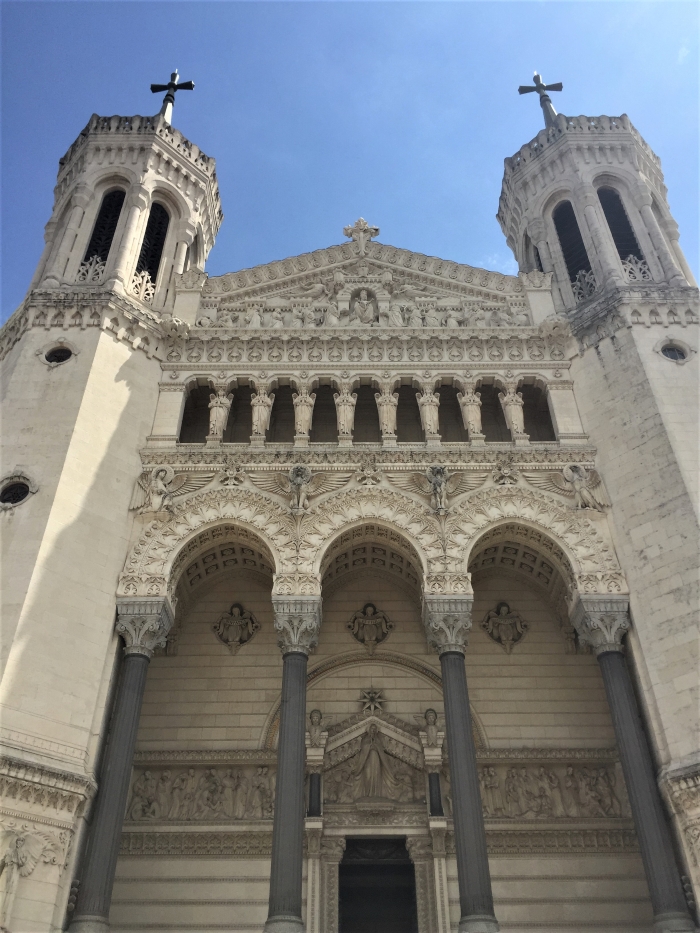
The Basilica overlooks the old town of Lyon and can be reached by one of the funicular railways. It was built between 1872 and 1896 on a location that had been dedicated to the Virgin Mary since the twelfth century. The prompt for its construction was apparently celebration of the fact that the Prussian army in the 1870 Franco-Prussian war stopped its advance before reaching Lyon, this was attributed to intercession by the Virgin Mary. This was a great place to do some A111 revision on the stories linked to Mary, the mother of Jesus and to aspects of the practices associated with her in the Catholic faith.

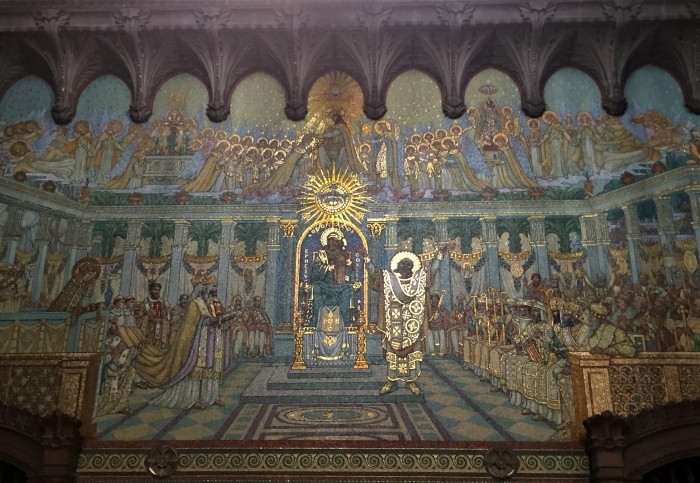
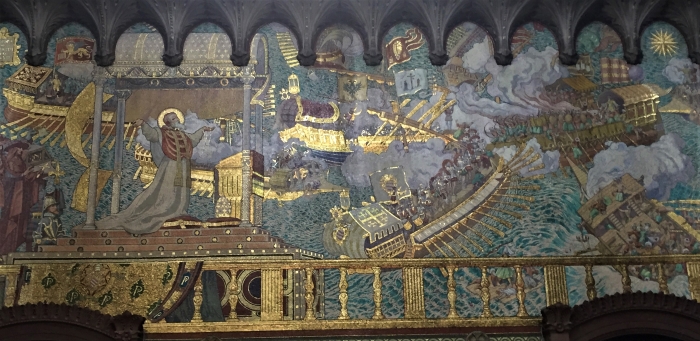
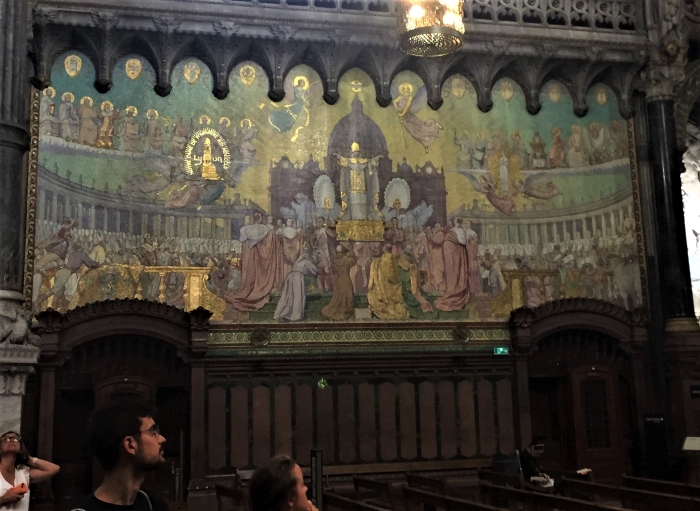
A major feature of the upper section of the Basilica are giant mosaics all linked to the story of the Virgin Mary. 

The Council of Ephesus (431 CE) The central question of this early Christian debate was around the human and/or divine nature of Jesus. Was Mary Christotokos (giving birth to Christ, a man), or Theotokos (giving birth to God)? 'Theotokos' won out and Mary was increasingly referred to as the Mother of God. Another bit of Marian mythology in the mosaic shows an angel (top row, two-thirds along from the left) carrying the house of her birth from Nazareth, via a few other sites, to its final resting place in Loreto, Italy - where it sits inside the Basilica della Santa Casa. 

The Battle of Lepanto (1571 CE) This is Mary in warrior-mode, leading the defeat of the Ottoman fleet at the naval battle of Lepanto off the coast of Greece. Central to her intercession in this victory were prayers said to the Rosary, which the Pope is holding up. This event was a key step in bringing the Rosary into the fold of Roman Catholic religious practice.

Proclamation of the Immaculate Conception (1854) This mosaic commemorates the point when Pope Pius IX officially declares the immaculate conception of Mary as part of the official dogma of the Roman Catholic church. Sinless in life, and now deemed to have been conceived without sin.

The lower part of the Basilica is a large crypt dedicated to St Joseph and in its own words 'welcoming Virgins from all over the world'. 

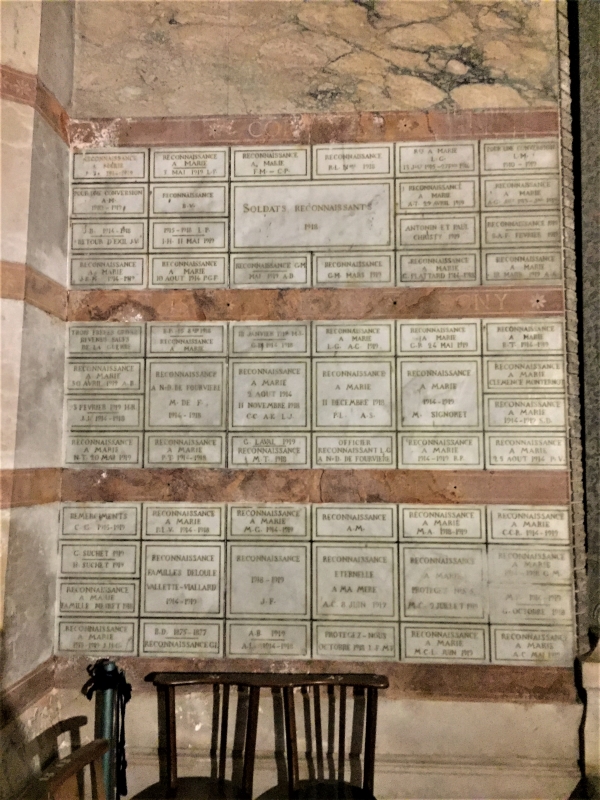
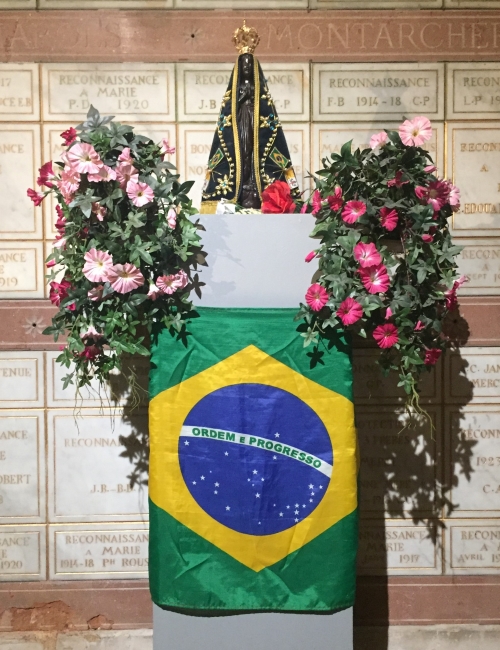
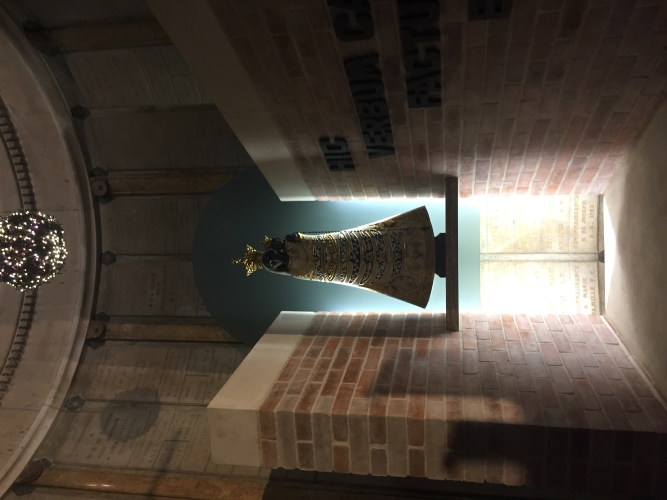
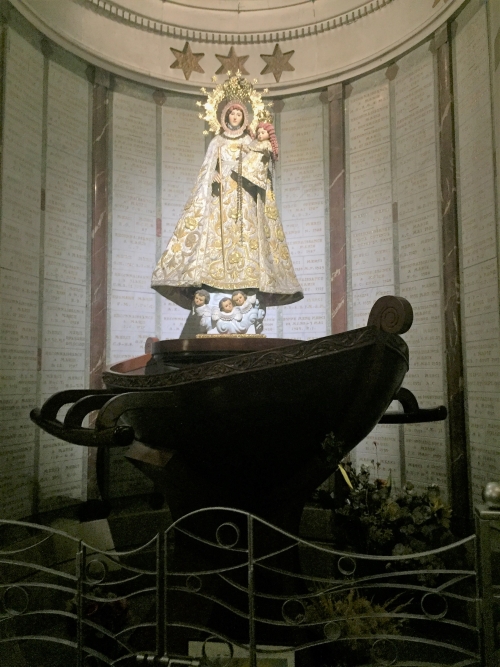
The walls are covered with ex-voto commemorations, recording both donations and answered prayers. There are multiple side chapels around the crypt occupied by copies of Virgins from key pilgrimage locations around the globe.


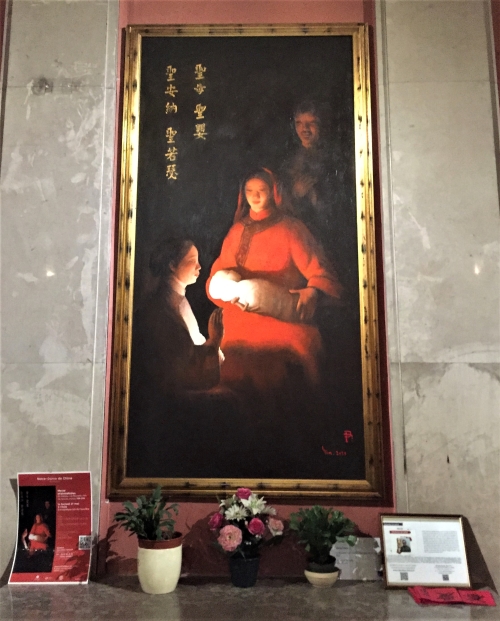
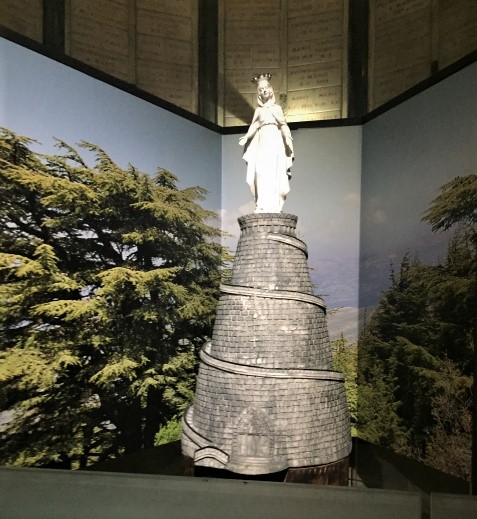
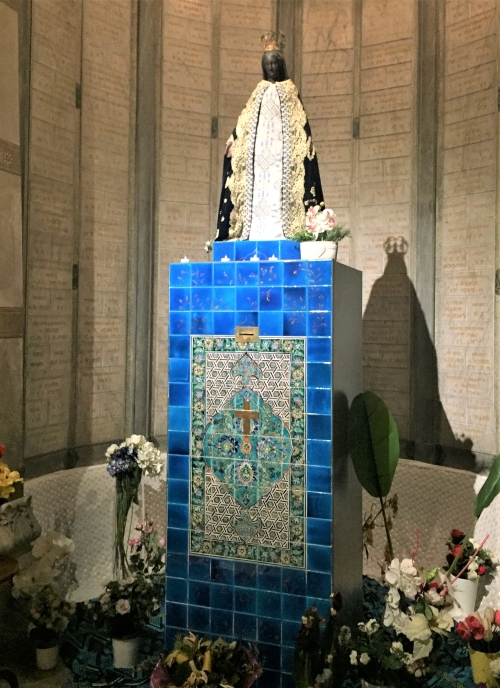
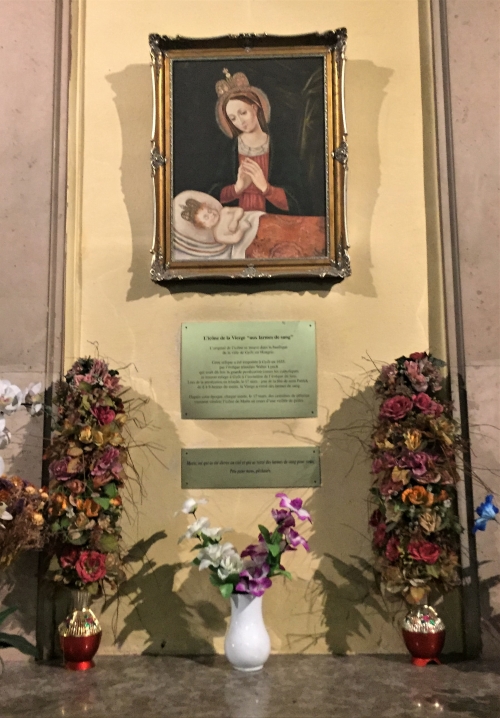
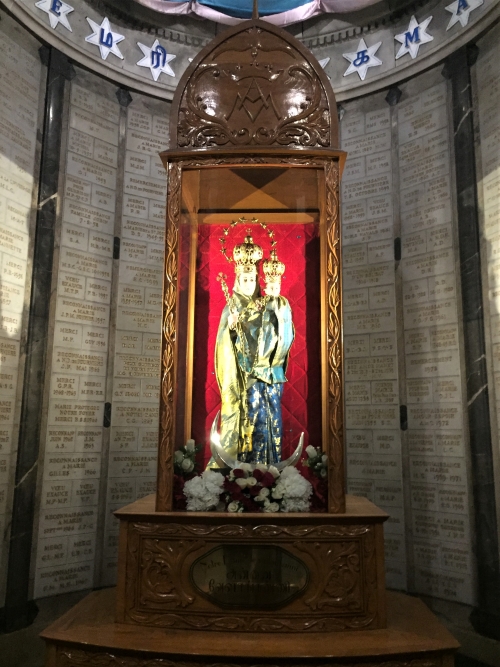
Our Lady of China, Our Lady of Lebanon, Our Lady of Africa


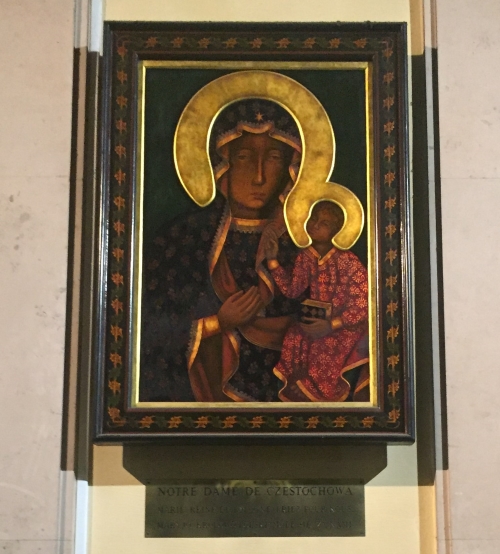
The Weeping Virgin of Gyor (Hungary), Our Lady of Good Health of Velankanni (India), Our Lady of Czestochova (Poland)


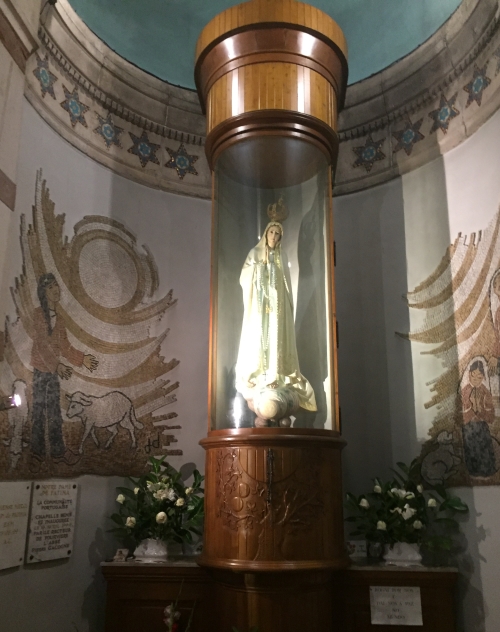
Our Lady of Fatima (Portugal), Our Lady of Guadalupe (Mexico), Our Lady of Aperecida (Brazil)


Our Lady of Loretto (Italy), Our Lady of 'La Naval' (Manila)

[Home Page]
Permalink
Share post
Steven Oliver

Pilgrims old and new in Lyon

Visible to anyone in the world
Edited by Steven Oliver, Wednesday 6 May 2026 at 20:57

 A chance to do some A111 pilgrimage revision whilst on holiday in the French city of Lyon. 

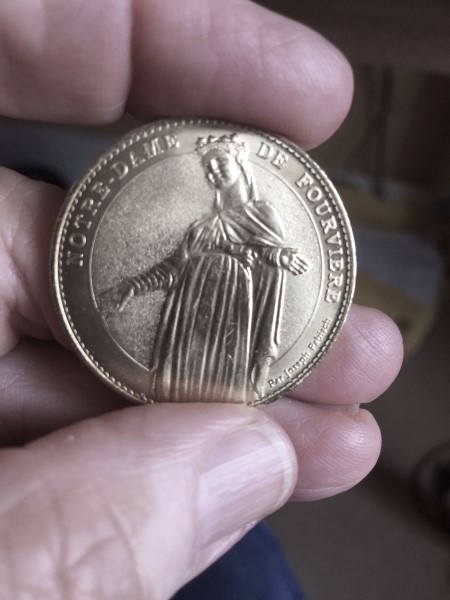
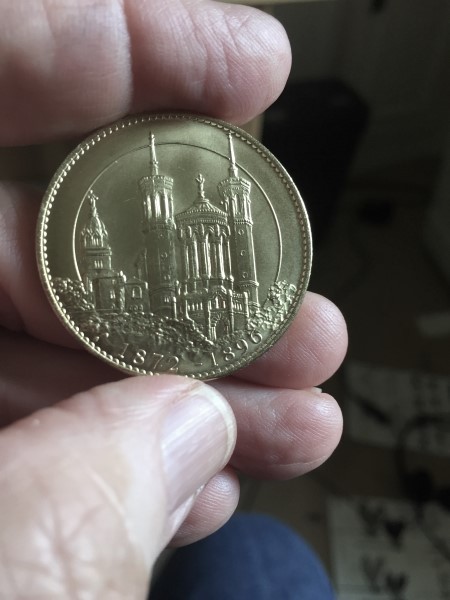
Firstly, €3 would buy you the equivalent of a pilgrim badge at the Basilica of Notre-Dame de Fourvière - for that you got an image of Mary (plenty of Marian imagery and history on show in and on the building) and of the Basilica itself which was built between 1872 and 1896.

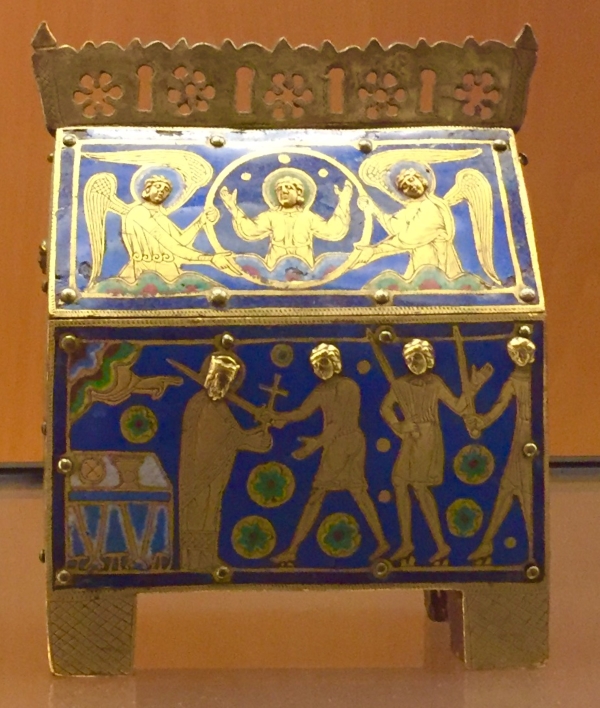
The other object was an enameled reliquary of St Thomas Becket that was displayed at the Musée des Beaux-Arts de Lyon. This was made in Limoges at some time around 1210 CE and comes from a church in the South of France, near Toulouse. There is a link between Thomas Becket and Lyon as the original chapel (c. 1180 CE) on the site of the current Notre-Dame de Fourvière was jointly dedicated to the Virgin Mary and St Thomas. There is no evidence that Thomas visited Lyon whilst exiled in France, but two twelfth century archbishops of Lyon had known him personally, the archbishop at the time of the chapel's founding, Jean Bellesmains (a previous Treasurer at York Minster), had studied with Thomas at Canterbury and became a fervent supporter of his reputation after his martyrdom.

[Home Page]
Permalink
Share post
Steven Oliver

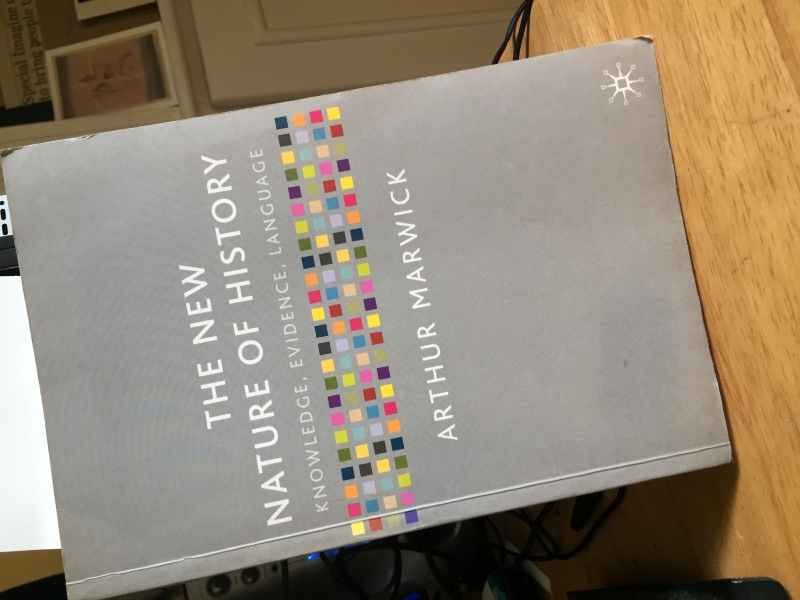
The New Nature of History

Visible to anyone in the world
Edited by Steven Oliver, Wednesday 6 May 2026 at 20:56

My A111 tutor had highlighted Arthur Marwick as someone to think about reading - particularly ahead of future modules covering 20th century history - so I was pleased to find this second hand copy of 'The New Nature of History', which includes some pretty forcefully made points on the nature and practice of history 😀. Marwick was the foundation Professor of History at the OU and looks to have strongly shaped the nature of the teaching and course content. He died in 2006.

These are just a few notes on points I want to remember.

The book is a rewriting of an earlier text 'The Nature of History', which had been a set text on the OU History course. The revision was apparently stimulated by Marwick engaging with, and seeking to combat, post-modernist perspectives on history. 

In the preface Marwick emphasises the importance of the sub-title: Knowledge, Evidence, Language. He defines history as the production of a body of knowledge about the past, one built on evidence and where language in the past has to be understood and in the present used with precision to ensure accurate communication. He has no truck with ideas that history is an entirely subjective expression of contemporary actors, trapped within language that is laden and fraught with power.

In this diagram he tries to summarise his ideas about the relationships between historians, the past and history.

The book contains two detailed chapters on 'How the discipline of history evolved'. I've kept a list below (with subheadings that come from Marwick's chapters) that I may link/annotate as my studies go on - and also as a prompt to revisit Marwick's (often trenchant) views on key scholars and writers as I progress and encounter more of them.

 
Ranke: his disciples and critics    
Jules Michelet (1798-1874) Alexis de Tocqueville (1805-59)  
Positivism and Marxism    
Auguste Comte (1798-1857) Karl Marx (1818-1883) Numa Denis Fustel de Coulanges (1830-89) 
Anglo-Saxon attitudes    
Thomas Babington Macaulay (1800-1859) William Stubbs (1825-1901) Edward Augustus Freeman (1823-92)  
John Richard Green (1837-83)  FW Maitland (1850-96)  George Bancroft (1800-91) 
Scientific history?    
CW Langlois (1863-1929)  Charles Seignobos (1854-1942)  J.B. Bury (1861-1927)
'New' history    
American 'new history'    
Frederick Jackson Turner (1861-1932)     
Annales School     
Lucien Febvre (1878-1956)  Marc Bloch (1886-1944) [link] Henri Pirenne (1862-1935) 
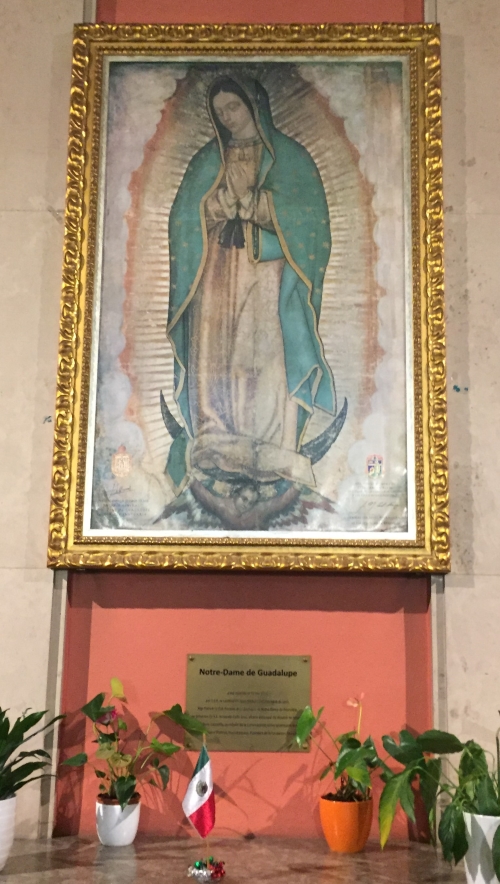
C. Ernest Labrousse (1895-1988)  Georges Lefebvre (1874-1959)   
History of ideas     
Friedrich Meinecke (1862-1954)  Benedetto Croce (1866-1952)  Gerhard Ritter (1888-1967)  
British labour and economic histories    
G.M. Trevelyan (1876-1962)  Arnold Toynbee (1852-83)  R.H.Tawney (1880-1962)  
J.H. Clapham (1873-1946)     
Political histories     
Lewis Namier (1888-1960) [link] G.R. Elton (1921-94)  A.J.P.Taylor (1906-88)  
Latter-day Marxism     
John Tosh (1945-)  E.H.Carr (1892-1982) [link] E.P.Thompson (1924-93)  
Christopher Hill (1912-2003)  David Cannadine (1950-)  Eric Hobsbawm (1917-2012)  
Eugene Genovese (1930-2012) Herbert Gutmann (1928-85)  Jurgen Kocka (1941-) 
     
Annales: 2nd and 3rd generations    
Fernand Braudel (1902-83) Georges Duby (1919-1996)  Roger Chartier (1945-) 
     
New histories of economics, society,
science and culture 
   
R.W.Fogel (1926-2013)  E.A.Wrigley (1931-2022)  Asa Briggs (1921-2016)  
Olwen Hufton (1938- )  Hayden White (1928-2018)  Clifford Geertz (1926-2006) 
Michel Foucault (1926-1984)  Natalie Zemon Davis (1928 - )  Carlo Ginzburg (1939- ) 
Robert Darnton (1939- )     


This looks like another useful set of prompts on questions to ask of any primary source - understandably, given Marwick's role at the OU, they already seem familiar.

The Catechism

  1. Is the source authentic, is it what it purports to be?
  2. When exactly was the source produced? What is its date? How close is its date to the date of the events to which it relates, or to dates relevant to the topic being investigated? How does this particular source relate chronologically to other relevant sources?
  3. What type of source is it? A private letter? Or an official report, a public document of record, or what?
  4. How did the source come into existence in the first place, and for what purpose? What person, or group of persons, created the source? What basic attitudes, prejudices, vested interests would he, she or they be likely to have? Who was it written for or addressed to?
  5. How far is the author of the source really in a good position to provide first-hand information on the particular topic the historian is interested in? Is the writer dependent, perhaps, on hearsay?
  6. How exactly was the document understood by contemporaries? What, precisely, does it say?
  7. How does the source relate to knowledge obtained from other sources, both primary and secondary?

Finally, what Marwick describes as a 'hierarchy of explanatory factors' - he proposes this as a structure for 'explanation' in historical writing. Interestingly he quotes this framework in his book on 'The Sixties' (pp. 23-25).

1. Structural, ideological and institutional circumstances

  1. Structural (geographical, demographic, economic and technological)
  2. Ideological (what is believed and is possible to be believed, religious faiths, existing political and social philosophies)
  3. Institutions (systems of government, justice, policing, voting and education, religious organisations, working-class organisations, the family)

2. Events
3. Human agencies
4. Convergence and contingency

It will be interesting in reading 'The Sixties' to reflect on how Marwick actually uses this framework - does it structure his writing, or is it in the background shaping his overall ideas?

[Home Page]


Permalink
Share post
Steven Oliver

A view on Benin Bronzes from Nigeria

Visible to anyone in the world
Edited by Steven Oliver, Wednesday 6 May 2026 at 20:56

I had been interested to come across details of a 'round-table' discussion of the return of Benin Art to Nigeria, being hosted by the Goethe-Institut (the German equivalent of the British Council) in Abuja. I'd heard about it via a Twitter link and eventually ended up watching it via a recording on a Goethe-Institut Facebook page.

A recording can be accessed here:

https://www.facebook.com/nadine.siegert/videos/798083458597257/?mibextid=v7YzmG

These are just a few summary notes of points that were discussed.

The context was the return of artefacts by the German government and debate within Nigeria about 'ownership' of objects and about where and how they might be displayed. The most recent development had been a statement from the outgoing president of Nigeria that the ownership of any returned artefacts would lie with the Oba.

There was a strong 'Benin' feel to the African panellists - the representative of the National Commission for Museums and Monuments didn't attend although a member of the regional government was in the audience. 

Some points that I found interesting:

Martin Huth (Deputy Head of Missions, German Embassy) - gave a potted history of museums and collection in Germany. From the Renaissance an increased interest in ancient art and the beginnings of art collections started with state rulers in the Holy Roman Empire. This became more widespread amongst German elites after 1848, collection became fashionable and was accompanied by a developing scientific interest in ethnology. Germany was a relative 'latecomer' to European colonialism, but as this developed it brought a boost to collection. He highlighted that in the mid 20th century Germany had both perpetrated and been the victim of cultural looting; plundering art works from Jewish people and conquered populations and then losing materials to Soviet Union and Western Allies. He brought up the term the 'nationalisation of art' to describe current desires to repatriate art that had been seen to have been stolen. Huth dated a change in culture to the late 1960's with student activism and subsequent discussions in the 1970's about it being untenable to retain artefacts like Benin Bronzes. He was keen to hear what Nigerian civic society wanted as the model for display of the art and asked whether a 'museum culture' was something that African society wanted to embrace, or was this an overly Eurocentric view?

John Asien (Nigerian Copyright Commission) - was very measured about concerns over the recent Presidential decree - he stressed that the Oba still had to work with others to ensure safe storage and display of the artefacts. He made an interesting point about ownership, highlighting that African culture stressed three parties in ownership,: ancestors, current and future generations.
Prof Ken Okoli (Academic, Art Historian) - made interesting points about the sacred nature of the objects (something stressed by a number of speakers) this was something that was largely passed over in the A111 module materials. He proposed at one point that to view the objects, once returned, people would need to perform various ritual ablutions - and that the objects would need to be purified on return given their 'desecration' in the West. Along with a number of people on the panel and the audience he gave a strong 'Bini' perspective and was clear he thought the objects should be returned to the Oba.
Prince Akeni Prosper (Heir-apparent to the Throne of Elluega I, the Ovie of Ozoro Kingdom) - gave an impressive account of his families' connection back to the 17th century civil wars in The Kingdom of Benin and the magical properties of the artefacts. Whilst the arguments around restitution were familiar, it was very interesting to hear them so eloquently put in terms of a 'traditional' community leader. 
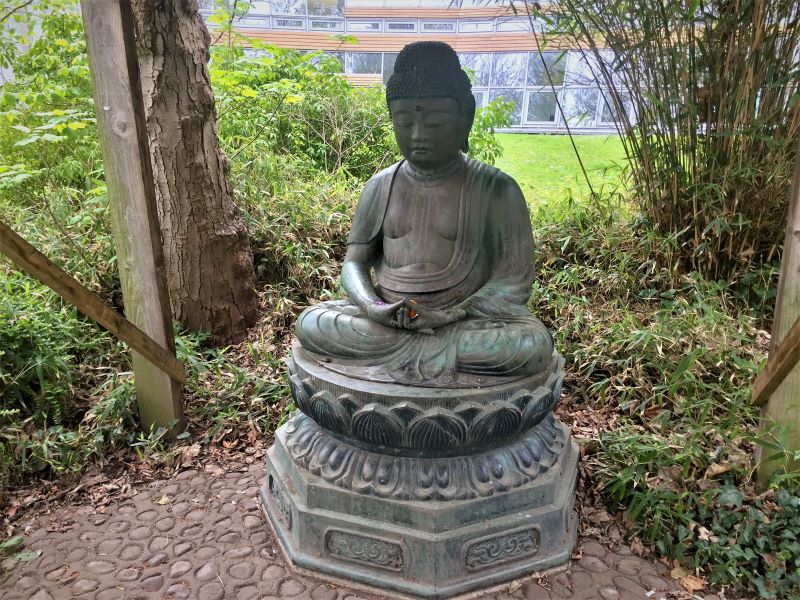
Overall it was an interesting discussion to listen in to. Perhaps understandably, there was very little positive that speakers or audience had to say about British holders of the artworks. Many of the points that would come up on any Twitter discussion about repatriation were also voiced, concerns about the security of the objects, criticism of the national government's interest in the heritage and art communities in Nigeria, questions about how accessible the objects might be once returned. There were some interesting observations about the possibility that strong Christian and Islamic cultures acted to reduce interest in these 'idolatrous' objects and that there might be limited interest amongst younger members of the Nigerian population.

[Home Page]
Permalink
Share post
Steven Oliver

A Yorkshire Buddha

Visible to anyone in the world
Edited by Steven Oliver, Wednesday 6 May 2026 at 20:55

A Yorkshire Buddha - this one sits in meditation on a lotus flower in the grounds of the University of York. When I took the picture there were some offerings of fruit and flowers.

I couldn't find much information about the statue, it is dated as 19th century and was donated by the family of a key benefactor to the University and a major 20th century public figure in York, John Bowes Morrell. It apparently used to sit in his front garden! I've done my study day each week for A111 in the JB Morrell library and so there is one more link with OU study.

On my first visit to the statue I'd not noticed some of the discreetly positioned items that were tucked into the corners of the Buddha's covering. The only one that I've been able to find out much about is the collection of 'coin charms' - these are found in use in China, Japan, Korea and Vietnam and can apparently also be part of Confucian and Taoist religions. Such items can be left for many different reasons, to commemorate particular events/people, as prayers for support/good fortune.


The university now has large numbers of students from countries where Buddhism plays a significant part in the culture. This statue is perhaps less 'exotic' now than when it was first donated - and looks to have an established functional value at least for some students.

[Home Page]
Permalink 1 comment (latest comment by Steven Oliver, Friday 23 June 2023 at 17:04)
Share post
Steven Oliver

Benin at the BM

Visible to anyone in the world
Edited by Steven Oliver, Wednesday 6 May 2026 at 20:55

Managed to 'negotiate' 20 minutes in the British Museum at the end of April. Fascinating both to see the Benin objects and to watch people looking at them. I'm a bit sceptical about the 'museum for the world' rhetoric - but perhaps just a little less having been reminded of what a global city London really is!

However displayed it was interesting to watch how much (and how little) attention the objects received. 

There is just so much going on in some the plaques (Ama), the detail in this one is amazing, the hairstyles, musical instruments, even the patterning in the clothes.

Details from Digital Benin

Oba supported by two attendants 

If you look closely you can make out Portuguese heads in the detail of the Oba's dress

Details from Digital Benin

An attempt to reinforce the depth of the relief casting - I'm still intrigued as to whether they were cast with sprue and channels to enable the brass to reach all the areas (a question for the future)

Ivory hip-pendant mask (Uhunmwu-Ẹkuẹ) thought to be of Queen Mother Idia

Understandable why this image is so iconic, the design alone is really striking even before you get to the historic meaning.

Details from Digital Benin

Figure of European with long hair, beard and moustache

Details from Digital Benin

Four page figures in front of palace compound

Another incredibly detailed and exciting plaque, with altar goods set out that you can see around you in the exhibits.

Details from Digital Benin

Oba with royal page holding a netted calabash rattle

Details from Digital Benin

This last plaque really intrigued me - I wasn't at all sure what to make of it - male?...female? 

Tracking down details online on the train home revealed it was thought to represent an 'Ehioba' carrying a stick/switch.

'Ehioba is leader of the Ooton guild, selected from descendants of previous rulers of Benin, who served the high priest Osuan. The bulge beneath his tunic on his chest represents the concealed jawbones of a deceased Iyase (a political opponent to the Oba).'

Details from Digital Benin

Made me think a lot about all the detailed scholarship and research that will have been conducted by Western experts to 'establish' an interpretation of this object - work that was only needed because it was stripped of all context by its initial Western looters.

[Home Page]
Permalink
Share post
Steven Oliver

The 'New Room' in Bristol

Visible to anyone in the world
Edited by Steven Oliver, Wednesday 6 May 2026 at 20:55

Coming home from a holiday in Devon I had a chance to look at the Methodist 'New Room' in Bristol, which features in the 'Christianity and its material culture' chapter of A111. 

The chapel is the second building on the site dating from 1748, the first which opened in 1739 was quickly outgrown. It sits just off the main Broadmead shopping centre in the middle of Bristol, there is a courtyard in front of the building with a statue of John Wesley on horseback.

One aspect of the building's design which wasn't mentioned in the A111 materials is the small stable block that flanks the entrance to the chapel. Travelling was very much part of a Methodist preacher's life and so the building including accommodation for both humans and horses!

I like the simplicity of the building's interior - the roof lighting really does flood the room and even on quite a grey day made it seem much more open and inviting than I'd expected.

Something that links with the more recent 'crossing boundaries' A111 theme and which initially surprised me was that the only translated information in the museum was in Korean. Apparently whilst the Methodist Church shrank dramatically in membership across the UK in the 20th century it saw a big increase in South Korea following missionary efforts from the USA - sufficient to make it worth the museum's while to try and encourage donations specifically from Korean pilgrims to the site! 

This variant on non-conformist Protestant Christianity is now practiced much more commonly outside the UK than it is within it.

[Home Page]
Permalink
Share post

This blog might contain posts that are only visible to logged-in users, or where only logged-in users can comment. If you have an account on the system, please log in for full access.

Total visits to this blog: 89822